2027 Online Electrical Engineering Programs With Hardware Lab Kits

Co-Founder and Chief Data Scientist
Choosing an online electrical engineering degree is difficult when you need real circuit-building experience, not only simulations. Hardware lab kits can let distance learners test components, collect measurements, and document designs from home. This matters because the U.S. Bureau of Labor Statistics projects employment for electrical and electronics engineers to grow 7% from 2024 to 2034. This guide explains how kit-based programs work, which credentials matter, what they cost, and how to determine whether an online format supports your engineering career goal.
Key Things You Should Know
- An online electrical engineering degree is most credible for engineering roles when the bachelor's program is ABET-accredited and includes assessed laboratory work; a mailed kit alone does not establish program quality.
- Electrical and electronics engineers had a combined median annual wage of $118,780 in May 2024, according to the U.S. Bureau of Labor Statistics, but pay varies substantially by specialty, location, industry, experience, and licensure needs.
- Before enrolling, confirm exactly how labs are completed, whether any campus residency is required, who pays for replacement components and shipping, and whether the degree meets your state and employer expectations.
What are online electrical engineering programs with hardware lab kits and how do they work?
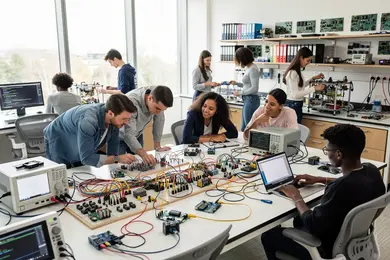
Online electrical engineering programs with hardware lab kits are degree programs that deliver lectures, assignments, software, and some laboratory equipment remotely. Instead of completing every experiment in a campus lab, students receive or purchase a package that may include a breadboard, multimeter, microcontroller, sensors, power supply, resistors, capacitors, operational amplifiers, and digital logic components.
The important distinction is that a hardware kit is a learning tool, not a separate credential. A strong program integrates the kit into graded lab courses, requires formal lab reports, teaches safe measurement practices, and gives students access to faculty or teaching assistants when equipment behaves unexpectedly.
Most kit-based courses combine several elements so students can connect theory to physical behavior:
- Recorded or live online instruction introduces circuit theory, electronics, signals, electromagnetics, programming, and design methods.
- Simulation software lets students model a circuit before building it and compare predicted results with measured output.
- Home experiments require students to wire, test, troubleshoot, measure, and document actual circuits using supplied or approved equipment.
- Remote-access or occasional campus labs may supplement home kits for equipment that is expensive, high-voltage, specialized, or safety-sensitive.
- Team design projects use video meetings, shared code repositories, design reviews, and mailed components or locally sourced parts.
This format works best for self-directed students who have a quiet workspace, reliable internet access, and time to troubleshoot outside scheduled class sessions. It may be a weaker fit for someone who learns primarily through immediate in-person supervision, wants daily access to advanced instrumentation, or needs a program that satisfies a specific professional licensure pathway.
How do online electrical engineering degrees compare to campus programs for hands-on learning?
An online degree can teach the same foundational mathematics and engineering concepts as a campus degree, but the hands-on experience is delivered differently. The practical question is not whether online learning is automatically better or worse; it is whether the program gives you enough supervised design, measurement, troubleshooting, and feedback for your intended career.
The comparison below highlights the trade-offs that matter most when evaluating a kit-based program against a traditional campus option.
| Factor | Online program with hardware kits | Campus-based program | Best fit |
| Schedule | Often asynchronous with scheduled support sessions | Usually fixed class and lab times | Working adults may benefit from online flexibility |
| Basic circuit practice | Can be completed at home with guided kits | Completed in dedicated instructional labs | Both can work when experiments are assessed carefully |
| Advanced equipment access | May rely on remote labs, simulations, or short residencies | Direct access to specialized instruments and facilities | Campus may suit students targeting hardware-intensive research |
| Peer collaboration | Structured through online design reviews and shared tools | More spontaneous in-person teamwork | Students needing regular face-to-face collaboration may prefer campus |
| Geographic flexibility | Available without relocating, subject to state authorization | Requires commuting or relocation | Online can reduce disruption for place-bound learners |
| Networking | Requires deliberate use of virtual events, internships, and local employers | Often built into labs, student groups, and recruiting events | Online students should create a proactive networking plan |
For many employers, accredited coursework, technical ability, internships, and a portfolio matter more than whether a lecture was streamed. However, employers hiring for semiconductor fabrication, power systems, aerospace test, or research laboratories may value direct experience with specialized equipment. Ask each school how it develops those skills rather than assuming simulations or a starter kit are equivalent to every campus lab.
Students exploring engineering alongside other options can also compare electrical engineering with the best degrees to get based on their preferred work environment, math preparation, and long-term career interests.
Which U.S. colleges offer accredited online electrical engineering programs with mailed lab kits?
Fully online, ABET-accredited electrical engineering bachelor's degrees with documented at-home laboratory components remain less common than online engineering technology, computer science, or engineering master's programs. Schools may change delivery methods, kit requirements, state availability, and residency expectations, so applicants should obtain current written confirmation before applying.
These examples are useful starting points for investigation, not a ranking or a guarantee that every laboratory requirement can be completed entirely from home.
| Institution | Program to investigate | Distance-learning and lab consideration | What to verify directly |
| Arizona State University | Online Bachelor of Science in Engineering in electrical engineering | Online engineering coursework has used hands-on laboratory activities and equipment-based learning | Current ABET status, kit contents, delivery location, course sequence, and any in-person requirements |
| University of North Dakota | Distance Bachelor of Science in Electrical Engineering | Distance engineering study may combine remote instruction with laboratory alternatives or scheduled requirements | Whether specific labs use mailed kits, remote access, approved local facilities, or campus attendance |
| Other ABET-accredited institutions | Electrical engineering or closely related engineering programs | Some offer online graduate coursework or hybrid laboratory models rather than a fully online bachelor's degree | Whether the exact degree, not merely the department, is available online and includes physical lab work |
A school should be able to answer direct questions about its lab model without vague marketing language. Request the course catalog, a sample lab manual, a list of required instruments, shipping rules, safety procedures, and the number of required synchronous or on-campus sessions.
Be especially cautious with programs labeled "electrical engineering technology." Those programs can be valuable and more applied, but they are not automatically interchangeable with an electrical engineering degree for graduate admission, engineering job classifications, or licensure-related goals.
What accreditation should online electrical engineering programs have for strong career outcomes?
For a bachelor's degree intended to prepare students for professional electrical engineering work, ABET programmatic accreditation is the central quality check. In the United States, accreditation is granted to specific programs, not broadly to every degree at a university. Confirm that the exact electrical engineering program and degree level are listed as accredited, and verify that the status applies to the period in which you expect to graduate.
Institutional accreditation also matters because it affects transfer-credit evaluation and federal financial aid eligibility. It does not replace ABET accreditation for an engineering bachelor's degree. A regionally or institutionally accredited school can offer a program that is not ABET-accredited.
Use the following framework to match accreditation to your goal.
| Credential or review | Why it matters | Who should prioritize it |
| ABET accreditation | Signals that a specific engineering program meets recognized educational standards | Students seeking traditional engineering roles, graduate study, or future licensure flexibility |
| Institutional accreditation | Supports broader academic recognition, aid eligibility, and transfer processes | All degree-seeking students |
| State authorization | Determines whether a school can enroll distance students where they live | Students studying outside the institution's home state |
| Professional Engineer licensing alignment | State boards set rules for education, exams, experience, and discipline-specific practice | Students considering public-facing engineering responsibility or regulated work |
Licensure is not required for every electrical engineering job. It is more relevant in certain consulting, public infrastructure, utilities, and sign-off roles. Because state board rules vary, prospective students should contact the relevant licensing board before assuming an online degree meets educational requirements.
A common mistake is relying on a university's overall reputation while skipping the exact program listing. Another is assuming a master's program needs ABET accreditation in the same way as an undergraduate engineering degree. For many students, the ABET-accredited bachelor's degree is the key credential; graduate program fit, faculty expertise, and course depth may become more important at the master's level.
What courses and lab projects are typically included in online electrical engineering curricula?
A bachelor's curriculum usually begins with calculus, differential equations, calculus-based physics, programming, and foundational engineering courses. It then moves into circuits, electronics, digital systems, signals, electromagnetics, communications, control systems, power, and a senior design experience. Online delivery does not eliminate these requirements; it changes how students access instruction and laboratory resources.
Hardware kits are most useful in courses where students can safely build and test low-voltage systems. Typical projects may include the following:
- Building resistor-capacitor and resistor-inductor circuits, then comparing measured time responses with calculations.
- Using microcontrollers and sensors to collect data, automate a process, or create an embedded-system prototype.
- Designing and testing amplifier, filter, transistor-switching, or operational-amplifier circuits.
- Implementing digital logic, finite-state machines, or simple communications interfaces.
- Completing a capstone project that documents requirements, design trade-offs, testing, failure analysis, and presentation results.
Some topics need more than a home kit. High-power electronics, radio-frequency measurements, clean-room fabrication, machines, and sophisticated control systems may require remote instrumentation, simulation, a partner site, or short in-person sessions. A transparent program identifies these limits and explains how students demonstrate competency.
AI-assisted coding, automated test analysis, and intelligent embedded systems are increasingly relevant to engineering work, but they do not replace fundamentals. Students should learn to validate outputs, interpret sensor data, document assumptions, and troubleshoot a physical system when software and hardware results disagree. Those habits make a portfolio more credible than a collection of simulation screenshots.
What are the admissions requirements for online electrical engineering bachelor's and master's degrees?
Bachelor's applicants generally need a high school diploma or equivalent and preparation in algebra, trigonometry, and often precalculus or calculus. Competitive programs may review grades, prior college coursework, placement results, and evidence that the applicant can manage calculus-based physics. Transfer applicants should request a formal evaluation rather than assuming technical courses will transfer directly.
Master's applicants commonly need a bachelor's degree in electrical engineering, computer engineering, or a related technical field. Programs may require prerequisite coursework in circuits, signals, mathematics, programming, or electromagnetics when the undergraduate degree is in another discipline.
Before applying, gather information that directly affects your timeline and total cost:
- Compare the published curriculum with your completed courses and ask which credits can transfer.
- Confirm that the school is authorized to enroll online students in your state.
- Ask whether laboratories, exams, orientations, or capstones have required in-person components.
- Request the kit list, software requirements, shipping policy, and replacement-cost policy.
- Verify application deadlines, prerequisite completion dates, and whether part-time sequencing is available.
Applicants who want to reduce the up-front application burden can review online universities with no application fee, then separately confirm whether the selected engineering program offers the required accreditation and laboratory format.
Do not choose a program solely because admission appears easier. Engineering coursework is cumulative, and weak preparation in mathematics can turn a flexible online format into a costly delay. A preparatory calculus, physics, or programming course may be the better first step.
How much do online electrical engineering programs with hardware kits cost, and are they worth it?
Total cost includes more than tuition. Students should calculate tuition and mandatory fees for every required credit, then add hardware kits, shipping, replacement parts, software or computer upgrades, books, proctoring, travel for any residency, and lost income if they reduce work hours. Public and private institutions can both be worthwhile; the decisive issue is the total price relative to completion likelihood and career value.
This cost checklist helps distinguish a low advertised tuition rate from a manageable full-degree budget.
| Cost category | Why it can change the budget | Question to ask |
| Tuition and mandatory fees | May differ by residency, course load, and delivery format | What is the current per-credit and full-program estimated cost? |
| Lab kit and instruments | Some kits are included, rented, reused, or purchased separately | Which items are required, reusable, refundable, or excluded? |
| Shipping and replacement parts | Distance, damage, and international restrictions can affect access | Who pays for shipping, returns, and lost components? |
| Travel and residency | A few required visits can materially change affordability | How many visits are mandatory, and when are they scheduled? |
| Time to completion | Part-time pacing can lower term costs but extend total time | Which prerequisites are offered regularly enough to avoid delays? |
An online program can be worth the investment when it lets a student earn an appropriately accredited degree without relocation, provides meaningful lab evidence for employers, and fits a realistic completion plan. It may be less worthwhile when the program lacks the accreditation needed for the student's goal, requires repeated travel that was not budgeted, or offers limited technical support for critical lab courses.
Compare financial aid offers in net-cost terms, not only by the amount of aid shown. Loans must be repaid, and scholarships may have renewal conditions. Electrical engineering can be among the highest paying majors, but a field-level wage statistic is not an individual earnings promise and should not be used as the only ROI calculation.
What entry-level and advanced career paths can an online electrical engineering degree lead to?
An accredited electrical engineering degree can support work in power and energy, electronics, controls, embedded systems, communications, aerospace and defense, manufacturing, transportation, medical devices, and automation. The best initial role depends on coursework, projects, internships, geographic location, and employer needs - not only the degree title.
The table shows how students can connect coursework and project evidence to common career directions.
| Career direction | Typical early-career work | Helpful evidence beyond coursework | Potential advancement |
| Electrical design | Assist with schematics, testing, documentation, and component selection | PCB, circuit, and test-report portfolio samples | Design engineer, systems engineer, technical lead |
| Embedded systems | Develop firmware, interface sensors, and test prototypes | Microcontroller projects, C/C++ or related programming, debugging practice | Embedded engineer, firmware lead, product architect |
| Controls and automation | Support sensors, actuators, industrial controls, and commissioning | Control-system projects and familiarity with industrial safety practices | Controls engineer, automation specialist, engineering manager |
| Power and energy | Analyze equipment, protection, distribution, or renewable-energy systems | Power coursework, internships, and awareness of utility standards | Power systems engineer, protection engineer, project engineer |
| Test and validation | Run experiments, analyze failures, and maintain test documentation | Strong measurement discipline and reproducible lab reports | Test engineer, reliability engineer, systems integration lead |
Hardware-kit projects can strengthen an entry-level portfolio when they show the engineering process: requirements, schematic or code, measurements, unexpected results, corrections, and a concise explanation of trade-offs. Employers generally learn more from that record than from a photo of a completed breadboard.
Short credentials can supplement, but rarely replace, an engineering degree for engineering roles. Review certifications that pay well if you want targeted skills in areas such as project management, cloud tools, safety, or technical software while building toward a longer-term degree goal.
What salary ranges and job outlook can electrical engineers expect in the United States?
According to U.S. Bureau of Labor Statistics occupational employment data for May 2024, electrical and electronics engineers had a combined median annual wage of $118,780. This is a national midpoint across two related occupations, not a starting-salary estimate. New graduates, workers in lower-cost labor markets, and roles with less specialized responsibility may earn less, while experienced engineers and workers in high-paying industries may earn more.
The Bureau of Labor Statistics projects 7% employment growth for electrical and electronics engineers from 2024 to 2034. That outlook suggests continuing demand, but it does not guarantee an opening for every graduate. Hiring can shift with defense spending, energy investment, semiconductor activity, regional manufacturing, and employer demand for particular skills.
Salary potential is strongest when students align their preparation with a specific market. For example, a power-focused student may prioritize utility internships and protection coursework, while an embedded-systems student may emphasize firmware, debugging, electronics, and version-controlled project work. Geographic mobility can also expand options, although remote work is less common for roles requiring physical testing, secure facilities, or plant-based operations.
When comparing offers, consider base pay alongside health coverage, retirement contributions, overtime expectations, professional development, relocation support, security-clearance eligibility where relevant, and advancement opportunities. A lower initial offer with strong mentoring and relevant hardware exposure can sometimes build more useful experience than a higher offer in an unrelated technical role.
How can students evaluate and choose a reputable online electrical engineering program with lab kits?
Choose the program by working backward from the role you want. A student targeting professional engineering flexibility should start with ABET accreditation and state licensure considerations. A working technician seeking advancement may prioritize transfer credits, evening scheduling, and the ability to complete labs at home. A student pursuing research-heavy hardware development may decide that campus access to advanced labs is worth the added cost or relocation.
Use these questions in conversations with admissions staff, program directors, and financial-aid offices:
- Is the exact electrical engineering bachelor's program ABET-accredited, and can you provide its current accreditation status?
- Which laboratory courses use mailed hardware, and which require remote access, approved local facilities, or campus attendance?
- What equipment is included, what must students buy, and what happens if a component fails?
- How are lab skills graded and supervised, including safety, measurement accuracy, and academic integrity?
- Can a part-time student take prerequisites in sequence without waiting multiple terms for a required course?
- What are the full estimated costs for tuition, fees, kits, shipping, proctoring, software, and required travel?
- What internship, career advising, tutoring, and employer-networking support is available to online students?
Common red flags include a school that will not clearly identify programmatic accreditation, vague statements that labs are "virtual" without explaining physical practice, an unexplained residency requirement, or pressure to enroll before you receive a written cost estimate. Also avoid treating a kit as proof of rigor: the quality of faculty feedback, assessment, curriculum sequence, and design work matters more than the box of components.
Finally, compare at least two or three programs using the same criteria. Keep a written record of answers, calculate the full cost of attendance, and select the option that best matches your intended engineering path rather than the one with the most aggressive convenience claim.
Other Things You Should Know About Electrical Engineering
Yes, an online degree can support electrical engineering careers when it provides a rigorous curriculum, meaningful laboratory and design work, and the accreditation expected for your goals. Confirm the exact program's ABET status and any state-specific licensure considerations before enrolling.
It depends on the institution and course. Some programs include kits in fees, while others require separate purchase, rental, shipping, or replacement payments. Ask for a course-by-course equipment list and total estimated charges in writing.
Some are designed for remote completion, while others require short residencies, proctored exams, or in-person work for advanced laboratories. Do not assume "online" means no travel; verify requirements for every lab and capstone course.
No. Electrical engineering technology is often more application-focused, while electrical engineering is typically more theory- and design-intensive. Either can be useful, but they may lead to different employer expectations, graduate-school options, and licensure pathways.
References
- Study Electrical & Electronic Engineering, why & how to study https://www.thecompleteuniversityguide.co.uk/subject-guide/electrical-and-electronic-engineering
- What Employers Really Think about Your Online Degree https://bachelors-completion.northeastern.edu/knowledge-hub/are-online-degrees-respected/
- Is Online Learning Effective for Engineering Courses? An In-Depth Analysis with iLearn Engineering® - iLearn Engineering® https://www.ilearnengineering.com/online-engineering-courses/is-online-learning-effective-for-engineering-courses-an-in-depth-analysis-with-ilearn-engineering
- Online vs Traditional Degrees: Similarities and Differences https://www.aiu.edu/blog/online-vs-traditional-degrees/
- Electrical engineering jobs for graduates - Graduate Programs https://gradprograms.mines.edu/blog/electrical-engineering-jobs-for-graduates/
- Ajman University https://www.ajman.ac.ae/en/academics/academic-programs-majors/programs/bachelor-of-science-in-electrical-engineering