2027 Online Data Science Master's for UX Researchers: A Career Transition Guide

Co-Founder and Chief Data Scientist
UX researchers considering data science already know how to frame questions, study behavior, and explain findings. The harder decision is whether an online master's will build the programming and statistical depth needed for a different role—or whether a smaller investment would do. This guide helps you identify realistic target jobs, compare programs against your skill gaps, and decide what evidence you would need to make the transition.
Key Things You Should Know
- Start with a target role: Product analytics and experimentation make more direct use of UX research experience than roles centered on building machine-learning systems.
- Judge programs by demonstrated work: Look for substantial statistics, programming, and projects using behavioral data—not a degree title alone.
- Keep salary expectations grounded: The U.S. Bureau of Labor Statistics (BLS) reports a $120,230 median annual wage for data scientists in May 2025; that occupation-wide figure is not a forecast of your post-degree pay.
What Is an Online Data Science Master's for UX Researchers?
It is a graduate degree completed primarily online that teaches students to analyze data with statistical and computational methods. It is not a UX-specific credential. For a UX researcher, its value depends on whether the coursework turns existing strengths—research design, behavioral interpretation, and stakeholder communication—into more rigorous quantitative analysis.
The distinction between degree titles matters less than the work you can do afterward. If your goal is measuring product behavior and evaluating experiments, some graduate-level data analytics programs may be a better fit than a machine-learning-heavy data science degree. Compare required courses and projects before choosing either label.
Can UX Researchers Transition to Data Science Through an Online Master's?
Yes, but admission and graduation alone do not establish readiness for a data science job. UX researchers often bring valuable experience in defining ambiguous problems, recognizing sampling limitations, and communicating findings. The transition becomes credible when they can also write code, work with large or messy datasets, and justify statistical choices.
Choose a master's if the roles you want consistently require deeper quantitative work than you can demonstrate now and you want structured courses, feedback, and substantial projects. Consider courses or a workplace project first if you mainly need SQL, dashboarding, or basic experiment analysis for an adjacent product role. A degree is not universally required; employers' expectations differ.
A practical first test is to analyze a public behavioral dataset in Python or R, document your assumptions, and explain what the results cannot prove. If that work reveals major gaps in programming or statistics, look for programs with appropriate foundations rather than assuming your research experience satisfies technical prerequisites. Researchers drawn specifically to machine-learning products can also examine AI programs for applicants without a computer science major, while checking whether those programs support their intended role.
What Are the Best Online Data Science Master's Programs for UX Researchers?
There is no universal best program for UX researchers. The strongest choice is the one whose prerequisites you can meet, whose required coursework closes your technical gaps, and whose projects let you demonstrate skills relevant to your target job. The following U.S. programs are starting points for investigation, not a ranking or a claim that their current courses, prices, or schedules are equivalent:
| Program to investigate | Degree | UX-to-data-science question to resolve |
| University of Texas at Austin | Online Master of Science in Data Science | Do current course requirements and project options support your preferred product or research analytics work? |
| University of Colorado Boulder | Online Master of Science in Data Science | Will its current course sequence give you enough supported practice in your weakest technical areas? |
| Georgia Institute of Technology | Online Master of Science in Analytics | Would an analytics degree serve your target roles as well as a degree titled data science? |
Check each current catalog and speak with admissions before treating any program as a finalist. Ask for required-course syllabi, project examples, online scheduling details, and a tuition-and-fee estimate for your enrollment plan. A prestigious name is a poor substitute for evidence that you can complete the work and use it in the jobs you want.
What Do You Learn in an Online Data Science Master's Program?
Relevant programs typically combine programming, statistics, data preparation, modeling, and communication, but the depth and balance vary. For a UX researcher, the most consequential distinction is whether you will apply and evaluate methods—not merely encounter their names in a course description.
Prioritize statistical inference and experimental design if you want to assess product changes. Seek SQL, reproducible coding, and data engineering practice if the job involves event-level product data. Machine learning matters more for recommendation, prediction, or classification work; it is less decisive for a role focused on interpreting experiments. In every case, look for a project in which you define a question, address data quality, select an appropriate method, and explain limitations to a nontechnical audience.
Behavioral data also raises privacy, consent, and fairness questions. If you expect to work on AI-enabled products, compare how programs teach those decisions in practice; AI master's curricula with ethical decision-making provide another point of comparison. A course title alone does not establish how much applied work a student completes.
What Are the Admission Requirements for Online Data Science Master's Programs?
Requirements differ by institution. A bachelor's degree and evidence of quantitative or computing readiness are common considerations, but programs set their own rules for prerequisite courses, test scores, work experience, and application materials. A UX researcher with a psychology, design, or social science background should not assume that background either qualifies or disqualifies them.
Separate formal prerequisites from preparation that would help you succeed. Before applying, compare your transcript and work samples with each program's published expectations in calculus, linear algebra, statistics, and programming. If something is missing, ask admissions whether a graded course, prior coursework, or another form of evidence meets the requirement; self-study may improve readiness without formally fulfilling a prerequisite.
In your application, describe quantitative research honestly. Running surveys or interpreting dashboards demonstrates useful experience, but it does not by itself demonstrate that you can implement a model or explain statistical inference. A small, well-documented coding project can make that distinction clearer.
How Long Does an Online Data Science Master's Take and Cost?
There is no reliable single duration or price: required credits, tuition rules, fees, course availability, and your pace all vary. Part-time study can preserve employment income but may extend the time you pay applicable term-based fees. A faster schedule reduces time enrolled only if required courses are available when you need them and the workload is manageable.
Request a personalized estimate that separates tuition from mandatory fees, materials or computing costs, and any required travel. Then check whether employer assistance or financial aid applies to your chosen pace. Compare the total expected cost to finish, not one school's per-credit tuition against another school's advertised program total. If you are also considering an AI degree, you can compare AI master's programs by duration but confirm that faster completion does not displace the statistical training your target role requires.
How Do Online and Campus Data Science Master's Programs Compare?
Neither format is inherently more rigorous or more useful for a career change. The important differences are how you access instruction, collaborate, obtain feedback, and build connections while completing the same kind of technical work.
Choose online study if keeping your UX job lets you apply new methods at work, and the program's live sessions, group projects, and exams fit your schedule. Consider campus study if in-person recruiting, regular face-to-face support, or a structured full-time environment is central to your plan. Ask either type of program how students obtain project feedback and career support; a format label does not answer those questions.
What Data Science Careers Can UX Researchers Pursue After Graduation?
The most direct transitions usually preserve some connection to product questions. A product analyst may examine user journeys and experiments; an experimentation analyst or scientist may focus on test design and causal interpretation; and a product-focused data scientist may combine those tasks with modeling. Job titles overlap, so compare actual postings rather than assuming identical titles require identical skills.
More engineering-intensive data scientist roles may require stronger software development, data pipelines, or production-model experience than coursework alone provides. To bridge that gap, build a portfolio project with reproducible code, a defensible evaluation method, and a concise decision memo. Your UX background is most persuasive when the project shows both technical competence and an understanding of what behavioral data can—and cannot—say about users.
What Salary and Job Outlook Can Data Science Graduates Expect?
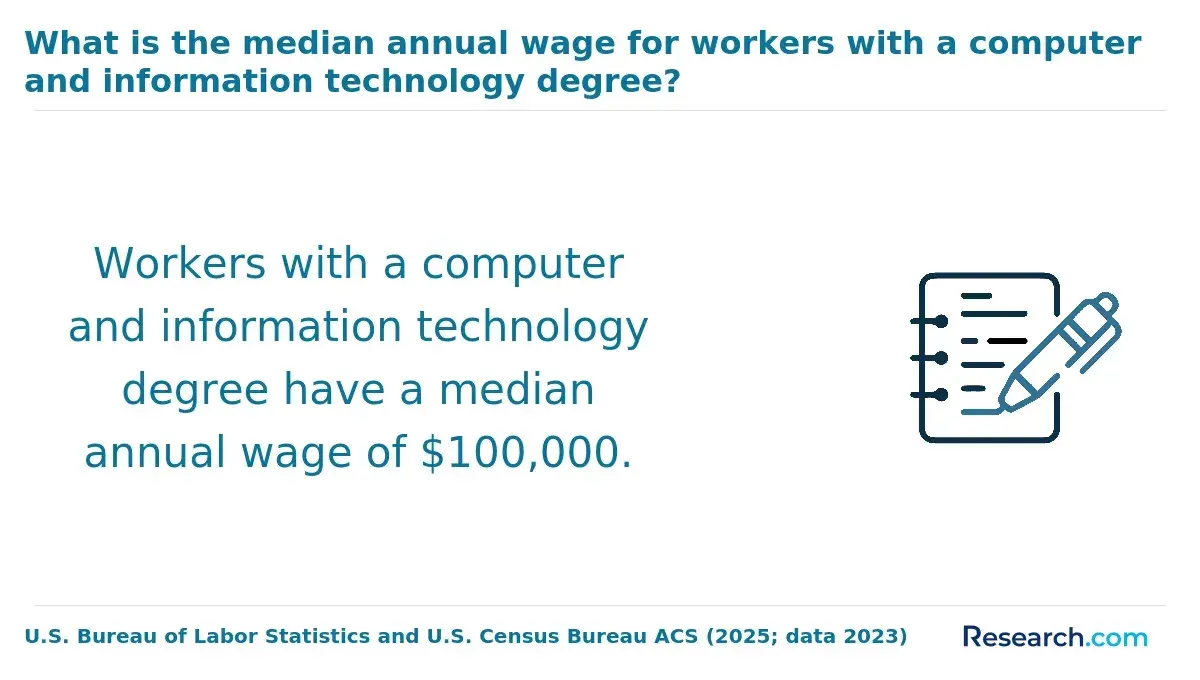
The BLS reports that the median annual wage for U.S. data scientists was $120,230 in May 2025. That is a midpoint across workers in the occupation, not an entry-level offer or a return attributable to a master's degree. Prior experience, responsibilities, location, and industry can substantially affect an individual offer; comparing industry pay for data science roles can help you put broad wage figures in context.
BLS projects 35% employment growth from 2025 to 2035 for data scientists. Growth indicates demand across the occupation, not that every graduate will secure a role or that UX experience will meet every posting's requirements. For a financial decision, compare plausible jobs you could pursue without the degree against jobs for which the degree and your resulting projects would make you a stronger candidate.
How Can You Evaluate an Accredited Online Data Science Master's Program?
First, verify the university's current institutional accreditation through the accreditor or the U.S. Department of Education's recognized-institution information. Then check whether the online program is available to residents of your state. Accreditation and state authorization are separate questions, and neither proves that a curriculum fits your career goal.
Use the same questions with every finalist so that marketing claims do not determine the choice:
- Which required courses address my specific gaps in coding, statistics, and working with product data?
- Can I review substantial student projects or capstone requirements, and will I have access to useful feedback?
- What are the complete cost, realistic course sequence, live-attendance requirements, and support available at my intended pace?
- Are published career outcomes specific to this program and its online students, and do they disclose who responded?
Be cautious when a program advertises career outcomes without defining the student group or presents optional electives as though every student takes them. Your final choice should rest on verified requirements and a feasible path from your present skills to the work you want to do.
Other Things You Should Know About Data Science
Only if your employer permits it and you can protect participants' privacy. Otherwise, use public or appropriately synthetic data and explain how your methods would apply to product research.
Not universally. Requirements vary by employer and role; some research-intensive positions may prefer advanced research training. Check postings for the work you want to perform rather than assuming a doctorate is required.
Yes, if you explain how the data was created, what assumptions it makes, and which conclusions would require real-world validation. Do not present simulated results as evidence of actual user behavior.
Not as a universal requirement. Follow each program's published admissions rules, then choose any additional coursework or certification for the specific skill or evidence it would provide.
References
- Post-Secondary Employment Outcomes Tool Shows What You Might Earn Depending on the College You Attend | Census.gov https://www.census.gov/library/stories/2022/06/job-and-earnings-prospects-by-college-and-degree.html
- Cost of Attendance (Budget) | 2025-2026 Federal Student Aid Handbook https://fsapartners.ed.gov/knowledge-center/fsa-handbook/2025-2026/vol3/ch2-cost-attendance-budget
- How to become a UX researcher | Salary, skills, requirements | Prospects https://www.prospects.ac.uk/job-profiles/ux-researcher/
- Understanding Accreditation for Online Degrees | UMass Global https://www.umassglobal.edu/blog-news/online-degrees-accredited-identify-quality-distance-learning-programs
- Now is the Time to Pursue a Career in Data | UCF Online https://www.ucf.edu/artificial-intelligence/data-careers/
- Master's in Data Science | utexas.edu https://cdso.utexas.edu/msds
- What Can I Do With a Degree in Data Science? Career Paths & Skills | Harvard SEAS https://seas.harvard.edu/news/what-can-i-do-degree-data-science-career-paths-skills
- M.S. in Data Science, Online | virginia.edu https://datascience.virginia.edu/degrees/msds-online
- Job Titles of Data Scientists | Data Science & Analytics | SUNY Buffalo State University https://dataanalytics.buffalostate.edu/job-titles-data-scientists
- A Guide to Choosing Between Data Science vs. Data Analytics | UCLA MSOL Data Science https://www.msol.ucla.edu/data-science-engineering/articles/demystifying-data-guide-choosing-between-data-science-vs-data-analytics/