2027 Online Data Science Master's After a Bachelor's in Business Administration: Prerequisites and Program Fit

Co-Founder and Chief Data Scientist
A bachelor's in business administration can be a useful starting point for an online data science master's, but it does not establish technical readiness on its own. Accounting, finance, operations, and analytics coursework may give you a head start; programming, mathematics, and statistics requirements depend on the program and your transcript.
This guide helps business graduates identify likely gaps, distinguish formal prerequisites from recommended preparation, and choose a program that fits their skills and career goals.
Key Things You Should Know
- A business administration degree does not automatically qualify or disqualify you; compare your completed courses with each program's stated mathematics, statistics, and programming requirements.
- Choose the program's technical depth for your intended role: business-facing analytics and model-building are different preparation targets.
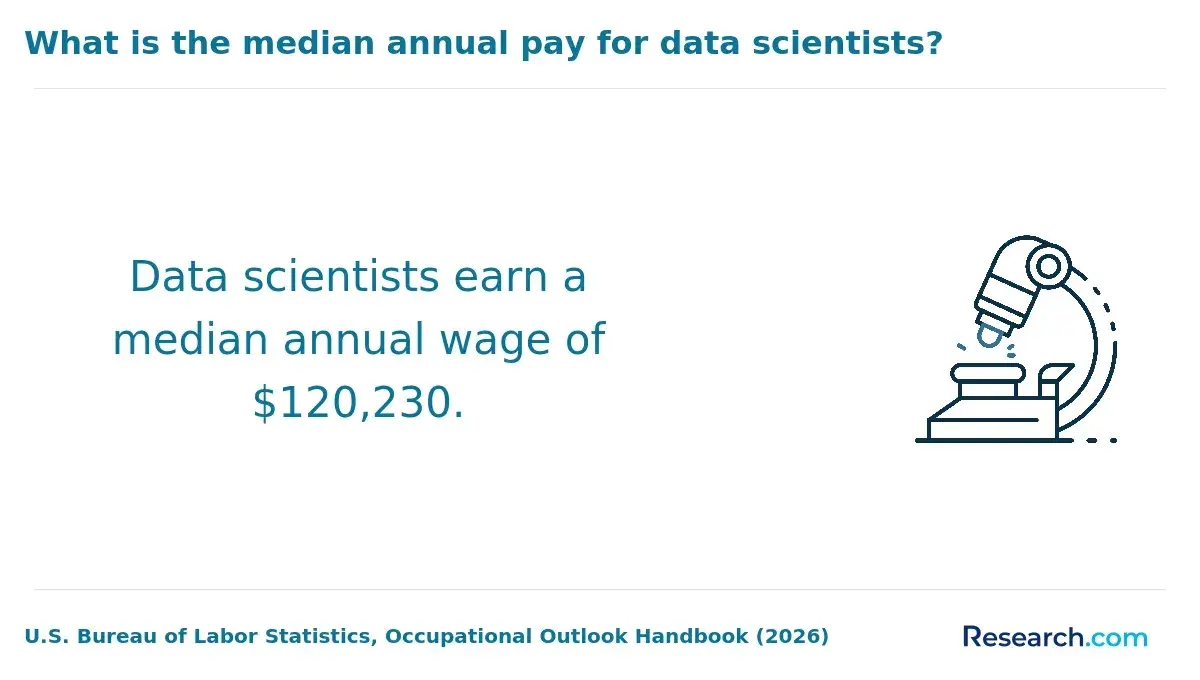
- The U.S. Bureau of Labor Statistics (BLS) reports a $120,230 median annual wage for data scientists in May 2025, but that occupation-wide figure is not an expected starting salary for master's graduates.
Can you earn an online data science master's after a business administration bachelor's degree?
Yes, if you meet the specific program's admissions criteria or complete an approved route into it. A business administration major is not inherently a barrier. What matters more is whether your record demonstrates the preparation needed for graduate-level quantitative and computing work.
Business coursework can contribute valuable context: framing an analytical question, interpreting financial or operational measures, and explaining results to decision-makers. Preparation varies widely, though. One graduate may have completed calculus and written code for forecasting projects; another may have studied statistics primarily through spreadsheets. Neither should rely on the degree title as a substitute for checking individual courses and skills.
Program fit is the central decision. A business-oriented data science program may build toward applied analysis and organizational decision-making. A more technically demanding program may expect students to arrive ready for mathematical modeling and substantial programming. Choose based on both your current preparation and the work you want to do afterward - not simply which program appears easiest to enter.
What prerequisites do online data science master's programs require?
Requirements differ by school, so use the admissions page and academic catalog for each program as the authority. The comparison below separates areas a business graduate might already know from gaps that warrant closer inspection; it is not a universal prerequisite list.
| Preparation area | Possible business-degree foundation | What to check for program fit |
| Statistics | Business statistics, research methods, or forecasting | Whether your coursework covered probability and statistical inference at the required level |
| Mathematics | Quantitative business courses or calculus, depending on the degree plan | Whether calculus and linear algebra are required before entry or taught within the program |
| Programming | Analytics assignments, database work, or independent projects | Which languages or coding abilities must be demonstrated at admission |
| Data work | Spreadsheet analysis, reporting, or business intelligence | Whether the curriculum assumes prior experience cleaning and querying data |
Compare course descriptions, not just transcript titles: "business statistics" may or may not cover the material a program expects. If a requirement is unclear, send admissions staff the syllabus and ask whether that particular course satisfies it. Ask separately whether an online course, assessed bridge course, or college-credit class can fulfill a formal prerequisite. Independent study can improve readiness without necessarily meeting an admissions rule.
For an example of how foundation pathways may be structured in a related field, see preparatory courses for AI master's programs. Confirm any data science program's own bridge policy before enrolling in outside coursework.
How do you choose an accredited online data science master's program?
First, verify the university's institutional accreditation through the accreditor or an official U.S. Department of Education accreditation resource. Then evaluate the program: institutional accreditation establishes a baseline, but it does not tell you whether the curriculum matches your preparation or career target.
Compare the catalog and admissions policy together. A suitable program should make its entry requirements, required courses, electives, assessment methods, and any capstone clear enough to judge the technical workload. For a business graduate, particularly useful evidence is whether early courses teach needed foundations or assume them. Check the program's current delivery and state-authorization information for your location, and ask which career services and faculty support online students can access.
A red flag is choosing by rankings or an "accredited" label alone while overlooking required coding and mathematics. Another is treating an advertised concentration as proof of depth without examining the courses you could actually take.
What admission requirements apply to business graduates entering data science programs?
Expect to verify requirements program by program. An application may call for a completed bachelor's degree, transcripts, a statement of purpose, recommendations, and evidence of quantitative or programming preparation. Schools differ on minimum grades, tests, prior coursework, and whether professional experience can supplement academic evidence; do not assume that business experience waives a stated course requirement.
Your application should connect specific evidence to the program's expectations. For example, describe the statistical methods you used in a class, the code you wrote for a work project, or the analysis you completed independently - and distinguish a project you can explain from a tool you have only used casually. If you are missing a formal prerequisite, obtain written clarification on the acceptable course and when it must be completed. If you are prepared through self-study, ask whether the program accepts that evidence for admission or merely recommends it before classes begin.
What courses are included in an online data science master's curriculum?
Course sequences vary, but a data science curriculum may include statistical modeling, programming, data management, machine learning, and an applied project. For a business graduate, the important distinction is where instruction starts: an introductory programming course can help close a gap, while an advanced modeling course may presume that you can already implement and evaluate methods independently.
Read course descriptions for mathematical expectations, hands-on assignments, and opportunities to work with imperfect real-world data. A project that requires you to define a business question, justify a method, and communicate limitations can make good use of your prior training. If your goal is primarily to develop or deploy AI systems rather than apply a broader mix of analytical methods, compare the curriculum with an artificial intelligence online degree guide; degree titles alone do not establish which route is more technical.
How do online data science master's programs compare with campus programs?
Delivery format does not, by itself, establish curriculum quality or difficulty. Compare the actual courses, instructors, assessments, and project opportunities. Online study may make continued employment more practical, but recorded lectures do not necessarily mean flexible deadlines, individually completed projects, or no scheduled meetings.
Before choosing an online program, check whether classes are synchronous, how group work crosses time zones, whether exams require set appointments, and whether a capstone requires access to a workplace or external partner. A campus option may better suit someone who needs regular in-person collaboration; an online option may better suit someone whose work and location make that impractical. Neither resolves missing prerequisites. If scheduling is your main constraint, compare data science master's completion times alongside the course load required at each pace.
How long do online data science master's programs take and cost?
There is no single reliable time or price for this decision: credit requirements, enrollment pace, prerequisite courses, residency rules, and tuition policies vary. Compare programs using the same assumptions about credits per term and fees. A shorter advertised path may require a course load that is unrealistic while working, while a longer path may increase the time before you can use the credential in a job search.
Ask each school for a current estimate that separates tuition, mandatory fees, materials or software, any travel requirement, and the cost of prerequisites outside the degree. Check whether an employer will reimburse approved courses and when reimbursement becomes available. For funding routes and questions to raise with financial aid offices, see how to fund a data science master's. Avoid comparing one school's tuition-only figure with another's all-in estimate - or assuming that a higher future salary will cover the difference.
What data science careers can business graduates pursue after graduation?
Your most credible next role depends on both new technical evidence and prior experience. Someone who has worked in operations or finance may be well positioned to pursue analytics work in that domain; a data scientist role with substantial model development may call for stronger coding, statistics, and project evidence. A master's can help build those skills, but it is not necessarily required for every analytics position.
Use the target job - not the degree title - to judge fit. Compare actual postings for business analyst, analytics-focused, and data scientist roles; note the methods, tools, and experience they request. Then look for a program project that lets you demonstrate those requirements while drawing on your business knowledge. If your goal is specifically health technology, AI graduate degrees for health technology roles offer a related curriculum comparison, though healthcare data and domain requirements need separate scrutiny.
What salaries and job outlook can data science master's graduates expect?
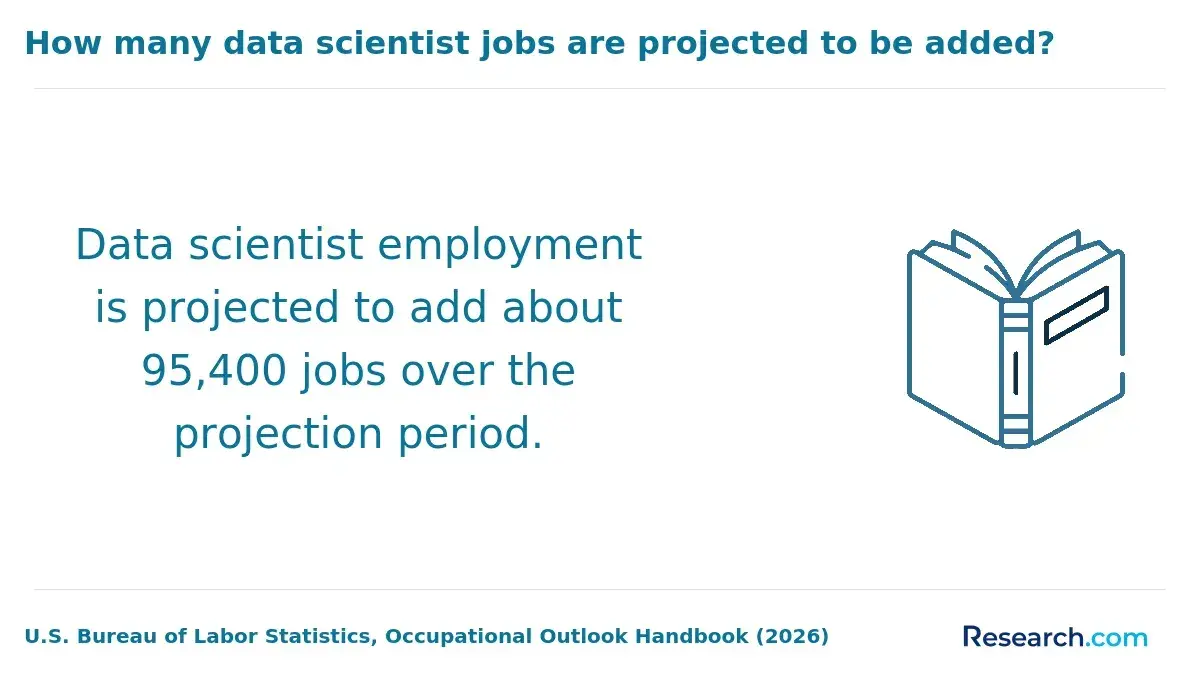
BLS reports that employment of U.S. data scientists is projected to grow 35% from 2025 to 2035. That indicates strong projected growth for the occupation, not a guarantee that every graduate - or every business-to-data-science career changer - will obtain a data scientist position.
BLS also reports a $120,230 median annual wage for data scientists in May 2025. The figure describes workers in the occupation across experience levels, not graduates of a particular master's program. For a personal cost-benefit decision, compare the roles you can plausibly pursue before and after the degree, account for your existing experience, and request any program outcome figures together with their population, time period, and response rate.
Are certifications or licenses required for data science careers?
Data scientist roles do not generally have a single professional license required across the U.S. Employers may value particular tools or certifications, but their preferences vary by role. A certificate should therefore address an identifiable skills gap or job-posting requirement, not serve as an assumed substitute for a program's formal admissions prerequisite.
For business graduates, a well-explained project can often provide more direct evidence of coding, statistical reasoning, and communication than a credential name alone. Check requirements for the specific employer and any regulated industry work you intend to pursue.
Other Things You Should Know About Data Science
Some programs may consider an application while you finish your degree, but enrollment may depend on a final transcript. Confirm the school's deadline for degree conferral.
Not without the necessary employer permission and compliance with the program's data-use rules. Ask whether a public or suitably de-identified dataset would meet the assignment requirements.
Not necessarily. Check the program's published hardware, software, and remote-computing requirements before purchasing equipment.
Possibly, but elective availability and course sequencing can limit your options. Ask an adviser when you must select a track and whether changing it would delay completion.
References
- What is Data Science? Careers and Skills Explained | post.edu https://post.edu/blog/world-of-data-science-careers/
- Syracuse Online Master's in Applied Data Science https://onlinegrad.syracuse.edu/information-science/applied-data-science/
- Profiling data scientists in the digital labour market | sciencedirect.com https://www.sciencedirect.com/science/article/pii/S0263237322000810
- What Can I Do With a Degree in Data Science? Career Paths & Skills | Harvard SEAS https://seas.harvard.edu/news/what-can-i-do-degree-data-science-career-paths-skills
- MIMS Admissions: Programming Proficiency | UC Berkeley School of Information https://www.ischool.berkeley.edu/programs/mims/admissions/programming
- Admissions and Application Requirements - UNC Online https://online.unc.edu/online-masters-programs/masters-data-science/admissions/
- Admissions - UVA School of Data Science https://datascience.virginia.edu/degrees/info/online-msds-admissions
- Master of Science in Data Science | CUNY SPS https://sps.cuny.edu/academics/graduate/master-science-data-science-ms
- Data Science Capstone Experience - Purdue Online https://www.purdue.edu/online/data-science/data-science-capstone-experience/
- Business Analytics vs. Data Science: 2025/26 Career Guide | Merrimack College https://online.merrimack.edu/business-analytics-vs-data-science/