2027 Online BA in Psychology - Mental Health vs. an Associate Degree in Human Services: Compare Curriculum, Cost, and Career Fit
Audited and Verified:
Our Editorial and Data Verification Process
Research.com uses government datasets, official education statistics and primary institutional information to support its career and degree guides. Our review process checks factual accuracy, occupational definitions, source dates and the requirements associated with the credentials discussed.
How This Article Was Fact-Checked
Our editorial team verifies salary estimates, employment projections, education requirements and program information against original data providers and official organizations. Salary figures are checked against the relevant occupational definitions and reporting periods. Information about licensure, accreditation and required in-person training is reviewed separately.
Fact-checked and verified on:

Co-Founder and Chief Data Scientist
If you want to work in mental health services, an online psychology BA and a human services associate degree can both be useful - but they prepare you for different starting points. The associate degree may offer a shorter route into supervised support work.
The BA provides more psychological science and research preparation and may meet degree requirements for a wider range of jobs or future study. This comparison is for prospective and returning students who need to weigh career fit against time, cost, and hands-on experience before enrolling.
Key Things You Should Know
- A human services associate degree commonly requires about 60 semester credits; a psychology BA commonly requires about 120. Your remaining credits - not the advertised degree length - determine your actual timeline and cost.
- Choose the associate route for a potentially faster start in supervised service roles; favor the BA when a target employer or future graduate program requires a bachelor's degree or stronger research preparation.
- Neither credential alone qualifies you to diagnose mental health conditions or provide independent psychotherapy. Compare placement access, total remaining cost, and local job requirements before choosing.
What Is the Difference Between an Online Psychology Bachelor's and Human Services Associate Degree?
A psychology BA with a mental health focus is a bachelor's degree in psychology, usually combining broad study of behavior with selected courses on mental health. "Mental health focus" may mean a formal concentration or simply a group of electives; check what appears on the transcript. An associate degree in human services is a shorter credential oriented toward helping people access services, communicate with agencies, and receive support under an organization's policies and supervision.
The distinction is not academic versus caring work: both can lead to community-serving jobs. It is primarily depth and direction. The BA generally develops more research and analytical skills; the associate program may devote a larger share of its shorter curriculum to service delivery. If a different specialty is influencing your decision, compare the actual curriculum and credential level rather than the label; guides to accredited online pathways in forensic psychology illustrate why a concentration must be evaluated separately from the underlying degree.
Which Degree Offers Better Mental Health Career Preparation?
For near-term, supervised support work, a human services associate program with a relevant, approved field placement may be the more direct preparation. For roles that specify a bachelor's degree - or for later study requiring stronger grounding in research methods - a psychology BA may fit better. Neither option should be judged solely by how many courses mention mental illness: employers also need evidence of documentation, professional boundaries, referrals, and respectful interaction with clients.
Look closely at where applied experience happens. An online BA might offer an internship, research project, or neither; an associate program's fieldwork might require travel to a local agency during business hours. Ask who arranges the site, what tasks students may perform, whether hours can fit around work, and who supervises them. Students specifically aiming for substance-use services can also compare online addiction counseling degree programs, but must check their state's rules before treating any degree as counselor preparation.
How Do Psychology and Human Services Curricula Compare?
This comparison shows the typical emphasis of each credential, not a universal course list. Use each school's current catalog to check required courses and whether applied experience is guaranteed or merely available.
| Learning area | Online psychology BA, mental health focus | Human services associate degree |
| Foundations | Psychological theory, development, social behavior, and mental health topics | Human services systems, helping relationships, and community resources |
| Methods | Typically includes statistics and psychological research methods | May emphasize documentation and service practice over independent research |
| Applied learning | Internship or project opportunities vary by program | Fieldwork may be integral, but hours and site rules vary |
| Professional scope | Academic study of mental health; not independent clinical training | Preparation for supervised support; not independent clinical training |
A useful curriculum test is to match required courses - not just electives - to the work you want to do. For example, a future research assistant benefits from methods and statistics, while an aspiring service coordinator may gain more immediately from supervised referral and documentation practice. Likewise, discussions of forensic psychology graduate career value and qualifications should not be mistaken for evidence that an undergraduate mental health elective qualifies someone for a specialized job.
Associate and bachelor's programs generally ask applicants for prior-school transcripts and require them to meet the institution's admission standards. A bachelor's program may also have transfer or major-entry rules. Schools, not degree labels, decide whether prior psychology, statistics, general education, or human services courses satisfy specific requirements.
If you already have college credit, request a written degree audit showing credits accepted, requirements fulfilled, credits still needed, and any minimum credits that must be earned at the institution. An accepted course might count only as an elective. Ask whether fieldwork has prerequisites and whether prior employment can satisfy any requirement; do not assume that it can. If graduate study is part of your plan, check the intended program's prerequisites directly - even short-duration online forensic psychology graduate options can have admission and preparation requirements that your chosen undergraduate curriculum does not automatically meet.
A full-time student starting without college credit often plans around roughly two academic years for an associate degree or four for a bachelor's degree. Online delivery can change where coursework happens, but it does not erase credit requirements, course sequencing, or fieldwork hours. Part-time enrollment, accepted transfer credits, and course availability can change either timeline substantially.
For a realistic completion estimate, ask each school for a term-by-term plan based on your evaluated credits and intended weekly course load. Confirm whether classes are asynchronous, whether live sessions are required, and when placements must occur. Advertised accelerated timelines - including forensic psychology undergraduate graduation timelines - are useful comparisons only when their credit and scheduling assumptions match your situation.
The associate degree usually involves fewer credits, but fewer credits do not automatically mean the lowest final cost. Compare the price of completing your specific remaining requirements at each school. A low per-credit rate may be offset by fees, courses that do not transfer, or a later bachelor's program that requires additional credits.
Request an itemized estimate covering tuition, mandatory fees, books, technology, and any placement-related travel or lost work hours. Then subtract only aid or employer assistance for which you have confirmed eligibility. If you expect graduate study later, budget for that separate decision rather than assuming the BA is the final expense; psychology graduate study on a budget is relevant only after you establish that a psychology master's actually advances your intended career.
Online instruction does not, by itself, make a psychology program less credible. Verify the institution's accreditation status with its accreditor, then examine the specific BA's curriculum, faculty access, student support, placement policies, and published outcomes. Ask whether the institution can support required experiences where you live.
Do not confuse institution-level accreditation with professional approval for a later clinical credential. APA accreditation is not a standard designation for general psychology bachelor's degrees. If your ultimate aim is licensed counseling, research the qualifying graduate pathway separately; clinical mental health counseling accreditation and pacing concern different program and licensure questions than the quality of an undergraduate psychology BA.
With an associate degree, plausible openings may include human services or behavioral-health support positions, depending on the employer, state, and your experience. Tasks can include connecting clients with resources, maintaining records, and assisting a supervised team. A psychology BA may also support applications for service coordination, program support, or research support jobs, particularly when paired with relevant fieldwork, methods skills, or prior employment. A BA does not automatically outrank an experienced associate-degree applicant for every support role.
Read job postings for required degree level, permitted duties, and experience before enrolling. If the jobs you want accept an associate credential plus relevant experience, paying for a BA may not be necessary now. Conversely, a posting that requires a bachelor's degree may make the shorter route an intermediate step rather than the finish line. A specialized graduate credential is not an automatic solution to a hiring barrier; weigh forensic psychology one-year program value considerations against the qualifications in actual postings before adding another degree.
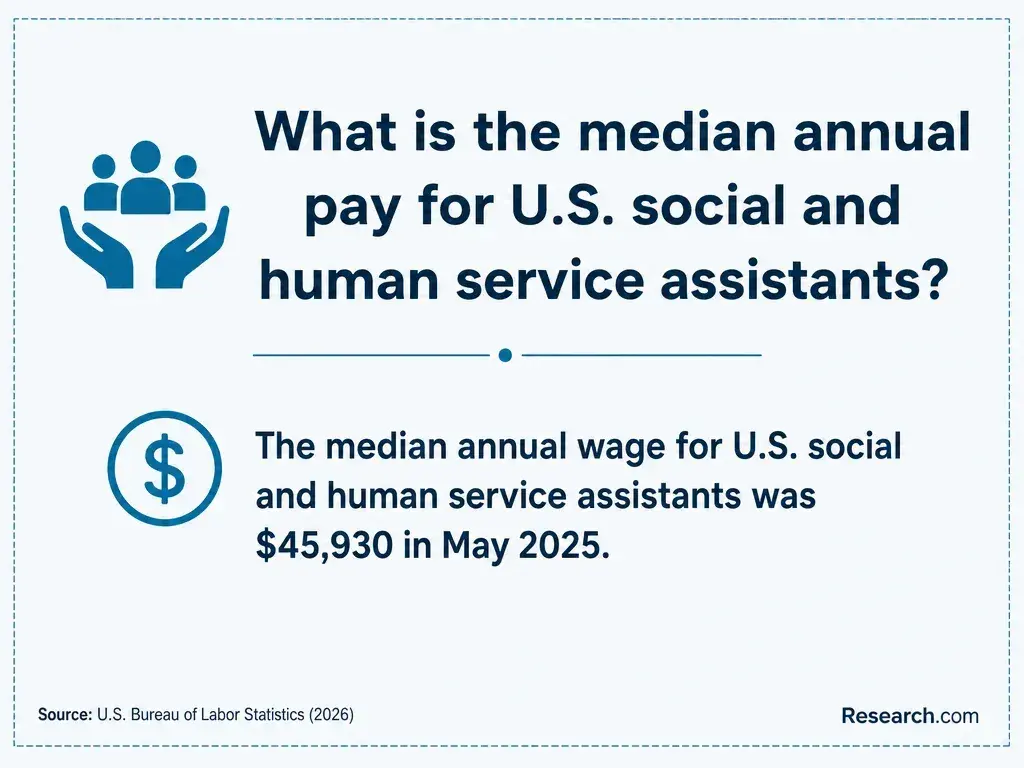
The US Bureau of Labor Statistics groups many relevant entry-level jobs under social and human service assistants. Its Occupational Outlook Handbook publishes occupation-wide pay and employment projections, but those figures are not separate salary forecasts for psychology BA or human services associate graduates. Pay also varies by employer, location, experience, and duties.
For a decision you can use, compare current BLS figures for the precise occupation with local postings that state their education requirements. Then estimate whether any additional degree cost is justified by jobs you could realistically pursue - not by the pay associated with a different profession. The same caution applies to shorter completion routes for psychology master's students: a faster credential has financial value only if it serves a verified career or academic requirement.
What Licenses or Certifications Are Needed for Mental Health Careers?
Most supervised, nonclinical support jobs do not require a psychotherapy license, although employers may require training, background checks, or role-specific credentials. Requirements for peer support, substance-use counseling, case management, and other positions differ by state and employer. Check the relevant state authority and the exact job posting before relying on either degree.
Independent psychotherapy and diagnosis generally require a qualifying professional education pathway, supervised experience, and state licensure; neither an associate degree in human services nor a psychology BA with mental health coursework supplies that authority alone. If therapist licensure is your goal, compare qualifying graduate programs against your state board's rules, including placement demands. Guides to shortening the path through a clinical counseling master's can inform scheduling questions, but speed cannot replace required training or supervised practice.
Other Things You Should Know About Psychology
Yes, but ask the bachelor's institution to evaluate your courses before assuming they will satisfy psychology major requirements.
No. It may be a formal concentration, a transcript designation, or simply electives. Ask the school how it records the focus.
Possibly, if the program approves the site, duties, supervision, and learning goals. Existing employment alone is not approval.
Review local job postings and consider an introductory course, approved volunteer opportunity, or entry-level support role before taking on a larger education expense.
- Price of Attending an Undergraduate Institution - COE https://nces.ed.gov/programs/coe/indicator/cua/price-of-attending-an-undergraduate-institution
- GAC - Chapter 135-5 REQUIREMENTS FOR LICENSURE https://rules.sos.ga.gov/gac/135-5
- Accreditation in the U.S. | ed.gov http://www.ed.gov/laws-and-policy/higher-education-laws-and-policy/college-accreditation/accreditation-in-the-us
- Requirements Related to the Practice of Counseling - NCBI https://www.ncbi.nlm.nih.gov/books/NBK259170/
- Policies for Online Teaching | Teaching and Learning Resource Center https://teaching.resources.osu.edu/teaching-topics/policies-online-teaching
- BA in Psychology (Online) | Rider University https://www.rider.edu/programs/psychology-online
- What Degree Do I Need to Become a Counselor or Therapist? | Palo Alto University https://paloaltou.edu/resources/blog/what-degree-do-i-need-become-counselor-or-therapist
- Counseling & Therapy (Graduate Education Required) | ucdavis.edu https://yellowcluster.ucdavis.edu/psychology-career-pathways/helping-professions/counseling-and-therapy-careers
- Labor market information | Metro State University https://www.metrostate.edu/students/support/career/finding-a-path/labor-market
- 4 Types of Psychology Degrees: Picking the Right Program | Bouvé College of Health Sciences https://bouve.northeastern.edu/news/4-types-of-psychology-degrees-picking-the-right-program/