2027 Online BA in Psychology - Addictions for Hospital Receptionists: Compare Prerequisites, Workload, and Career Fit
Audited and Verified:
Our Editorial and Data Verification Process
Research.com uses government datasets, official education statistics and primary institutional information to support its career and degree guides. Our review process checks factual accuracy, occupational definitions, source dates and the requirements associated with the credentials discussed.
How This Article Was Fact-Checked
Our editorial team verifies salary estimates, employment projections, education requirements and program information against original data providers and official organizations. Salary figures are checked against the relevant occupational definitions and reporting periods. Information about licensure, accreditation and required in-person training is reviewed separately.
Fact-checked and verified on:

Co-Founder and Chief Data Scientist
Hospital receptionists often know how to welcome distressed patients, protect private information, and connect people with the right department. Moving into addiction or behavioral-health work requires a different question: which new responsibilities do you want, and what preparation do they require? This guide compares online psychology BA prerequisites, coursework, schedules, costs, and career fit for receptionists considering that move. It also distinguishes support roles from regulated counseling, so you can decide whether a bachelor's degree, a more targeted credential, or workplace training is the better next step.
Key Things You Should Know
- An online psychology BA with addictions coursework can support a move toward intake, outreach, or recovery-service coordination, but it does not independently qualify you to diagnose or counsel patients.
- Many bachelor's programs require roughly 120 semester credits in total; the credits you still need depend on an official evaluation of prior study, not simply the number accepted for transfer.
- Compare the actual weekly schedule, approved fieldwork opportunities, total remaining cost, and requirements for your target job before enrolling.
What Is an Online BA in Psychology With an Addictions Focus?
It is an undergraduate psychology degree that combines general education and psychological science with coursework on substance use, prevention, recovery, or behavioral-health services. "Addictions focus" might mean an officially named concentration, a minor, or simply a set of electives. Check the catalog and transcript designation rather than relying on a program description.
For a receptionist, the BA is most useful when the goal is broader responsibility in patient-facing support or a foundation for later study. It is less direct if the goal is a specific, state-regulated counseling credential. When reviewing psychology major options at online colleges, compare the required addictions courses and applied opportunities - not just the degree title.
What Prerequisites Are Needed for an Online Psychology Bachelor's Degree?
Entry requirements vary by school and by whether you apply as a first-year or transfer student. A high school credential is generally the starting point for undergraduate admission; transfer applicants usually provide transcripts from every college attended. Schools may also set GPA rules or require particular coursework before entry to the major. Reception experience can strengthen an application, but it normally does not replace academic admission requirements.
If you have previous college credit, distinguish credit accepted by the university from credit applied to the BA. A statistics class, for example, might transfer as an elective without satisfying the psychology major's statistics requirement. Request a written degree audit showing general education, major, elective, and remaining residency requirements. Guidance on moving existing credits into psychology study can help you frame questions for the registrar and psychology department; only the receiving institution can approve equivalencies.
How Does an Addictions Psychology Degree Prepare Hospital Receptionists?
Reception work provides a relevant starting point: accurate registration, calm communication, scheduling, confidentiality, and knowing when to bring in clinical staff. Psychology study can add an evidence-based understanding of behavior, substance use, stigma, and recovery systems. Together, those skills may support applications for nonclinical intake, referral, outreach, or program-support jobs - provided you can demonstrate the duties an employer requests.
The boundary matters at the front desk. Recognizing that someone needs help is not the same as screening, diagnosing, giving treatment advice, or promising confidentiality beyond hospital policy. Follow established escalation and emergency procedures, and leave clinical judgments to qualified staff. If your goal is specifically addiction-service work rather than a broad psychology education, compare the curriculum and credential alignment of distance learning degrees in addiction counseling before choosing a BA.
Expect a foundation in introductory psychology, statistics, research methods, development, and social or biological aspects of behavior. Depending on the school, addictions-related offerings may examine substance-use disorders, prevention, family and community contexts, recovery services, and ethics. Reading research critically is especially valuable: it helps you separate evidence about an intervention from a claim made in an advertisement or informal workplace conversation.
Check which courses are required, which are offered regularly, and whether an internship or capstone is available. A course about counseling methods teaches academic concepts; it is not permission to counsel patients. Likewise, forensic coursework points toward a different subject area. Comparing shorter online forensic psychology master's pathways would be a later, separate decision - not a substitute for checking the addictions BA curriculum against your immediate career goal.
The consequential difference for a working receptionist is often control over when learning happens, not where lectures are delivered. An online class may be asynchronous yet still have fixed deadlines, group meetings, proctored exams, or an in-person placement. A campus program may offer easier access to faculty and local organizations but conflict with shifts or a commute.
This comparison identifies the scheduling facts to obtain from each school before committing.
| Feature | Online program | Campus program |
| Class attendance | May be asynchronous or require live sessions | Usually tied to scheduled class meetings |
| Applied experience | May require an approved local site and supervisor | May offer campus-connected opportunities; placement is not guaranteed |
| Shift-work fit | Can reduce commuting, but deadlines and meetings still constrain time | Depends on course times, travel, and section availability |
Ask for a sample syllabus and the upcoming course schedule. Condensed terms can increase the weekly pace even when they shorten the calendar; review psychology degrees with condensed course schedules with that trade-off in mind.
Many US bachelor's degrees total about 120 semester credits, but your completion time depends on the credits applied to requirements, course sequencing, and how many classes fit around your shifts. An admissions estimate is not a graduation plan until the school evaluates your transcript and shows when required courses will run.
Compare the price of remaining credits, not just advertised tuition per credit. Include mandatory online fees, books, technology, any placement-related travel, and income lost if you must reduce work hours. Ask your hospital whether it offers tuition assistance and whether a psychology major qualifies; do not assume reimbursement is available. For aid questions specific to this field, consult financial aid for substance abuse counseling bachelor's degrees, then confirm your own eligibility and enrollment requirements with each school's aid office.
First, verify the institution's recognized accreditation through the US Department of Education or the Council for Higher Education Accreditation directory. Then confirm that the advertised online BA and addictions focus appear in the current catalog. The American Psychological Association does not accredit general psychology bachelor's degrees; institutional accreditation alone also does not establish eligibility for an addiction-counselor license.
Quality for this decision means dependable access to required courses, advising for working students, useful methods training, and clear policies for any field experience. Ask who approves sites and whether a current hospital job could qualify; routine reception duties should not be presumed to satisfy an academic placement. A low advertised price is useful only alongside those checks. When weighing tuition against substance abuse counseling career outcomes, avoid treating a program's price or an occupation-wide wage as a promised return for its graduates.
The most plausible transition builds on hospital experience rather than assuming the BA opens a clinical role. Depending on the employer, possibilities include behavioral-health intake coordinator, recovery-program assistant, community outreach worker, human-services assistant, or case-coordination support. Titles are inconsistent: compare actual duties, required credentials, and supervision in each posting.
Seek evidence of readiness while studying: a supervisor-approved improvement project using permitted information, a nonclinical internship, or volunteer work with a recovery organization can demonstrate communication and service coordination. Do not use patient records or undertake clinical tasks without authorization. If the target job instead requires graduate study, choosing a fast-track psychology master's program should begin with that job's requirements; a general psychology master's is not automatically a counseling qualification.
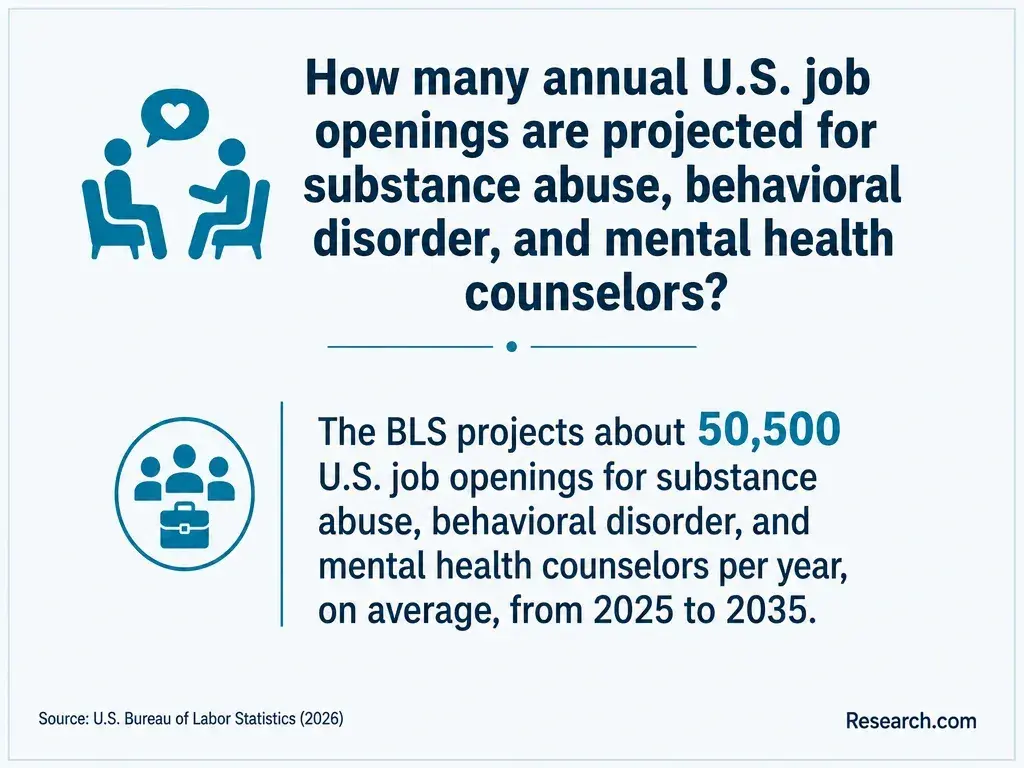
Use occupation data as context, not as a forecast of your pay. The US Bureau of Labor Statistics reports a May 2024 median annual wage of $59,190 for the combined occupation of substance abuse, behavioral disorder, and mental health counselors, with projected employment growth of 17% from 2024 to 2034. That category includes workers with different duties and qualifications; its median is not the expected wage for a receptionist who earns a psychology BA or moves into entry-level intake work.
For a realistic comparison, collect local postings for the exact support job you want and note their pay ranges, required experience, credentials, and shifts. Counseling roles may require substantially more preparation. Use short counseling master's formats and career planning only if licensed counseling is your goal, and verify that a program meets the rules where you intend to practice.
What Licenses and Certifications Are Needed for Addiction Counseling?
There is no single nationwide credential that an addictions-focused psychology BA automatically awards. States set or recognize different addiction-counselor titles and may require specified coursework, supervised experience, an examination, and an application. Peer-support credentials and licensed mental-health counselor pathways have different purposes and rules. A hospital's job title alone does not establish what work the state permits.
Before enrolling, identify the exact position and state where you plan to work. Check the responsible state board or credentialing authority for its education, supervision, and scope-of-practice requirements, then ask the school to document how its curriculum aligns. If the destination is licensed mental health counseling rather than addiction-service support, include graduate education and supervised practice in the plan; budget planning for mental health counseling study addresses a different, potentially longer investment than a psychology BA alone.
Other Things You Should Know About Psychology
Possibly, but only if the academic program approves the site, supervisor, learning objectives, and duties. Existing employment does not automatically count, and clinical tasks remain outside a receptionist's authority.
Not without the required hospital permission and any applicable academic review. Even a seemingly anonymous dataset may be restricted. A project using public data or a hypothetical workflow may be safer.
Before enrolling, ask about live attendance, exam windows, late-work rules, and leave options. Discuss predictable conflicts with your advisor and employer early; "online" does not necessarily mean self-paced.
Use the credential's official name. List a concentration only if the school formally awards it; otherwise, describe relevant coursework and approved projects without implying a counseling license or clinical training.
- School-Determined Requirements | 2024-2025 Federal Student Aid Handbook https://fsapartners.ed.gov/knowledge-center/fsa-handbook/2024-2025/vol1/ch1-school-determined-requirements
- Behavioral Health Career Descriptions | samhsa.gov https://www.samhsa.gov/about/careers/behavioral-health-workforce/careers-by-state/descriptions
- Case Management - StatPearls - NCBI Bookshelf https://www.ncbi.nlm.nih.gov/books/NBK562214/
- A Guide to Professions in Addiction Studies and Recovery | University of the Cumberlands https://www.ucumberlands.edu/blog/guide-to-professions-in-addiction-studies-and-recovery
- Addictions and Substance Use Disorders | maricopa.edu https://www.maricopa.edu/degrees-certificates/behavioral-science-human-services/addictions-substance-use-disorders-3302-aas
- APA-Accredited Programs https://accreditation.apa.org/accredited-programs
- Time on Task in Online Courses | RIT https://www.rit.edu/teaching/time-task-online-courses
- NC State Transfer Planner - Transfer Student Resources https://transfer.ncsu.edu/resources/nc-state-transfer-planner/
- Practicums, Internships and Projects What's the Difference? | Oregon State University https://health.oregonstate.edu/internships/types-of-experiential-learning
- Employer Tuition Reimbursement: How It Works and How to Pay for College | Winston-Salem State University https://ramsonline.wssu.edu/blog/employer-education-benefits/