2027 Online BA in Psychology - Addictions: Choosing a Program When Your Job Duties Already Match the Curriculum

Co-Founder and Chief Data Scientist
If your job already involves addiction outreach, recovery support, or service coordination, an online psychology BA may cover work you know well. The decision is whether its research training, degree credential, and future options justify the time and cost.
This guide is for working addiction-service professionals comparing programs while keeping their jobs. It shows how to identify skills you still need, check whether your workplace experience can support coursework, and distinguish a useful academic degree from a counselor qualification it may not provide.
Key Things You Should Know
- Choose a program for the skills and credential you lack - not simply because its addictions courses describe your current duties. Compare statistics, research methods, psychology breadth, and the degree audit.
- A psychology BA does not itself authorize addiction counseling. Check your state's rules for the specific job title, required education, supervised experience, and examination before enrolling.
- A bachelor's degree commonly requires about 120 semester credits, but transfer decisions and remaining requirements determine your actual timeline and cost. Get a written, program-specific evaluation.
What Is an Online Bachelor's Degree in Psychology With an Addictions Focus?
It is an undergraduate psychology degree that adds coursework on substance use, prevention, treatment systems, or recovery. "Addictions focus" might mean an officially recorded concentration, a group of electives, or simply courses a school highlights. Ask what will appear on your transcript and which courses are guaranteed to be offered online.
For an experienced recovery-support worker, the degree's distinctive value may be its broader psychology and research foundation, not an introduction to services they already provide. A program with strong methods courses could help you evaluate an outreach initiative or prepare for graduate study. A counseling-oriented bachelor's might fit better if your state accepts its particular coursework toward a credential. Use comparing online psychology degree curricula to frame the search, then confirm each school's current catalog rather than relying on a program label.
Can You Become an Addiction Counselor With a Bachelor's Degree?
Possibly in some jurisdictions and at some credential levels, but not because the diploma says "psychology" or "addictions." States distinguish among substance-use counselors, licensed mental health counselors, and recovery-support roles. Their education, approved coursework, supervision, examination, and scope-of-practice rules can differ substantially.
Start with the title and duties of the job you want. If you want to provide independent psychotherapy or hold a mental health counseling license, a psychology BA is generally preparation for further qualifying education, not the qualifying credential. Investigate online clinical counseling graduate completion options only after checking your state board's program and placement requirements. If you want to advance in nonclinical outreach or service coordination, a BA may be useful without being a license pathway.
How Do You Choose an Accredited Online Psychology Program?
First, verify the institution's recognized institutional accreditation and the exact degree it awards. Institutional accreditation matters for academic quality oversight and can affect aid and credit transfer; it does not certify that an addictions concentration meets a state counselor board's rules. APA accreditation should not be presented as a requirement for a general psychology BA.
Next, request a written degree audit showing which prior credits satisfy general education, the major, statistics, research methods, and electives - and which credits remain. Compare those requirements with what you already do at work. An inexpensive course that duplicates your experience is less valuable than accessible faculty guidance on research or a needed prerequisite. Affordable online psychology degree programs can be a starting point, but compare your remaining-credit cost, required course availability, advising, and graduation rules before choosing.
Ask the program director whether a workplace project can meet any applied requirement. Your employer's willingness is not academic approval, and access to client information is not automatic permission to use it for class.
Expect psychology foundations, development, abnormal psychology, statistics, research methods, and electives addressing substance use or recovery; the actual mix varies by school. The useful comparison is not whether a course sounds familiar, but what it asks you to demonstrate beyond your current responsibilities.
The table separates common workplace experience from academic learning that may add value. Neither column establishes permission to deliver clinical services.
| Area | What your job may already teach | What coursework may add |
| Recovery services | Referral pathways, documentation, and community partnerships | Comparison of prevention and recovery models and their evidence |
| Behavior and development | Experience supporting people with varied needs | Psychological theories, lifespan development, and limits of generalization |
| Research and evaluation | Collecting service counts or preparing reports | Study design, statistics, measurement quality, and cautious interpretation |
If your goal is a state-recognized substance-use counseling credential, compare required coursework with the BA's actual syllabus. Also check aid eligibility for online substance use counseling study when weighing a more directly counseling-focused bachelor's against a psychology BA. Familiar subject matter alone does not make the degrees interchangeable.
Online delivery can remove commuting without removing scheduled obligations. For someone working shifts, the consequential differences are live class times, group projects, exam windows, faculty access, and any in-person placement or residency. A campus program may offer easier access to a research team or local faculty; an online program may fit employment better if those opportunities are available remotely.
Ask for a sample course schedule and the rules for using your current workplace as an approved learning site. If you are comparing specializations because a faster online option caught your attention, comparing faster forensic psychology undergraduate options illustrates a separate decision: speed only helps when the curriculum fits your intended work and your credits actually apply. The same caution holds for an addictions focus.
Requirements depend on whether you apply as a first-time student or a transfer applicant. Schools may request transcripts and proof of prior education; admission to the university does not necessarily mean every previous course satisfies psychology-major requirements. An applied associate degree or workplace training can be valuable without automatically replacing statistics or research methods.
Send official records and ask for a term-specific evaluation before committing. If graduate school is your reason for earning the BA, check the intended graduate program's prerequisites early: a concentration name will not substitute for required methods courses. Even intensive forensic psychology master's admissions and study plans, if you are considering a different specialization later, should be judged by their stated entry requirements rather than assumed to accept every psychology curriculum.
A bachelor's degree commonly totals about 120 semester credits, but that figure is not the number you must take at the new school. Your remaining general education, major, course-sequence, and residency requirements control completion time. Working fewer courses per term may protect your income and capacity while extending the period in which fees apply.
Request a written estimate based on your degree audit: remaining credits multiplied by the applicable tuition rate, plus mandatory fees, materials, any travel or unpaid applied work, and likely future rate changes. Ask your employer whether education assistance covers this degree and whether repayment is required if you leave. A shorter program in another field, including forensic psychology master's study with faster pacing for someone who already holds a bachelor's, is not a cost-saving substitute unless it serves the same career objective and admits you.
Depending on employer requirements and your experience, potential nonclinical roles include recovery-program coordinator, outreach specialist, intake coordinator, case-support worker, and program-evaluation assistant. If you already perform similar duties, the degree may be more useful for advancement into supervision, reporting, or program development than for changing your job title immediately.
Compare postings for your target role with evidence you can offer: documented referral work, accessible communication, ethical recordkeeping, statistics, or an approved evaluation project. Do not assume the degree qualifies you to diagnose, provide therapy, or supervise licensed treatment. A move into a different field also needs a separate job-market check; for example, career planning with a forensic psychology graduate degree involves different employers and qualifications from addiction-service work.
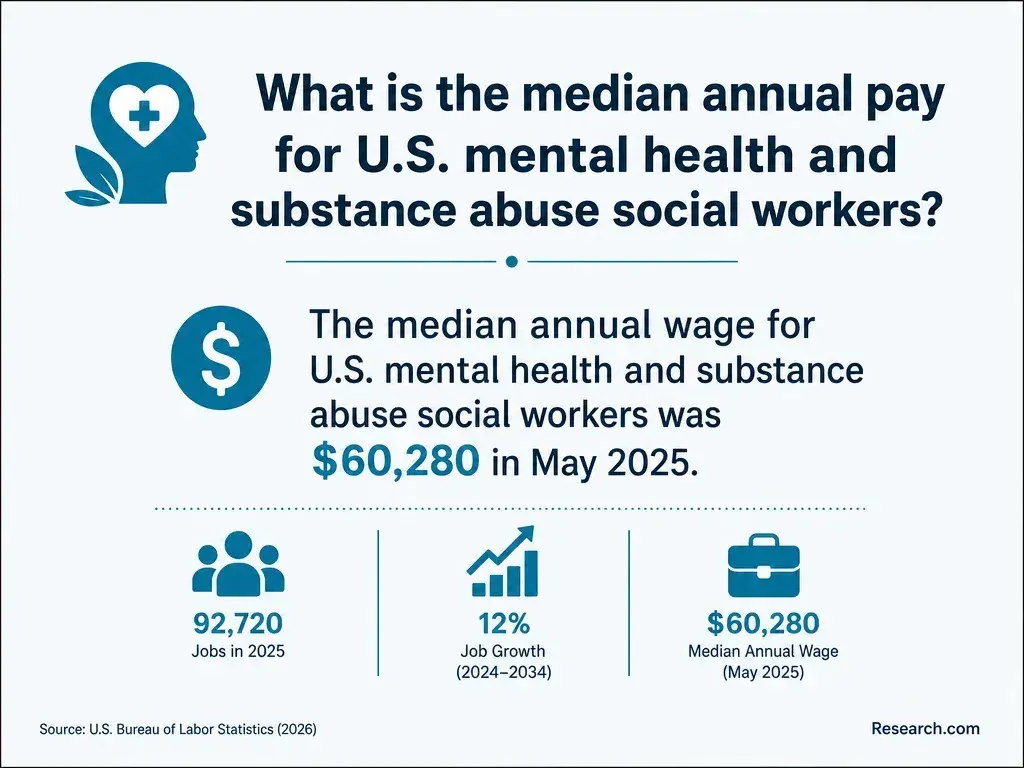
There is no single salary or growth rate for graduates of an addictions-focused psychology BA. Pay depends on the occupation, location, employer, experience, and any required credential. The U.S. Bureau of Labor Statistics reports a May 2024 median annual wage of $59,190 for the combined occupation of substance abuse, behavioral disorder, and mental health counselors. That occupation-wide median includes workers with different qualifications; it is not an expected salary for a new BA graduate or a recovery-support worker.
Use local postings for the role you can actually hold, then compare the likely pay difference with your remaining education cost. For a broader discussion of substance abuse counseling bachelor's fees and career prospects, keep the same distinction between degree costs and wages tied to a particular occupation.
What Licenses and Certifications Do Addiction Professionals Need?
Requirements follow the position and jurisdiction, not the concentration title. A state or its designated credentialing body may specify an approved degree or courses, supervised hours, examination, continuing education, and permitted duties for an addiction counselor. Peer-support certification can be a distinct pathway, while licensed mental health counseling generally has its own graduate education and supervised-practice requirements.
Before enrolling, obtain the regulator's criteria for your exact target credential and ask the program for a written course-by-course explanation of any claimed alignment. Have the regulator or designated credentialing body confirm uncertain points; a school's general statement that graduates can work in addictions is not an eligibility ruling. If graduate counseling is the intended next step, account for placements and other mental health counseling program charges beyond tuition as well as the BA itself.
Other Things You Should Know About Psychology
Only within your employer's rules and the course's requirements. Removing names may not eliminate identification risk; use an approved hypothetical example when permission or privacy is uncertain.
Not necessarily. Ask your credentialing body whether it accepts the specific course, provider, and documentation before treating enrollment as continuing education.
Disclose only what you choose and what is relevant. You can explain your professional goals and qualifications without sharing private health information.
Check whether the program requires a particular approved worksite or project supervisor. Also review any employer tuition-assistance repayment terms before changing jobs.
- Persistence and Dropout in Higher Online Education - PMC https://pmc.ncbi.nlm.nih.gov/articles/PMC9197481/
- Cost of Attendance (Budget) | 2025-2026 Federal Student Aid Handbook https://fsapartners.ed.gov/knowledge-center/fsa-handbook/2025-2026/vol3/ch2-cost-attendance-budget
- Employer-offered educational assistance programs can help pay for college | Internal Revenue Service https://www.irs.gov/newsroom/employer-offered-educational-assistance-programs-can-help-pay-for-college
- STATE LICENSURE FOR SUBSTANCE USE DISORDER COUNSELING: IMPLICATIONS FOR BILLING ELIGIBILITY | ASPE https://aspe.hhs.gov/reports/state-licensure-substance-use-disorder-counseling-implications-billing-eligibility-0
- Substance Use Disorder Treatment Training Certificate Program | The University of Utah https://socialwork.utah.edu/certificates/substance-use-disorder-treatment-training.php
- Employer Tuition Reimbursement: How It Works and How to Pay for College | Winston-Salem State University https://ramsonline.wssu.edu/blog/employer-education-benefits/
- Human & Social Services: Chemical Dependency (435A) | Southern State Community College https://www.sscc.edu/academics/associate/human-social-services-chemical-dependency.shtml
- Internship & Practicum - Human Services https://humanservices.santarosa.edu/internship-practicum
- Credit for Prior Learning - IU Indianapolis - Indiana University https://ctas.indianapolis.iu.edu/transfer/prior-learning/index.html
- Practicum Education Manual - VI. Practicum Education Placement Policies, Procedures, and Processes https://socialwork.wayne.edu/practicum/manual/policies