2027 Nursing Curriculum Design Work: How Educators Use Outcomes, Assessments, and Standards
Audited and Verified:
Our Editorial and Data Verification Process
Research.com uses government datasets, official education statistics and primary institutional information to support its career and degree guides. Our review process checks factual accuracy, occupational definitions, source dates and the requirements associated with the credentials discussed.
How This Article Was Fact-Checked
Our editorial team verifies salary estimates, employment projections, education requirements and program information against original data providers and official organizations. Salary figures are checked against the relevant occupational definitions and reporting periods. Information about licensure, accreditation and required in-person training is reviewed separately.
Fact-checked and verified on:

Co-Founder and Chief Data Scientist
A nursing course can cover the right topics yet fail to show whether students can use them safely in practice. Curriculum design addresses that gap by connecting what graduates must be able to do with what they learn, how they practice, and how faculty assess them. For educators revising a program - and students comparing programs - this guide explains the design process, the standards that constrain it, and the evidence worth requesting. It also puts degree requirements, costs, and career claims in perspective so a polished course list does not become a substitute for demonstrated preparation.
Key Things You Should Know
- Effective curriculum design links each graduate outcome to instruction, supervised practice, and evidence of student performance - not merely to a course title.
- Educators need separate checks for standards alignment, state approval, and individual competence; none of those alone establishes the others.
- For program comparisons, ask for an outcomes map and assessment examples, then verify clinical arrangements, progression results, and total costs for your entry term.
What Is Nursing Curriculum Design and Why Does It Matter?
Nursing curriculum design is the deliberate selection and sequencing of learning outcomes, content, practice experiences, and assessments. An outcome states what a learner should be able to demonstrate by a defined point; a course topic states what will be taught. "Medication safety," for example, is a topic. Recognizing a discrepancy, explaining a safe response, and communicating it appropriately are assessable outcomes.
Educators typically work backward from the intended graduate role. A prelicensure RN curriculum must develop generalist nursing judgment and supervised care skills. Practical-nursing education has a different intended role, while an advanced practice certificate builds on an existing RN's preparation and targets a defined specialty. Their maps should not be interchangeable. Even when comparing faster routes into practical nursing education, the important design question is which learning experiences remain required and how competence is checked - not simply how many months are removed.
How Do Nursing Programs Align Outcomes With Assessments and Standards?
Educators use an alignment map to trace each program outcome through courses and learning experiences to an assessment. They mark where a skill is introduced, practiced, and evaluated at the expected graduate level. The map can reveal a gap - such as repeated lectures on escalation without an observed opportunity to practice it - or an assessment that measures recall when the outcome calls for judgment.
The examples below show how different forms of evidence answer different questions. They are illustrative, not a universal course sequence or a substitute for a program's approved evaluation plan.
| Intended outcome | Learning opportunity | Evidence of performance |
| Recognize and communicate a change in patient condition | Case discussion, simulation, then supervised clinical practice | Scenario rubric and faculty or approved clinical evaluation of observed performance |
| Use evidence to support a care decision | Guided appraisal and application to a bounded clinical question | Written rationale assessed for evidence quality and appropriate application |
| Coordinate care within the graduate's role | Team-based exercises and supervised handoffs | Handoff rubric, feedback, and evaluation across more than one opportunity |
A passing quiz cannot by itself establish safe bedside performance, and participation in simulation is not the same as an independently observed clinical competency. Faculty should define the expected performance level, use consistent rubrics, review results across courses and cohorts, and revise teaching or assessments when patterns show a gap. The same logic matters in condensed advanced practice study: when examining one-year family nursing advanced practice options, educators and applicants should look for documented specialty-outcome and supervised-experience requirements rather than infer equivalence from the timeline.
What Accreditation and Licensing Requirements Shape Nursing Curricula?
Standards set boundaries, but they do not write a school's lessons. Institutional accreditation addresses the institution; nursing program accreditation, when applicable, evaluates the nursing program against the accreditor's standards. State boards determine approval and requirements relevant to prelicensure programs and eligibility for initial licensure in their jurisdictions. Faculty translate these requirements - alongside the intended role's competencies and examination expectations - into teachable, assessable outcomes.
These authorities answer different questions. A prelicensure graduate still needs to meet the state's requirements and obtain a license; an accredited graduate certificate does not itself award advanced practice certification or authorization. This distinction is particularly important when reviewing psychiatric NP certificate length options: the exact population focus, prior credentials, clinical preparation, certification eligibility, and state requirements matter more than the word "certificate." Educators should document which version of each applicable standard their curriculum map addresses and check whether a change requires formal approval.
Prelicensure associate and bachelor's programs commonly combine sciences and general education with nursing study in assessment, pharmacology, adult and population-based care, behavioral health, maternal-newborn or pediatric care, and supervised clinical learning. Exact course names and sequences vary. BSN curricula commonly provide additional breadth in areas such as population health, research appraisal, and leadership; that does not mean an ADN graduate skips essential entry-level RN preparation.
For curriculum designers, the useful comparison is not which catalog has more course titles. It is where students first learn a concept, when they apply it with increasing complexity, and where faculty evaluate it. Prior study may change the sequence: someone comparing ABSN prerequisite policies should confirm which sciences, labs, and general education credits the school accepts before assuming the nursing sequence itself can be compressed. An RN-to-BSN curriculum, by contrast, generally assumes an existing RN license and is not an initial-licensure route.
Online delivery can change where students encounter lectures, discussions, and written assessments; it does not remove the need to evaluate hands-on skills and applicable supervised clinical performance. A hybrid program may require scheduled simulation, skills labs, campus visits, and clinical shifts at approved sites. A campus program also needs a deliberate connection between classroom teaching and clinical evaluation.
Educators should decide which outcomes can be assessed remotely, which require simulation, and which require observed care in an approved setting. They must then specify who arranges sites, who supervises students, how performance is documented, and what happens if a placement is delayed. These questions become more consequential in advanced practice programs that rely on preceptors; online FNP programs with preceptor support offer a useful comparison point, but applicants should verify what that support actually guarantees. Neither online access nor a student's existing job automatically makes a clinical experience acceptable.
Admission criteria help ensure students have the preparation needed for the curriculum, but they are not themselves evidence that graduates achieve its outcomes. Prelicensure programs may review prerequisite sciences and labs, grades, entrance assessments, and readiness for clinical-site requirements. An RN-to-BSN program generally requires RN licensure. Graduate specialty tracks may require a nursing degree, an active license, and relevant prior coursework or experience. Policies differ by school and entry term.
Educators should check that prerequisites genuinely support first-term learning rather than preserve requirements with no clear purpose. Applicants using admission-focused nursing school comparisons should separately verify admission to the institution, selection into the nursing major or track, and eligibility to enter clinical placements. A less selective admissions process does not establish weaker - or stronger - curriculum alignment.
A traditional associate degree is often planned around two academic years and a traditional bachelor's degree around four, but prerequisites, clinical capacity, transfer review, and course sequencing can change an individual timeline. Postlicensure and accelerated pathways follow different schedules. For curriculum designers, shortening a program means checking whether outcomes, practice opportunities, and assessments still fit - not merely removing duplicated content.
Students should compare a written, term-by-term cost estimate: tuition and fees, books and equipment, required testing, health and background requirements, travel to clinical sites, and earnings affected by the schedule. Price per credit alone can hide a longer or more expensive route. Someone considering affordable nursing master's study for BSN graduates should also distinguish the degree's intended outcome - such as education or leadership - from an APRN track before judging its value. Published prices and completion times require confirmation with the school.
Curriculum outcomes should match the roles graduates are being prepared to pursue. A prelicensure ADN or BSN graduate may seek entry-level RN roles after meeting examination and state licensure requirements; graduation alone does not authorize practice. A licensed RN completing an RN-to-BSN program may broaden academic preparation without changing the underlying RN license. Specialty units still provide orientation and assess setting-specific competence.
Graduate pathways require even closer role matching. Nursing education and leadership tracks do not inherently prepare someone for NP practice, while a psychiatric NP track targets a defined advanced practice role and population. When considering psychiatric MSN study with condensed timelines, compare the program's specialty preparation, clinical arrangements, and certification implications - not just its award and end date. Educators can use graduate destinations and employer feedback to test whether stated outcomes reflect actual work, without treating employment as proof of every clinical competency.
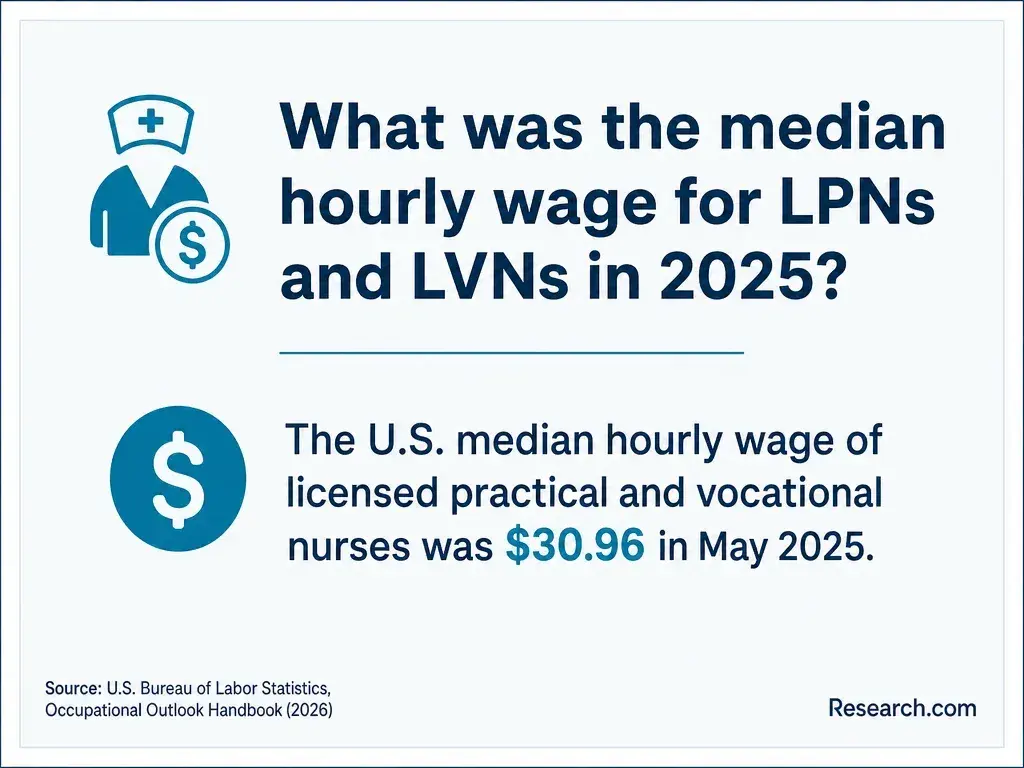
There is no defensible single "nursing graduate salary." U.S. Bureau of Labor Statistics wage data are reported by occupation, not by curriculum or degree title. Registered nurses, licensed practical and vocational nurses, nurse practitioners, and nursing instructors have different occupational definitions; an occupation-wide median is not a new graduate's offer. Location, setting, shifts, experience, and the license required for the job can also affect pay.
Use the latest BLS wage and employment projections for the specific occupation as context, then compare local postings and actual offers against the full cost and time of the pathway. For an RN considering advanced practice, cost comparisons across online NP pathways can inform the expense side of that decision, but higher occupational pay does not guarantee a return on a particular program. Schools should not present occupation-wide wages as salaries earned by their own graduates without appropriately defined graduate-outcomes data.
How Do You Choose a Reputable, Standards-Aligned Nursing Program?
Request evidence that connects the program's promises to its actual teaching and evaluation. A strong curriculum can explain what graduates must demonstrate, where they practice it, and how faculty respond when assessment results reveal a weakness. Approval and accreditation checks remain essential, but neither replaces that evidence.
Use the following questions with a program representative or curriculum committee; ask for written policies that apply to your intended entry term.
- What is the exact degree or track, intended graduate role, and applicable state approval and accreditation status?
- Can the program show how a major outcome progresses from introduction through supervised practice to final assessment?
- Who arranges and approves clinical sites and supervisors, and how are simulation and observed clinical performance evaluated separately?
- What do recent progression, completion, and applicable licensure-exam results cover, and which students are included?
- What is the realistic term-by-term schedule and full cost, including required in-person learning and possible placement travel?
A short timeline needs the same scrutiny. For example, accelerated FNP certificate admissions and requirements are relevant only to qualified nurses pursuing that specialty; their prior graduate preparation does not make a condensed certificate an alternative to initial RN education. Choose the program whose documented outcomes, assessments, regulatory fit, and practical demands match the role you actually want.
Other Things You Should Know About Nursing
Faculty and program leaders typically maintain it together. Course faculty supply assessment evidence, while the program coordinates changes across courses and checks applicable approval and accreditation obligations.
Review assessment results and student progression regularly, with a fuller review when standards, licensing requirements, practice expectations, or persistent performance patterns change. The school's own review schedule may be more specific.
It is one useful prelicensure outcome, but not a complete measure. Check the cohort and reporting period, then consider clinical evaluations, progression, completion, and how faculty use the findings.
Compare the exam's demands with observed clinical evaluation criteria, review the quality and consistency of supervision, and identify where students need earlier practice or clearer feedback. Do not assume that adding another lecture will address a performance gap.
- Nursing Professional Development Evidence-Based Practice | nih.gov https://www.ncbi.nlm.nih.gov/books/NBK589676/
- The Role of Undergraduate Nursing Education in Patient Safety | PSNet https://psnet.ahrq.gov/perspective/role-undergraduate-nursing-education-patient-safety
- Assessing the Competence of Nursing Students in Clinical Practice: The Clinical Preceptors' Perspective - PMC https://pmc.ncbi.nlm.nih.gov/articles/PMC11121458/
- Nursing Program Goals and Learning Outcomes | Eastern Connecticut State University https://www.easternct.edu/health-sciences/resources/nursing-program-goals-and-learning-outcomes.html
- The Transfer of Simulation Skills to Clinical Practice | columbia.edu https://academiccommons.columbia.edu/doi/10.7916/72ez-0s31
- Learning practical nursing skills in simulation centers | sciencedirect.com https://www.sciencedirect.com/science/article/pii/S2666142X22000297
- Align Assessments, Objectives, Instructional Strategies | Carnegie Mellon University https://www.cmu.edu/teaching/assessment/basics/alignment.html
- Breaking Down the NCLEX® Test Plan for Curricular Guidance | Wolters Kluwer https://www.wolterskluwer.com/en/expert-insights/breaking-down-the-nclex-test-plan-for-curricular-guidance
- Essentials Curriculum Mapping Tools | aacnnursing.org https://www.aacnnursing.org/essentials/tool-kit/curriculum-mapping-tools
- Approval of Nursing Education Programs | NCSBN https://www.ncsbn.org/nursing-regulation/education/approval-of-nursing-education-programs.page