2027 Nurse Residency Applications: Deadlines, References, Interviews, and Program Comparison
Audited and Verified:
Our Editorial and Data Verification Process
Research.com uses government datasets, official education statistics and primary institutional information to support its career and degree guides. Our review process checks factual accuracy, occupational definitions, source dates and the requirements associated with the credentials discussed.
How This Article Was Fact-Checked
Our editorial team verifies salary estimates, employment projections, education requirements and program information against original data providers and official organizations. Salary figures are checked against the relevant occupational definitions and reporting periods. Information about licensure, accreditation and required in-person training is reviewed separately.
Fact-checked and verified on:

Co-Founder and Chief Data Scientist
Nurse residency openings may close before graduation, while interviews and offers can arrive before you have an RN license. For nursing students and new graduates, that timing makes it important to track each employer's rules rather than wait for a single application season. This guide explains how to build a deadline calendar, choose references, prepare for interviews, and compare the paid training and support behind competing offers. You'll be able to identify a program that fits your licensure timeline, preferred unit, and need for supervised practice.
Key Things You Should Know
- Apply according to each employer's cohort calendar; some recruit before graduation, but RN licensure may be required before the start date.
- Prepare clinical references early and confirm whether each application needs letters, contact details, or both; requirements differ by employer.
- Compare more than the offer rate: residencies often run about 12 months, while unit orientation, preceptor access, and independent-assignment timing can differ substantially.
What Is a Nurse Residency Program?
A nurse residency is an employer-run transition-to-practice program for newly hired nurses. It typically combines a paid RN position with unit orientation, precepted shifts, education sessions, feedback, and support as responsibility increases. A residency does not replace a nursing degree, the NCLEX, an RN license, or the employer's assessment of clinical competence.
Ask how much of the advertised program is unit-specific, supervised orientation rather than classroom or group meetings. That distinction matters if you are choosing between, for example, an emergency department position and a general medical-surgical position. Postlicensure education serves a different purpose: RN-to-BSN project-based learning options may help a licensed nurse complete a degree, but they are not a substitute for new-hire orientation.
Who Is Eligible for Nurse Residency Programs?
Eligibility is set by the employer and sometimes by a particular cohort or unit. Programs commonly target nursing students nearing graduation and newly licensed RNs, but they vary in whether they accept associate-degree graduates, diploma graduates, BSN graduates, nurses licensed for several months, or RNs with limited prior experience. An application may be permitted before licensure even when an active RN license is mandatory by the start date.
Read the posting for four separate conditions: eligible graduation dates, acceptable degree or program, prior RN-work limits, and the license deadline. If you hold an ADN or plan further study, do not assume you must complete a BSN or graduate degree before applying. Associate-degree RN to MSN options address later academic advancement, not an employer's authority to hire you into a residency.
When Should You Apply for a Nurse Residency Program?
There is no nationwide nurse residency deadline. Hospitals may recruit by graduation cohort, by unit opening, or through rolling postings, and an application window can close once positions are filled. Start checking target employers while you are still in nursing school; use the date and time displayed in each live posting as the controlling deadline.
Build a simple application calendar around the steps that can delay a start date:
- Record each posting's opening and closing dates, graduation-date range, unit choices, interview period, and proposed start date.
- Work backward to request references and transcripts, then reserve time to tailor your application before the posting closes.
- Check your state board's initial-licensure process and your employer's deadline for submitting an RN license number.
- Ask the recruiter what happens if your NCLEX results or license are not available by the planned start date; do not assume a deferral is automatic.
Keep future graduate-school deadlines on a separate calendar. Even an accelerated postgraduate family NP certificate is a distinct application and credentialing pathway, not a faster way to enter a new-graduate RN residency.
Most employers use their standard job-application system, but attachments and screening questions vary. Check the actual posting before uploading materials: an incomplete application may not be reviewed even if your qualifications fit.
Prepare a reusable file set, then submit only what the employer requests:
- A resume showing expected or completed graduation, clinical placements, relevant patient-care work, and credentials you actually hold.
- An unofficial or official transcript, if requested, and accurate graduation and licensure dates.
- A tailored statement or cover letter explaining your unit interest, learning goals, and approach to safe escalation.
- Reference contact information or recommendation letters in the specified format.
- Any requested certification records, work authorization information, or responses to unit-preference questions.
Do not label a pending RN license as active or present a student clinical placement as independent RN employment. More advanced academic applications may request different evidence; doctoral nursing application requirements compared are not a checklist for a hospital residency.
Choose people who have directly observed how you learn, communicate, respond to feedback, and protect patient safety. Depending on employer rules, a clinical instructor, capstone preceptor, nurse manager, or healthcare supervisor may be more useful than a prominent contact who barely knows your work.
Ask each person's permission before listing them. Share the job posting, deadline, submission instructions, your resume, and a short reminder of work they personally observed. Give them time to respond, and confirm whether the employer wants a letter, an online form, or contact details only. Never draft claims about patient care for a reference to endorse without their review.
A reference speaks to your past performance; a preceptor supervises learning in a clinical setting. That difference remains important if you later explore FNP study options with school-supported placements: residency references cannot establish that a graduate clinical placement has been arranged.
An employer may begin with a recruiter screen, then use a panel, nurse-manager interview, peer interview, or unit visit. Expect questions about why you chose the unit, how you prioritize, when you seek help, how you respond to feedback, and how you communicate a patient-safety concern. Some employers use scenario questions; answer within a student or new-graduate nurse's scope rather than inventing independent clinical experience.
Prepare two or three truthful examples from clinical learning or relevant work. Explain the situation, your responsibility, the action you took, and what you learned. For a safety example, describe whom you notified and why; avoid patient identifiers. Ask the interviewers who your preceptor will be, how progress is assessed, and what support is available when you are unsure.
If asked about long-term education, be honest without implying that graduate school replaces the RN experience the role requires. Online BSN-to-MSN programs organized by tuition may inform a future plan, but the immediate interview is about readiness to learn and practice safely in this job.
Compare written offers and program details for the specific unit, not just the hospital's residency brand. A strong hospital-wide curriculum cannot compensate for unclear preceptor coverage or an unsupported transition to a full patient assignment.
The table separates offer details you can verify from the questions that reveal how the residency will work on your unit.
| Comparison factor | Evidence to request | Why it matters |
| Unit and schedule | Assigned unit, shift pattern, weekend expectations, and floating policy | Determines whether the role fits your interests and living arrangements. |
| Orientation and preceptorship | Expected supervised weeks, preceptor assignment, and progression criteria | Shows how support changes before you carry an independent assignment. |
| Residency curriculum | Meeting frequency, paid education time, and attendance requirements | Reveals obligations beyond scheduled bedside shifts. |
| Support and feedback | Educator access, check-in schedule, and process for addressing difficulty | Helps you assess whether problems can be identified and addressed early. |
| Offer terms | Base pay, differentials, benefits start date, service commitment, and repayment terms | Allows a fair comparison of compensation and financial risk. |
Ask to speak with a recent resident from the same unit if the employer permits it. Look for specific answers about workload progression and access to help, not promises that every nurse becomes independent on the same schedule. If an employer advertises tuition assistance, verify eligibility and repayment conditions before factoring future study - including cost comparisons across online NP pathways - into the value of today's offer.
Three checks address different questions. Your state board of nursing determines initial RN licensure eligibility and issues the license. Your nursing school's approvals and accreditations concern its educational program. An employer's residency accreditation or recognition, if claimed, concerns the transition-to-practice program - not your individual license or the school's accreditation.
Verify your license requirements with the board in the state where you will practice and confirm the employer's deadline for an active license. If a residency advertises accreditation, check the named organization, the specific program and site covered, and whether the status is current. Do not infer accreditation from a hospital's general reputation.
Later graduate education raises separate program- and role-specific questions. For example, nonclinical DNP specialization options should not be mistaken for nurse practitioner preparation or for a credential that expands an RN resident's scope of practice.
Many nurse residencies are designed around roughly a year of transition support, but the paid, precepted unit orientation may be much shorter than the full residency. Confirm both timelines, how competency is evaluated, and whether education sessions continue after independent assignments begin.
Employer residencies are generally paid jobs rather than tuition-charging degree programs. Still, compare the written offer for base rate, shift differentials, benefits, parking or commuting costs, required supplies, and any service commitment or repayment clause. Ask whether education days are paid and what happens financially if you leave early or transfer units; do not assume every program has the same policy.
These employment costs are separate from future graduate tuition. Lower-tuition psychiatric nursing graduate programs, for example, would require their own cost and eligibility review rather than being treated as part of a residency's price.
What Career Outcomes, Salaries, and Job Prospects Follow Residency?
A residency can provide structured support as you move from supervised learning toward your unit's expected RN responsibilities. Completing it does not guarantee continued employment, specialty certification, a promotion, or independent competence in every clinical situation. Ask employers whether they publish retention or completion results for the relevant unit and cohort, and what those figures actually measure.
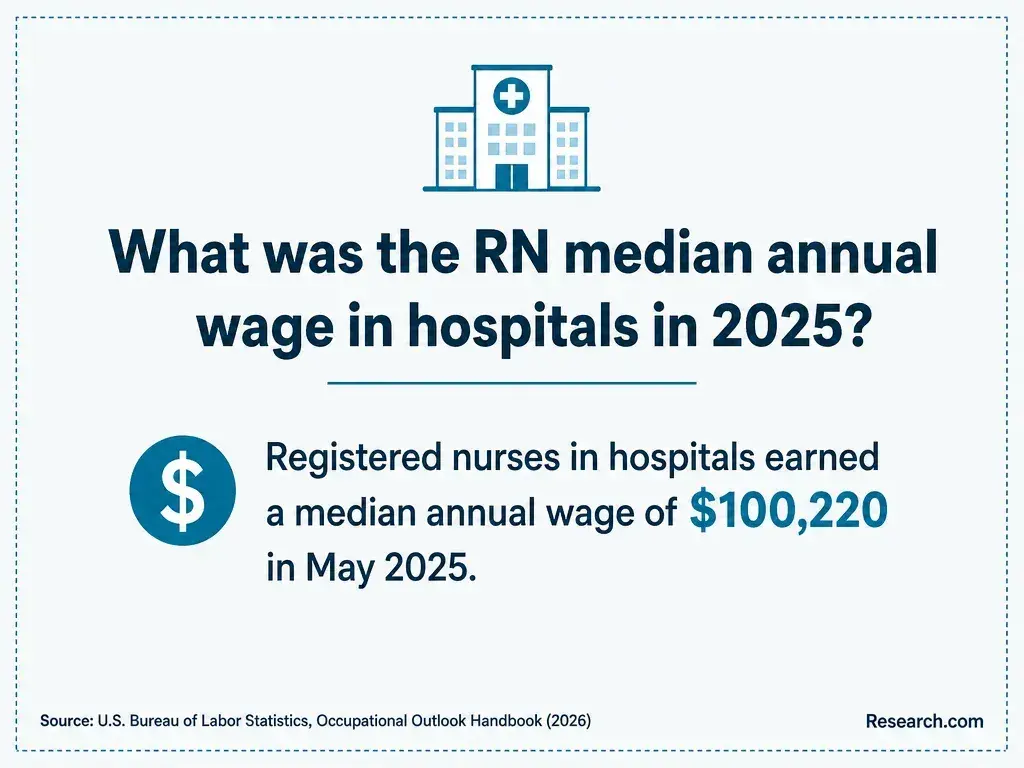
For salary context, use the offer's base rate, expected paid hours, differentials, and benefits - not a national median as a prediction of new-graduate pay. The U.S. Bureau of Labor Statistics reports registered-nurse wages and employment projections for the occupation overall; those figures combine nurses across experience levels, settings, and regions and do not measure residency graduates' earnings.
If your eventual goal is advanced practice, first determine whether you want the patient population and clinical responsibilities that role entails. Short-format FNP program comparisons concern a later education decision; finishing an RN residency does not itself qualify you for NP certification or licensure.
Other Things You Should Know About Nursing
Usually, yes, but an employer may limit how many units you can select within its own system. Follow each posting's instructions and keep your availability and offer deadlines organized.
Request the decision deadline and review the written terms before accepting. If you need more time, ask promptly rather than treating an accepted offer as a placeholder.
Some teaching sessions may be virtual, but a direct-care RN residency requires on-site orientation and supervised work on the assigned unit. Confirm any additional in-person meeting requirements.
Possibly, but transfer eligibility, timing, orientation needs, and service commitments depend on employer policy. Ask about the process before accepting if unit fit is uncertain.
- The role of accreditation in 21st century health professions education: report of an International Consensus Group https://pmc.ncbi.nlm.nih.gov/articles/PMC7520947/
- Applicant Frequently Asked Questions | ca.gov https://www.rn.ca.gov/applicants/lic-faqs.shtml
- The interview process | VA Careers https://vacareers.va.gov/job-application-process/the-interview-process/
- Recommendation letters | Helpful resources | The Ohio State University https://gpadmissions.osu.edu/resources/recommendation-letters.html
- Reference Check Guidelines - UF Administrative | Administrators https://admin.hr.ufl.edu/hiring/making-offer/reference-check-guidelines/
- How to Strengthen your Application through Purposeful References - Johns Hopkins School of Nursing https://nursing.jhu.edu/magazine/articles/2023/10/how-to-strengthen-your-application-through-purposeful-references/
- Nurse Residency Application | Capital Health Hospitals https://www.capitalhealth.org/professionals/nurse-residency-and-mentoring-program/application-information
- Finding New Grad Nurse Residency Programs | Trusted Health https://www.trustedhealth.com/new-grad/how-to-find-new-grad-nurse-residency-programs
- Graduate Nurse Residency Program FAQs | Texashealthresources https://jobs.texashealth.org/gnfaqs/
- Board of Nursing Licensure Requirements | NCSBN https://www.ncsbn.org/nursing-regulation/education/board-of-nursing-licensure-requirements.page