2027 MSN/MBA Dual Degree Programs for Nurses in Minnesota: Entry Requirements, Format, and Total Cost
Audited and Verified:
Our Editorial and Data Verification Process
Research.com uses government datasets, official education statistics and primary institutional information to support its career and degree guides. Our review process checks factual accuracy, occupational definitions, source dates and the requirements associated with the credentials discussed.
How This Article Was Fact-Checked
Our editorial team verifies salary estimates, employment projections, education requirements and program information against original data providers and official organizations. Salary figures are checked against the relevant occupational definitions and reporting periods. Information about licensure, accreditation and required in-person training is reviewed separately.
Fact-checked and verified on:

Co-Founder and Chief Data Scientist
A nurse considering an MSN/MBA needs to know whether a Minnesota school actually awards both degrees through a coordinated program, and what that arrangement costs compared with other leadership education.
That distinction matters because a school offering an MSN and an MBA separately may not share credits, admission decisions, or tuition rules. This guide explains what to verify before applying, how to estimate the full expense, and when a single degree may better serve an experienced RN's career goal.
Key Things You Should Know
- An MSN/MBA is two graduate degrees, not an APRN credential; confirm that the Minnesota institution formally coordinates both awards before treating it as a dual-degree option.
- Expect separate nursing and business eligibility checks. An RN license, prior degree, professional experience, and required attendance depend on the specific program.
- There is no reliable statewide MSN/MBA price: calculate shared and remaining credits at their applicable rates, then add fees, travel, supplies, and any lost earnings.
What Is an MSN/MBA Dual Degree for Nurses in Minnesota?
An MSN/MBA dual degree combines a Master of Science in Nursing with a Master of Business Administration. For an experienced RN, the intended payoff is usually the ability to connect nursing operations and quality improvement with finance, strategy, and organizational management.
A formally coordinated pathway may allow approved courses to count toward both awards; merely enrolling in two separate degrees does not guarantee that benefit.
Most leadership-oriented MSN/MBA pathways are postlicensure: they assume the applicant is already an RN and do not prepare a non-nurse for initial licensure. Nor does a nursing administration MSN, whether paired with an MBA or not, automatically qualify its graduate as a nurse practitioner.
ADN-prepared RNs should check whether the institution offers a genuine graduate bridge rather than assuming direct admission; MSN pathways that accept ADN-prepared nurses illustrate a separate eligibility question from admission to an MBA.
Which Minnesota Schools Offer MSN/MBA Dual Degree Programs?
Do not assume a Minnesota school offers an MSN/MBA simply because it advertises both degrees. A specific Minnesota-based, formally coordinated MSN/MBA program, its current intake status, and its published total price cannot be confirmed here.
Naming schools as confirmed dual-degree providers without that evidence would make a potentially expensive application decision less reliable.
The distinction below helps nurses screen Minnesota offerings and online programs available to Minnesota residents. The school, not a degree directory, must confirm the award and credit-sharing arrangement for the intended entry term:
| Offering you find | What it establishes | What remains to verify |
| Explicit MSN/MBA dual-degree pathway | The institution advertises a coordinated route to two awards. | Current admission, shared credits, both degrees' requirements, and total charges. |
| MSN and MBA listed separately | Both degrees exist at the institution. | Whether joint admission or any cross-counting is permitted. |
| Online dual degree at a school outside Minnesota | A potential option for a Minnesota resident. | Minnesota enrollment authorization, nursing activities, attendance, and tuition. |
Ask for the current catalog page and a written, term-specific degree plan showing the two awards. Nurses who have not yet obtained RN licensure need a prelicensure route first; admission-focused nursing school comparisons address that different starting point, not MSN/MBA admission.
What Are the Admission Requirements for Minnesota MSN/MBA Programs?
Admission depends on whether the school accepts applicants into a combined pathway or requires separate decisions from its nursing and business schools.
For a postlicensure MSN, applicants commonly need an eligible nursing degree and an active RN license; an MBA may separately assess prior coursework, work history, and quantitative readiness. None of those general patterns substitutes for a program's stated criteria.
Before paying an application fee, obtain written answers to the requirements most likely to change your eligibility:
- Which RN licenses and prior degrees qualify, including an ADN plus a non-nursing bachelor's degree?
- Are GPA thresholds, statistics courses, management experience, recommendations, essays, interviews, or entrance tests required by either school?
- Is admission to both degrees simultaneous, and can a student begin one if the other application is denied?
- Are background checks or site agreements needed for a nursing leadership practicum?
A non-nurse should not mistake a postlicensure MSN/MBA for an initial RN pathway. If nursing is the immediate goal, comparing ABSN entry requirements is more relevant than applying to a graduate nursing leadership track.
"Online" can describe course delivery without describing the entire schedule. Nursing leadership projects may require an approved organization or supervisor, while MBA courses may include live meetings, team projects, or occasional campus sessions.
A nurse working shifts should ask for the upcoming course rotation, not just the program's online label, and check whether required meetings can be attended after a schedule change.
Confirm which activities are asynchronous, which have fixed times, whether any campus visits are mandatory, and who arranges an acceptable site if a practicum is required.
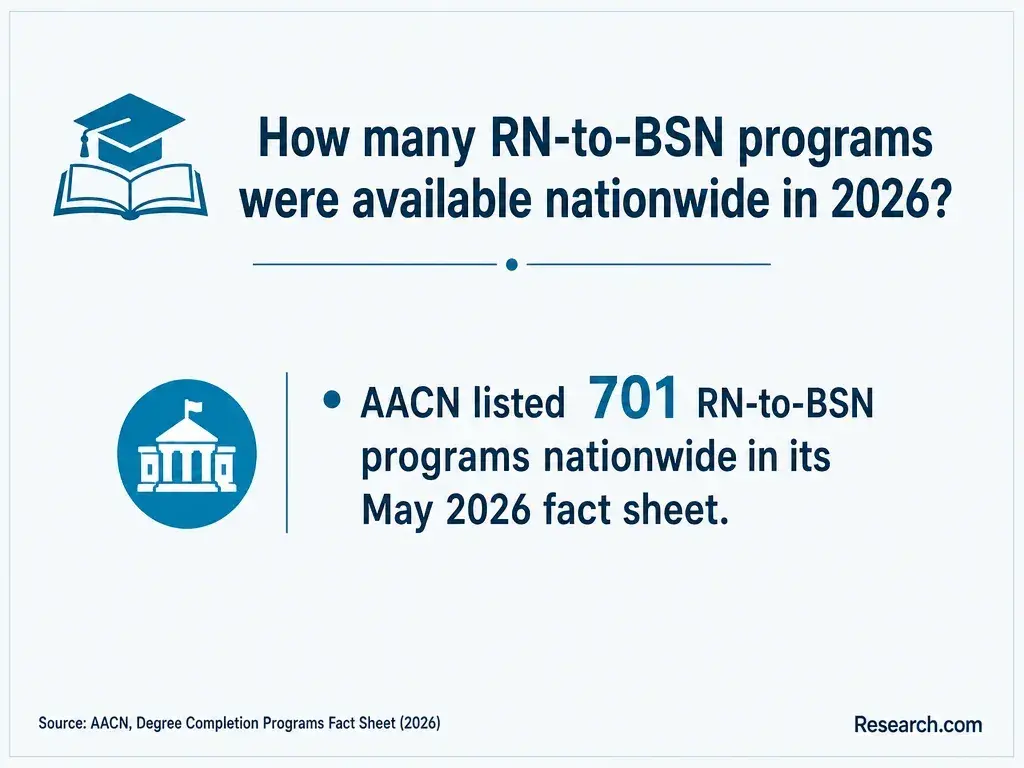
Also ask whether Minnesota residency affects enrollment in an out-of-state online program. An RN who first needs a bachelor's degree can investigate RN-to-BSN study without added bedside rotations, but that is a separate credential step and does not establish the format of a later MSN/MBA.
The MSN portion of a leadership-focused pathway may cover nursing systems, evidence-based improvement, informatics, population health, and organizational leadership.
MBA study typically adds accounting, finance, operations, strategy, and management. Actual course titles, projects, and any shared credits must come from the institution's degree plan.
Look beyond course labels when comparing curricula. A nurse aiming to manage staffing and quality needs opportunities to apply budgets and performance measures in healthcare settings; a nurse seeking finance or consulting work may need stronger accounting and analytics preparation.
A leadership MSN is not a substitute for advanced-practice clinical coursework or supervised patient-care experiences. For an NP goal, clinical training support in family NP education addresses a requirement that an MSN/MBA generally does not.
There is no dependable Minnesota-wide completion time. A nurse's timeline depends on the institution's required credits, how many courses can count toward both degrees, prerequisites, course availability, and whether the student attends full time or while employed. Two schools advertising the same awards can therefore produce different graduation dates.
Request a term-by-term plan for your intended workload. Check whether a nursing course or MBA capstone runs only once a year, whether the degrees can be completed in different terms, and what happens to the plan after a leave of absence.
If the desired outcome is advanced nursing leadership rather than business training, short-format DNP degree programs provide an alternative to investigate, but published speed alone does not show whether a program meets your goals or scheduling needs.
No single total cost can be responsibly assigned to Minnesota MSN/MBA study without a confirmed program, credit plan, and tuition schedule.
A dual degree may save credits relative to completing both awards separately, but savings are not assured: schools may charge different rates for nursing and MBA courses, limit shared credits, or bill additional program fees.
Use the school's written degree audit and fee schedule to build a total rather than comparing advertised per-credit rates alone:
- Multiply nursing credits and MBA credits by their respective applicable rates, counting each billed course only once.
- Add mandatory university and program fees, books, software, and any required project or practicum expenses.
- Add travel and lodging for required visits, plus the cost of reduced work hours if the schedule makes that necessary.
- Subtract only confirmed grants or employer payments for which you meet the conditions; account for annual caps, required grades, and repayment clauses.
For a hypothetical illustration, not a Minnesota program quote, 54 billed credits at $800 each produce $43,200 in tuition; $4,000 in fees, materials, and travel raises direct costs to $47,200 before financing charges or lost earnings.
Recalculate using the actual course mix and rates. If the MBA adds little value to your target job, lower-tuition BSN-to-MSN education options may be worth comparing against the full two-degree bill.
Check three distinct matters before enrolling: the institution's accreditation, the accreditation status and scope of the specific nursing program, and whether the school can enroll you and support any required nursing activities where you live.
Institutional accreditation does not by itself establish nursing program accreditation; an MBA's recognition is a separate question. Ask the school for the relevant accreditor listings and the status applicable to your entry term.
An existing RN remains responsible for maintaining the license required for employment or program activities. Completing an MSN/MBA neither issues an RN license nor establishes eligibility for APRN licensure or NP certification.
If a DNP is also under consideration, DNP programs with accessible admission requirements should still be checked individually for accreditation, track purpose, and any licensure implications; easier admission is not evidence of professional eligibility.
An MSN/MBA can be relevant to nurse manager, director of nursing operations, quality or patient-safety leader, service-line administrator, and healthcare operations roles. The fit depends heavily on existing RN experience and evidence of leading budgets, teams, improvement work, or cross-functional projects.
The degree does not itself confer a management position or authority beyond the nurse's license and employer-assigned responsibilities.
Compare target job postings before choosing courses: a unit-management role may value staffing and clinical leadership experience, while an operations role may emphasize finance, analytics, and large-scale change.
An experienced nurse whose goal is independent primary care instead needs a qualifying APRN pathway; comparing post-master's FNP study options addresses a different career transition from an MSN/MBA.
What Salaries and Job Outlook Can MSN/MBA Graduates Expect?
There is no meaningful "MSN/MBA graduate salary" that applies across nursing leadership jobs. Compensation depends on the actual occupation, employer, location, scope of responsibility, and the nurse's prior experience.
U.S. Bureau of Labor Statistics figures for medical and health services managers can provide broad context for some administrative roles, but that occupation includes people without nursing degrees and cannot predict an individual MSN/MBA graduate's offer.
The same limitation applies to job-growth projections: growth for a management occupation is not a forecast of openings reserved for dual-degree nurses. For a practical return-on-investment check, compare local postings and real compensation offers with the program's full cost and any income forgone during study.
Nurses pursuing psychiatric advanced practice should evaluate that labor market and its qualifying education separately; postgraduate PMHNP certificate comparisons are not interchangeable with MSN/MBA career or salary estimates.
Other Things You Should Know About Nursing
Possibly. Ask whether the benefit covers graduate nursing and business courses, whether each has a separate annual cap, and whether you must repay funds if you leave the employer.
Not necessarily. Compare the concentration's courses with the job you want; general finance, operations, and strategy may be useful, while healthcare-specific electives may better match a particular role.
Only if the program approves the site and supervision and the employer permits the work. Employment duties do not automatically satisfy academic project requirements.
Often a standalone MSN is the more direct comparison. Ask whether your existing MBA changes any nursing degree requirements before paying for a second business credential.
- Qualified Ed expenses | Internal Revenue Service https://www.irs.gov/credits-deductions/individuals/qualified-ed-expenses
- Cost of Attendance (Budget) | 2026-2027 Federal Student Aid Handbook https://fsapartners.ed.gov/knowledge-center/fsa-handbook/2026-2027/vol3/ch2-cost-attendance-budget
- MSN and MBA Dual Degree | Walden University https://www.waldenu.edu/online-masters-programs/master-of-science-in-nursing-and-master-of-business-administration
- MBA/MSN in Healthcare Organizational Leadership | jhu.edu https://carey.jhu.edu/programs/dual-degrees/mba-msn-healthcare-organizational-leadership
- Online Learning | Saint Paul College https://www.saintpaul.edu/online-learning/
- RN-to-BSN | Online Bachelor's Degree | Capella University https://www.capella.edu/online-nursing-degrees/bachelors-rn-to-bsn-completion/
- Modes of Instruction - Office of the Registrar https://registrar.berkeley.edu/modes-of-instruction/
- Online MSN-MBA Dual Degree Option | Purdue Global https://www.purdueglobal.edu/degree-programs/nursing/msn-mba-online/
- Admissions | University of San Diego Catalog https://graduate.catalog.sandiego.edu/academics/admissions
- Learning Modalities | Golden Gate University https://ggu.edu/learning-modalities/