
2027 Most Affordable Associate Degrees for Gig Workers

Co-Founder and Chief Data Scientist
For gig workers, the cheapest associate degree is not necessarily the one with the lowest tuition. A required daytime clinical placement or a course offered only once a year can cost you working hours and delay graduation.
College Board reported average published tuition and fees of $4,050 for in-district students at public two-year colleges in 2024-25, but that figure excludes many expenses. This guide compares degree fields by cost, scheduling demands, and career fit so you can choose a path you can afford to finish.
Key Things You Should Know
- Start with an in-district community college, then compare the full cost of required credits, fees, supplies, and unpaid work hours - not tuition alone.
- Business, information technology, and transfer-oriented psychology programs may offer more scheduling flexibility; nursing and some healthcare programs often require fixed, in-person training.
- Many associate degrees require roughly 60 credits, but part-time enrollment, prerequisites, and course availability can extend the time and cost of completion.
Top 10 Most Affordable Associate Degrees for Gig Workers - Affordable Degrees
Business Programs
An AA or AS in business often emphasizes transferable accounting, economics, and management courses; a business AAS may focus on immediate workplace skills. For gig workers who manage clients or want office-based employment, the best-value program is usually one that fits around paid work and teaches usable bookkeeping or operations skills. Compare software fees, course schedules, and whether credits apply to a bachelor's degree. A business associate degree does not by itself qualify someone for a management role.
Healthcare Programs
Healthcare AAS programs can prepare students for specific technical roles, while an AS in health sciences may primarily support transfer. A low tuition quote can obscure lab fees, immunizations, background checks, transportation, and unpaid clinical hours. For someone dependent on unpredictable gig income, a placement with fixed weekday shifts may be difficult to complete. Identify the intended occupation first, then check whether the program meets its certification or licensing requirements; a general healthcare degree may not qualify you for a regulated job.
Information Technology Programs
IT associate degrees may cover networking, cybersecurity, programming, or support. An AS may suit a planned bachelor's transfer; an AAS may emphasize practical labs and workplace preparation. Online coursework can preserve working hours, but check for scheduled labs, software and equipment costs, and whether required classes run every term. Compare the curriculum with entry-level job postings rather than assuming a broad "technology" label matches your goal. Employers may also value demonstrable projects, experience, or industry certifications.
Nursing / Pre-Nursing Programs
An associate degree in nursing can provide a route toward registered nurse eligibility, subject to state approval and licensing requirements. Pre-nursing is different: it generally covers prerequisites and does not itself qualify someone to become an RN. Nursing admission may be selective even at an open-admission college. Compare prerequisite costs, clinical travel, equipment, exam fees, and whether clinical shifts conflict with paid gigs. Before enrolling, confirm state-board approval, required in-person work, and the program's published licensure-exam outcomes.
Criminal Justice Programs
Criminal justice AA and AS programs may support transfer, while some AAS programs emphasize public-safety or administrative work. For a gig worker, the affordable choice depends on the intended job: a transfer agreement matters if a bachelor's degree is the goal, whereas predictable evening courses may matter more for immediate workforce preparation. Police and corrections hiring can involve separate academy training, background screening, and agency requirements. Do not pay for specialized coursework before checking the hiring rules of your target employer.
Psychology / Counseling Programs
Psychology associate degrees are generally transfer-oriented, making them a possible low-cost start toward a bachelor's degree. Courses in psychology and research can also complement human-services work, but an associate degree alone does not qualify someone to practice as a licensed counselor or psychologist. Gig workers should prioritize an affordable transfer agreement over an appealing program title: credits accepted by a university may still fail to satisfy its major requirements. Check the destination program's course map before enrolling.
What Are the Best Associate Degrees for Gig Workers?
For most gig workers, the best-value starting points are an in-district business or IT program with dependable part-time scheduling. Choose nursing or another clinical healthcare program when the specific licensed occupation justifies its higher non-tuition costs and fixed attendance. Choose a transfer-oriented degree when your target career requires more education.
This comparison highlights the expense most likely to change each field's actual affordability. It compares degree paths, not verified prices at individual colleges; request a program-specific estimate before deciding.
| Degree field | Potential cost advantage | Cost or scheduling risk to check |
| Business | Often available with online or evening coursework | Software fees and credits that may not transfer |
| Healthcare | Can target a defined occupation | Labs, screenings, and clinical travel |
| Information technology | Skills may be practiced through coursework and projects | Equipment, software, and scheduled labs |
| Nursing / pre-nursing | Clear goal when pursuing RN eligibility | Selective admission and fixed clinical shifts |
| Criminal justice | Possible transfer pathway | Additional employer or academy requirements |
| Psychology / counseling | Possible lower-cost start toward a bachelor's degree | Further education required for licensed practice |
If you are still deciding among fields, compare their longer-term educational requirements alongside these costs. A guide to the best college majors can help frame that broader choice, but your intended job should determine which credits are worth buying now.
How Much Do Affordable Associate Degrees Cost?
Affordable means a manageable cost to complete, not merely a low per-credit rate. College Board's $4,050 public two-year in-district tuition-and-fees average for 2024-25 is a useful published-price benchmark, not a quote for a particular degree or the amount a student ultimately pays.
Use the benchmark as a starting point for a written estimate from each college:
- $4,050: Average published annual tuition and fees for in-district students at public two-year colleges in 2024-25; individual colleges and residency categories differ.
Ask for the price of all remaining required credits, mandatory program fees, books, equipment, and travel. Sticker price is the published charge; net price reflects grants and scholarships; total program cost also depends on how long you enroll and what you must purchase. Federal aid may reduce eligible students' bills, but eligibility varies, and borrowing raises eventual cost. Check whether accepted transfer credits or an approved prior-learning assessment would replace required courses - neither is automatic.
Are Online Associate Degrees a Good Option for Gig Workers?
Yes, if the delivery format lets you complete required work without repeatedly giving up paid shifts. Asynchronous classes allow students to access lessons at different times, but still have deadlines; scheduled online classes require attendance at set times. Online study can also involve proctored exams, campus labs, internships, or local clinical placements.
Ask for a term-by-term schedule rather than relying on a "flexible" label. If military service affects your schedule or education benefits, comparisons of online colleges for military can provide additional questions to bring to an adviser. Confirm the particular associate program's delivery requirements separately.
Which Associate Degree Programs Are Accredited?
There is no single accreditation status shared by every program in these fields. Check that the college holds recognized institutional accreditation; federal aid eligibility and transfer policies also need separate verification. For regulated occupations, institutional accreditation alone may not be enough: nursing and certain allied-health paths can have additional program-approval or accreditation requirements.
A short verification sequence can prevent an expensive enrollment mistake:
- Find the college's current institutional accreditation and confirm it with the accreditor.
- Ask the program which state approvals or specialized accreditations apply to your intended occupation.
- If transferring, obtain confirmation that specific courses will count toward the destination major - not merely transfer as electives.
What Coursework Do Affordable Associate Degrees Include?
Most associate programs combine general education with major courses. AA and AS degrees commonly include composition, mathematics, and other courses intended to support transfer; an AAS often devotes more coursework to occupational training. The abbreviation is a clue, not a guarantee of how a particular college structures its program.
Business students might study accounting; IT students might complete networking labs; psychology students might take introductory research courses. Nursing and other clinical programs add science prerequisites, labs, and supervised practice. Review the complete course sequence: a prerequisite offered only occasionally can delay graduation even when your tuition is low and most classes are online.
What Are the Admission Requirements for Associate Degree Programs?
Many community colleges admit students with a high school diploma or equivalent, though placement, prerequisites, and documentation rules vary. Admission to the college is not necessarily admission to the major. Nursing and some allied-health programs may separately evaluate prerequisite grades, tests, background requirements, and available clinical seats.
Before applying, request a program evaluation of any previous college work and ask when selective admission occurs. Also confirm whether part-time students can take each required course in sequence. That question matters when gig income makes a full-time schedule unrealistic.
What Jobs Can You Get With an Associate Degree?
Possible paths include office support or bookkeeping-related work after business study, entry-level IT support after relevant technical training, and occupation-specific healthcare work after completing the applicable training and credential requirements. An associate degree can also be a step toward a bachelor's degree rather than an immediate job credential. Actual hiring depends on skills, experience, employer requirements, and local opportunities.
If your immediate goal is a narrowly defined skill rather than a degree or transfer pathway, compare the total expense of the degree with short certificate programs that pay well online. Check employer requirements before choosing the shorter option: a certificate may cost less but cannot substitute for a degree or license where one is required.
How Much Can Associate Degree Graduates Earn?
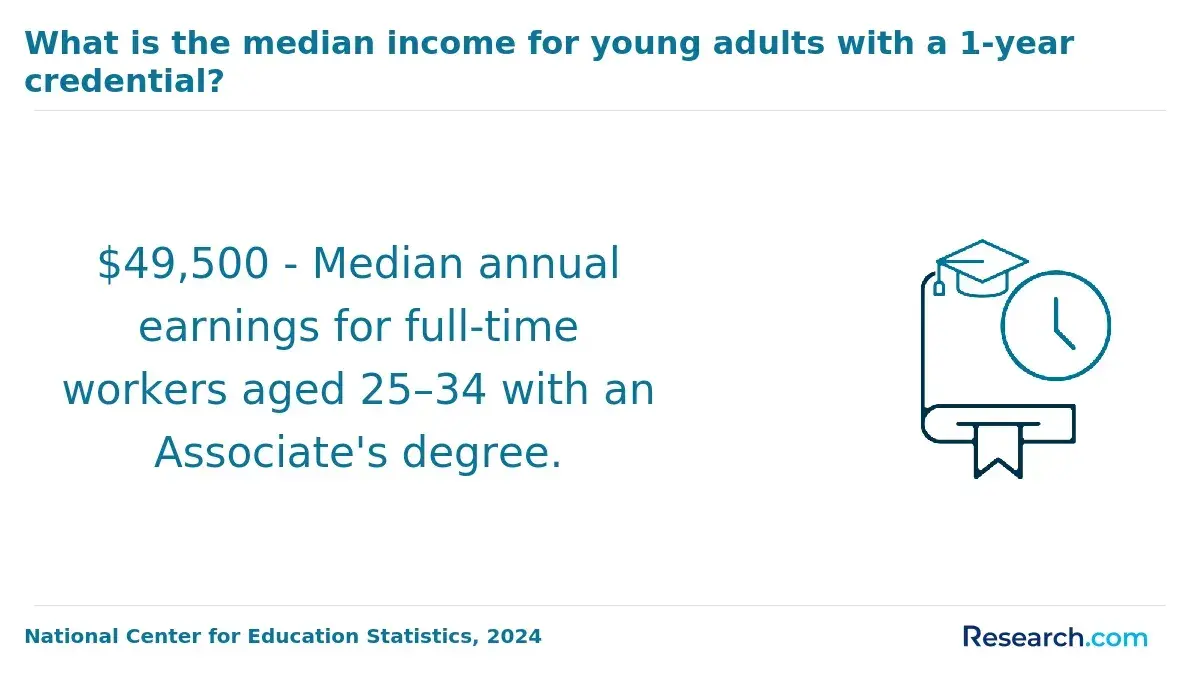
There is no reliable salary that applies to all associate degree graduates, let alone all gig workers who earn one. The U.S. Bureau of Labor Statistics reported median weekly earnings of $1,099 for employed people with an associate degree in 2024. That describes a broad group of workers; it is not a forecast of what completing a particular program will pay you.
For a useful return-on-investment comparison, identify a target occupation, check its local job requirements and pay, and weigh potential earnings against the full cost of study and time away from gigs. If your goal eventually requires graduate education, even the cheapest masters degree online would be a later expense - not a reason to assume an associate degree alone opens that career.
What Certifications and Licenses Do Gig Workers Need?
Requirements depend on the job, not on gig-worker status. Business and many entry-level IT jobs may have no government license requirement, though employers can prefer relevant software skills or industry certifications. Registered nursing requires meeting the state board's eligibility rules and passing the applicable licensure examination; other healthcare occupations may require separate credentials. Public-safety jobs can have agency-specific training and screening. Licensed counseling and psychology require substantially more education and other state requirements than an associate degree.
Before paying an enrollment deposit, name the exact occupation you want and check its requirements with the relevant state board or prospective employer. Then ask the college to show how its curriculum - and any required clinical or field experience - fits that path.
Other Things You Should Know About
Often, yes, especially with part-time enrollment and asynchronous courses. Confirm when required classes run and whether labs or placements have fixed hours.
No. Tuition, online fees, equipment, residency rates, and required travel can offset savings. Compare the full price to completion.
Start with your goal. AA and AS pathways often emphasize transfer; an AAS often emphasizes workforce skills. Verify the actual curriculum and transfer agreement.
Eligible part-time students may receive federal aid, but award amounts and enrollment rules vary. Ask the financial aid office to estimate your aid at the course load you can sustain.
References
- Don't Miss Out on Federal Pell Grants | studentaid.gov https://studentaid.gov/articles/dont-miss-out-on-pell-grants/
- Cost of Attendance (Budget) | 2025-2026 Federal Student Aid Handbook https://fsapartners.ed.gov/knowledge-center/fsa-handbook/2025-2026/vol3/ch2-cost-attendance-budget
- Associate's degree: Career Outlook | bls.gov https://www.bls.gov/careeroutlook/subject/associates_degree.htm
- Types of Aid - Community College System of New Hampshire https://www.ccsnh.edu/paying-for-college-new/financial-aid-new/types-of-aid-new/
- How Long Are Community College Programs? | Edison State Community College https://www.edisonohio.edu/blog/how-long-are-community-college-programs
- What Career Paths Can I Pursue With an Associate Degree? | mwcc.edu https://mwcc.edu/blog/career-paths-to-pursue-with-an-associate-degree/
- Asynchronous and Synchronous Online Courses | nmsu.edu https://dacc.nmsu.edu/faculty-and-staff/online-quality-assurance/asynchronous-and-synchronous-online-courses.html
- How the College Credit Transfer Process Works and How it Can Be Improved | ACE Blog https://ace.edu/blog/how-the-college-credit-transfer-process-works-and-how-it-can-be-improved/
- Eligibility Requirements | bccc.edu https://www.bccc.edu/paying-for-college/financial-aid-scholarships/eligibility-requirements
- What are Asynchronous Classes? | University of Bridgeport https://www.bridgeport.edu/news/what-are-asynchronous-classes/


