2027 MLIS vs. a Communications Master's for Knowledge Services

Co-Founder and Chief Data Scientist
Choosing between an MLIS and a communications master's can be difficult when a job description mentions both managing information and making it useful to people. The distinction matters: the U.S. Bureau of Labor Statistics projects 2.6% employment growth for librarians and media collections specialists from 2025 to 2035, so preparation should match the roles you actually want rather than a broad promise of opportunity.
This guide compares credentials, coursework, costs, and career paths to help prospective students choose a degree - or another route - that fits their goals.
Key Things You Should Know
- Choose an MLIS when your target jobs center on librarianship, information organization, research support, or stewardship of collections; choose communications when they center on messaging, audiences, and organizational communication.
- ALA accreditation applies to specific library and information studies master's programs, not automatically to every graduate program at an accredited university; check it against actual job requirements.
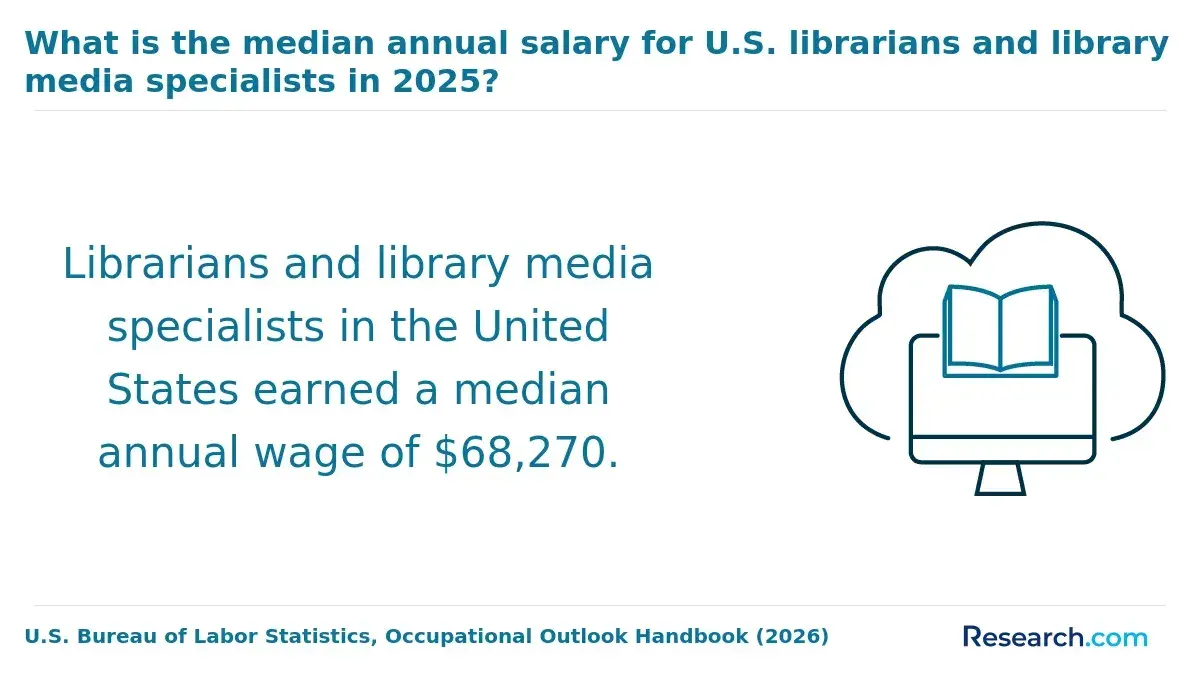
- The May 2025 median pay for librarians and media collections specialists was $68,270, but that occupational figure cannot predict your salary or establish that an MLIS will pay for itself.
What is the difference between an MLIS and a communications master's for knowledge services?
An MLIS focuses on how information is organized, found, evaluated, preserved, and delivered. A communications master's generally focuses on how organizations develop messages, understand audiences, and communicate effectively. Both can support knowledge services - work that helps people find, use, and share organizational knowledge - but they prepare students to contribute in different ways.
The comparison below separates the work each degree most directly supports. Individual programs vary, so use it to identify skills to verify in a curriculum rather than assuming every graduate learns the same tools.
| Decision point | MLIS or related LIS master's | Communications master's |
| Primary focus | Information access, organization, services, and stewardship | Messaging, audiences, media, and communication strategy |
| Typical knowledge-service contribution | Building searchable resources, supporting research, managing metadata or collections | Explaining knowledge clearly, encouraging its use, managing stakeholder communication |
| Most relevant job requirement to check | Whether the employer requires an ALA-accredited LIS degree | Whether the employer prioritizes writing, campaigns, engagement, or change communication |
Neither degree owns every knowledge-management job. A role combining a searchable internal knowledge base with employee adoption may value either background, provided the applicant can demonstrate the missing skills.
Which degree better prepares you for library, information, and knowledge management careers?
For professional librarian roles and work centered on collections, discovery, reference, or research support, the MLIS is usually the more direct preparation. For internal communications, content strategy, or campaigns that help employees understand and use information, a communications master's may be more relevant.
Knowledge management falls between them. If the job calls for taxonomies - controlled categories that make content easier to find - metadata, search improvement, or information governance, prioritize LIS coursework and applied projects. If it calls for stakeholder interviews, editorial planning, training messages, and adoption of a new knowledge platform, communications training may have the advantage. Read several current job descriptions and mark the required qualifications separately from preferred skills before choosing a degree.
Is an ALA-accredited MLIS required for professional library jobs?
Not universally, but many professional librarian employers require or prefer a master's from an American Library Association (ALA)-accredited library and information studies program. A communications master's generally will not satisfy a posting that explicitly requires that credential. Other information roles may accept several degrees or place greater weight on experience.
MLIS and MLS are common degree names, while some institutions award a Master of Information or another LIS degree. Check the specific program in the current ALA directory rather than judging eligibility by its title or the university's institutional accreditation. Accreditation does not, by itself, verify a concentration, internship, or online format.
School librarian roles need a separate check: state certification, licensure, or endorsement rules may apply regardless of the graduate program's accreditation. Consult the state education authority for the jurisdiction where you intend to work. Specialized employers, including law and medical libraries, may also prefer subject knowledge or additional experience; those preferences are not universal legal requirements.
What careers can you pursue with an MLIS versus a communications master's?
Degree fit becomes clearer when you compare the work, not just the job title. The examples below show where each credential offers a plausible entry point; individual postings determine eligibility.
| Career direction | Work performed | Likely degree fit |
| Public or academic librarian | Reference, instruction, collections, and access services | MLIS is commonly required or preferred for professional roles |
| Metadata or digital collections specialist | Describes and organizes digital resources for discovery and management | MLIS can fit; technical skills and project experience matter |
| Knowledge manager | Improves how an organization captures, finds, and shares expertise | Either may fit, depending on whether systems or communication dominate |
| Internal communications or content strategist | Plans messages and content for defined audiences | Communications is typically the more direct fit |
Archives, records, and information-governance positions can have distinct expectations; an MLIS alone does not establish archival or regulatory expertise. To test your fit, seek an internship, library position, or supervised project that produces evidence of your work. Examples include a documented search improvement, a small metadata project, or an audience-tested knowledge guide. For a broader view of library science masters career outcomes, compare the occupations with the exact qualifications in openings you would pursue.
How do MLIS and communications master's curricula compare?
An MLIS curriculum commonly emphasizes information organization, user services, research methods, and the management of information resources. Relevant electives might address metadata, digital preservation, records management, or knowledge organization. A communications curriculum is more likely to emphasize communication theory, research, writing, audiences, and strategy. Course titles alone are not enough: examine assignments to see whether you will practice the work named in your target postings.
For a knowledge-base role, an MLIS student might build a taxonomy and test whether users can retrieve documents; a communications student might study users, rewrite guidance, and plan its rollout. A strong program can offer opportunities to do both, but distinguish a formal concentration from an elective, and an elective from a course that will be available when you need it. Ask how often relevant courses run and whether a practicum or capstone can address your intended setting.
If you want to demonstrate existing skills rather than repeat introductory material, compare published assessment and pacing policies carefully. Descriptions of competency based MLIS programs can help frame questions, but confirm how a specific school awards credit and sequences its courses.
Should you choose an online or campus-based graduate program?
Choose the format that lets you complete the relevant work, not simply the one that eliminates a commute. Online study can suit working students, but online courses may still have scheduled meetings, group work, fixed deadlines, or a locally arranged practicum. Campus study may make access to nearby collections, employers, and in-person projects easier, though those opportunities still need verification.
Before applying, ask whether required classes are synchronous, when key electives are offered, whether internships can be completed near you, and whether any campus visits are required. Compare each answer with your work schedule and location. A starting point for identifying the best accredited online MLIS options is useful only if you subsequently verify each program's current accreditation, delivery requirements, and course availability directly.
What are the admission requirements for each master's degree?
Requirements vary by institution and program. Applicants commonly need a bachelor's degree and may be asked for transcripts, a statement of purpose, recommendations, a résumé, or writing samples. A communications program may request work that demonstrates communication skills; an MLIS statement may instead ask applicants to explain their information-service interests. Do not assume either degree requires an undergraduate major with the same name.
If you are changing fields, use your application to connect prior work to specific program outcomes: research and customer service can inform reference work, while writing and stakeholder experience can support organizational knowledge sharing. Check each program's published rules for prerequisites, test scores, and international credentials. Ask admissions staff for an individual review when your academic record or experience does not fit the standard description; relevant experience is valuable but does not automatically replace a formal requirement.
How long do these programs take and how much do they cost?
There is no reliable single price or completion time for either degree. Required credits, enrollment pace, tuition category, course sequencing, and practicum arrangements differ by school. To compare offers fairly, calculate required credits × applicable tuition per credit + mandatory fees, then add books, equipment, and any travel or placement costs. Published tuition alone is not the total cost of attendance.
Ask each program for a course-by-course schedule showing the earliest feasible completion date at your intended pace. An elective offered infrequently can extend enrollment even when the advertised timeline looks short. Guidance on how long does an MLIS take can help you plan questions, but the program's current schedule should control your estimate.
Compare gross program cost with what you would personally pay after any confirmed employer support or awards; treat borrowing as financing, not a discount. Verify current aid eligibility and loan terms with the school's financial aid office and Federal Student Aid before relying on a funding plan. For return on investment, weigh the cost and income you may forgo against the qualifications demanded by your target jobs - not an assumed salary increase.
How do salaries and job outlook compare across knowledge-service careers?
U.S. Bureau of Labor Statistics figures offer occupational context, not degree-specific outcomes. The figures below cover selected roles related to LIS study; they do not measure what graduates of either master's program earn, and job duties can differ substantially within an occupation.
| U.S. occupation | Median annual pay, May 2025 | Projected employment change, 2025-2035 |
| Librarians and media collections specialists | $68,270 | +2.6% |
| Archivists | $64,550 | +3.4% |
| Library technicians | $44,580 | −6.4% |
The librarian and technician figures are particularly important to keep separate: a paraprofessional library position is not the same career outcome as a professional librarian position. The modest projected growth for librarians also makes local openings, required credentials, and relevant experience more useful to your decision than a national median alone. Communications and corporate knowledge-management jobs span different occupational categories, so these LIS figures should not be used as a direct salary comparison with a communications master's.
How can you choose a reputable program for your career goals?
Start with three job postings you would realistically apply for. Identify their required degree, preferred skills, and evidence of experience; then ask prospective programs to show where students can build that evidence. This avoids paying for a credential that sounds relevant but does not meet an employer's stated requirement.
Use the following checks to narrow a shortlist before comparing offers:
- Verify the specific program's accreditation where your target jobs call for an ALA-accredited LIS degree; check school librarian licensing separately with the relevant state.
- Match required courses, available electives, and applied projects to the work you want, and ask when those opportunities will next be offered.
- Compare a feasible completion schedule and full cost using your tuition category, fees, and any travel or practicum expenses.
- Ask for documented career support and outcomes relevant to your target role, and note what the school cannot substantiate.
If location or budget narrows your choices, lists of accredited Southern library science degrees can provide candidates to investigate. Recheck current accreditation and costs directly before making a commitment. The best choice is conditional: an MLIS is stronger when it meets a librarian hiring requirement, while communications study - or targeted experience without another degree - may be the more economical path when messaging and adoption are the work you want to do.
Other Things You Should Know About Library Science
Yes. Assistant, technician, volunteer, and other support opportunities can expose you to services and collections. Duties and hiring requirements vary, so use the experience to learn about the work without assuming it qualifies you for professional librarian positions.
Possibly, but graduate transfer-credit limits and course-equivalency decisions are program-specific. Request a written evaluation before assuming prior coursework will reduce the credits you must complete.
It may help you build a missing skill set. Check the certificate's courses, cost, and employer relevance; it generally should not be assumed to replace an MLIS where a job explicitly requires that degree.
Describe the problem, your method, and the result while removing confidential records and identifying details. When permission is uncertain, create a comparable demonstration using public or invented sample content and label it clearly.
References
- General and Program Specific Requirements for Library Media Specialist | nysed.gov https://www.nysed.gov/college-university-evaluation/general-and-program-specific-requirements-library-media-specialist
- Program: Library and Information Science, MLIS - Pitt Catalog https://catalog.upp.pitt.edu/preview_program.php
- MLIS Curriculum, Specialties & Courses | University of Arizona College of Information Science https://infosci.arizona.edu/ma-library-information-science/curriculum-specialties-courses
- Admissions and Costs | rutgers.edu https://sci.rutgers.edu/academics/graduate-programs/master-information/admissions-and-costs
- MLIS Tuition & Financial Aid - University of Denver | DEN-EDU https://morgridgeonline.du.edu/online-mlis-program/tuition-financial-aid/
- Accreditation Frequently Asked Questions | ALA https://www.ala.org/educationcareers/accreditedprograms/faq