2027 MLIS Programs for Digital Repository Preservation Roles

Co-Founder and Chief Data Scientist
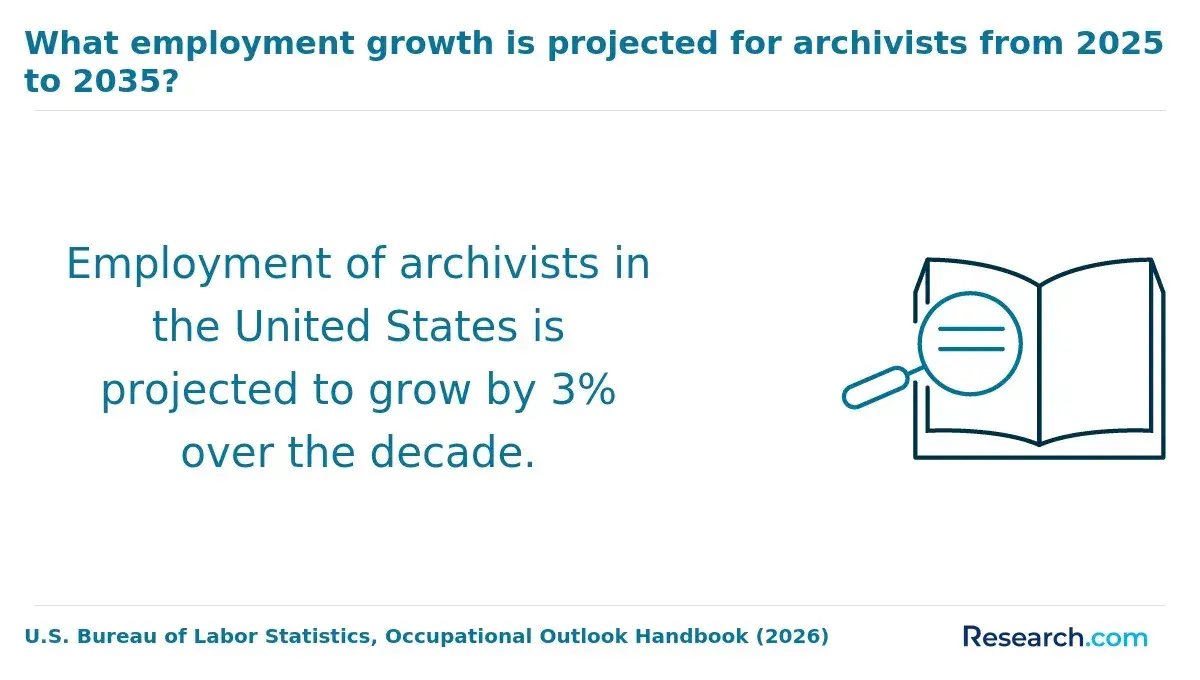
Choosing an MLIS for digital repository work means looking beyond a program's name: you need courses and projects that prepare you to keep digital collections usable over time. The U.S. Bureau of Labor Statistics projects 3.4% employment growth for archivists from 2025 to 2035, but that broad occupation includes many roles outside digital preservation. This guide helps prospective students identify relevant training, compare program formats and costs, and decide whether an MLIS fits the jobs they want.
Key Things You Should Know
- Look for verified coursework in digital preservation, metadata, and repositories, plus an applied project; a relevant elective is not necessarily a formal specialization.
- Check the specific master's program in the ALA accreditation directory, then confirm when specialized electives run and whether a practicum can match your career goal.
- The May 2025 median salary for archivists was $64,550, but that occupation-wide figure is not a digital repository salary or a graduate earnings guarantee.
What Is an MLIS Degree for Digital Repository Preservation Roles?
An MLIS prepares students to organize, provide access to, and steward information. For digital repository preservation roles, the relevant work is maintaining digital materials so they remain identifiable, authentic, accessible, and usable as files, software, and institutional needs change. An institutional repository might hold research articles and datasets; a digital collections repository might hold digitized photographs or born-digital records.
Preservation is more than uploading files or making backups. Staff may document where files came from, check whether they have changed unexpectedly, manage descriptive and preservation metadata, plan format migration, and coordinate storage, rights, and access decisions. Depending on the employer, this work may sit in a library, archive, museum, university IT unit, or records program.
Degree titles vary: an MLS, Master of Science in Library Science, or Master of Information may also offer relevant preparation. Compare the actual curriculum and projects rather than assuming that only a degree titled "MLIS" fits the role.
Which MLIS Programs Offer Digital Preservation and Archives Specializations?
No single program label reliably identifies the best preparation. Universities may document a formal archives or digital curation concentration, offer relevant electives without a named track, or allow students to build an independent project. Those are different levels of evidence; none should be described as a digital preservation specialization without an official program description.
Start with the current ALA directory and each university's graduate catalog. A comparison of MLIS accreditation and career outcomes can help frame the search, but confirm each program's current status and offerings with the institution. For every candidate, check whether digital preservation and archives courses are required or elective, when they are next scheduled, and whether students can complete a repository-focused practicum or capstone. A catalog listing alone does not establish that a course runs every term.
If a school cannot confirm access to the specialized courses or applied work you need, compare it as a general LIS option - not as a verified preservation pathway. Ask to see recent course schedules and examples of eligible projects before committing.
Is ALA Accreditation Required for Digital Repository Careers?
Not universally. Some professional librarian positions require or prefer a master's degree from an American Library Association (ALA)-accredited program. Archives and repository positions may instead accept an MLIS, an archival studies degree, another relevant graduate degree, or equivalent experience, depending on the employer. Read several postings for the job title and setting you want before treating accreditation as either optional or mandatory.
ALA accredits specific library and information studies master's programs, not every degree offered by an accredited university. Check the program and its current status in the ALA directory; institutional accreditation alone does not establish ALA accreditation, and ALA accreditation does not verify a particular preservation elective or internship.
School librarian certification is a separate question governed by state rules. If you might work in schools as well as repositories, consult the relevant state education authority; Illinois library certification options illustrate why a state-specific check matters. An online MLIS should not be assumed to meet every state's school librarian requirements.
What Do You Learn in a Digital Preservation MLIS Program?
A strong pathway connects collection decisions to technical workflows. Students should learn not only what a repository system does, but how to document an object, assess risks to its continued use, and explain access decisions to colleagues and depositors.
The table maps common learning areas to work a prospective student could demonstrate. It is a curriculum checklist, not a claim that every MLIS offers these courses.
| Learning area | Application in repository work | Useful evidence of learning |
| Digital preservation | Plan file checks, storage documentation, and responses to obsolete formats | A preservation workflow or risk assessment |
| Metadata and description | Describe objects consistently and support discovery and exchange | A documented metadata profile using appropriate schemas |
| Archives and appraisal | Decide what to retain and preserve its context | An appraisal or processing plan |
| Repositories and systems | Manage deposits, permissions, and system-to-system handoffs | A tested deposit workflow or system evaluation |
| Rights and access | Record permissions and balance access with restrictions | A documented access decision |
For example, Dublin Core can help describe repository items, while preservation metadata records information needed to manage them over time. A useful capstone might document an ingest workflow from deposit through file checking, description, storage, and access. The strongest portfolio explains decisions and limitations, not just which software was used.
Are Online or Campus MLIS Programs Better for Digital Repository Careers?
Neither format is inherently better. An online program may let a working student stay near a current job or local archive; a campus program may make it easier to use nearby collections and facilities. For this specialty, access to appropriate courses, supervision, systems, and projects matters more than the location of lectures.
Online does not necessarily mean asynchronous, and a remote degree does not guarantee a remote practicum. Ask whether specialized electives have live meetings, whether they run during the terms you can attend, and whether a local employer can host an approved repository project. Campus students should ask the same questions about course sequencing and project access.
A competency based librarian degree may appeal to students seeking flexible pacing, but confirm its accreditation, assessment model, and opportunities for supervised preservation work before comparing it with a conventional semester-based MLIS.
What Are the Admission Requirements for MLIS Programs?
Applicants generally need a bachelor's degree and must submit the documents each graduate program specifies. These may include transcripts, a statement of purpose, a résumé, and recommendations; minimum grades, tests, deadlines, and prerequisites vary. An undergraduate library science major is not necessarily required.
For this career goal, use the statement of purpose to connect your experience to a concrete interest - such as preserving research outputs, digitized collections, or organizational records. Relevant experience can include collections work, metadata cleanup, records handling, or technical support, but it does not automatically replace a published admission requirement.
If you hope to transfer graduate credits or have an unusual academic record, request an individual policy review before applying. Ask admissions which credits might transfer and ask the department whether they would satisfy required courses or only electives.
How Long Do MLIS Programs Take and What Do They Cost?
Completion time depends on required credits, enrollment pace, course sequencing, and any practicum. Full-time study commonly takes about two years; part-time study can take longer, especially if a needed elective is offered infrequently. A library information degree duration comparison is a starting point, not a substitute for a term-by-term plan from each program.
Without current, comparable tuition schedules for specific programs, a single price would be misleading. Build a cost estimate for each school by multiplying its applicable tuition rate by required credits, then adding mandatory fees, materials, and any travel or practicum expenses. Confirm whether online students pay a different rate and whether taking an additional term changes fees.
Keep three figures separate: the program's gross cost, what you would pay after confirmed employer support or other funding, and what you would borrow. Ask the financial aid office about aid eligibility for your planned enrollment period rather than assuming a scholarship, assistantship, or loan arrangement will apply. Compare that cost with the qualifications in your target job postings - not with an occupation-wide salary alone.
What Careers Can You Pursue in Digital Repository Preservation?
Potential titles include digital archivist, digital preservation specialist, repository manager, digital collections librarian, and metadata librarian. Titles overlap, but duties differ: one role may emphasize archival appraisal, another repository operations, and another description or systems integration. Academic libraries, archives, museums, government agencies, and other organizations employ people to steward digital collections.
Entry routes also vary. A current library or archives employee might move into repository work through a project involving deposits or metadata. Someone with IT experience might enter through systems administration and develop archival or collections expertise. Advancement can mean managing preservation policy, staff, budgets, or cross-institutional workflows.
Use job postings to separate required credentials from preferred ones. An MLIS can be valuable for positions combining librarianship, collections policy, and repository services; a technical repository role may also consider applicants with another degree and substantial systems experience. Do not pursue an MLIS solely because a job title contains "digital."
How Much Do Digital Archivists and Preservation Specialists Earn?
The Bureau of Labor Statistics reports a May 2025 median annual salary of $64,550 for archivists. That is the midpoint for the broader U.S. occupation, not a reported median for digital archivists or preservation specialists specifically. Job level, employer, location, supervisory duties, and technical scope can all affect an individual offer.
BLS projects 3.4% growth for archivists from 2025 to 2035. That projection describes the occupation as a whole; it does not predict openings in a particular city or guarantee demand for repository specialists. When weighing an MLIS against its cost, compare actual postings and published pay ranges in your target market. A guide to high salary librarian careers can provide broader context, but those roles may require different experience or responsibilities.
What Certifications and Skills Support Digital Preservation Careers?
There is no single certification that universally licenses someone to work in digital repository preservation. An optional credential or short course can help address a skills gap, but employers may value a well-documented project and relevant work experience more. Review target job postings before paying for additional training.
Prioritize skills you can demonstrate: clear metadata documentation, file and format assessment, basic scripting or batch processing where relevant, repository workflow testing, and communication with depositors, archivists, and IT staff. Preservation decisions also require judgment about privacy, rights, resources, and long-term access; software proficiency alone is not enough.
A practical next step is to compare several target postings with your current skills, then seek one supervised project that closes the largest gap. Document the problem, your decisions, the workflow, and what you would improve. That evidence can make either an MLIS, a shorter course, or experience-based preparation easier to evaluate.
Other Things You Should Know About Library Science
Possibly. Ask whether it has a defined project and someone who can supervise you. Even a small, documented contribution can help you test your interest without assuming that volunteer access includes sensitive materials or repository systems.
The answer depends on the repository's policies, deposit agreement, applicable rights, and any restrictions on the material. Repository staff may help document the decision, but they should not assume that possession of a file grants permission to publish it.
Follow the institution's review and access procedures before publishing it. A restriction, redaction, or consultation with the appropriate policy or legal staff may be necessary; the right response depends on the records and their context.
It can set collection and format policies that reflect its resources, but it should document what it accepts, what support it can provide, and any preservation limitations. Accepting a file and promising to keep it usable indefinitely are different commitments.
References
- PREMIS for Digital Preservation https://www.digitalpreservation.gov/series/challenge/premis.html
- Fall 2024 Voluntary Internship Opportunities | National Archives https://www.archives.gov/careers/internships/vip-opportunities-fall-2024
- Capstone projects as opportunities for real-life applications | Trends and Issues in Higher Ed https://www.washington.edu/trends/capstone-projects-as-opportunities-for-real-life-applications/
- MLIS Admissions & Cost | College of Information Science https://infosci.arizona.edu/ma-library-information-science/admissions-cost
- Advanced Study in Digital Preservation (Post Master's) | kent.edu http://catalog-archive.kent.edu/archive/academics/catalog/2011/CollegesPrograms/CI/certs/c826.html
- Program: Library and Information Science, MLIS - Pitt Catalog https://catalog.upp.pitt.edu/preview_program.php
- Archival Studies | MLIS https://online.missouri.edu/degrees-programs/mu/education/archival-studies/mlis
- Digital preservation program at the Libraries - Research Guides https://libguides.umn.edu/dp/strategies
- Assessing File Format Risk for Born-Digital Preservation Planning | si.edu https://library.si.edu/finding-aid/assessing-file-format-risk-born-digital-preservation-planning
- Digital Preservation Framework | UTSA Libraries https://lib.utsa.edu/about/policies/digital-preservation-framework