2027 Michigan MADS vs. CU Boulder Online MS-DS: Cost, Curriculum, Admissions, and Format

Co-Founder and Chief Data Scientist
Michigan's Master of Applied Data Science (MADS) and the University of Colorado Boulder's online Master of Science in Data Science (MS-DS) serve students who want a graduate degree without relocating. The consequential differences are how you enter, how you study, and what you will pay - not simply the names on the diplomas. This comparison is for prospective students weighing a structured applied program against a more modular, performance-based route. It will help you identify the stronger fit and the current details to confirm before enrolling.
Key Things You Should Know
- CU Boulder's online MS-DS is generally the lower-tuition choice, but compare current degree-wide tuition and required fees - not a single course price - before deciding.
- Michigan MADS uses a conventional application and an applied, cohort-oriented learning experience; CU Boulder offers performance-based entry through designated coursework and a more modular pace.
- Neither degree guarantees a data scientist job or a salary increase. The US median annual wage for data scientists was $120,230 in May 2025, according to the Bureau of Labor Statistics (BLS); that is an occupation-wide figure, not a graduate outcome for either program.
How do Michigan MADS and CU Boulder's online MS-DS compare?
The clearest distinction is the learning arrangement. Michigan MADS emphasizes an integrated applied curriculum and interaction within a graduate program; CU Boulder's online MS-DS lets students demonstrate readiness through initial coursework and build the degree in smaller units. Compare the current catalogs before treating either description as a promise about a particular class or term.
This overview puts the decision-making differences side by side. "Better fit" depends on whether you value a more structured student experience or lower-cost, modular access.
| Criterion | Michigan MADS | CU Boulder online MS-DS |
| Entry route | Conventional graduate application and admission decision | Performance-based admission through designated coursework |
| Learning emphasis | Applied data science in an integrated graduate curriculum | Data science foundations with modular courses and elective choice |
| Scheduling | Online study within the program's academic schedule | Online, smaller course units with frequent opportunities to begin coursework |
| Cost position | Typically the higher published tuition commitment | Typically the lower published tuition commitment |
| Best initial fit | Students seeking a structured applied experience | Students prioritizing flexible entry, pacing, and tuition |
If neither curriculum matches your target work, broaden the search rather than choosing by university name. A data analytics master's program comparison can help you assess degrees with a different emphasis.
Which program costs less: Michigan MADS or CU Boulder's online MS-DS?
CU Boulder is generally the lower-tuition option. A defensible total, however, requires each school's current rate and your actual course plan. Published prices can change, and a per-course figure does not establish what an entire degree will cost.
For an apples-to-apples comparison, request a written estimate from each program using the same starting term and your expected enrollment pace. Include tuition for every required course, mandatory university and technology fees, and any charges tied to your location or enrollment status. Then add books, software or computing costs if applicable. Compare employer reimbursement and financing separately: a payment plan can improve cash flow without reducing the price, while borrowing can increase your eventual cost.
A common mistake is to compare CU Boulder's advertised entry-course price with the cost of Michigan's full degree. Another is to assume that taking longer will leave the total unchanged. Confirm how each school handles rate changes, course retakes, and breaks in enrollment before committing. If price is decisive and your intended specialization is machine learning, ML graduate study with a budget below $20,000 provides another comparison point - not a substitute for checking either university's current bill.
What are the admission requirements for each online data science degree?
Michigan MADS and CU Boulder differ most in how applicants establish readiness. Michigan uses a conventional application reviewed for admission. CU Boulder's online MS-DS uses a performance-based pathway: prospective students complete designated courses successfully to qualify for the degree. Do not assume that registering for those courses means you have already met every requirement to enter or finish the degree.
For Michigan, check the current application instructions for required academic records, written materials, deadlines, and any stated quantitative or programming expectations. For Boulder, identify the current pathway courses, the grades needed for admission, and when admission takes effect. Policies for international credentials, English-language proficiency, and prior graduate work may add requirements in either case.
Choose the performance-based route if you would rather show readiness through graded work than rely primarily on an application file. Choose Michigan's route if you want an admission decision before making a substantial course commitment. In both cases, preparation in programming, statistics, and mathematical reasoning will make the coursework more manageable; useful preparation is not automatically a formal admissions prerequisite.
How do the online formats and pacing differ between the programs?
Both degrees are online, but "online" does not mean identical scheduling. Michigan MADS follows an organized academic schedule and places more emphasis on an integrated student experience. CU Boulder's modular courses make it easier to adjust how much you take on at once. That distinction matters if work or caregiving demands change from term to term.
Before selecting either program, inspect a current course syllabus - not just the marketing description. Check whether lectures are asynchronous, when assignments and exams are due, whether group work requires live meetings, and how often the courses you need are offered. A self-paced video library can still have fixed assessment deadlines.
Michigan's structure may suit students who benefit from a defined progression and regular peer interaction. Boulder may suit students who want to test the workload with limited initial enrollment or vary their course load. Neither format removes the need to reserve consistent study time, particularly for coding assignments and projects.
What courses and technical skills does each data science curriculum cover?
Both programs address the core work of data science: preparing data, applying statistical methods, building models, and communicating results. Michigan MADS frames those skills through applied problems and their use in decisions. CU Boulder's MS-DS combines foundational study with elective choices that can shape a more individualized technical path.
Course titles alone cannot tell you how deeply either program teaches a skill. Compare the current required-course lists, elective availability, and representative assignments. For your intended job, look for opportunities to write substantial code, evaluate models on appropriate data, explain uncertainty, and communicate findings to a nontechnical audience. Also check whether a culminating project is required, optional, or replaced by work completed across courses; do not assume that every master's includes the same kind of capstone.
Specialization is especially important when you have a defined industry goal. A student interested in clinical applications, for example, should examine project access, privacy constraints, and relevant coursework rather than assuming that a general machine-learning class provides healthcare preparation. Healthcare applications in artificial intelligence graduate study offers a more focused lens for that goal.
How long does it take to complete Michigan MADS or CU Boulder's MS-DS?
There is no reliable single completion time for either student. Your pace depends on the course load you can sustain, how often required classes run, and whether you take breaks. Michigan's scheduled progression offers a clearer planning framework; Boulder's modular approach gives you more control but also makes it easier to progress slowly.
Ask each program for a sample plan based on your available hours, including prerequisites or pathway courses where applicable. Check the maximum time allowed to finish and whether a required course could delay graduation if you miss its offering. The fastest advertised path is not necessarily the least expensive or most realistic path for a working student.
What careers and job roles can each data science master's degree support?
Either degree can help a qualified candidate pursue data scientist, data analyst, analytics engineer, or machine-learning-adjacent work. The appropriate target depends on prior experience and the projects, software skills, and domain knowledge you can demonstrate - not the degree title alone. Employers may also expect production engineering skills that require experience beyond graduate coursework.
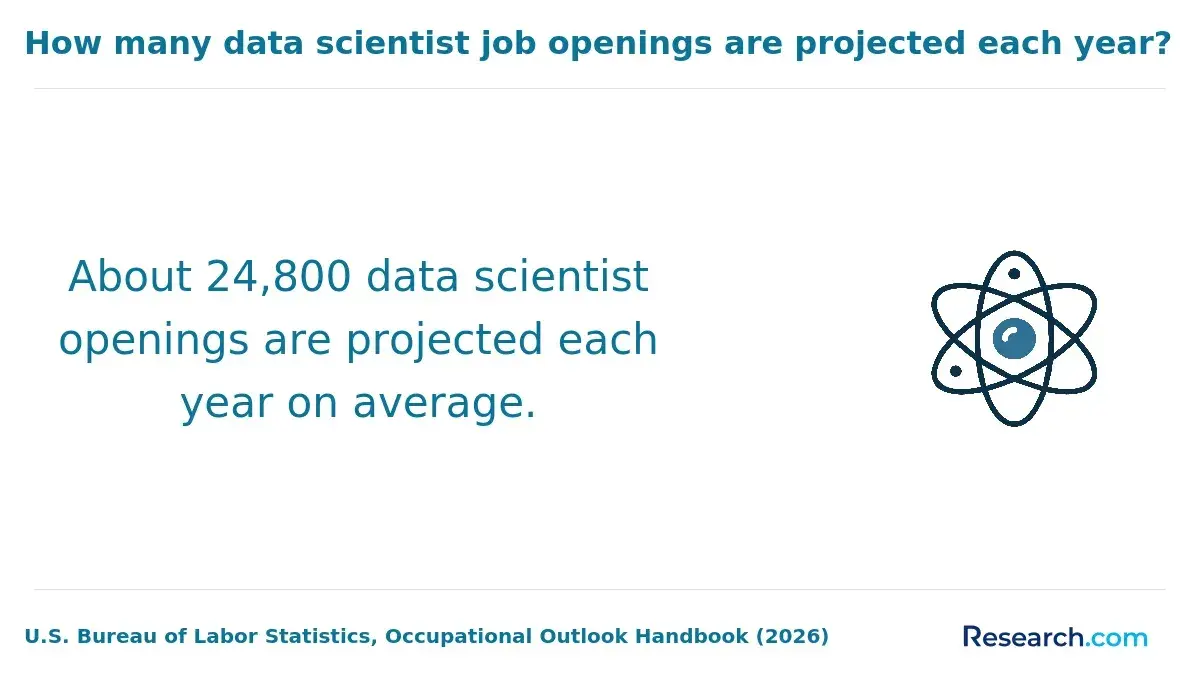
US demand provides context, not a hiring promise: BLS projects data scientist employment to grow 35% from 2025 to 2035. Competition for a particular position still depends on location, industry, and the applicant's record. Students moving from analysis into data science should use coursework to produce evidence of model evaluation and reproducible work; experienced analysts may get more value from technical depth or leadership-relevant projects.
If your actual goal is a dedicated AI role, compare each program's available electives with degrees built specifically around that field. Online AI master's cost and earnings considerations can help frame that alternative without assuming an AI-labeled degree is automatically the better investment.
What salaries can graduates expect after earning an online data science master's?
Neither school's degree establishes a salary you should expect personally. The BLS reports a $120,230 median annual wage for US data scientists in May 2025. That midpoint covers workers across employers and experience levels; it is not an entry-level offer, a Michigan or Boulder graduate average, or evidence that a master's caused higher pay.
For a useful financial estimate, compare your current compensation with pay for the specific roles and locations you could realistically enter. Account for your existing experience and whether you seek a promotion, a new employer, or a career change. Industry can substantially change the comparison; Pay comparisons for graduates entering data science industries provide context, but should not be treated as program-specific outcomes. Be wary of any ROI claim that subtracts tuition from an occupation-wide salary without estimating the pay increase the degree might actually help you achieve.
How do accreditation and professional standards apply to these data science degrees?
Michigan and CU Boulder are established universities with institutional accreditation. That is different from claiming that either particular online data science degree has a specialized data science accreditation. Verify each institution's current standing through its accreditor or official university accreditation information if that distinction matters to an employer, another school, or an aid provider.
Data science generally has no single professional license that these degrees confer. For career fit, give greater weight to demonstrable practices: appropriate statistical evaluation, reproducible analysis, responsible handling of data, and clear disclosure of model limitations. If you plan to work with regulated data, check the relevant employer and industry requirements separately; institutional accreditation alone does not establish job-specific compliance.
Which online data science master's program is the better choice for your goals?
Choose CU Boulder's online MS-DS if keeping tuition down, demonstrating readiness through coursework, and adjusting your pace are your leading priorities. The trade-off is that flexibility puts more responsibility on you to plan a coherent set of courses and maintain momentum.
Choose Michigan MADS if you place greater value on a structured applied curriculum and the student experience associated with it - and its verified total cost fits your budget. The higher likely price is worth considering only if those features materially improve how you learn or support the work you intend to do.
Before paying for either program, make a final check against your target role: obtain the current degree-wide cost, map required courses and available electives to the skills in relevant job postings, and review actual assignment and scheduling expectations. If one program wins only on reputation while the other meets your skill, time, and budget requirements more convincingly, choose on the latter evidence.
Other Things You Should Know About Data Science
Online study does not generally require relocating, but enrollment availability can depend on where you reside. Confirm your state's eligibility with the program before applying.
Do not assume they will count. Ask each program for its current transfer-credit policy and request a course-specific review before relying on prior credits in your budget or graduation plan.
Only with the required employer permissions and in accordance with university rules. If approval is unlikely, ask whether public or appropriately de-identified datasets will meet the assignment requirements.
Requirements depend on the tools and projects used in your courses. Review current technical specifications and ask what computing resources the program provides before buying equipment.
References
- Master of Applied Data Science tuition and funding | umsi https://si.umich.edu/admissions-aid/tuition-and-funding/master-applied-data-science-tuition-and-funding
- What Is a Capstone Project? | National University https://www.nu.edu/blog/what-is-a-capstone-project/
- Tuition and Fees - The Ohio State University https://registrar.osu.edu/student-hub/tuition-and-fees/
- Online Overview | Master of Science in Data Science | Student Support & Advising Services https://www.colorado.edu/program/data-science/coursera
- Grad school requirements: Everything you need to apply | About the University of Cincinnati https://www.uc.edu/blog/grad-school-requirements.html
- Admissions Requirements and Procedures - Pitt Catalog https://catalog.upp.pitt.edu/content.php