
2027 Is an Online BS in Business Administration the Right Next Step for Recruiting Coordinators?
Audited and Verified:
Our Editorial and Data Verification Process
Research.com uses government datasets, official education statistics and primary institutional information to support its career and degree guides. Our review process checks factual accuracy, occupational definitions, source dates and the requirements associated with the credentials discussed.
How This Article Was Fact-Checked
Our editorial team verifies salary estimates, employment projections, education requirements and program information against original data providers and official organizations. Salary figures are checked against the relevant occupational definitions and reporting periods. Information about licensure, accreditation and required in-person training is reviewed separately.
Fact-checked and verified on:

Co-Founder and Chief Data Scientist
Recruiting coordinators already keep hiring processes moving. The decision is whether finishing an online BS in business administration will open a worthwhile next step - or add cost without addressing the skills an employer wants. This guide is for coordinators weighing advancement into recruiting, HR operations, or broader business roles. It connects the degree to your daily work, compares it with more targeted options, and shows what to verify about schedules, credits, costs, and career requirements before enrolling.
Key Things You Should Know
- An online BS in business administration is most compelling when a bachelor's degree is a barrier to roles you want and you can apply its HR, operations, and analytics coursework at work.
- It is not required for every recruiting coordinator job; targeted HR training and stronger recruiting experience may be a more direct next step.
- The U.S. Bureau of Labor Statistics reports a $75,940 median annual wage for human resources specialists in May 2025, but that occupation-wide figure is not an expected salary for a coordinator who earns a degree.
What does a recruiting coordinator do, and can a business administration degree help?
A recruiting coordinator organizes interviews, communicates with candidates and hiring teams, updates applicant tracking systems, and helps keep hiring records and deadlines accurate. The role depends on discretion and follow-through: a scheduling error can affect a candidate's experience, while mishandling an applicant's information can create privacy problems.
A BS in business administration can add context to that work through organizational behavior, operations, business communication, and data analysis. For example, a coordinator who understands process mapping may be better equipped to identify where interview scheduling stalls. The degree does not, by itself, establish expertise in employment law or qualify someone to make hiring decisions. If your goal is specifically HR, compare the curriculum with human resources qualifications and degree routes before choosing a broad business program.
Is an online BS in business administration worth it for recruiting coordinators?
It may be worth it if job postings for your target roles call for a bachelor's degree, your previous college credits can satisfy meaningful requirements, and you want options beyond recruiting. It is less persuasive if you already have a bachelor's degree, need only a specific HR skill, or would take on substantial debt without a clear advancement opportunity.
Start with your next job, not the degree title. Compare several postings from employers you would realistically pursue: note whether they require a bachelor's degree, prefer HR-specific study, or emphasize recruiting results and applicant tracking system experience. Then ask your manager what qualifications matter for advancement at your organization. A coordinator seeking a recruiting specialist role may gain more immediate value from sourcing practice and mentorship; someone seeking wider HR or operations roles may benefit more from broad business study. For schedules designed around continued employment, review business administration education for employed professionals.
What education and experience do recruiting coordinators typically need?
Requirements vary by employer. Some coordinator positions accept relevant administrative, customer service, or scheduling experience without a bachelor's degree; others prefer a degree, especially when the role includes substantial HR work. Experience coordinating multiple calendars, writing clear candidate messages, maintaining accurate records, and using workplace software can be persuasive evidence of readiness.
If you are already employed in recruiting, document responsibilities rather than relying on your title. Examples include managing interview logistics across departments, improving a documented workflow, or training colleagues on an approved process. Do not disclose applicant information in work samples. A degree is one possible route past a hiring requirement, not a substitute for this evidence. If you decide to apply to several schools, you can also explore ways to reduce upfront college application expenses.
Online study can remove a commute and make it easier to remain employed. Campus study may offer more convenient face-to-face access to classmates, faculty, and local recruiting events. Neither format is automatically more rigorous or more useful to an employer; the decisive issue is whether you can complete the actual coursework while building relevant skills.
Before choosing online delivery, check for live class meetings, group presentations, timed or proctored exams, internship requirements, and fixed weekly deadlines. An accelerated term may fit a coordinator with predictable hours but become difficult during a busy hiring period. Compare course calendars and expected weekly work - not just advertised completion dates - when you explore fast-track online business programs.
Prioritize courses that address a demonstrated gap in your target role. Human resource management and organizational behavior explain workplace systems; business law can introduce employment-related concepts without replacing specialist legal training. Statistics, spreadsheets, and information systems can help you interpret hiring-process measures, while operations or project management can strengthen scheduling and workflow design.
Check which subjects are required, which are electives, and whether an HR concentration is formally awarded. A course in project management is useful for coordinating work, but it is not a project-management credential. If your goal has shifted toward a dedicated project role, compare specialized study and its funding separately; information on financial aid at low-cost project management schools can help frame that alternative. For a recruiting-focused degree, an approved, privacy-conscious project - such as mapping an interview workflow using nonidentifying information - may be more relevant than an unrelated elective.
Schools commonly request proof of secondary-school completion or prior college study and official transcripts. Transfer applicants may face different GPA rules, prerequisite requirements, or a separate process for entering the business major. Test, essay, and quantitative-course policies vary; prior recruiting experience does not automatically waive academic requirements.
Ask admissions what is needed to enter, then ask the appropriate adviser or transfer office how previous credits would apply to general education, the business core, electives, and residency requirements. Credits a school accepts may not satisfy the courses you still need to graduate. For a closer look at common variations, see business administration admissions eligibility rules.
The answer depends chiefly on the credits that apply to your chosen program, required course sequencing, enrollment pace, and the school's charges. An associate degree or previous college coursework may shorten the path, but only an official evaluation can show which requirements remain. Part-time study may protect your income and workload while extending the calendar time to graduation.
Request a written degree plan and calculate the cost of remaining required credits, mandatory fees, books or software, and any proctoring or travel. Check whether employer tuition assistance pays upfront or reimburses you later, and confirm eligibility conditions before counting it toward your budget. Use online business administration program cost-and-time comparisons as a starting point, not a substitute for a school-specific estimate. If you plan to seek federal aid, compare eligibility and application requirements at FAFSA-eligible online business administration colleges before committing.
A realistic next move builds on the work you already do. Recruiting specialist or recruiter roles may require more sourcing, candidate assessment, and stakeholder management. HR operations roles may emphasize records, systems, onboarding, and policy execution. Training coordinator or people-operations positions can draw on communication and process skills. Moving into HR management generally requires substantial professional experience beyond a bachelor's degree.
A broad business degree also supports exploration outside HR, but a larger transition needs function-specific evidence. For example, supply chain work involves purchasing, inventory, or logistics knowledge that recruiting coordination alone may not demonstrate. If that is the actual destination, compare its coursework and shorter online supply chain degree pathways rather than assuming a general business degree is the most direct route.
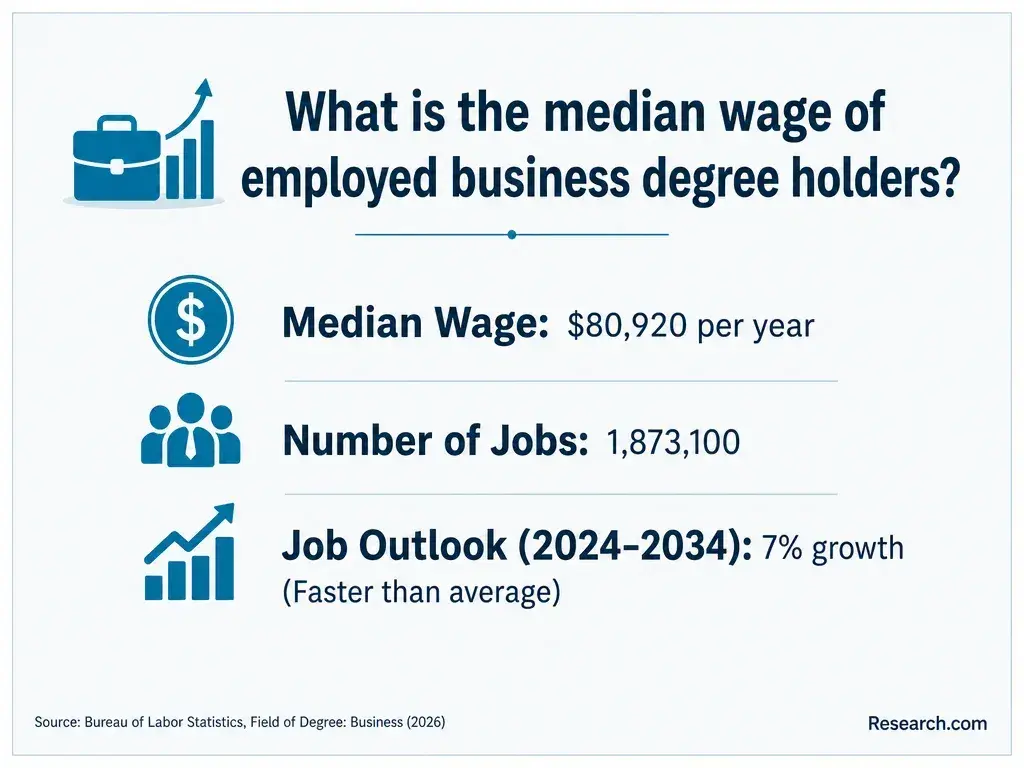
The U.S. Bureau of Labor Statistics does not provide a single national wage and outlook figure specifically for recruiting coordinators. For the related, broader occupation of human resources specialists, it reports a median annual wage of $75,940 in May 2025 and projects 6% employment growth from 2025 to 2035. Those figures cover specialists across experience levels and duties; they should not be treated as a starting salary, a coordinator-specific forecast, or a return on a business degree.
For a useful pay comparison, examine local postings for the precise role you want and distinguish base pay from bonuses or contract rates. Compare their stated qualifications with your current experience and the degree's remaining cost. A credential is most valuable when it closes a documented hiring gap, not merely because a related occupation has a higher national median.
How can you choose an accredited online business administration program?
First, verify the institution's recognized accreditation and the exact degree it awards. Institutional accreditation and business-school accreditation - such as AACSB, ACBSP, or IACBE - have different scopes; confirm whether any advertised business accreditation covers the program you are considering. Then review the current catalog, not just a program summary, for HR electives, online availability, transfer rules, and graduation requirements.
Ask for a completed-credit evaluation, a remaining-course plan, and a realistic schedule for required classes. Confirm access to career advising and whether an internship or capstone can relate to recruiting work without exposing candidate data. A national guide to ranked online business colleges can help you identify programs to investigate, but rank or accreditation alone cannot establish your personal cost, schedule fit, or employment outcome.
Other Things You Should Know About Business Administration
Not universally. Check target job postings and the certifying organization's current eligibility rules before investing in an exam or preparation course.
Some can, but remote eligibility depends on the employer and duties. Confirm whether interviews, onboarding, or team meetings require on-site attendance.
Possibly, with faculty approval and any required employer permission. Use approved, nonidentifying information; employment does not automatically award academic credit.
Check whether the jobs you want require another degree or instead call for HR knowledge and experience. A certificate, selected courses, or supervised recruiting responsibilities may be more direct.
- 8 Things You Should Know About Federal Work-Study | studentaid.gov https://studentaid.gov/articles/8-things-federal-work-study/
- Section 10 Compensation Discrimination | U.S. Equal Employment Opportunity Commission https://www.eeoc.gov/laws/guidance/section-10-compensation-discrimination
- Accreditation in the U.S. | ed.gov http://www.ed.gov/laws-and-policy/higher-education-laws-and-policy/college-accreditation/accreditation-in-the-us
- Regional vs. National Accreditation: Which is Better? | Drexel University Online https://www.online.drexel.edu/news/national-vs-regional-accreditation.aspx
- Is Talent Acquisition Right for You? A Look Into Recruiting Careers https://sopa.tulane.edu/blog/talent-acquisition-right-you-look-recruiting-careers
- Recruiting Coordinators: How to Become One | Franklin University https://www.franklin.edu/career-guide/human-resources-assistants/how-to-become-recruiting-coordinators
- What Is Business Administration? Roles, Skills, and Careers | SCU https://www.scu.edu/business/blog/business-concepts/what-is-business-administration/
- What Is a Business Administration Degree? Key Concepts | American Military University https://www.amu.apus.edu/area-of-study/business-administration-and-management/resources/what-is-a-business-administration-degree-key-concepts/
- Could You Earn a Fast, Online Bachelor's Degree in 12 Months? | University of Wisconsin Flexible Option https://flex.wisconsin.edu/stories-news/earn-fast-online-bachelors-degree-in-12-months/
- Is an Online Degree Worth It? 5 Things to Consider Before You Enroll - Online Degrees & Programs | Kent State University https://onlinedegrees.kent.edu/blog/is-an-online-degree-worth-it-5-things-to-consider-before-you-enroll


