
2027 How to Become a Preschool and Childcare Center Director: Education, Salary, and Job Outlook

Co-Founder and Chief Data Scientist
If you want to lead an early childhood program rather than work only in one classroom, becoming a preschool and childcare center director may be the right next step. Directors are responsible for the quality, safety, staffing, compliance, family communication, and financial health of a center. The role combines education leadership with daily operations, which means it suits people who care deeply about children but are also comfortable managing adults, budgets, schedules, and regulations.
This guide explains what credentials are typically expected, which skills matter most, how the career path usually develops, what salary range to expect, and how to decide whether this work fits your strengths and long-term goals. Because licensing rules vary by state and employer, use this as a planning guide and confirm the exact requirements in the state where you intend to work.
What are the benefits of becoming a preschool and childcare center director?
- The job outlook for preschool and childcare center directors is growing steadily, with a projected 7% increase in employment through 2025, reflecting strong demand for leadership in early education.
- The average salary for directors is approximately $49,000 annually, offering financial stability along with the rewarding opportunity to shape young minds and educational programs.
- Pursuing this career fosters personal growth and community impact by leading quality childcare initiatives, making it an inspiring choice for education-focused professionals.
What credentials do you need to become a preschool and childcare center director?
To become a preschool and childcare center director, you usually need a mix of early childhood education, supervised experience, state-required training, and in many cases a director credential or license. The exact preschool director education requirements in the United States depend on the state, the type of center, the ages served, and whether the program is private, nonprofit, federally funded, or school-affiliated.
Most aspiring directors should plan for the following credentials:
- Bachelor's degree: Many director roles expect a bachelor's degree in early childhood education, child development, education administration, or a closely related field. A bachelor's degree is especially useful for centers with higher enrollment, formal curricula, or accreditation goals.
- Associate's degree with experience: Some employers and states may accept an associate's degree when it is paired with substantial childcare experience and approved training. If you are trying to move into the field efficiently, compare options such as the fastest associates degree programs, but make sure the coursework matches your state's childcare licensing rules.
- Master's degree: A master's degree is not always required, but it can help for leadership positions in larger organizations, multi-site systems, higher-quality centers, or roles that involve curriculum design, compliance oversight, or staff development.
- State-issued director's license or approval: Childcare center director licensing and certification requirements vary widely. States commonly require approved coursework in child development, health and safety training, administrative training, and a specified amount of experience in licensed childcare settings.
- National or professional credentials: Credentials such as the Child Development Associate (CDA) credential or a Director's Credential can strengthen your qualifications, especially if your degree is not specifically in early childhood education.
- Continuing professional development: Directors are typically expected to complete ongoing training in areas such as health and safety, mandated reporting, curriculum planning, inclusion, family engagement, leadership, and emergency preparedness.
The safest approach is to work backward from the job you want. Review your state licensing agency's director qualifications, then compare those rules with job postings from local centers. This will show whether you need a degree, a specific credential, management experience, or additional coursework before applying.
What skills do you need to have as a preschool and childcare center director?
A strong preschool and childcare center director must be both an educator and an operator. You need enough child development knowledge to judge program quality, enough leadership skill to support teachers, and enough administrative discipline to keep the center safe, compliant, and financially stable.
- Leadership: Directors set the tone for the center. You must be able to coach teachers, address performance issues, encourage collaboration, and create a culture where staff understand expectations and feel supported.
- Business management: The role often includes budgeting, enrollment planning, tuition processes, purchasing, payroll coordination, scheduling, recordkeeping, and vendor communication. Poor administrative systems can quickly affect classroom quality.
- Early childhood education expertise: Directors need a practical understanding of child development, age-appropriate curriculum, classroom observation, behavior guidance, inclusion, and licensing standards.
- Communication: You will communicate with teachers, parents, licensing officials, owners, boards, and community partners. Clear writing and calm, direct conversations are essential, especially when discussing sensitive concerns.
- Crisis management and problem-solving: Illness, injuries, staff absences, parent complaints, enrollment changes, and inspection issues can happen with little warning. Directors must respond quickly without creating panic.
- First aid and safety awareness: Even when teachers provide direct supervision, directors are responsible for ensuring that staff follow health, safety, sanitation, emergency, and child supervision procedures.
- Organization and time management: Directors juggle classroom needs, parent tours, staff schedules, compliance deadlines, hiring, documentation, and unexpected problems. Strong systems prevent missed requirements.
- Emotional intelligence and patience: This is a people-heavy job. You need patience with children, empathy for families, fairness with staff, and the ability to stay steady when others are stressed.
The most successful directors do not rely only on being “good with children.” They build repeatable systems, communicate consistently, and use data and observation to improve the center without losing sight of relationships.
What is the typical career progression for a preschool and childcare center director?
The path to becoming a preschool and childcare center director usually starts with classroom experience and gradually adds supervision, administration, and compliance responsibilities. Employers often want directors who understand what teachers face day to day because that experience improves hiring, coaching, scheduling, and parent communication.
- Assistant Teacher/Teacher: Many directors begin by working directly with children, supporting lessons, supervising routines, and learning classroom management. This stage often lasts 1 to 3 years and builds a foundation in child development, safety, and family interaction.
- Lead Teacher/Assistant Director: The next step may involve planning curriculum, mentoring newer teachers, communicating more frequently with families, helping with staff schedules, and supporting center operations. This stage often requires 2 to 4 years of experience and additional certifications.
- Director: Directors oversee hiring, staff supervision, budgeting, curriculum quality, enrollment, licensing compliance, safety procedures, family engagement, and daily operations. Many roles expect a bachelor's degree, leadership ability, business skills, and 3 to 5 years of management experience.
- Senior Director/Regional Director: Experienced directors may move into roles that oversee multiple centers, standardize policies, train other leaders, manage larger budgets, and support strategic growth. Advanced degrees and a strong record of program improvement can matter at this level.
- Lateral Specializations: Some professionals move into curriculum design, special education, policy advocacy, licensing support, professional development, consulting, or specialized programs such as STEAM, bilingual education, or inclusion.
Career progression is not always linear. A teacher with strong administrative skills may move quickly into assistant director work, while a director who enjoys curriculum may shift into training or program design. The key is to document measurable leadership experience, such as staff supervision, compliance support, family engagement, or quality improvement work.
How much can you earn as a preschool and childcare center director?
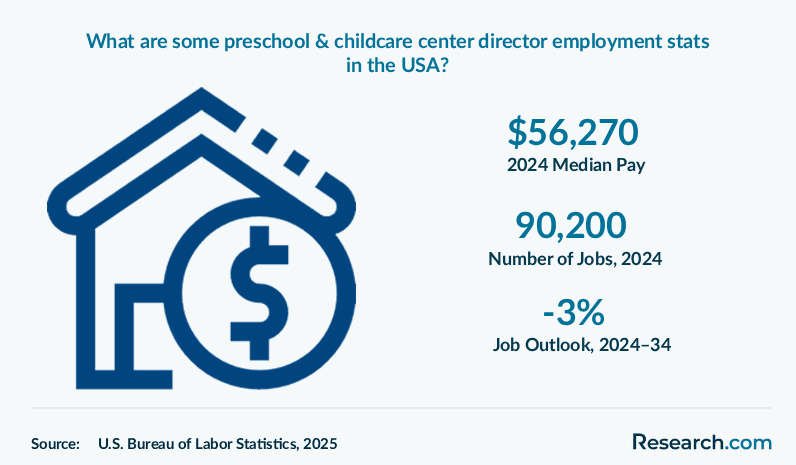
As of May 2024, the preschool director average salary in the United States is approximately $56,270, or about $27.05 per hour. Reported salaries range from $37,000 to $96,000 annually, depending on location, employer type, education, years of experience, center size, and management responsibility.
Location can make a significant difference. The preschool director salary in Maryland tends to be higher than the national average, and directors in metropolitan areas such as New York earn a median of $79,660. Other states with strong education systems, including Massachusetts, also offer competitive pay of around $68,660.
Salary potential is usually higher when a director manages a larger center, supervises more staff, oversees multiple classrooms, works in a high-cost metro area, or holds credentials beyond the minimum. Programs tied to larger organizations may also offer stronger benefits, training budgets, and promotion pathways than very small independent centers.
Education can influence earnings, but it should be planned carefully. Most roles require a bachelor's degree in early childhood education or a related area along with hands-on experience. Advanced credentials, such as the National Administration Credential, may improve competitiveness for leadership roles. If you are exploring an entry point and wondering what is the easiest associate degree to get, make sure the program still includes coursework accepted by your state and relevant to childcare leadership.
When comparing job offers, look beyond salary. Health benefits, paid planning time, tuition support, staff ratios, enrollment stability, and the quality of the ownership or governing board can strongly affect both income stability and job satisfaction.
What internships can you apply for to gain experience as a preschool and childcare center director?
Internships and practicum experiences help future directors understand how childcare centers actually operate. The best opportunities expose you not only to children and classrooms, but also to enrollment, staffing, parent communication, compliance, curriculum planning, and director decision-making.
Consider these experience-building options:
- Preschool and Childcare Centers: Interning directly at a licensed preschool or childcare facility is the most relevant option. Look for placements where you can shadow the director, assist with administrative tasks, observe parent communication, support curriculum planning, and learn how licensing documentation is maintained.
- Preschool Motor Group (PMG) Internship: Availability may vary, but this type of structured experience can involve running sensory-motor groups, documenting child progress, supporting parent education, and learning about developmental milestones under professional supervision.
- Nonprofits, Government Agencies, and Healthcare Providers: These internships may focus on community program design, family outreach, early intervention coordination, compliance, or child and family services. They can broaden your understanding of the systems that affect childcare access and quality.
- ChildCareEd Virtual Internships: Virtual roles in marketing or IT connected to childcare services can help you understand the business, communication, and technology side of childcare management, especially if you want future responsibility for enrollment, outreach, or operations.
- Future Educator Project in San Francisco: Experience in after-school and summer programs can strengthen your skills in curriculum delivery, behavior management, teamwork, and youth development.
If you are searching for Early Childhood Education Internships New York or Childcare Management Internships in NYC, prioritize roles that include leadership exposure rather than only classroom assistance. Ask whether you can attend staff meetings, observe licensing preparation, help with family communications, or support scheduling and records. These experiences will be more useful when applying for assistant director or director-track roles.
Internships are strongest when paired with relevant education. If you are comparing degree pathways, reviewing the highest paying bachelors degree options may help you understand broader education and career trade-offs, but for this field, alignment with early childhood and state licensing requirements is especially important.
How can you advance your career as a preschool and childcare center director?
Career advancement for preschool and childcare center directors usually comes from becoming a stronger instructional leader, a more reliable operator, and a better developer of staff. Promotions often depend on your ability to improve quality while keeping the center compliant, financially stable, and trusted by families.
- Advanced Education: A Master's in Early Childhood Education, educational leadership, administration, or a related field can prepare you for senior director, regional director, curriculum leadership, or policy-focused roles.
- Certification Programs: Credentials such as the Child Development Associate (CDA) and director-focused administrative credentials can demonstrate commitment to professional standards and may help meet employer or state expectations.
- Networking: Professional associations, conferences, local childcare coalitions, and community partnerships can expose you to new practices, mentors, job openings, and policy changes affecting early childhood education.
- Mentorship: A strong mentor can help you handle difficult parent conversations, licensing concerns, staffing problems, budgeting decisions, and leadership transitions more effectively.
Directors who want to move up should keep evidence of results. Track improvements in staff retention, enrollment, inspection outcomes, family satisfaction, curriculum implementation, training completion, and classroom quality. Concrete outcomes make advancement conversations more persuasive.
Where can you work as a preschool and childcare center director?
Preschool and childcare center directors work in several types of organizations, and each setting has different expectations. Someone searching for child care center director jobs in San Jose CA, for example, may find opportunities in private centers, nonprofit programs, employer-sponsored childcare, Head Start programs, and school- or university-affiliated centers.
- Private Childcare Centers: Companies like Bright Horizons and KinderCare may offer structured policies, established curricula, centralized support, and clear advancement paths. Directors in these settings often focus on enrollment, staffing, quality assurance, and parent satisfaction.
- Non-Profit Organizations: Organizations such as the YMCA and local community centers may emphasize affordability, community service, family support, and social development. Directors may work closely with grants, donors, or community partners.
- Government Programs: Programs like Head Start and Early Head Start provide federally funded early childhood education. Directors in these settings must be comfortable with documentation, compliance, family services, and program standards.
- Educational Institutions: Colleges and universities may operate childcare centers for students, faculty, or staff. These settings can offer access to academic resources, teacher preparation programs, research-informed practices, or practicum students.
- Healthcare Systems: Hospitals and healthcare organizations may provide childcare for employees or families. Directors may need to coordinate specialized schedules, safety protocols, and services that support families in demanding work environments.
For those researching types of facilities hiring preschool directors in California, compare more than job titles. A director role at a small independent center may be highly hands-on, while a director role in a large organization may involve more reporting, staffing systems, and corporate or agency oversight. If you need additional credentials, options through online cheap colleges may help reduce education costs while you continue gaining experience.
What challenges will you encounter as a preschool and childcare center director?
Preschool and childcare center directors face challenges that are both operational and emotional. The work can be deeply meaningful, but it also requires constant attention to staffing, safety, family expectations, compliance, and finances.
- Staff management: Recruiting, training, scheduling, and retaining qualified educators can be difficult, especially when pay is modest and the work is physically and emotionally demanding.
- Regulatory compliance: Directors must stay current with licensing rules, staff-child ratios, documentation, background checks, training requirements, safety procedures, and inspection expectations.
- Emotional intelligence: Parent concerns, staff conflict, child behavior issues, and stressful incidents require calm, fair, and professional responses. Directors often have to solve problems without escalating tension.
- Industry evolution: Family needs, technology tools, curriculum expectations, inclusion practices, and safety standards continue to change. Directors must adapt without overwhelming staff.
- Financial stewardship: Budgets can be tight. Directors may need to balance tuition, enrollment, staff wages, supplies, facility costs, and quality improvements without compromising care.
A common mistake is underestimating the business side of the role. Passion for early childhood education matters, but directors also need disciplined systems for hiring, compliance, communication, and budgeting. Without those systems, even a caring center can become unstable.
What tips do you need to know to excel as a preschool and childcare center director?
To excel as a preschool and childcare center director, focus on consistency. Families need to trust the center, teachers need clear support, and children need safe routines. Strong directors create systems that make quality care repeatable, even on difficult days.
- Build both leadership and operational skills. You need to inspire staff, but you also need reliable procedures for scheduling, documentation, supplies, enrollment, and compliance.
- Create a respectful center culture. Teachers are more likely to stay and perform well when expectations are clear, feedback is fair, and communication is consistent.
- Stay current with professional development. Regulations, curriculum practices, safety expectations, and family needs change over time, so ongoing learning is part of the job.
- Invest in staff training and mentorship. New teachers especially need practical guidance on classroom routines, behavior support, family communication, and documentation.
- Set clear expectations early. Staff should understand supervision standards, lesson planning requirements, parent communication rules, emergency procedures, and professional conduct.
- Communicate openly with families. Share important updates promptly, listen carefully to concerns, and document serious conversations when appropriate.
- Lead calmly during problems. Children, families, and staff take emotional cues from the director. A steady response during conflict or emergencies builds confidence.
- Use observation instead of assumptions. Visit classrooms, review records, listen to teachers, and use what you see to guide decisions about staffing, training, and curriculum.
The best directors are visible but not reactive. They know what is happening in classrooms, make decisions based on evidence, and create a workplace where adults can do their best work for children.
How do you know if becoming a preschool and childcare center director is the right career choice for you?
Becoming a preschool and childcare center director may be a good fit if you enjoy early childhood education, want to lead adults, and can handle responsibility for safety, quality, and operations. It may not be the best fit if you prefer spending nearly all your time teaching children directly or if administrative work drains you.
Consider these factors when deciding whether the preschool and childcare center director career fit is right for you:
- Communication and Leadership: You should be comfortable giving feedback, leading meetings, handling parent concerns, and supporting teachers through both routine and difficult situations.
- Organizational Skills: The role requires tracking many details at once, including schedules, files, inspections, training deadlines, staffing, enrollment, and family communication.
- Commitment to Child Welfare: Directors must be strongly committed to safe, nurturing, developmentally appropriate environments for children.
- Lifestyle and Work Hours: Be prepared for full-time work, often exceeding 40 hours per week, with availability during early mornings and late evenings.
- Work Environment and Growth: The job is dynamic and can be demanding, but it offers stability, with employment projected to grow by 8% from 2021 to 2031.
- Personal Values and Career Goals: This career fits people who want their work to have community impact and who are willing to balance mission-driven service with management responsibility.
- Educational Investment: If cost is a concern, a cheap bachelor's degree may help you meet qualification requirements while limiting debt, as long as the program aligns with your state and career goals.
A practical way to test your fit is to shadow a director or take on assistant director responsibilities before committing fully. Pay attention to whether you enjoy solving operational problems, coaching staff, and communicating with families as much as you enjoy supporting children.
What Professionals Who Work as a Preschool and Childcare Center Director Say About Their Careers
- : "Pursuing a career as a preschool and childcare center director has offered me exceptional job stability and a competitive salary that reflects my dedication to early childhood education. The increasing demand for quality childcare ensures steady opportunities for professionals in this field, which is truly reassuring. — Corbin"
- : "Working in this industry presents unique challenges daily, such as balancing administrative duties with the needs of children and staff. Yet, these challenges foster creativity and problem-solving skills that have profoundly enriched my professional experience and personal growth. — Zev"
- : "The access to continuous professional development and specialized training programs has been invaluable in advancing my career as a childcare center director. The supportive environment encourages leadership growth and keeps me motivated to make a lasting impact on the community. — Nico"
Other Things You Should Know About Becoming a Preschool and Childcare Center Director
Certifications such as Child Development Associate (CDA) and Director Credential can enhance a director's qualifications in 2027. These certifications offer specialized knowledge and demonstrate commitment to quality education and leadership in early childhood settings.
In 2027, many states require preschool and childcare center directors to engage in ongoing professional development. This may include workshops, conferences, or courses focusing on leadership, early childhood education best practices, and regulatory updates to ensure quality care and compliance.
Essential skills include leadership, communication, and financial management. Directors must also excel in curriculum planning and staff supervision. According to the National Association for the Education of Young Children, these skills are crucial for effectively running a center in 2027.
References
- 10 Essential Skills Every Daycare Director Must Have — Daycare Studio https://www.daycarestudio.net/home/10-essential-skills-every-child-care-director-must-have
- What is a Childcare Director? Explore the Childcare Director Career Path in 2025 https://www.tealhq.com/professional-goals/childcare-director
- What it is Like to be a Child Care Center Director | ASU Online https://asuonline.asu.edu/newsroom/online-learning-tips/what-you-need-know-about-career-child-care-center-director/
- Preschool and Childcare Center Directors: Salary, career path, job outlook, education and more - RaiseMe https://www.raise.me/careers/management/preschool-and-childcare-center-directors/
- The Child Center of NY Internship Program - The Child Center of NY https://childcenterny.org/the-child-center-of-ny-internship-program/
- Top 5 Things I Wish I Had Known As a Director | McCormick Center for Early Childhood Leadership https://mccormickcenter.nl.edu/library/top-5-things-i-wish-i-had-known-as-a-director/
- 12 Major Challenges Faced by Childcare Owners in 2025 https://illumine.app/blog/12-toughest-challenges-faced-by-childcare-owners
- 10 Common Childcare Management Challenges (and How to Solve Them) https://www.tryplayground.com/blog/10-common-childcare-management-challenges-(and-how-to-solve-them)
- Mastering the Role of Director in Early Childhood Education and Care ( – Butler Diaries https://butlerdiaries.com/blogs/blog/mastering-the-role-of-director-in-early-childhood-education-and-care-ecec-tips-for-success
- Internships & Student Jobs – Office of Child Care and Family Resources – UW–Madison https://occfr.wisc.edu/ece-resources/internships-student-jobs/
- U.S. Bureau of Labor Statistics. (2024). Medical and health services managers. U.S. Department of Labor. https://www.bls.gov/oes/2023/may/oes119031.htm
- U.S. Bureau of Labor Statistics. (2025). Preschool and childcare center directors. U.S. Department of Labor. https://www.bls.gov/ooh/management/preschool-and-childcare-center-directors.htm


