2027 DNP Psychiatric-Mental Health NP Programs for Nurses in Illinois: BSN and MSN Entry Routes and Clinical Training
Audited and Verified:
Our Editorial and Data Verification Process
Research.com uses government datasets, official education statistics and primary institutional information to support its career and degree guides. Our review process checks factual accuracy, occupational definitions, source dates and the requirements associated with the credentials discussed.
How This Article Was Fact-Checked
Our editorial team verifies salary estimates, employment projections, education requirements and program information against original data providers and official organizations. Salary figures are checked against the relevant occupational definitions and reporting periods. Information about licensure, accreditation and required in-person training is reviewed separately.
Fact-checked and verified on:

Co-Founder and Chief Data Scientist
An Illinois RN considering psychiatric-mental health nurse practitioner practice needs to choose more than a doctoral program: the entry route must match the nurse's existing degree and, if applicable, APRN preparation. Clinical access matters just as much as online coursework, because supervised psychiatric care cannot be completed solely from home.
This guide compares BSN-to-DNP and MSN-to-DNP options, explains what to verify about clinical training and cost, and separates graduation from the certification and Illinois licensure needed to practice.
Key Things You Should Know
- A BSN-prepared RN generally needs an NP-preparation track; an MSN-prepared APRN may need either new PMHNP specialty preparation or only DNP completion, depending on existing certification and career goals.
- ANCC's PMHNP certification pathway requires at least 500 faculty-supervised clinical hours in the specialty; DNP programs also plan for at least 1,000 post-baccalaureate practice hours under AACN guidance. Schools determine how qualifying hours count toward each requirement.
- An online Illinois DNP still requires approved clinical experiences, and earning the degree alone does not grant PMHNP certification or Illinois APRN licensure.
What are DNP psychiatric-mental health nurse practitioner programs in Illinois?
A psychiatric-mental health nurse practitioner (PMHNP) DNP is a practice doctorate that combines advanced nursing study with preparation to assess and manage mental health conditions across the lifespan.
A qualifying PMHNP track includes specialty coursework and supervised patient care; a general DNP in leadership or quality improvement does not, by itself, prepare a nurse for PMHNP certification.
Illinois applicants may encounter PMHNP doctoral offerings at institutions including the University of Illinois Chicago and Rush University. Track names, entry points, delivery formats, and open admission terms can change.
Before treating any listing as an option, confirm that the school is accepting students into its PMHNP track for your intended term and can support clinical training where you live.
If you already hold PMHNP certification and want doctoral preparation for practice improvement or leadership, a specialty-qualifying track may repeat training you have completed. Compare its curriculum with shorter routes to a DNP degree, then ask the receiving school for a written review of your prior graduate coursework and practice hours.
What are the BSN-to-DNP and MSN-to-DNP entry routes in Illinois?
The decisive distinction is whether the applicant needs initial PMHNP preparation, a new APRN population focus, or only the doctoral degree. "MSN-to-DNP" does not guarantee that a program includes a PMHNP specialty track.
This comparison shows what each starting credential typically means for the next educational step; individual schools make the final credit and competency determinations:
| Starting point | Likely route | What to confirm |
| RN with a BSN | BSN-to-DNP with PMHNP preparation | Whether the track includes the courses and supervised care needed to seek PMHNP certification |
| RN with a non-APRN MSN | PMHNP-preparation DNP, if admitted | Which graduate credits apply; a leadership or education MSN does not establish NP preparation |
| Certified APRN in another population focus | PMHNP specialty preparation plus any desired DNP work | A formal gap analysis and required new psychiatric clinical experiences |
| Already-certified PMHNP with an MSN | Post-master's DNP without repeating the specialty track, if available | Required doctoral coursework, project, and accepted prior practice hours |
For an MSN-prepared APRN changing specialties, comparing faster PMHNP certificate pathways may reveal a more direct route to specialty preparation. A certificate still needs to meet the certifying body's educational and clinical requirements; it does not automatically award a DNP.
What are the admission requirements for Illinois DNP PMHNP programs?
Expect schools to review an active RN license, a qualifying nursing degree, academic transcripts, graduate-study readiness, and any experience required by the specific track.
Applications may also require references, a statement of purpose, an interview, and documentation needed for clinical-site clearance. An MSN applicant may need syllabi and verified supervised-hour records so faculty can assess prior preparation.
Admission to a university is not the same as admission to its PMHNP track. Applicants should ask whether an Illinois RN license is required at application or before clinical work, whether out-of-state RNs can enroll, and whether the program accepts an MSN earned outside an APRN specialty. Clinical sites may impose additional background-check, immunization, or onboarding conditions.
An LPN, unlicensed bachelor's graduate, or RN without the degree required by a particular entry route should not assume doctoral admission is possible.
Resources for comparing entry barriers at nursing schools address a different stage of education; the relevant first step here is to obtain the nursing credential the DNP track requires.
Online describes how some instruction is delivered, not where all learning occurs. A hybrid program may require scheduled video classes, campus visits, simulation, or in-person assessments.
Both online and campus-based tracks require program-approved supervised clinical care; a nearby job site counts only if the school approves the experience, preceptor, and learning plan.
For a working RN, the useful comparison is a weekly schedule, not the word "flexible." Ask for the number and timing of live sessions, required campus dates, typical clinical days during specialty courses, and whether placements can occur near your home.
If you live outside Illinois, obtain written confirmation that the school can enroll you and arrange qualifying clinical education in your jurisdiction.
An MSN-PMHNP program may be worth considering if the immediate goal is certification rather than a doctorate. Compare its specialty preparation and scheduling with exploring faster online MSN-PMHNP programs; neither an online format nor an advertised completion time removes clinical obligations.
A PMHNP track ordinarily builds on advanced health assessment, pathophysiology, and pharmacology, then develops psychiatric assessment, diagnosis, psychopharmacology, psychotherapy, and care for patients across the lifespan.
DNP study adds evidence appraisal, systems leadership, and an applied practice-improvement project. The school's course map, not the degree title, shows whether all required specialty content is present.
Clinical education should provide supervised encounters with appropriate psychiatric patient populations and documented evaluation by qualified preceptors and faculty. Ask how the school distributes experiences across age groups and care settings, who secures placements, and what happens if a proposed site or preceptor is declined.
ANCC's 500-hour PMHNP specialty minimum and AACN's 1,000 post-baccalaureate DNP practice-hour expectation serve different purposes; the school must explain which documented hours satisfy each standard. Prior employment or simulation should not be assumed to replace supervised specialty care.
Population focus matters when comparing alternatives. A shorter family NP certificate pathway prepares for a different specialty and cannot be treated as interchangeable with PMHNP clinical education, even if some advanced-practice courses overlap.
A BSN-to-DNP student generally has more specialty and doctoral work to complete than an already-certified PMHNP entering a post-master's DNP. An MSN in another field does not necessarily shorten the PMHNP clinical sequence.
Published timelines depend on accepted credits, course rotation, enrollment pace, and placement availability, so request a term-by-term plan for your transcript rather than relying on the shortest advertised duration.
Compare costs using the same assumptions at every school: remaining credits multiplied by the applicable tuition rate, plus mandatory fees, books and technology, clinical onboarding, travel and lodging for campus visits, certification and licensure expenses, and any earnings lost when clinical days replace paid shifts.
Ask whether tuition changes with residency, online enrollment, or part-time status, and what an extra term would cost if a placement is delayed.
Broader PMHNP programs compared by tuition can establish alternatives, but a lower per-credit rate does not establish a lower total cost. Compare the full credential each option awards and obtain an individualized written estimate before committing.
Check three separate matters: institutional accreditation, nursing program accreditation such as CCNE or ACEN where applicable, and the track's ability to support the education required for PMHNP certification and practice in your intended state.
An institution's accreditation alone does not establish that a particular DNP track meets specialty certification requirements. Confirm each claim with the school and the responsible accreditor or credentialing organization.
Clinical placement deserves equal scrutiny because a student cannot complete a specialty track without approved patients, preceptors, and faculty oversight. Request the school's written placement policy: who identifies sites, geographic restrictions, preceptor qualifications, deadlines, and the contingency plan when a site withdraws.
Ask for recent PMHNP certification outcomes with the reporting year and number of test-takers if the school publishes them; a percentage without its cohort size is hard to interpret.
When considering less restrictive DNP entry options, apply the same accreditation and placement checks. Easier admission is useful only if the program provides the specific preparation you need and can deliver its required clinical experiences.
Graduation, national certification, and state authorization are distinct steps. A graduate seeking PMHNP practice must meet the American Nurses Credentialing Center's eligibility requirements and pass its Psychiatric-Mental Health Nurse Practitioner (Across the Lifespan) certification examination.
The graduate must also obtain the Illinois APRN license and applicable authority for the intended practice; the Illinois Department of Financial and Professional Regulation determines state licensure requirements. An active RN license remains foundational.
Before enrollment, ask the program to identify the certification examination its track prepares students to seek and how it documents qualifying education and clinical hours.
Before accepting a job, verify the current Illinois rules for your APRN license, prescribing authority, and practice arrangement. Neither a DNP diploma nor an RN compact privilege alone authorizes PMHNP practice in Illinois or another state.
For readers who have not yet become RNs, claims about a guide to six-month LPN-to-RN claims and alternatives concern an earlier licensure step. LPN education or an LPN license is not a substitute for the RN license and graduate PMHNP preparation required along this route.
Once appropriately certified, licensed, and credentialed by an employer, a PMHNP may provide psychiatric assessment and ongoing mental health care in outpatient clinics, community agencies, hospitals, or integrated primary care.
The work can involve diagnostic evaluation, medication management within legal authority, psychotherapy where supported by training and the role, and coordination with other professionals. Employers may seek experience with particular ages, conditions, or settings beyond degree completion.
A DNP can also support practice-improvement, clinical leadership, or teaching responsibilities, but those positions have their own hiring criteria.
When evaluating an offer, ask about orientation, consultation access, patient complexity, visit length, administrative time, and prescribing and documentation expectations. These conditions may matter more to early PMHNP practice than the doctorate's title.
For an ADN-prepared RN exploring a longer-term move into advanced practice, ADN-to-MSN degree progression may be one educational step to compare. Confirm that any bridge leads to eligible PMHNP preparation rather than assuming every MSN or subsequent DNP does.
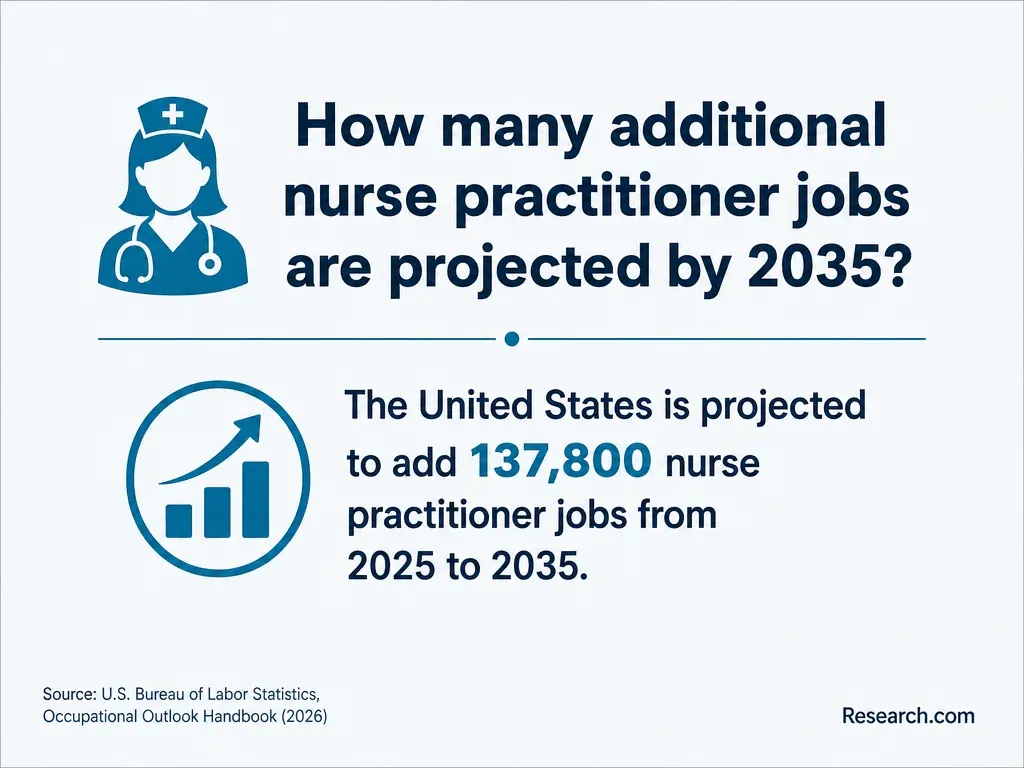
How much do psychiatric-mental health nurse practitioners earn in Illinois?
Public wage series generally report nurse practitioners as an occupation; they do not consistently isolate Illinois PMHNPs or distinguish MSN-prepared from DNP-prepared clinicians. An Illinois NP wage figure can therefore provide market context, but it cannot predict a PMHNP graduate's pay or establish a doctoral salary premium.
For a current numerical benchmark, consult the latest U.S. Bureau of Labor Statistics Illinois nurse practitioner wage estimate and note its reference year before comparing offers.
Actual compensation depends on location, employer, experience, schedule, patient volume, benefits, and whether a quoted amount is a salary or contractor revenue before expenses.
Evaluate the full offer alongside tuition and lost earnings. If certification, not doctoral study, is your immediate goal, BSN-to-MSN bridge cost comparisons can help frame a lower-cost alternative, provided the specific MSN includes qualifying PMHNP preparation.
Other Things You Should Know About Nursing
Not automatically. The patient's location can trigger that state's licensure and telehealth rules. Check the requirements of every jurisdiction where patients will be located.
No degree grants prescribing authority by itself. Verify the current Illinois APRN and controlled-substance requirements, plus any applicable federal registration, before prescribing.
It may. Federal Public Service Loan Forgiveness depends on the loan type, repayment history, and qualifying employer - not the PMHNP job title alone. Check the program's current federal rules and your employer's eligibility.
No. A PMHNP is an advanced practice registered nurse with psychiatric specialty preparation; a psychiatrist is a physician. Their education, licenses, and professional scopes differ.
- Exam Application - Single State - Alabama Board of Nursing https://www.abn.alabama.gov/licensing/apply/licensure-by-exam/exam-application-single-state/
- Nurses | illinois.gov https://idfpr.illinois.gov/dpr/lr/lrapneng.html
- Nursing: Psychiatric-Mental Health Nurse Practitioner, D.N.P. | University of New Hampshire https://www.unh.edu/program/doctor-nursing-practice/nursing-psychiatric-mental-health-nurse-practitioner
- DNP: Psychiatric Mental Health Nurse Practitioner | University of Maryland School of Nursing https://www.nursing.umaryland.edu/academics/doctoral/dnp/psychiatric-mental-health-nurse-practitioner/
- Clinical Collaborations | Nell Hodgson Woodruff School of Nursing https://www.nursing.emory.edu/degrees-programs/simulation-and-clinical-experience/clinical-collaborations
- Psychiatric-Mental Health Nurse Practitioner | University of Illinois Chicago https://nursing.uic.edu/programs/doctor-nursing-practice/dnp-focus-areas/psychiatric-mental-health-np/
- Psychiatric Mental Health Nurse Practitioner, D.N.P. | utc.edu https://catalog.utc.edu/preview_program.php
- Psychiatric Mental Health Nurse Practitioner | UW School of Nursing https://nursing.uw.edu/academics/dnp/pmhnp/
- Graduate Clinical Placements | Master of Science in Nursing Handbook 2025-2026 https://u.osu.edu/msnursinghandbook2025/clinical-requirements/specialty-clinical-locations-and-travel/
- NP Clinical Hours, Preceptors and Placement Explained | Arkansas State University Online https://degree.astate.edu/online-programs/healthcare/msn/np-clinical-hours-and-placement/