
2027 DNP Adult-Gerontology Primary Care NP Programs for Nurses in Maryland: BSN and MSN Entry Routes and Clinical Training
Audited and Verified:
Our Editorial and Data Verification Process
Research.com uses government datasets, official education statistics and primary institutional information to support its career and degree guides. Our review process checks factual accuracy, occupational definitions, source dates and the requirements associated with the credentials discussed.
How This Article Was Fact-Checked
Our editorial team verifies salary estimates, employment projections, education requirements and program information against original data providers and official organizations. Salary figures are checked against the relevant occupational definitions and reporting periods. Information about licensure, accreditation and required in-person training is reviewed separately.
Fact-checked and verified on:

Co-Founder and Chief Data Scientist
A Maryland RN considering adult-gerontology primary care needs more than a DNP program with convenient classes. The specialty requires supervised care across adulthood, and an MSN-prepared nurse may need a different route from a BSN-prepared applicant.
This guide identifies Maryland schools to investigate, compares entry routes and delivery formats, and explains the clinical, financial, and credentialing questions to resolve before applying. It is designed to help you choose a program that fits both your prior preparation and the patients you intend to serve.
Key Things You Should Know
- Johns Hopkins University and the University of Maryland School of Nursing are two Maryland institutions to investigate for DNP adult-gerontology primary care NP preparation; confirm each school's track and entry options for your intended term.
- BSN-to-DNP and MSN-to-DNP are not interchangeable: an MSN without NP preparation may still require the full AGPCNP specialty curriculum and supervised patient-care experiences.
- Compare three separate requirements before enrolling: completion of an eligible AGPCNP program, national specialty certification, and Maryland authorization to practice as an NP. A DNP alone does not provide the latter two.
What Are DNP Adult-Gerontology Primary Care NP Programs in Maryland?
A DNP adult-gerontology primary care nurse practitioner program prepares an already-licensed nurse for advanced assessment, diagnosis, treatment, prevention, and ongoing management of patients from adolescence through older adulthood.
AGPCNP describes the NP role and population focus; DNP describes the practice doctorate. An AGPCNP track must provide the specialty education and supervised clinical preparation needed for certification, not merely a doctorate with an adult-health theme.
Primary care preparation is especially relevant to outpatient clinics, long-term care, and other settings emphasizing continuity and management of common or chronic conditions. It is not the same population focus as adult-gerontology acute care, family practice, or psychiatric-mental health practice.
If a nurse's actual goal is psychiatric care rather than adult primary care, comparing faster PMHNP certificate pathways may be more useful than pursuing an AGPCNP DNP. The nurse's existing credentials would determine whether a certificate is an eligible option.
Which Maryland Schools Offer DNP AGPCNP Programs for Nurses?
Johns Hopkins University School of Nursing in Baltimore and the University of Maryland School of Nursing in Baltimore are the principal Maryland institutions to check for a DNP AGPCNP track.
Treat a school name as the start of a comparison, not proof that every entry route, start term, or clinical arrangement is available to you. Ask each program for the catalog and specialty plan of study that will govern your cohort.
The table identifies what to verify with each school before comparing offers. Program length, format, placement policies, and tuition can differ by entry route and enrollment term.
| Maryland institution | Program to investigate | Decision-critical confirmation |
| Johns Hopkins University School of Nursing | DNP advanced practice, adult-gerontological primary care NP | Available BSN- and MSN-entry plans, required campus attendance, clinical-site support, and total charges |
| University of Maryland School of Nursing | DNP adult-gerontology primary care NP specialty | Available entry routes, course schedule, approved clinical geography, and total charges |
Do not mistake a broader list of Maryland DNP programs for a list of AGPCNP programs: a school may offer only another NP population focus or a non-APRN doctorate. If adult primary care is not your intended role, compare the relevant specialty instead. For example, shorter online mental health NP master's programs address a different clinical goal and credential pathway.
What Are the BSN and MSN Entry Routes to a Maryland DNP?
A BSN-to-DNP AGPCNP route generally combines graduate NP specialty preparation with doctoral practice coursework. It suits an RN with a BSN who wants both AGPCNP preparation and the DNP, provided the longer course sequence and clinical schedule are workable. An RN whose immediate goal is NP eligibility should also compare an appropriately accredited AGPCNP master's route before assuming a doctorate is necessary.
MSN-to-DNP requires a closer review of what the MSN actually covered. An already-certified AGPCNP may primarily need doctoral coursework and practice-hour review.
An MSN-prepared nurse in education, leadership, or a different NP population focus may need substantial new AGPCNP coursework and supervised direct care. Only the receiving school can assess transcripts, syllabi, prior supervised hours, and competencies and issue a reliable plan.
An ADN-prepared RN should not assume direct admission to a BSN-entry DNP track. Depending on a school's policies, a BSN completion route or continuing from an ADN into MSN study may provide an intermediate step. Confirm which resulting credential actually meets the Maryland DNP program's entry rules.
Online DNP coursework can reduce commuting, but it cannot turn AGPCNP preparation into an entirely remote experience. Compare the actual schedule: live classes, intensives, simulation, exams, faculty meetings, and supervised clinical shifts may occur at fixed times. For an employed nurse, the decisive question is often whether approved preceptors and patient encounters are available within a manageable distance, not whether lectures stream online.
Delivery labels also mean different things at different nursing levels. Reading about online coursework formats in practical nursing programs, for example, will not establish what an advanced practice doctorate permits or requires. Request the DNP program's term-by-term calendar and written clinical-placement policy.
Ask whether the school finds sites, assists with student-proposed sites, or expects students to secure preceptors, and whether it accepts placements where you live and hold RN practice authority.
Check institutional accreditation and nursing program accreditation separately. For nursing, verify the applicable program and degree in the Commission on Collegiate Nursing Education (CCNE) or Accreditation Commission for Education in Nursing (ACEN) directory, as appropriate.
Then ask the school to document that its specific AGPCNP curriculum meets the educational eligibility requirements of the certification examination you plan to take and the requirements applicable to Maryland applicants. General university accreditation alone cannot answer that question.
Accreditation also does not establish that every online student can complete clinical work in every jurisdiction. Confirm the school's enrollment authorization and placement rules for your location. Likewise, comparing no-traditional-clinical RN-to-BSN options is not a model for NP education: an AGPCNP candidate needs approved supervised advanced-practice patient care, even if much of the academic coursework is online.
Expect advanced health assessment, pathophysiology, and pharmacology alongside adult-gerontology primary care, diagnostic reasoning, prevention, and management of acute and chronic conditions. DNP study also typically includes evidence appraisal, systems leadership, quality improvement, and a practice-focused scholarly project. The school's published plan, not a generic DNP description, determines course sequence and requirements.
Clinical experiences must offer appropriate patients, an approved preceptor, faculty oversight, and assessment of AGPCNP competencies. Ask for the required number and distribution of direct-care hours, permitted sites, preceptor qualifications, and rules for counting prior graduate practice hours toward any doctoral total.
RN employment, simulation, and previously completed hours do not automatically replace new specialty experiences. A DNP project may also require organizational permission and privacy or ethics review when workplace data are involved.
This distinction matters especially to an MSN-prepared nurse considering online practice doctorates for MSN-prepared nurses. A doctorate designed to build on an existing NP credential is not a substitute for the supervised AGPCNP education needed to enter a new population focus.
Maryland DNP AGPCNP applicants should expect schools to evaluate an appropriate nursing degree, RN license, transcripts, academic preparation, professional recommendations, and a statement of goals.
Schools may also assess nursing experience, an interview, and eligibility for clinical placement. Requirements differ by entry route; an MSN applicant should be prepared to provide syllabi, certification information if applicable, and documentation of supervised graduate practice hours.
Before paying an application fee, ask admissions whether your current license and degree qualify for the specific AGPCNP entry route, not merely admission to the university. Also check how the school evaluates prior graduate courses, whether it requires particular prerequisite grades, and what background, immunization, or site requirements must be met before clinical work.
Understanding barriers to DNP admission can help frame those questions, but an apparently accessible DNP is useful only if its specialty track fits your intended credential.
BSN-entry study generally takes longer than a post-master's plan for an already-qualified AGPCNP because it must include initial NP specialty preparation. An MSN in another field may not receive the shorter plan available to an AGPCNP graduate. Obtain each school's individualized credit and term estimate before comparing advertised completion times.
Calculate cost from the credits you must actually take, the applicable tuition rate, mandatory fees, and the number of terms, not from a single per-credit figure. Add books, clinical compliance expenses, travel or lodging for campus visits, certification and licensing charges, and income lost if clinical shifts reduce paid work.
A lower tuition rate may not mean a lower total cost if the program requires more credits or expensive travel. Online NP tuition and fee considerations provide a useful comparison framework, but request written, route-specific estimates from the Maryland schools and confirm any employer reimbursement conditions.
Graduation, certification, and state authorization are distinct steps. AGPCNP graduates should verify eligibility with their chosen national certifier.
The American Nurses Credentialing Center offers the AGPCNP-BC credential, while the American Academy of Nurse Practitioners Certification Board offers the AGNP-C credential for the relevant adult-gerontology primary care role. Check each organization's current handbook for the required education, documentation, examination, and renewal rules.
After certification, an applicant must satisfy the Maryland Board of Nursing's requirements for NP advanced practice authorization, including applicable RN license or practice-authority requirements. Verify the board's current application and prescribing requirements before beginning work; a diploma or exam pass is not itself permission to practice independently or prescribe.
Choose preparation for the population you expect to treat. An MSN-prepared nurse considering a broader lifespan primary care role could investigate a shorter post-master's FNP pathway, but FNP and AGPCNP curricula and certifications are not interchangeable.
What Careers, Salaries, and Job Outlook Do Maryland AGPCNP Graduates Have?
Maryland AGPCNP graduates may pursue roles in adult primary care practices, specialty outpatient clinics, long-term care, and other settings serving adults and older patients. The job's patient mix, supervision and collaboration arrangements, prescribing responsibilities, call schedule, and onboarding matter more than its title alone. A new NP should assess mentorship and the opportunity to build competence with the employer's patients and workflows.
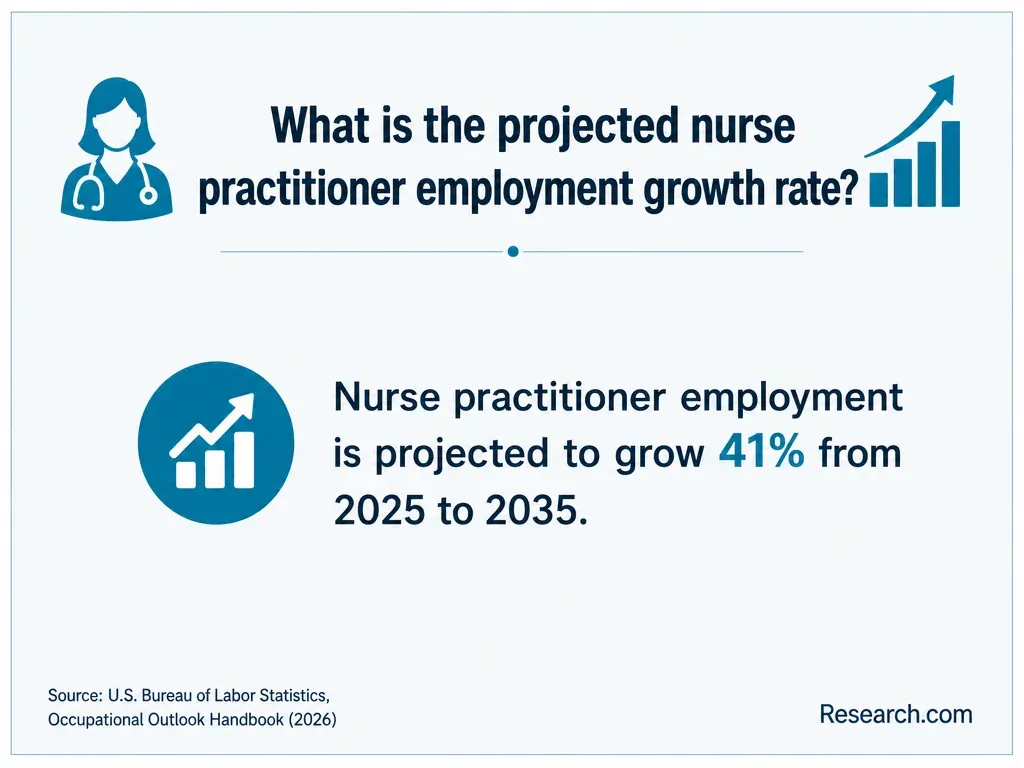
For pay and outlook, the U.S. Bureau of Labor Statistics reports on the nurse practitioner occupation, not a separate Maryland AGPCNP or DNP-graduate category. Its occupational wage and growth figures therefore provide market context, not a reliable estimate of an individual graduate's offer.
Compare actual Maryland postings and offers by location, specialty, hours, benefits, and experience requirements; do not calculate a guaranteed DNP return from an occupation-wide median.
If the alternative career is psychiatric practice, compare its training and total cost on its own terms. Online PMHNP tuition and fee considerations may inform that separate decision, but lower tuition in another specialty is not a reason to choose a population you do not intend to serve.
Other Things You Should Know About Nursing Programs
Not solely because the NP is authorized in Maryland. Check the patient's state rules, applicable NP authority, and employer policies before providing interstate care.
A postgraduate residency is not a universal substitute for education, certification, or licensure. Some employers offer fellowships or extended onboarding; ask what support a particular position provides.
Only with the required school and organization permissions and appropriate privacy and oversight review. Employment does not automatically authorize access or disclosure for a student project.
It can support some teaching applications, but faculty qualifications depend on the position, institution, and teaching assignment. Clinical expertise alone does not guarantee an educator appointment.
- Advanced Practice Registered Nursing | Maryland.gov Enterprise Agency Template https://health.maryland.gov/mbon/Pages/Advanced-Practice-Registered-Nursing-Eligibility.aspx
- Cost of Attendance (Budget) | 2025-2026 Federal Student Aid Handbook https://fsapartners.ed.gov/knowledge-center/fsa-handbook/2025-2026/vol3/ch2-cost-attendance-budget
- Tuition and Fees | University of Baltimore https://www.ubalt.edu/admission-and-aid/tuition-and-fees/index.cfm
- DNP: Adult-Gerontology Primary Care Nurse Practitioner | gwu.edu https://nursing.gwu.edu/programs/dnp/adult-gerontology-primary-care-nurse-practitioner
- Clinical Placements | Berkley School of Nursing https://nursing.georgetown.edu/degree-programs/online-nursing-programs/program-experience/clinical-placements/
- Clinical Placement Services - Johns Hopkins School of Nursing https://nursing.jhu.edu/clinical-placement/
- Tuition and Fees - Student Financial Services | UMB: An Age-Friendly University https://www.umaryland.edu/student-financial-services/tuition-and-fees/
- DNP: Adult-Gerontology Acute Care Nurse Practitioner | University of Maryland School of Nursing https://www.nursing.umaryland.edu/academics/doctoral/dnp/dnp-adult-gerontology-acute-care-nurse-practitioner/


