2027 Data Science Master's Tuition Increases: How to Budget for a Multiyear Program

Co-Founder and Chief Data Scientist
A data science master's that fits your budget today may cost more by the time you finish. For prospective students comparing multiyear programs, the key is to estimate what you will pay each term, not multiply the first year's advertised price by the expected program length. This guide explains how to account for changing tuition, fees, enrollment pace, and financing so you can choose a program with a cost you can sustain through graduation.
Key Things You Should Know
- Do not assume a 2026 tuition quote is locked for the full degree; confirm which rate applies to each future term and whether the school offers a written rate guarantee.
- Budget with a term-by-term estimate that includes required credits, mandatory fees, living costs, and a contingency for an extra term; tuition alone is not the total cost.
- Compare programs at a pace you can realistically maintain. A lower per-credit price may not save money if scheduling or course availability extends enrollment.
What Does a Data Science Master's Degree Cost?
There is no single reliable 2026 price for a US data science master's. Schools vary in required credits, tuition structure, fees, residency rules, and whether rates change between academic years.
A published per-credit rate is a starting point, not a degree-cost quote. Before committing, obtain the current tuition and fee schedule and the program's required-credit total from the institution.
The categories below show what to separate when comparing estimates. Keeping them distinct makes a future tuition increase easier to model without mistakenly applying it to every expense:
| Cost category | What to confirm | Why it matters over multiple years |
| Tuition | Rate per credit or term, required credits, and any residency or program-specific rate | Later credits may be billed at a different rate. |
| Mandatory fees | Which fees apply per credit, term, course, or year | Repeated term fees can make a slower pace more expensive. |
| Materials and technology | Required software, computing access, equipment, and course materials | Requirements may differ by course or project. |
| Living and attendance costs | Housing, transportation, and any required campus visits | These depend heavily on format and personal circumstances. |
| Financing and foregone income | Loan interest and any reduction in paid work | Neither appears in an advertised tuition figure. |
Ask each school for an estimate based on your intended credit load and start term. If a future rate has not been approved or published, label it unknown rather than treating the current price as a promise.
How Can You Budget for Rising Tuition Across Multiple Years?
Build a term-by-term budget before accepting an offer. For each term, multiply planned credits by the rate expected to apply, then add that term's required fees and personal attendance costs.
Keep published charges separate from assumptions about future increases: no schoolwide increase should be applied to a program unless its pricing policy supports that assumption.
These steps turn a tuition quote into a budget you can revise when a new fee schedule appears:
- Map required courses to terms using the program's actual course rotation and prerequisites; identify the earliest realistic graduation term.
- Record the published tuition and fees for each known term. For unpublished terms, create a separate higher-cost scenario rather than presenting a guessed increase as fact.
- Test one delayed-completion scenario that adds an extra term's applicable fees, living expenses, and any credits you would still need.
- Subtract confirmed grants or employer benefits only after checking eligibility, annual limits, payment timing, and whether a grade or continued employment is required.
If the higher-cost scenario would require borrowing you cannot comfortably repay, compare a lighter course load that preserves employment, a less expensive program, or a later start. A lighter load can protect current income but may add recurring fees and expose more credits to later tuition rates.
For funding routes and their conditions, explore financial aid for graduate data science degrees.
How Do Online and Campus-Based Data Science Master's Costs Compare?
Online study can reduce commuting or relocation costs, but it does not necessarily have lower tuition. Some universities charge a distinct online rate; others apply the same tuition and add technology or distance-learning fees. Compare the same planned credit load and completion period for both formats.
This comparison identifies costs that may change with delivery format; the applicable amounts must come from each school's published charges and your own circumstances:
| Cost factor | Online program | Campus-based program |
| Tuition and required fees | Check online-specific rates and technology fees. | Check residency rules and campus fees. |
| Travel and housing | Check for required visits; living costs still apply. | Account for commuting or relocation. |
| Ability to keep working | Depends on meeting times and workload, not format alone. | Depends on class schedules and local access. |
| Completion risk | Check course availability and maximum time allowed. | Check the same constraints, including required in-person courses. |
Choose online study when its schedule lets you maintain income and its full cost remains favorable after fees. Choose campus study when access to particular courses, facilities, or local opportunities justifies its additional attendance costs.
If your interests also include machine learning, affordable online machine learning master's options offer another program category to compare, but verify that its curriculum meets your data science goals.
What Additional Expenses Should Data Science Master's Students Expect?
Beyond mandatory charges, potential expenses include a suitable computer, course materials, cloud-computing usage, travel for required events, and childcare or transportation.
Check whether the school supplies software licenses or computing resources before buying them. An internship or capstone may also affect how many paid hours you can work, even when it carries no separate fee.
Financing has its own cost: loan interest and repayment terms can make two programs with similar tuition materially different for a student who must borrow.
Request an itemized school estimate, then add expenses the school cannot know, particularly lost income. Avoid the common mistake of comparing one program's tuition-only figure with another program's total cost of attendance.
What Accreditation Should a Data Science Master's Program Have?
Check that the institution holds recognized institutional accreditation and that its status is current. The US Department of Education's accreditation database and the accreditor's own directory can help verify a school's claim.
Institutional accreditation matters when evaluating eligibility for federal student aid; it does not, by itself, establish that a particular data science curriculum suits your goals.
Do not assume a program needs a separate data science-specific accreditation to be legitimate. Instead, verify the institution's status, the degree-granting school, and any relevant state authorization for where you will study. If aid eligibility is essential to your budget, confirm it directly with the financial aid office before paying a deposit.
What Courses Are Included in a Data Science Master's Curriculum?
Course requirements affect cost because electives, prerequisites, and course rotations determine how many credits you take and when. Programs commonly cover some combination of statistics, programming, data management, machine learning, and applied projects, but titles alone do not establish depth.
Read the catalog's required-course list and note whether a capstone, internship, or thesis adds a term.
Match the curriculum to the work you want to do before paying for advanced electives. Someone targeting data pipelines, for example, should check for substantial database, cloud, and engineering work rather than assume a machine learning course covers it. AI master's pathways for data engineering skills may be worth comparing if that combination is central to your career plan.
What Are the Admission Requirements for Data Science Master's Programs?
Requirements vary by institution. Check each program's official admissions page for its degree, mathematics, programming, application, and testing requirements.
A prerequisite completed before admission may affect your start date; one added to your graduate plan may affect both tuition and time to completion. Ask whether any required preparation counts toward the degree before budgeting for it.
If your intended role emphasizes reporting or business decision-making more than advanced modeling, explore master's degrees in data analytics alongside data science programs. Compare their required courses and prerequisites, not just their names, to avoid paying for a curriculum that does not match your objective.
How Long Does It Take to Complete a Data Science Master's Degree?
Completion time depends on required credits, course frequency, prerequisites, and how many courses you can take while meeting work and family obligations.
A school's shortest advertised timeline may assume continuous enrollment or a heavier load than you can sustain. Ask for a course sequence at your intended pace, including summer availability and the latest date by which you must finish.
This matters financially in both directions: finishing sooner can limit exposure to later tuition rates and recurring fees, while a manageable pace may let you retain more income.
To examine the scheduling trade-off, compare data science master's completion times against each program's actual course schedule - not its marketing timeline alone.
What Careers and Salaries Can a Data Science Master's Degree Lead To?
A relevant master's can support applications for data scientist and related analytical roles, but the role you can obtain depends on your existing experience, technical skills, projects, and the employer.
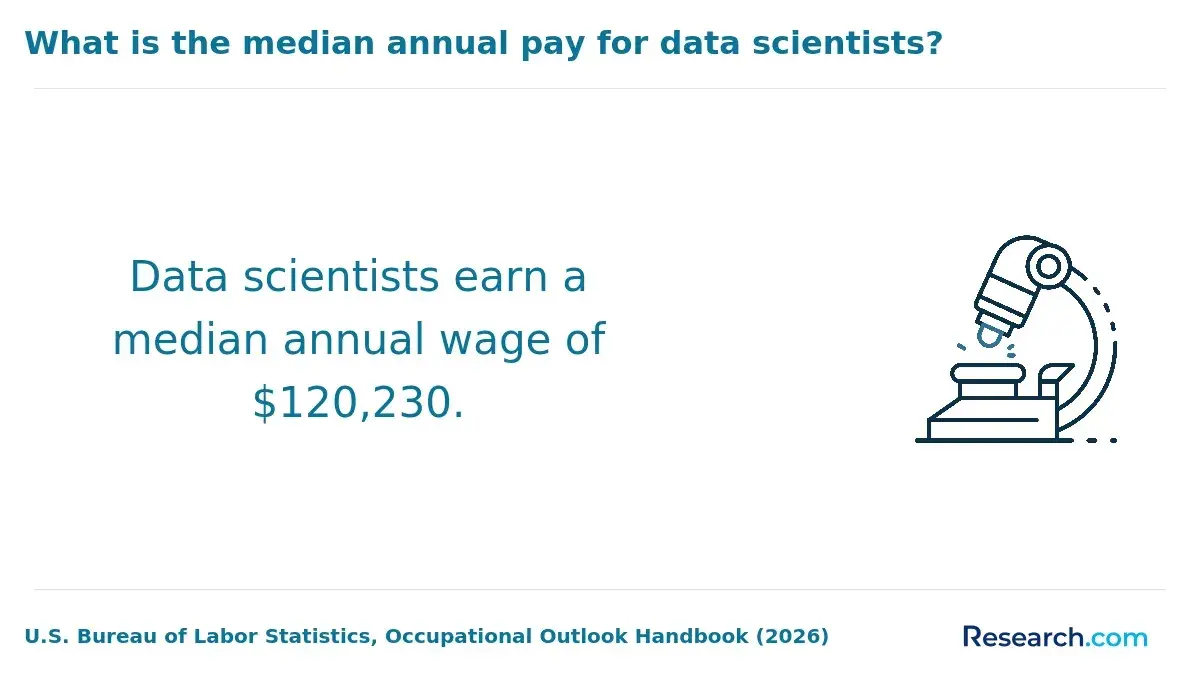
The US Bureau of Labor Statistics reports a $120,230 median annual wage for data scientists in May 2025. That occupation-wide figure is not a starting salary for new graduates or an estimate of the raise a degree will produce.
For a personal return-on-investment decision, compare the program's full cost and any lost income with a realistic change in your employment prospects - not with the national median wage. Request career-outcome reports when available, and check whom they include, when salaries were measured, and whether respondents already worked in the field.
What Is the Job Outlook for Data Science Master's Graduates?
The US Bureau of Labor Statistics projects 35% growth in data scientist employment from 2025 to 2035. That indicates a growing occupation, not a forecast of hiring for graduates of any particular master's program. Competition for an individual position still depends on skills, experience, location, and the role's requirements.
Use the outlook as context, then inspect job postings for the positions you would actually pursue. If a program's projects and courses do not help you demonstrate those required skills, strong national growth alone is not a sound reason to accept a multiyear financial commitment.
Other Things You Should Know About Data Science
Not necessarily. A deposit's refund terms, enrollment effect, and relationship to tuition pricing are separate school policies. Get each in writing before paying.
Do not assume so. Eligibility can depend on whether you have been admitted, whether the courses count toward your eligible program, and the type of aid. Ask the financial aid office about your specific courses.
A leave may change your course sequence, return-term tuition rate, aid status, or loan obligations. Check the institution's leave policy and speak with its financial aid office before stopping enrollment.
Only if your employer pays before the school bill is due. Many benefits are conditional or paid after a term; confirm the payment schedule and requirements so you can plan for any temporary cash shortfall.
References
- Cost of Attendance (Budget) | 2025-2026 Federal Student Aid Handbook https://fsapartners.ed.gov/knowledge-center/fsa-handbook/2025-2026/vol3/ch2-cost-attendance-budget
- Types of Financial Aid: Grants, Work-Study, and Loans | studentaid.gov https://studentaid.gov/understand-aid/types
- Reduced Course Load | Study in the States - Homeland Security https://studyinthestates.dhs.gov/sevis-help-hub/student-records/manage-program-dates-registration-and-course-load/reduced-course
- Estimated Cost of Attendance | Student Success | University of Kentucky https://studentsuccess.uky.edu/financial-aid-and-scholarships/estimated-cost-attendance
- Tuition & Financial Aid | MS in Data Science - Pace Online https://online.pace.edu/graduate-programs/ms-in-data-science/tuition-and-financial-aid/
- Mandatory Fee Descriptions - Tuition Rates and Fees https://www.tuition.pitt.edu/mandatory-fee-descriptions
- Federal Financial Aid Changes FAQs | ucsc.edu https://financialaid.ucsc.edu/get-support/financial-aid-changes-faqs/
- Cost of Attendance - UChicago Financial Aid https://financialaid.uchicago.edu/graduate/costs/cost-of-attendance/