2027 Critical Care Transport Nurse Workday: Patient Mix, Responsibilities, and Teamwork
Audited and Verified:
Our Editorial and Data Verification Process
Research.com uses government datasets, official education statistics and primary institutional information to support its career and degree guides. Our review process checks factual accuracy, occupational definitions, source dates and the requirements associated with the credentials discussed.
How This Article Was Fact-Checked
Our editorial team verifies salary estimates, employment projections, education requirements and program information against original data providers and official organizations. Salary figures are checked against the relevant occupational definitions and reporting periods. Information about licensure, accreditation and required in-person training is reviewed separately.
Fact-checked and verified on:

Co-Founder and Chief Data Scientist
Critical care transport nursing moves high-acuity care between hospitals - and sometimes from an emergency scene - without the resources of a full hospital unit. For an RN considering the specialty, the decision is about more than enjoying emergency care: it involves unpredictable assignments, confined workspaces, close teamwork, and responsibility for a patient whose condition may change in transit. This guide explains the workday, patient mix, preparation, credentials, and employment trade-offs so you can judge whether transport nursing is a realistic next step.
Key Things You Should Know
- A transport nurse assesses, stabilizes, monitors, and hands off a critically ill patient while working within a small team and the transport service's protocols.
- Most roles call for an active RN license and substantial ICU, emergency, or comparable high-acuity experience; a nursing degree alone does not establish transport readiness.
- National RN wage and growth figures cover all registered nurses, not transport specialists. Compare actual offers by base pay, shift structure, call requirements, training, and safety support.
What does a critical care transport nurse do during a typical workday?
A critical care transport nurse provides ongoing, hospital-level nursing care while a patient travels by ground ambulance, helicopter, or fixed-wing aircraft. The assignment is usually an interfacility transfer to a higher level of care or a specialized service. Some flight programs also respond to emergency scenes; that work depends on the program's mission and staffing.
A shift often begins with a team briefing and checks of medications, oxygen, monitors, ventilators, infusion pumps, communications equipment, and transport supplies. When a request arrives, the team reviews the patient's condition and transfer needs, prepares the appropriate equipment, and receives a report from the sending clinicians. During transport, the nurse reassesses the patient, manages ordered therapies and life-support equipment within authorized scope and protocols, documents changes, and communicates concerns to teammates or medical control. At the destination, the team gives a structured handoff, then restocks and prepares for the next call.
That sequence is predictable; the pace is not. A shift may include several transfers or long periods of readiness interrupted by an urgent dispatch. Ask prospective employers whether shifts are staffed in-house or on call, how often crews are dispatched, and what happens after a prolonged mission near shift change.
For a related example of how nursing programs coordinate supervised clinical learning, see comparing clinical site support for FNP students.
What types of patients do critical care transport nurses treat?
The patient mix depends on the transport program's capabilities and referral network. A general adult team might move patients with respiratory failure, shock, severe infection, major trauma, cardiac emergencies, or complex postoperative needs. These patients may require a ventilator, multiple infusions, invasive monitoring, or frequent reassessment during the trip.
Specialized teams may transport premature newborns, critically ill children, obstetric patients, or patients needing advanced cardiac or other specialty support. Those assignments require population-specific training and equipment; experience transporting adults does not automatically qualify a nurse for neonatal or pediatric missions.
A useful distinction when evaluating jobs: ask for the program's actual case mix, not just its aircraft or ambulance type. A largely scheduled interfacility service and a scene-response flight service can differ substantially in preparation time, available patient history, and the decisions the crew must make before departure.
Nurses exploring other specialty-focused graduate education options can also review shorter psychiatric-mental health nursing master's pathways.
How do you become a critical care transport nurse?
For a nursing student or early-career RN, transport is generally a later step, not a first independent specialty assignment. Employers set their own experience and onboarding standards, so job postings are more useful than a universal timeline.
A realistic progression has four stages. Each builds a different kind of readiness:
- Complete a prelicensure nursing program, meet your state board's requirements, pass the NCLEX-RN, and obtain an active RN license.
- Develop independently evaluated high-acuity skills in an ICU, emergency department, or another setting the target employer accepts.
- Review local transport postings for patient-population experience, required courses, physical expectations, and ground or flight-specific qualifications.
- Enter a transport service with supervised orientation, equipment training, scenario practice, and documented competency checks before taking the full assignment.
If you already work in critical care, a transport-team observation opportunity - when an employer permits one - can reveal whether the confined workspace, travel time, and crew communication suit you better than another ICU role. Do not leave a strong clinical position solely to collect credentials before checking local hiring requirements.
For comparison, one-year family nurse practitioner pathways offer an example of another structured route to advanced nursing practice.
The essential nursing credential is an active RN license with authority to practice where the transport assignment requires it. RNs can reach initial licensure through an approved associate, diploma, or bachelor's nursing pathway followed by the applicable examination and state licensing process. Some transport employers require or prefer a BSN; others consider experienced ADN-prepared RNs. Check the specific posting rather than assuming one degree rule applies nationwide.
A BSN may broaden eligibility where it is an employer requirement, but it does not replace bedside critical care experience or transport orientation. Conversely, an ADN-prepared RN who meets an employer's clinical and licensing requirements need not pursue a graduate degree just to perform this role. ADN-to-MSN bridge programs serve different long-term educational goals and should not be mistaken for required transport preparation.
Routes crossing state lines raise an additional question: whether the nurse has practice authority in every relevant jurisdiction. A multistate license may help when the nurse and states meet Nurse Licensure Compact rules, but it is not a substitute for checking applicable state requirements and the employer's operating policies.
Certification requirements vary by employer and patient population. Job postings commonly distinguish life-support courses, professional specialty certification, and employer-verified competence; none of these is the same as an RN license.
Adult transport employers may ask for current resuscitation-course credentials such as BLS and ACLS, while pediatric or neonatal teams may specify population-relevant training. The Board of Certification for Emergency Nursing awards the Certified Transport Registered Nurse (CTRN) and Certified Flight Registered Nurse (CFRN) credentials. An employer may require one, prefer one, or allow a period after hiring to obtain it. Critical care credentials such as CCRN can also be valued, but they do not automatically substitute for CTRN or CFRN when a job specifically requires one.
Before paying for an exam or course, compare the posting with the certifying body's current eligibility and renewal rules. Then ask the employer which credentials are required at application, which can be completed during orientation, and whether exam fees or continuing education are covered.
Nurses interested in a separate postgraduate qualification can also review PMHNP certificate completion timelines.
Transport care is coordinated rather than performed by one clinician alone. A sending physician and care team explain the patient's condition and transfer plan; the receiving team confirms its ability to take the patient. The transport nurse and clinical partner - often a paramedic or another nurse - prepare the patient for travel, divide monitoring and treatment tasks, and communicate changes. Medical-control physicians provide consultation under the service's arrangements when a situation exceeds standing protocols or calls for escalation.
On an aircraft, the pilot or flight crew controls aviation decisions, including whether conditions permit a safe mission. Clinical urgency does not override that authority. In a ground unit, the driver and clinical crew coordinate movement and safety while care continues in the patient compartment.
Good teamwork is observable in brief, closed-loop communication: someone names a concern, the responsible teammate acknowledges it, and the crew confirms the plan. When comparing employers, ask how crews resolve disagreements, contact medical control, and debrief difficult calls - not merely how many disciplines appear on the staffing chart.
For nurses interested in developing leadership qualifications, online DNP leadership pathways for graduate nurses provide a related look at doctoral-level nursing education.
Prelicensure courses in assessment, physiology, pharmacology, and clinical judgment provide a foundation. ICU or emergency experience then helps an RN recognize deterioration, prioritize competing problems, communicate concise reports, and work with complex equipment. Transport adds a distinct constraint: the team may have limited space, supplies, staffing, and access to the patient during travel.
Relevant employer training can include ventilator and infusion-pump operation, transport equipment checks, pediatric or neonatal care when applicable, documentation, infection prevention, and safe movement of patients. Simulation is especially useful for rehearsing equipment failures and team communication, but participation alone does not establish independent competence. A sound orientation includes supervised missions and assessment of performance with the service's actual equipment and protocols.
If you are choosing between another degree and targeted preparation, start with the gaps named in local postings and your own clinical evaluations. For many licensed RNs, stronger high-acuity experience and a well-supported transport orientation are more directly relevant than additional graduate coursework.
For a broader look at graduate nursing education, compare short online DNP completion pathways.
There is no single reliable national wage figure specific to critical care transport nurses. The U.S. Bureau of Labor Statistics (BLS) reports wages for the broader registered nurse occupation, which includes many specialties and settings; its May 2024 national median annual wage for RNs was $93,600. That figure is a benchmark for context, not a prediction of a transport offer or a transport nurse's typical pay.
Compensation can vary with location, employer, experience, ground versus flight staffing, and how the organization pays for nights, weekends, overtime, standby time, and call-backs. A higher hourly rate may be less attractive if it comes with unpredictable call obligations or reduced benefits.
Compare offers using the expected annual schedule and the employer's written pay rules. Include health and retirement benefits, certification support, travel between bases, and whether required training is paid; do not estimate annual income from an hourly rate without accounting for actual paid hours.
Nurses weighing future education expenses alongside career earnings can also consult these nurse practitioner program tuition comparisons.
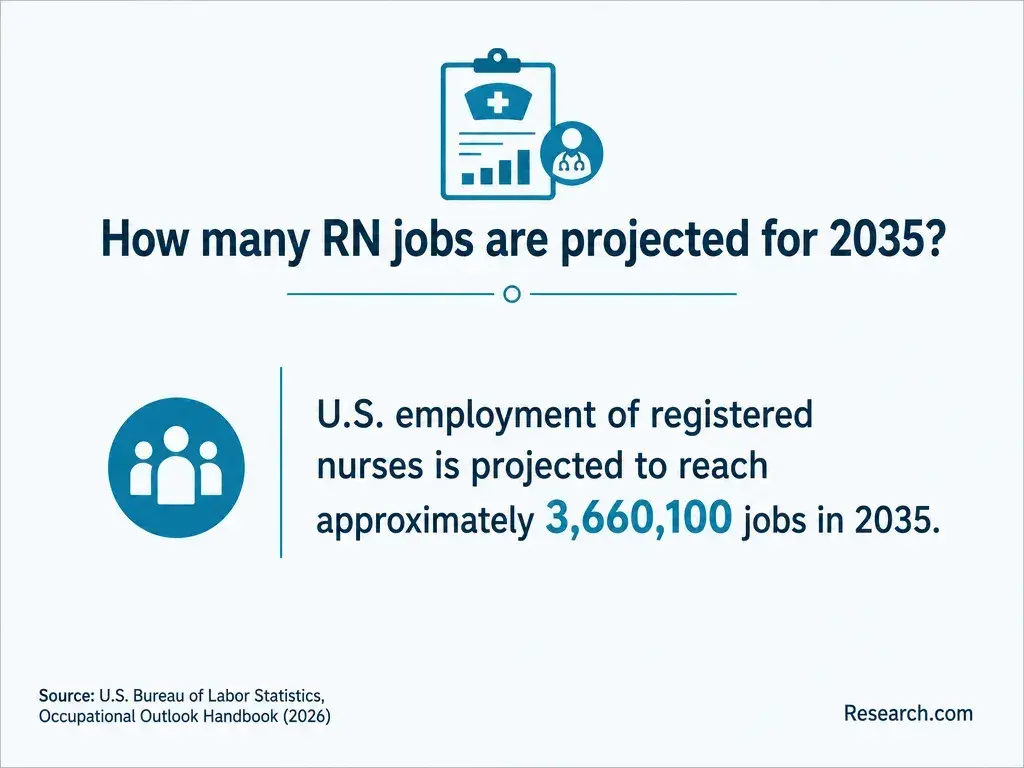
BLS does not publish a separate employment projection for critical care transport nurses. Its projection for registered nurses as a whole is 5% employment growth from 2024 to 2034. That occupation-wide forecast cannot show how many openings a particular flight program or ground service will have.
Local prospects depend on referral patterns, hospital networks, service coverage, funding, and turnover. Transport teams are small compared with the overall RN workforce, so a region can have a need for critical care nurses without many open transport positions at a given time.
For a practical market check, review several months of local postings. Note whether openings recur, which patient populations they serve, what experience they require, and whether roles are full-time, part-time, or call-based. That evidence is more useful for planning your next move than applying a national RN growth percentage to a small specialty team.
For readers considering other nursing career pathways, affordable online psychiatric nurse practitioner programs offer another example of specialty-focused graduate education.
How can you choose an accredited nursing program for transport nursing?
If you are not yet an RN, choose a nursing program that supports initial RN licensure first; transport specialization comes later. Verify the school's institutional accreditation, the nursing program's accreditation where applicable, and the state board's approval or recognition for your intended licensure route. These are separate checks, and a school's general accreditation alone does not establish RN examination eligibility.
Compare programs by supervised clinical access, graduation and NCLEX outcomes with their reporting years, total cost, and whether the schedule is feasible for you. Ask how the program introduces high-acuity assessment and whether students have opportunities to observe critical care practice. An advertised "transport" elective is less important than sound generalist preparation and reliable clinical learning.
Already licensed? You usually do not need a new nursing degree solely to explore transport. Check the target employer's degree policy before enrolling in an RN-to-BSN program, and weigh any required degree against the experience, orientation, and specialty training the job also demands.
For licensed nurses comparing graduate study costs after completing a BSN, see affordable online BSN-to-MSN bridge programs.
Other Things You Should Know About Nursing
It depends on the vehicle, patient needs, safety rules, and transport service policy. Ask the crew or coordinating hospital; never assume a seat will be available, particularly on an aircraft.
The aviation team makes the flight-safety decision. Clinicians and dispatch then coordinate an appropriate alternative, which may include ground transport or waiting while the sending facility continues care.
Yes, if a service offers observation and permits it under privacy and safety rules. Watch how the crew prepares, communicates, and hands off care, not only what happens during the trip.
Ask about actual case mix, supervised orientation, staffing partners, dispatch frequency, call expectations, medical-control access, and how the service evaluates readiness for independent assignments.
- Aeromedical Transport - StatPearls - NCBI Bookshelf - NIH https://www.ncbi.nlm.nih.gov/books/NBK518986/
- Characteristics and Demographics of Patients Requiring Emergent Air Medical - PMC https://pmc.ncbi.nlm.nih.gov/articles/PMC8904089/
- Risk Factors for Stress and Burnout | Healthcare Workers https://www.cdc.gov/niosh/healthcare/risk-factors/stress-burnout.html
- The Importance of Ground Critical Care Transport | PubMed https://pubmed.ncbi.nlm.nih.gov/27625421/
- AFMS Capability: Critical Care Air Transport Team | af.mil https://www.airforcemedicine.af.mil/platforms/AFMS-Capability-Critical-Care-Air-Transport-Team/
- Continuing Competency | Washington State Board of Nursing https://nursing.wa.gov/licensing/continuing-competency
- Strategy 3: Nurse Bedside Shift Report | Agency for Healthcare Research and Quality https://www.ahrq.gov/patient-safety/patients-families/engagingfamilies/strategy3/index.html
- What is a Critical Care Nurse? | Salary & Career Outlook | Maryville Nursing https://nursing.maryville.edu/blog/critical-care-nurse
- Critical Care Transport Nurse Career Path | uprovidence.edu https://www.uprovidence.edu/about/news/critical-care-transport-nurse/
- Certified Transport Registered Nurse Program Overview | The Board of Certification for Emergency Nursing https://bcen.org/ctrn/program-overview/