2027 Choosing a BS in Business Administration: How to Check a Tuition Quote Not Shown in the University Catalog
Audited and Verified:
Our Editorial and Data Verification Process
Research.com uses government datasets, official education statistics and primary institutional information to support its career and degree guides. Our review process checks factual accuracy, occupational definitions, source dates and the requirements associated with the credentials discussed.
How This Article Was Fact-Checked
Our editorial team verifies salary estimates, employment projections, education requirements and program information against original data providers and official organizations. Salary figures are checked against the relevant occupational definitions and reporting periods. Information about licensure, accreditation and required in-person training is reviewed separately.
Fact-checked and verified on:

Co-Founder and Chief Data Scientist
A university has quoted you a price for a BS in Business Administration, but you cannot find that rate in its catalog. Before you accept an offer or make a deposit, you need to know who authorized the quote, which charges it covers, and whether it applies throughout your remaining coursework.
This guide is for first-time, transfer, and returning students comparing business programs. It explains how to obtain a reliable written cost breakdown, identify charges that could change, and decide whether the degree still fits your budget and goals.
Key Things You Should Know
- Ask the bursar or student accounts office to confirm the quoted tuition rate in writing for your degree, enrollment term, campus or online format, and student classification.
- Compare the quote with an official degree audit: accepted transfer credits do not necessarily reduce the business courses you must pay to complete.
- Budget for required fees, uncovered courses, possible additional terms, and aid or employer payments separately; a tuition quote is not a final net-price guarantee.
What Is a BS in Business Administration?
A Bachelor of Science in Business Administration is an undergraduate degree combining general education with coursework across business functions. A school may offer concentrations, but their names and requirements vary. A BS, Bachelor of Business Administration, and specialized business degree are not interchangeable simply because they share some courses.
That distinction matters when checking a quote. A rate advertised for an online BBA, for example, may not apply to a campus-based BS or to courses billed through another division. If your goal is specifically a supply chain role, compare the BS curriculum and quoted cost with supply chain degree cost and duration comparisons rather than assuming the broader degree is the cheaper route.
How Can You Verify a Tuition Quote Not Listed in the University Catalog?
Treat an unpublished quote as a proposal to verify, not as the university's established rate. The catalog may omit a newly approved rate, refer readers to a separate tuition schedule, or cover a different student group. Only the university can resolve which policy applies to your enrollment.
Use this sequence before paying a nonrefundable deposit or choosing courses:
- Save the dated quote and note who issued it, when it expires, and any conditions in the message or offer letter.
- Ask the bursar or student accounts office for the official rate schedule or a written, itemized confirmation covering your exact degree, start term, delivery format, residency or other rate classification, and enrollment intensity.
- Ask whether tuition is charged per credit, course, term, or subscription period; request mandatory fees, course-specific charges, and the policy for later rate increases.
- Request an official degree audit or written requirement review showing which prior credits apply and what courses remain, then ask the billing office to price that enrollment pattern.
- If the quote conflicts with the catalog or website, send both documents to student accounts and admissions and request a written explanation from the office authorized to set or approve the rate.
For comparisons with affordable colleges for online business degrees, use the same remaining-credit assumptions at every school. A low published per-credit rate can be a poor comparison if it excludes fees or depends on transfer credits the school has not approved. If the university will not identify the rate's authority or terms in writing, regard the final cost as unresolved.
What Does a BS in Business Administration Cost?
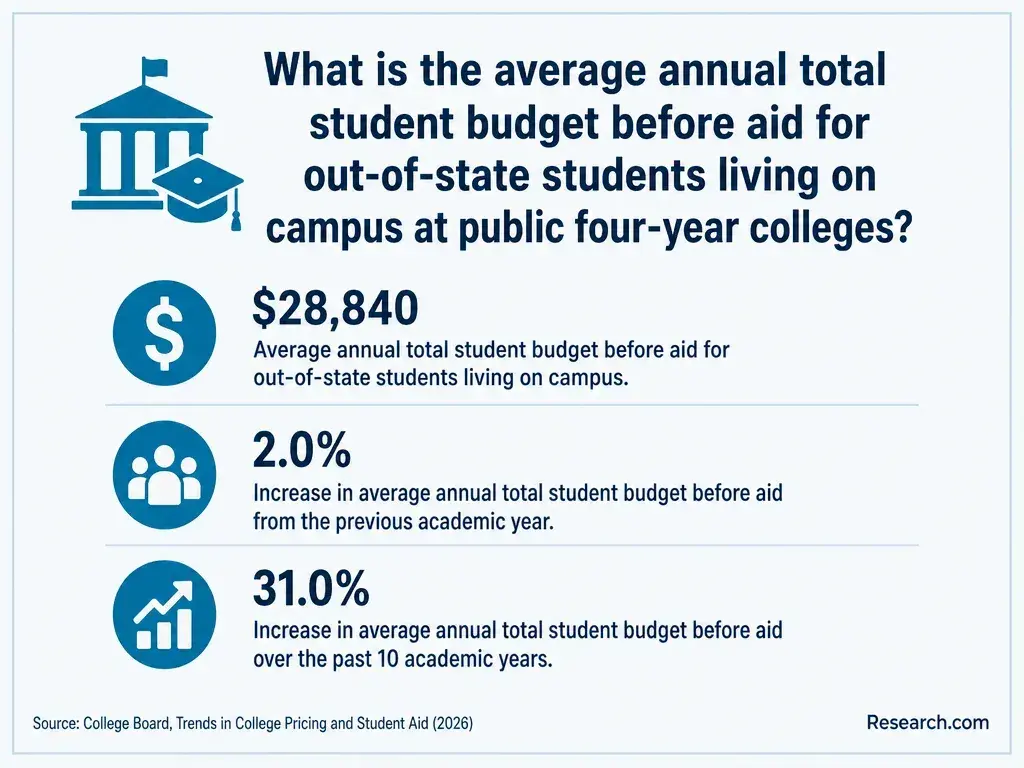
There is no responsible single price for this degree: schools use different billing units, and students need different numbers of courses. The following cost categories help distinguish the quoted tuition from the amount you may actually need to fund.
| Cost category | What to confirm | Why the quote may be incomplete |
| Tuition | Billing unit, applicable rate, and remaining required coursework | The quote may assume a full-time schedule or exclude courses outside the business division. |
| Required charges | Institutional, technology, course, and graduation fees | Some charges appear only when a course or term is billed. |
| Learning and attendance costs | Books, software, proctoring, commuting, or required visits | These expenses may not appear on a tuition schedule. |
| Financing and timing | Aid eligibility, loan terms, employer reimbursement, and payment deadlines | Funds arriving later do not eliminate an earlier payment obligation. |
Calculate an estimated completion cost from the school's confirmed billing rules and your approved remaining requirements. Then distinguish sticker cost from costs after confirmed grants or scholarships, and both from the cash you must have before reimbursement arrives.
An extra prerequisite or unavailable required course can add another billed term. If you are also considering a project management pathway, project management undergraduate scholarship comparisons can help frame aid questions, but only an award from your chosen school establishes what you will receive.
Confirm the institution's current accreditation with the accreditor and the U.S. Department of Education's accreditation records. Then check whether a claimed business accreditation - such as AACSB, ACBSP, or IACBE - covers the relevant school or program. Institutional accreditation and business accreditation address different scopes; neither verifies a tuition quote or guarantees employment.
Also establish that the institution is authorized to offer the program where you will study, particularly if you will enroll online from another state. Ask which university office approves tuition schedules and whether the rate applies to your specific program. Lists of online universities with no application charge may help narrow initial application expenses, but an application-fee policy says nothing about program approval or the price of completing a degree.
Business administration programs commonly cover accounting, economics, finance, marketing, management, operations, quantitative methods, and business communication alongside general education. The actual course map matters more than a generic description: prerequisites, concentrations, and capstones can change which courses remain and when you can take them.
Request a degree audit that separates general education, business core, concentration, electives, and residency requirements. If you already have project experience or want a more focused qualification, compare the required courses and transfer treatment with transfer-friendly project management bachelor's degrees. A business elective with a project management theme does not automatically create a formal concentration or replace a required core course.

Requirements vary by school and applicant type. First-time students may need a secondary-school credential; transfer applicants generally submit prior college transcripts. A business major may also have entry requirements distinct from admission to the university. Some programs require mathematics, accounting, or other preparatory courses before particular business classes, even when those courses are not admission conditions.
Before relying on a completion-cost estimate, ask admissions and the business adviser to identify outstanding requirements and the term in which you can take them. Use a guide to compare business administration admission prerequisites, then confirm the rules for your school and catalog year. Admission alone does not establish how previous credits will apply or what your final tuition bill will be.
Completion time depends on approved transfer credit, course sequencing, term availability, and how many credits you can take while meeting academic-progress rules. A preliminary statement that a school will "accept" credits does not show whether they satisfy the business core, a concentration, or graduation residency requirements.
Ask an adviser for a term-by-term plan based on the official audit, including any prerequisites offered infrequently. Then have student accounts apply the verified rate to that plan. Online colleges offering accelerated bachelor's degrees provide another format to investigate, but a shorter advertised calendar does not prove fewer required credits, a lower total price, or a workable weekly schedule.
Choose the format whose actual obligations fit your schedule and whose rate the university confirms for you. An online quote may differ from a campus quote, and online study can still require live meetings, timed exams, group presentations, or scheduled internships. Campus study may add commuting costs while providing in-person access to classes and services.
Ask for sample course schedules, assessment rules, any required visits, and a list of courses not offered in your preferred format. When comparing a broad business BS with three-year supply chain undergraduate degree routes, check both schools' transfer decisions and required course schedules. The fastest advertised route is not necessarily the fastest route for your prior credits and available study time.
A BS can support applications for roles such as operations coordinator, administrative specialist, sales support associate, or marketing coordinator, depending on your skills and the employer's requirements. Relevant work experience, internships, spreadsheets, communication, and evidence of completed projects can matter as much as the degree title for a particular opening. Graduation does not by itself qualify someone to manage staff or hold a regulated credential.
Check local postings for the roles you want before committing to an uncertain tuition quote. If your goal is specifically HR, compare the business curriculum with HR bachelor's completion with transferred coursework. The more focused route may be worth considering if it accepts your credits and covers the HR responsibilities employers seek; the broader BS may suit you better if you want flexibility across functions.
What Are the Salary and Job Outlook for Business Administration Graduates?
There is no single salary or job-growth figure for everyone with a business administration degree. U.S. Bureau of Labor Statistics figures describe occupations, not outcomes guaranteed by a particular major. For example, human resources specialists had a median annual wage of $75,940 in May 2025, and BLS projects 6% employment growth from 2025 to 2035. That median includes workers at different career stages; it is not a starting salary for a new graduate.
For a financial decision, compare realistic openings in your target location with the program's confirmed completion cost, borrowing needs, and the experience you already have. If your intended work is in logistics rather than HR, supply chain degree cost and duration comparisons may help you assess a more specialized route. Do not use an occupation-wide wage to justify paying an unpublished rate that the university has not confirmed.
Other Things You Should Know About Business Administration
Only as a starting point. Their rate may depend on enrollment term, location, format, credit load, or an individual award. Request a quote issued for your own record.
Ask for the estimate first. If a school says a deposit is required, request its written deposit and refund policies so you understand the risk before paying.
Contact student accounts promptly with the dated quote, the bill, and your enrollment details. Ask for an itemized explanation and the school's billing-dispute procedure before a payment deadline passes.
Save the dated quote, applicable rate schedule, written clarifications, degree audit, aid offer, enrollment agreement, and bills. They help you identify changes and document a dispute.
- U.S. GAO - Financial Aid Offers: Action Needed to Improve Information on College Costs and Student Aid https://www.gao.gov/products/gao-23-104708
- Types of Financial Aid: Grants, Work-Study, and Loans | studentaid.gov https://studentaid.gov/understand-aid/types
- Cost of Attendance (Budget) | 2025-2026 Federal Student Aid Handbook https://fsapartners.ed.gov/knowledge-center/fsa-handbook/2025-2026/vol3/ch2-cost-attendance-budget
- Tuition and Fees - The Ohio State University https://registrar.osu.edu/student-hub/tuition-and-fees/
- Explanation of Fees | University of North Texas https://studentaccounting.unt.edu/explanation-fees.html
- Undergraduate Tuition Rates - Student Accounts | Illinois State https://studentaccounts.illinoisstate.edu/billing/undergraduate-tuition/
- Transfer Credits | Registration & Advising | Skyhawk Station https://www.fortlewis.edu/skyhawk-station/student-record/transfer-credits
- OHIO Online Tuition and Fees https://www.ohio.edu/bursar/undergraduate-tuition/ohio-online-tuition-fees
- Glossary of financial aid terms Graduate and Professional | The Ohio State University https://sfa.osu.edu/graduate-students/about-aid/financial-aid-terms
- Understanding tuition and fees - Student Financial Services | Virginia Commonwealth University https://sfs.vcu.edu/tuition-and-fees/understanding-tuition-and-fees/