2027 Choosing a BS in Business Administration for Business Roles in Advertising Agencies
Audited and Verified:
Our Editorial and Data Verification Process
Research.com uses government datasets, official education statistics and primary institutional information to support its career and degree guides. Our review process checks factual accuracy, occupational definitions, source dates and the requirements associated with the credentials discussed.
How This Article Was Fact-Checked
Our editorial team verifies salary estimates, employment projections, education requirements and program information against original data providers and official organizations. Salary figures are checked against the relevant occupational definitions and reporting periods. Information about licensure, accreditation and required in-person training is reviewed separately.
Fact-checked and verified on:

Co-Founder and Chief Data Scientist
Advertising agencies need people who can manage client relationships, budgets, timelines, and campaign performance, not just create ads. If you are considering a BS in Business Administration, the decision is whether its broad business training will prepare you for the agency work you want, or whether a more specialized path would serve you better.
This guide connects degree choices to actual agency responsibilities, explains where experience matters more than a course title, and shows what to verify before committing to a program.
Key Things You Should Know
- A BS in Business Administration can prepare you for agency account, operations, and project-coordination roles, but internships or work samples are often needed to demonstrate agency readiness.
- Choose marketing and analytics coursework for campaign-related work; prioritize finance, operations, and project management for budgets, staffing, and delivery.
- The U.S. Bureau of Labor Statistics reports a $78,760 median annual wage for market research analysts in May 2025; that occupation-wide figure is not an expected starting salary for an agency graduate.
What Is a BS in Business Administration for Advertising Agency Careers?
A BS in Business Administration is an undergraduate degree covering business functions such as accounting, marketing, management, finance, and quantitative analysis.
In an advertising agency, that foundation can support the business side of campaigns: estimating costs, interpreting results, coordinating work across teams, and communicating with clients.
It is not necessarily an advertising degree. An advertising or communications major may offer more instruction in creative strategy, media, or copywriting, while a BS in Business Administration may offer more preparation for budgets and operations.
Degree titles alone do not establish the difference: compare the required courses and available projects at each school. If you are weighing the investment against likely career routes, use business administration degree cost versus career outlook as a starting comparison, then check each program's actual requirements and price.
What Advertising Agency Jobs Can You Get With a Business Administration Degree?
The most plausible entry points depend on what you can do, not just what your diploma says. The table connects common agency functions with the evidence an applicant could bring to an interview; titles and hiring standards vary by employer:
| Agency function | Possible early-career role | Useful evidence of readiness |
| Client service | Account coordinator | Clear client updates, meeting notes, and organized follow-through |
| Campaign delivery | Project or traffic coordinator | Schedules, task tracking, and handling of changing deadlines |
| Research and measurement | Marketing or research assistant | Spreadsheet analysis and careful interpretation of campaign data |
| Agency operations | Operations or billing assistant | Budget tracking, invoicing basics, and process documentation |
A graduate might also pursue media-planning or paid-media support roles, but those jobs can require platform-specific skills. Account director, marketing manager, and agency operations manager are generally experience-dependent positions, not automatic next steps after graduation.
If coordinating complex work is your main goal, compare the business degree with online degree options in project management at lower cost; judge both by their coursework and access to relevant projects.
Is a Business Administration Degree Good for Advertising Careers?
Yes, particularly for the commercial and organizational side of agency work. The degree is a stronger fit when you want to connect campaign decisions to client objectives, budgets, staffing, or performance.
It is less direct if your goal is to build a copywriting, graphic design, or video-production portfolio; specialized study and substantial creative practice may matter more for those paths.
For a career changer, start by identifying what your existing experience already proves. Customer service can support account work; scheduling can support traffic coordination; and financial or analytical work can support budgeting or measurement.
Then identify the missing agency-specific evidence. If you are more interested in purchasing and physical distribution than advertising production, explore lower-cost supply chain completion routes rather than choosing an agency-oriented course plan for an unrelated goal.
Most students would enroll in a business administration program and select relevant marketing courses or a formal concentration, if offered - not a separately defined "advertising program."
The most useful combination pairs marketing research and consumer behavior with accounting, statistics, spreadsheets, and project or operations coursework. That mix helps an agency employee understand both what a campaign aims to achieve and what it takes to deliver it within a budget.
Look beyond course names. A campaign analysis using appropriately sourced data, a documented project schedule, or a presentation that explains measurement limits can become stronger evidence of skill than an elective alone.
Confirm whether a marketing concentration is officially awarded, whether its courses are offered when you need them, and whether it adds credits. If your interest turns toward supplier logistics rather than campaigns, accelerated degree planning for supply chain undergraduates is a separate comparison, not a substitute for agency-relevant marketing work.
Choose the format that lets you complete both the degree and relevant experience. An online program may make classes easier to attend alongside work, but fixed deadlines, live presentations, group projects, proctored exams, or an internship can still constrain your schedule.
A campus program may offer easier access to student organizations, faculty, and local agency recruiting, though those opportunities are not guaranteed.
Ask each school how students complete team projects and find internships, whether career services work with online students, and whether required classes are available in your intended sequence.
If studying online is the practical choice, compare tuition for online business colleges alongside scheduling and career support; the lowest advertised tuition may not produce the lowest completion cost.
Requirements vary by school and by whether you apply as a first-year or transfer student. Schools may request secondary-school or college transcripts, set academic-standing standards, and require particular mathematics or business courses before entry to the major.
Admission to the institution does not necessarily mean admission to every concentration or that prior credits will satisfy business-core requirements.
Before applying, request the current catalog requirements and, if you have college credit, an official evaluation showing where each course applies. Ask specifically about statistics, accounting, and prerequisite sequencing if you hope to take marketing analytics early.
For a broader explanation of required credits before entering business administration study, compare the general guidance with the school's binding policies.
A full-time bachelor's pathway commonly spans four academic years, but a transfer student's remaining time depends on credits applied to requirements, course availability, and enrollment pace.
Do not calculate a completion date from accepted credits alone. An internship or concentration course offered infrequently can also affect the schedule.
For cost, compare remaining tuition and mandatory fees, then account for books, software, travel, and any reduction in paid work. Request a degree audit and a term-by-term estimate before treating an accelerated option as cheaper.
Shorter pathways to an online business degree may reduce calendar time, but a faster schedule can make agency internships or employment harder to manage.
First, verify the institution's accreditation and status with the accreditor and the school. Then check whether any claimed AACSB, ACBSP, or IACBE business accreditation covers the school or program you would actually attend. Institutional accreditation and specialized business accreditation have different scopes; neither, by itself, proves strong agency placement.
Ask for evidence that matters to your goal: where business students intern, whether advertising or marketing employers recruit there, and what career-outcome data include online and transfer students.
If you are comparing online business administration degrees at lower prices, apply the same accreditation and outcome checks to every option rather than using price as a proxy for quality.
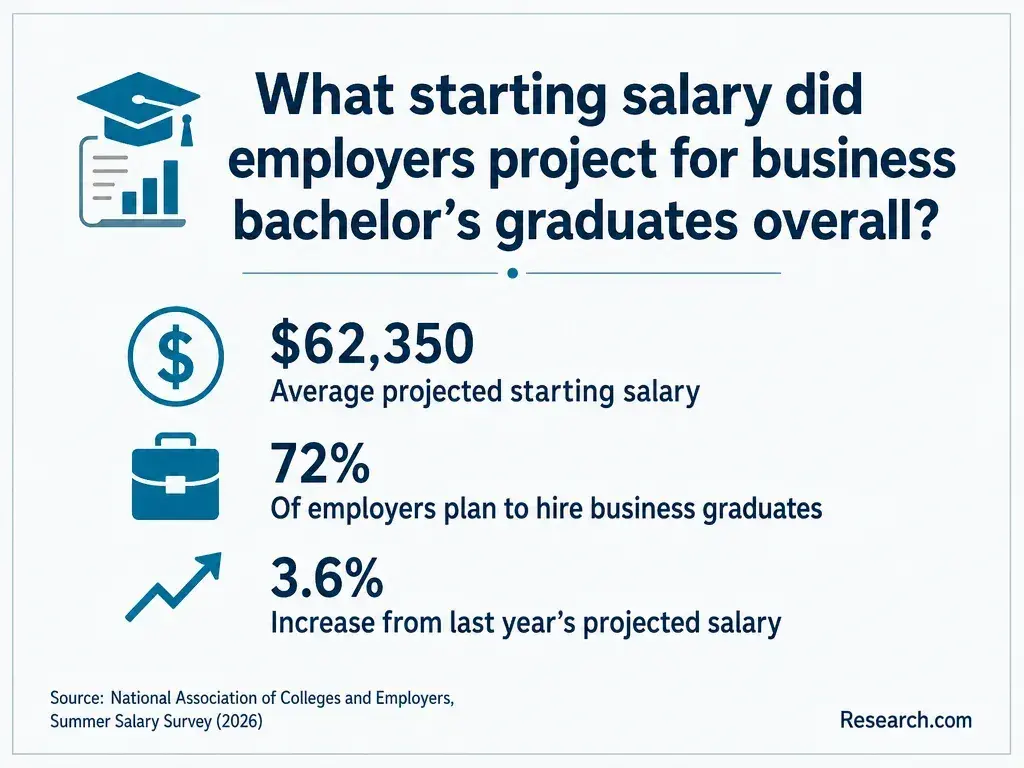
Pay depends on the occupation, responsibilities, location, employer, and experience - not on the degree alone. The U.S. Bureau of Labor Statistics reports that market research analysts had a $78,760 median annual wage in May 2025, with employment projected to grow 7% from 2025 to 2035.
That occupation includes workers outside advertising agencies and at different career stages, so its median should not be used as an offer estimate for a new graduate or an account coordinator.
Management pay is even less suitable as a starting-salary benchmark because managers typically carry substantial prior responsibility. If your long-term goal is agency leadership, organizational leadership bachelor's routes of three years or less offer another educational comparison, but neither degree replaces the client, budget, and team experience needed for management.
What Certifications Help Business Graduates Advance in Advertising Agencies?
Voluntary training in advertising platforms, web analytics, or project-management methods can help you demonstrate a specific tool or workflow.
Choose it after identifying the work you want: a paid-media assistant may need platform practice, while a traffic coordinator may benefit more from scheduling and project-delivery skills. Check the issuing organization's current eligibility, assessments, renewal rules, and fees before paying.
Certifications complement rather than replace credible work samples. A concise campaign-measurement exercise or permission-cleared project plan can show how you interpret information and communicate decisions.
For someone considering a substantial move into project management, online degree options in project management at lower cost may be worth comparing with targeted certification, but a second degree is not necessary simply to learn an agency tool.
If financing is the obstacle and you are considering a project-management degree instead, compare grants for project management undergraduates separately; aid depends on the student and eligible program.
Other Things You Should Know About Business Administration
Agency employees may serve several clients and coordinate with separate client teams. In-house employees usually work for one organization. Compare the actual job descriptions: titles alone do not reveal workload, decision authority, or the skills required.
Only if you have permission to share it. Remove confidential client information and personal data, respect ownership agreements, and clearly label a classroom exercise or proposed campaign as such.
Usually not for entry-level agency roles. Relevant experience and evidence of the specific skills in the job posting are generally more immediate priorities; assess graduate study against a defined later-career goal.
It can, if you can explain your responsibilities and show permissible evidence of your work. Describe the client objective, your contribution, and any results you can substantiate without disclosing private information.
- Applying Experiential Learning to Career Development... - PMC https://pmc.ncbi.nlm.nih.gov/articles/PMC8711830/
- Direct Assessment (Competency-Based) Programs | ed.gov http://www.ed.gov/laws-and-policy/higher-education-laws-and-policy/higher-education-policy/direct-assessment-competency-based-programs
- What Can You Do With a Business Administration Degree? | American Military University https://www.amu.apus.edu/area-of-study/business-administration-and-management/resources/what-can-you-do-with-a-business-administration-degree-exploring-options/
- Student internships and employment opportunities after graduation: A field experiment - ScienceDirect https://www.sciencedirect.com/science/article/pii/S0272775721000601
- What AACSB Accreditation Means for Your Business Career | App State Online https://onlineprograms.appstate.edu/blog/why-aacsb-accreditation-matters-business-program/
- What the Data Says About Completing an Internship | University of Colorado Denver https://www.cudenver.edu/student/beyond-the-classroom/what-the-data-says-about-completing-an-internship
- BA vs. BS in Business Administration | New England College https://www.nec.edu/news/ba-vs-bs-business-administration
- The Top Business Degrees in Demand | snhu.edu https://www.snhu.edu/about-us/newsroom/business/the-top-business-degrees-in-demand
- How to Choose a Concentration for Your Business Administration Degree - National https://www.national.edu/2026/02/02/how-to-choose-a-concentration-for-your-business-administration-degree/
- Top Career with a Bachelor's in Marketing | MBU | Missouri Baptist University (Mobap) https://www.mobap.edu/news/top-careers-with-a-bachelors-in-marketing/