2027 Cardiovascular ICU Nurse Workday: Patient Mix, Responsibilities, and Teamwork
Audited and Verified:
Our Editorial and Data Verification Process
Research.com uses government datasets, official education statistics and primary institutional information to support its career and degree guides. Our review process checks factual accuracy, occupational definitions, source dates and the requirements associated with the credentials discussed.
How This Article Was Fact-Checked
Our editorial team verifies salary estimates, employment projections, education requirements and program information against original data providers and official organizations. Salary figures are checked against the relevant occupational definitions and reporting periods. Information about licensure, accreditation and required in-person training is reviewed separately.
Fact-checked and verified on:

Co-Founder and Chief Data Scientist
Cardiovascular ICU nursing can look appealing from outside the unit, but the job is more than reading heart rhythms and managing equipment. For nursing students, new graduates, and RNs considering a move, the important question is whether the patient mix, pace, teamwork, and training expectations fit.
This guide follows a typical shift, explains how nurses prepare for the role, and shows what to check before accepting a CVICU position.
Key Things You Should Know
- CVICU nurses commonly work 12-hour shifts caring for one or two critically ill patients, although assignments and schedules vary by hospital and patient acuity.
- The work combines frequent assessment, rapid escalation, medication and device monitoring, family communication, and close coordination with a multidisciplinary team.
- The usual entry point is an RN license plus substantial specialty orientation - not a separate CVICU degree or an advanced practice credential.
What Does a Cardiovascular ICU Nurse Do During a Typical Workday?
A cardiovascular intensive care unit, or CVICU, cares for patients who need intensive monitoring and treatment for serious heart or blood-vessel conditions. Some hospitals call their postoperative unit a cardiac surgery ICU; others use CVICU for both surgical and medical cardiac patients. That difference changes the workday, so the unit's actual admissions matter more than its name.
A typical shift starts with a detailed handoff: why each patient is there, what changed, current medications and support devices, pending tests, and the plan for the next several hours. The nurse then checks the patient, monitoring equipment, medication infusions, and documented orders against what is happening at the bedside. Throughout the shift, they reassess, administer and evaluate prescribed therapies, document trends, participate in rounds, coordinate procedures, and explain changes to patients and families.
The day rarely follows a fixed sequence. A newly arrived postoperative patient may require frequent reassessment, while another patient may be preparing to have support reduced, begin mobility, or transfer to a lower-acuity unit. A change in circulation, breathing, rhythm, or mental status can immediately reorder priorities. At handoff, the nurse must communicate not just tasks completed but unresolved risks and the patient's response to treatment.
Classroom work and online degree completion can strengthen an RN's knowledge, but they do not replace bedside onboarding. For example, RN-to-BSN programs without traditional clinical rotations are degree-completion options, not substitutes for supervised CVICU orientation.
What Patients Do Cardiovascular ICU Nurses Care For?
The patient mix depends on the hospital's services and where it sends patients after surgery. A CVICU may care for people recovering from coronary bypass or valve surgery, patients with severe heart failure or cardiogenic shock, and patients who need close monitoring after complex cardiovascular procedures. Some units also care for people receiving temporary mechanical circulatory support, such as an intra-aortic balloon pump, Impella device, or extracorporeal membrane oxygenation. Not every CVICU uses every device.
This mix affects both workload and preparation. A postoperative assignment may center on immediate changes in bleeding, circulation, breathing, and pain; a heart-failure assignment may involve longer-term support and complicated family discussions. A low patient count does not necessarily mean a light shift: one unstable patient can require sustained bedside attention and help from several clinicians.
Ask a prospective unit which patients it admits most often, whether it takes patients directly from the operating room, and which devices new hires are trained to manage. Those answers are more useful than a generic CVICU job description. Nurses interested instead in diagnosing and managing patients in an advanced practice role should recognize that cost-focused nurse practitioner study options address a different career path, not entry into bedside CVICU nursing.
How Do Cardiovascular ICU Nurses Collaborate With the Critical Care Team?
CVICU nursing is continuous team-based care. During rounds, the bedside nurse brings firsthand observations - changes over the shift, responses to prescribed treatment, safety concerns, and what the patient or family understands. Physicians and advanced practice clinicians assess the broader treatment plan and issue orders; nurses carry out care within their scope, evaluate responses, and promptly raise concerns. Respiratory therapists, pharmacists, physical and occupational therapists, dietitians, and other specialists contribute according to the patient's needs.
Good teamwork is especially visible during a deterioration or handoff. The nurse communicates a specific concern, relevant trends, and what has already been done; the team agrees on next steps and who will reassess the result. Charge nurses and experienced colleagues also help coordinate resources when an assignment becomes too complex for one nurse to manage safely.
Bedside collaboration is different from holding an advanced practice or leadership credential. A guide to DNP programs without traditional clinicals, for example, may be useful for a later non-APRN goal, but a DNP alone does not change an RN's CVICU scope or confer nurse practitioner authority.
CVICU nurses are registered nurses. A common route is completion of a state-approved prelicensure associate degree in nursing or Bachelor of Science in Nursing program, followed by eligibility for the NCLEX-RN and state RN licensure. Some employers prefer a BSN, particularly for new-graduate specialty residencies; others hire associate-degree RNs. Check the specific hospital's posting rather than assuming one degree is universally required.
After licensure, the decisive education is usually employer-provided specialty orientation: supervised patient assignments, equipment training, and documented competency assessment. Some units hire new graduates into structured residencies; others expect prior acute-care or ICU experience. An RN already working in another specialty may need targeted CVICU training rather than another degree.
An LPN/LVN pathway is not the same as initial RN preparation. Fast-track LPN programs with online coursework may be an entry point into nursing for some students, but LPN/LVN licensure alone does not qualify someone for an RN CVICU position.
An active RN license in the state of practice, or an applicable multistate privilege, is the legal starting point. Employers may also require credentials such as Basic Life Support and Advanced Cardiovascular Life Support, with timing specified in the job posting or orientation plan. They separately validate unit-specific skills, including the equipment the nurse will actually use.
Professional certification is different from licensure and onboarding. The AACN Certification Corporation's CCRN credential is a relevant critical-care nursing certification for eligible experienced nurses, but it is not an entry-level license or a universal hiring requirement. Check the certifying organization's current practice-hour and application rules before planning an exam.
Credentials for other specialties are not interchangeable. For instance, postgraduate PMHNP certificate comparisons concern psychiatric-mental health nurse practitioner preparation, not CVICU bedside certification.
Helpful foundations include cardiovascular anatomy and physiology, pathophysiology, pharmacology, health assessment, and the clinical judgment taught in prelicensure nursing courses. In the unit, nurses build on those foundations to interpret trends in vital signs and monitoring, recognize when a patient is changing, manage prescribed infusions safely, prevent infection, and communicate clearly under pressure.
Equally important are skills that are harder to judge from a transcript: organizing care when priorities change, explaining complex situations to families, documenting accurately, asking for help early, and accepting feedback during supervised practice. Simulation can help a nurse rehearse these decisions, but it does not by itself establish independent competence with a patient or device.
Choose further study for the role you actually want. Accelerated online PMHNP MSN programs prepare nurses for a different specialty and are not a shortcut to CVICU proficiency; a strong orientation with an experienced preceptor is more directly relevant.
For someone starting without a nursing license, prelicensure ADN programs commonly take about two to three years and traditional BSN programs about four years, though prerequisites, enrollment pace, and program structure can change the total. An eligible student with an earlier bachelor's degree may have an accelerated BSN option. Graduation is followed by the steps required for NCLEX-RN eligibility and state licensure; neither graduation nor passing an exam alone should be confused with holding an active license.
For an already-licensed RN, the move into CVICU may involve an application and a months-long specialty orientation rather than another degree. The length depends on prior experience, patient acuity, and how the employer evaluates readiness. Ask whether orientation includes a consistent preceptor, progressively complex assignments, device-specific training, and a plan if more supervised time is needed.
An RN considering graduate education later can review online ADN-to-MSN program comparisons, but a bridge program is not a prerequisite for taking a CVICU job.
There is no reliable national median wage specifically for CVICU nurses in the U.S. Bureau of Labor Statistics' registered nurse occupation data. The BLS reported a May 2024 median annual wage of $93,600 for registered nurses overall. That dated, occupation-wide figure is a reference point - not a current CVICU pay rate, a new graduate's starting salary, or a promised offer. Check the latest BLS release and local postings when comparing opportunities.
Actual compensation depends on location, employer, experience, shift differentials, overtime, and benefits. Compare offers on the same basis: base hourly rate, expected schedule, differentials, retirement and health benefits, and any conditions attached to a sign-on bonus. Also weigh the value of a well-supported orientation; a higher rate may be less attractive if staffing and training make the job difficult to sustain.
Graduate tuition should not be treated as a necessary cost of entering this specialty. Affordable nursing master's study for BSN graduates is relevant if a separate future role requires it, not as an assumed route to higher CVICU pay.
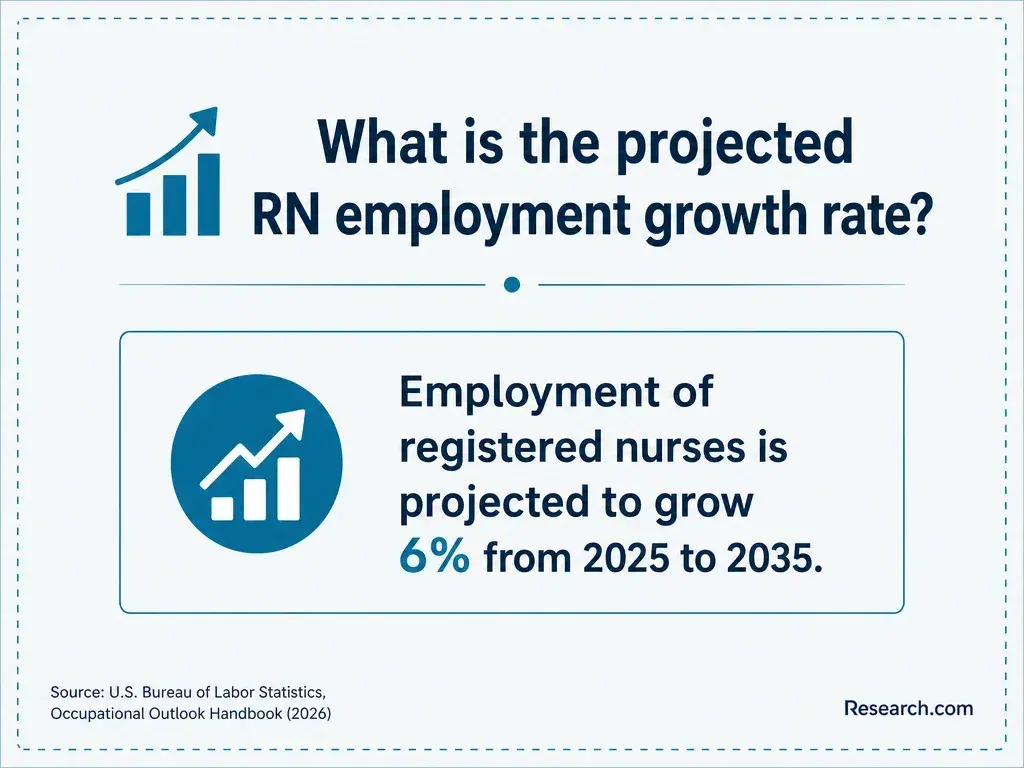
CVICU does not have its own BLS employment projection. Registered nurse projections describe a much broader occupation and cannot tell an applicant how many CVICU openings will exist at a particular hospital. Local prospects depend on cardiac surgery and advanced heart-failure services, staffing, turnover, and whether units hire and train new graduates or primarily recruit experienced ICU nurses.
For a useful local picture, look beyond the number of advertised openings. Compare the patient populations and experience requirements in postings, ask recruiters how often the unit runs a new-hire cohort, and find out whether openings reflect growth, routine turnover, or hard-to-fill shifts. This helps distinguish an accessible first job from a position that expects immediately usable critical-care skills.
CVICU experience may support later career choices, but those roles have separate requirements. Online FNP certificate routes after an MSN, for example, concern a distinct advanced practice pathway and should not be read as a CVICU job-outlook indicator.
How Can You Choose a Reputable Cardiovascular Nursing Program?
There is no single degree program that makes a graduate a CVICU nurse. If you need initial RN preparation, evaluate a prelicensure program's state board status, institutional accreditation, applicable nursing program accreditation, NCLEX outcomes, and access to supervised clinical learning. If you are already an RN, scrutinize the employer's CVICU transition program instead: its patient exposure, preceptors, skills checks, and support after formal orientation are more directly tied to the job.
Before committing, ask to review the written orientation plan and speak with nurses who recently completed it. Find out how assignments progress, who decides when a nurse is ready for particular devices or patients, what happens when the assigned preceptor is unavailable, and how the unit responds when a nurse raises a safety concern. For students, ask whether critical-care placements are available - but do not assume a school can guarantee a CVICU placement or job.
Do not choose a program because its title sounds advanced. Exploring less competitive DNP admissions addresses a different educational decision; it does not replace RN licensure, appropriate clinical experience, or a credible CVICU onboarding plan.
Other Things You Should Know About Nursing
No. Depending on the hospital, they may also care for patients with severe heart failure, shock, or other critical cardiovascular conditions. Ask the unit about its actual admissions.
No. Monitoring supports repeated bedside assessment, treatment evaluation, communication, documentation, and hands-on care. Nurses must investigate and escalate concerning changes rather than rely on a monitor alone.
Yes, at hospitals that offer new-graduate CVICU hiring and structured orientation. Other units require prior nursing or ICU experience, so eligibility depends on the specific posting.
Ask about the usual patient mix, assignment decisions, orientation length, preceptor consistency, device training, and support during nights and weekends. The answers reveal more about early-career fit than the unit name alone.
- Nurses' Time Allocation and Multitasking of Nursing Activities | nih.gov https://pmc.ncbi.nlm.nih.gov/articles/PMC6371290/
- Chapter 9 Cardiovascular Assessment - Nursing Skills - NCBI https://www.ncbi.nlm.nih.gov/books/NBK593199/
- HEALTH POLICY COMMISSION 958 CMR 8.00 | mass.gov https://www.mass.gov/doc/958-cmr-8-patient-assignment-limits-for-registered-nurses-in-intensive-care-units-in-acute-hospitals/download
- Adverse Drug Reactions in the Intensive Care Unit | springer.com https://link.springer.com/rwe/10.1007/978-3-319-17900-1_33
- Cardiac Nurse Responsibilities: A Typical Day on the Unit | FreshRN https://www.freshrn.com/cardiac-nurse-a-typical-day/
- Critical Care Statistics | Society of Critical Care Medicine (SCCM) https://sccm.org/communications/critical-care-statistics
- The Importance of the Optimal Nurse-to-Patient Ratio | wolterskluwer.com https://www.wolterskluwer.com/en/expert-insights/the-importance-of-the-optimal-nursetopatient-ratio