2027 Can Your AS in Psychology Transfer into an Online BS in Business Administration?
Audited and Verified:
Our Editorial and Data Verification Process
Research.com uses government datasets, official education statistics and primary institutional information to support its career and degree guides. Our review process checks factual accuracy, occupational definitions, source dates and the requirements associated with the credentials discussed.
How This Article Was Fact-Checked
Our editorial team verifies salary estimates, employment projections, education requirements and program information against original data providers and official organizations. Salary figures are checked against the relevant occupational definitions and reporting periods. Information about licensure, accreditation and required in-person training is reviewed separately.
Fact-checked and verified on:

Co-Founder and Chief Data Scientist
An AS in Psychology can be a useful starting point for an online BS in Business Administration, but transferring credits is not the same as satisfying business degree requirements. For psychology students considering a change of direction, that distinction can affect tuition, course scheduling, and graduation time. This guide explains how schools evaluate an associate degree, where psychology coursework may fit, and what to request before enrolling.
You will be able to compare programs using the credits and requirements that remain - not just the number a school agrees to accept.
Key Things You Should Know
- Yes, an AS in Psychology can lead into an online BS in Business Administration; the receiving university decides which courses it accepts and where they apply.
- General education and electives may transfer even when accounting, economics, and other business requirements remain. An official degree audit is more useful than an accepted-credit total alone.
- Compare programs by remaining required courses, their availability, tuition, and residency rules. An advertised transfer maximum does not establish your completion time or cost.
Can an AS in Psychology transfer into an online BS in Business Administration?
Yes. An associate of science (AS) in psychology does not normally bar admission to an online business administration bachelor's program. Psychology coursework can provide preparation in research, statistics, writing, and understanding behavior. The challenge is fitting those credits into a different major's degree plan.
Keep four decisions separate: admission to the university, admission to the business major if it has separate requirements, acceptance of individual transfer courses, and application of those courses toward graduation. A school might admit you and accept a psychology course while counting it only as a free elective. Neither decision waives a required accounting course.
Start with universities that will review your transcript against the specific online BS curriculum. If speed matters, accelerated online bachelor's programs are worth examining, but a shorter course calendar cannot make an unmet prerequisite disappear.
How many psychology associate degree credits will transfer to an online business degree?
There is no reliable number based on the AS title alone. The receiving school evaluates your courses, grades, prior institution, transfer limits, and any applicable articulation agreement. It then determines whether accepted credits meet general education, business prerequisites, major requirements, or electives.
For example, a psychology statistics course might satisfy a quantitative requirement at one university but count only as an elective at another if the business major specifies a different statistics course. Credits beyond the space available for electives may appear on your record without reducing the courses needed to graduate. Ask for a course-by-course evaluation and a requirement-by-requirement degree audit, not just a transfer-credit total.
If your goal is specifically HR, compare the business degree audit with using existing credits in a human resources degree. The better transfer destination is the one that applies more of your work to a curriculum suited to your goal, not necessarily the one that accepts more credits overall.
What transfer requirements apply to online business administration programs?
Requirements vary by institution and, sometimes, by business major. A university may set its own transfer-admission standard while the business department separately requires particular courses or grades before you enter upper-level study. Check whether mathematics, statistics, accounting, economics, or communication courses are admission prerequisites, graduation requirements, or recommended preparation; those are different obligations.
For a closer look at required credits before entering business administration study, compare the guidance with each school's current catalog.
Before applying, gather official transcripts, course descriptions, and syllabi for courses whose equivalencies are unclear. Request written answers to these questions:
- Will my AS receive any degree-wide general education treatment, or will each course be evaluated separately?
- Which courses must I finish before admission to the business major or enrollment in upper-level courses?
- What minimum grades, transfer-credit limits, course-recency rules, and credits completed at this university apply?
- Who approves a disputed equivalency or substitution, and how will that decision appear in my degree audit?
The transfer office or registrar generally evaluates credit; the business department or academic adviser determines how approved equivalencies satisfy its curriculum. Confirm both decisions before using an estimate as a graduation plan.
Psychology courses most often have a plausible home in general education or electives. Statistics and research methods may also support business study, but similar subject matter does not guarantee equivalence to a required business course.
The table shows common possibilities - not promises of transfer. It can help you identify the courses for which a syllabus review is most valuable.
| AS coursework | Possible place in a business degree | What to verify |
| English composition or public speaking | Writing or communication requirement | Required course level and equivalency |
| College mathematics or statistics | Quantitative general education or business prerequisite | Specified math content and whether the major requires business statistics |
| Introductory psychology or social psychology | Social science general education or elective | Whether the requirement has already been filled |
| Research methods | Elective or, with approval, a methods requirement | Whether its content matches the required course |
| Psychology electives | Free electives | Remaining elective space and transfer limits |
Psychology's treatment of motivation and group behavior can be useful in management or HR classes, but it does not automatically replace organizational behavior or human resource management. If those subjects are your main interest, a human resources program selection guide can help you assess whether a dedicated HR curriculum better fits your plans.
Expect a business core that introduces accounting, finance, economics, marketing, management, operations, and business decision-making. Programs may also require statistics, information systems, business law, a strategy capstone, or a formal concentration. The exact mix and sequence belong to the university's catalog, not to the BS title alone.
Your psychology background may be especially useful when analyzing customers, communicating with teams, or interpreting research. Plan separately for less familiar quantitative work: check whether your first accounting and finance classes assume spreadsheet fluency or prerequisite mathematics. If you are comparing online business degrees with compressed terms, review the course sequence as well as the term length; taking an unfamiliar quantitative course quickly may not suit every student.
Online delivery also varies. Ask about live sessions, group assignments, proctored exams, software access, internships, and any campus visits. An online class can still have fixed weekly deadlines and scheduled collaboration.
Your remaining courses - not merely the credits printed on your AS transcript - determine the timeline. A student whose general education is largely satisfied may still need a sequence of business prerequisites, upper-level core courses, and a capstone. Part-time enrollment, courses offered only in certain terms, or a required first course in a sequence can extend completion.
Ask an adviser for a term-by-term plan showing each remaining requirement, its prerequisite, and its next online offering. Then test that plan against the number of courses you can realistically manage alongside work and other commitments. Shorter undergraduate business programs across the US may offer useful comparisons, but advertised speed matters only if your evaluated credits fit the required sequence.
Calculate cost from the courses you must still take, not from the credits a school says it will accept. Compare tuition charged per credit or term, mandatory online and technology fees, books or software, and any charges for assessments or required visits. Check whether taking fewer courses per term changes fees or the duration of your enrollment.
Transfer can lower the bill when it replaces required courses, but accepted elective credit may produce little savings if you still need the full business core. Ask each school for an itemized estimate tied to your degree audit and enrollment pace. When reviewing other online business-related options, project management fees books and aid considerations illustrate why tuition alone is an incomplete comparison; use the actual business program's charges for your decision.
Discuss grants, loans, employer assistance, and aid eligibility with the financial-aid office before enrolling. An added prerequisite or delayed required course can affect both total cost and when you pay it.
First, confirm the university's current institutional accreditation and that the exact BS in Business Administration is available online to you. If a school advertises AACSB, ACBSP, or IACBE accreditation, verify whether that business accreditation covers the relevant school or program; it is distinct from institutional accreditation and does not establish your personal transfer equivalencies.
Next, compare written degree audits, the availability of required online courses, advising access, transfer-appeal procedures, and total remaining cost. Ask whether an internship, capstone, examination, or residency has scheduling or location requirements. Application-cost-free online school options may make it easier to seek multiple evaluations, but an application-fee policy is not a measure of program quality or final affordability.
Choose using the catalog and policies that apply to your intended enrollment term. A preliminary admissions conversation is useful, but obtain the official evaluation and confirm how any exceptions are recorded.
A business degree can support applications for roles in operations, marketing, HR, sales support, or project coordination. Your psychology preparation may be particularly relevant when a role involves interviewing, customer research, training, or understanding team behavior. Employers will still assess function-specific skills and experience.
For example, an HR assistant may maintain records and coordinate hiring processes, while a marketing coordinator may support campaigns and interpret customer information. A project coordinator may track schedules and communicate with stakeholders; a supply chain role may call for more specialized operations knowledge. If logistics is your target, compare accelerated supply chain bachelor's degrees with the general business curriculum rather than assuming either offers identical preparation.
Use electives, relevant employment, an approved internship, or a capstone to build evidence for a specific entry role. A BS does not by itself confer a management position, professional certification, or authorization for a regulated occupation.
What salaries and job outlook can business administration graduates expect?
There is no single salary or job-growth figure for an online BS in Business Administration: labor statistics describe occupations, not the earnings of everyone with a particular degree.
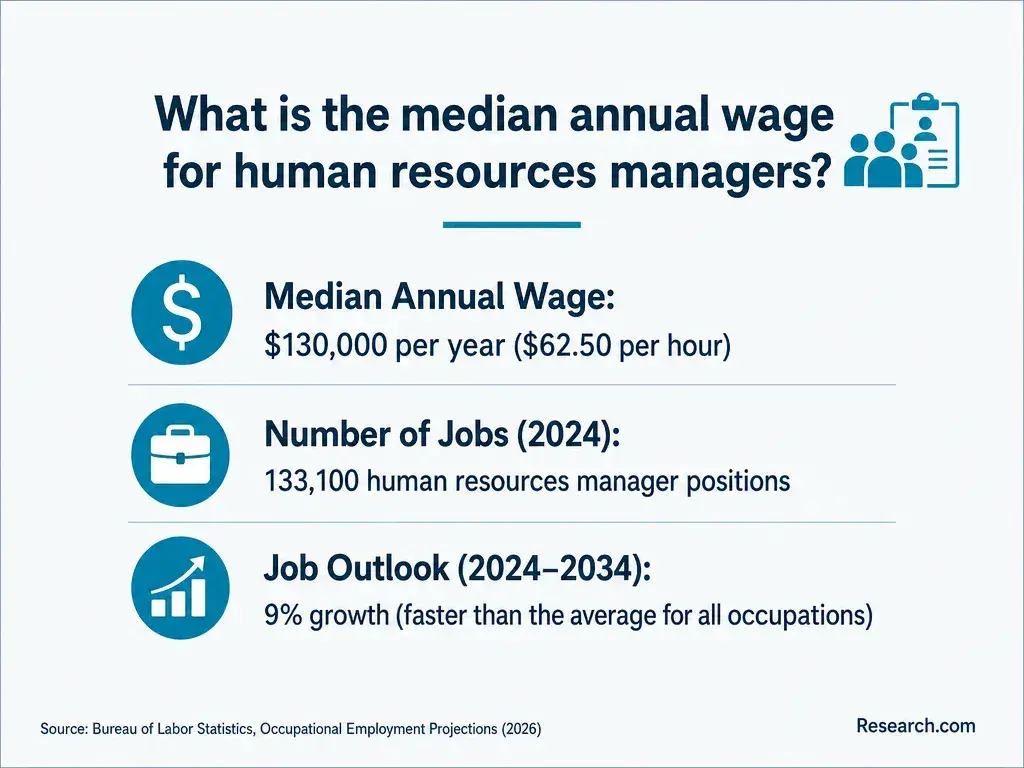
The US Bureau of Labor Statistics reports a May 2025 median annual wage of $75,940 for human resources specialists and projects 6% employment growth from 2025 to 2035. Those occupation-wide figures include workers with different experience levels; they are not a starting-salary offer to a psychology AS transfer student.
Use occupational figures only after identifying the work you want to do. Review local postings for the required degree, software skills, and experience, then decide whether your remaining business courses and available projects address those gaps. If you already work in an organization and want to advance while studying, flexible online study for business administration career growth is most useful when its schedule fits both your job and the degree audit you have received.
Other Things You Should Know About Business Administration
Often, yes, but admission and the treatment of your general education may differ if the associate degree is unfinished. Ask each university to evaluate both scenarios before deciding whether to graduate from your current college first.
Only if the university offers an applicable prior-learning assessment and approves your documented learning. Employment alone does not award credit or automatically satisfy an internship or capstone.
Diploma wording is set by the institution. Ask the registrar how the degree title appears on the diploma and transcript rather than assuming online and campus versions use identical wording.
Check second-degree rules and compare the remaining coursework with a targeted certificate or prerequisites for your intended role. A second bachelor's may be worthwhile, but an AS-to-BS transfer pathway may not be your shortest route.
- Definitions | Transfer Credit Ohio https://transfercredit.ohio.gov/educational-partners/educational-partner-initiatives/articulation-transfer-policy-policy/articulation-transfer-policy-definitions
- .14 Evaluation and Review Process for Transfer of Courses and Credits. | Library of Maryland Regulations https://regs.maryland.gov/us/md/exec/comar/13B.06.02.14
- Articulation Agreements | Brooklyn College https://www.brooklyn.edu/teo/articulation-agreements/
- Transfer from associate degree to business bachelor's with ease | wisc.edu https://dcs.wisc.edu/blog/transfer-from-associate-degree-to-business-bachelors/
- ExcelTrack® Bachelor's Degree in Business Administration | Purdue Global https://www.purdueglobal.edu/degree-programs/business/exceltrack-bachelor-business-administration/
- Step-by-Step Transfer Evaluation Process | CUA https://undergraduate-studies.catholic.edu/academic-support/transfers/incoming/process-incoming.html
- How Do Transfer Credits Work When You Go Back to School? | Whitworth Online https://online.whitworth.edu/news-articles/how-do-transfer-credits-work-when-you-go-back-to-school/
- Business Pre-Core Courses | FIU College of Business https://business.fiu.edu/academics/undergraduate/admissions/business-pre-core-courses/
- Transfer credit policies - Office of Admissions https://admit.washington.edu/apply/transfer/policies/
- Applied Psychology: Organizational Psychology, B.S. | University of New Hampshire https://www.unh.edu/program/bachelor-science/applied-psychology-organizational-psychology