
2027 Can R Experience Replace Python Preparation for a Data Science Master's?

Co-Founder and Chief Data Scientist
Strong R skills can make you a capable data science master's applicant without making you ready for every program's Python coursework. If you use R for analysis, the decision is whether your target programs accept that experience as evidence of programming ability, and whether their first courses expect you to write Python from day one.
This guide helps you separate admission requirements from classroom readiness, identify the skills that transfer, and decide how much Python preparation to do before enrolling.
Key Things You Should Know
- R experience may satisfy a program's general programming expectation, but it does not automatically fulfill a stated Python prerequisite; check the exact admissions policy.
- Before a Python-based first term, prioritize writing and debugging Python code over relearning statistics you already use confidently in R.
- The U.S. Bureau of Labor Statistics projects 35% growth in data scientist employment from 2025 to 2035. That outlook makes program fit important, but it does not establish that any particular language or degree will secure a job.
Can R Experience Replace Python Preparation for a Data Science Master's?
For admission, sometimes; for Python-based coursework, usually not entirely. A program that asks for experience in a programming language may recognize substantial R work.
A program that explicitly requires Python, a Python placement assessment, or proficiency before a specified course may not treat R as a substitute. Only the program can confirm how it applies its requirement.
R experience transfers most directly when you have written reusable code, cleaned messy data, tested analyses, and explained results - not just run prepared scripts. Your statistical reasoning remains valuable. The gap is practical fluency with Python syntax, libraries, debugging, and the way assignments are submitted and evaluated.
Choose a program that teaches Python early if you have strong R and statistical skills but limited Python experience. Prepare before enrollment if required courses assume Python proficiency at entry.
If your main interest is applied analysis rather than a particular data science curriculum, compare advanced degree options in data analytics against the same course-level programming expectations.
What Programming Skills Do Data Science Master's Programs Require?
Requirements vary: admissions pages may describe a broad programming prerequisite, while course descriptions reveal the language used in graded work. The comparison below distinguishes knowledge an R user may already possess from skills that need direct Python practice:
| Skill | What may transfer from R | Potential Python gap |
| Data analysis | Cleaning, joining, summarizing, and checking data | Performing those tasks with the libraries used in class |
| Statistical modeling | Choosing methods, interpreting results, and checking assumptions | Using Python model interfaces and evaluating their output |
| Programming workflow | Functions, reproducible scripts, and version control, if already practiced | Python environments, packages, errors, and assignment conventions |
SQL, linear algebra, calculus, and statistics can matter as much as language choice, but their required depth is program-specific. Read both the admissions requirements and the descriptions of first-term courses: "programming experience accepted" does not mean "no Python needed in class."
How Can R Users Prepare for Python-Based Data Science Graduate Study?
Use a familiar analysis to test whether you can work independently in Python. This is preparation for coursework, not formal fulfillment of a prerequisite unless the program says it is:
- Rebuild an R project in Python: import data, clean it, produce a visualization, fit a model, and explain any differences in results.
- Write functions and tests, manage packages in a project environment, and troubleshoot an error without relying on a copied solution.
- Save the code and a short explanation of your choices so you can show admissions staff concrete evidence if they request it.
- Compare your work with first-course descriptions or a published readiness assessment, then ask the program which gaps to close before classes begin.
A common mistake is mistaking familiarity with Python notebooks for the ability to complete an unfamiliar assignment. Practice starting from an unclean dataset and documenting your work so someone else can run it.
What Does a Data Science Master's Curriculum Typically Include?
A data science master's may combine statistics, data management, programming, machine learning, and applied projects, but the sequence and depth vary.
For an R user, the decisive question is when Python appears: an introductory course leaves more room to learn it during the degree than a first-term machine learning course that assumes fluency.
Check syllabi or ask for sample assignments rather than relying on course titles. If you want production-oriented work, look for substantial practice building and maintaining data workflows, not merely a mention of pipelines.
Graduate AI study with data pipeline coursework offers a related path to compare if that technical emphasis matters more to you than a broad data science degree.
What Are the Admission Requirements for Data Science Master's Programs?
Programs set their own standards for prior degrees, quantitative coursework, programming, application materials, and professional experience. Do not assume that using R at work either qualifies you automatically or rules you out. Identify whether a requirement is mandatory, recommended, or something students may complete after admission.
When a policy says "programming proficiency," ask whether assessed R work qualifies and what evidence the school accepts. A transcript, work sample, or documented project can demonstrate different things; self-study may improve readiness without earning prerequisite credit.
Application procedures differ, too: if an essay is an obstacle and machine learning is your intended field, compare machine learning master's programs without an admissions essay, then verify their current requirements directly.
Are Online Data Science Master's Programs as Rigorous as Campus Programs?
Delivery format alone does not establish rigor. Compare required courses, assessment methods, instructor access, projects, and the amount of independent coding, not simply whether classes meet online or on campus. An online Python-heavy course can be especially demanding for an R user if help is limited or assignments move quickly.
Ask whether sessions are live, when coding support is available, and whether the first courses provide a Python bridge. If speed is also a priority, compare the pacing of accelerated online master's study in AI; a faster schedule or different degree title is not, by itself, a better fit for learning Python.
How Long Does a Data Science Master's Take and Cost?
Completion time and total cost depend on the program's credit requirements, tuition policy, fees, and whether you study full-time or part-time. A published tuition rate may exclude technology charges, required materials, travel, or the cost of taking time away from work. Without a particular program and enrollment plan, a reliable total cannot be stated.
Request a cost estimate for your pace of study and ask whether a preparatory Python course adds tuition or delays degree progress. Compare that expense with lower-cost preparation if the school accepts it. For funding questions beyond the program's own aid offer, see covering the cost of a data science master's.
How Can You Verify a Data Science Master's Program's Accreditation?
Check the institution's stated accreditor against the U.S. Department of Education's recognized-accreditor information, and confirm that the degree is awarded by that institution.
Institutional accreditation does not mean every data science program has separate programmatic accreditation; do not mistake the absence of a specialty credential for proof that the institution is unaccredited.
For an online program, also confirm that it can enroll students where you live. Accreditation and state authorization address different questions. Neither tells you whether R will meet an admissions prerequisite, so verify that policy separately with the program.
What Careers and Salaries Can a Data Science Master's Lead To?
Depending on your prior experience and the work you can demonstrate, relevant roles may include data scientist, analyst, or machine learning specialist.
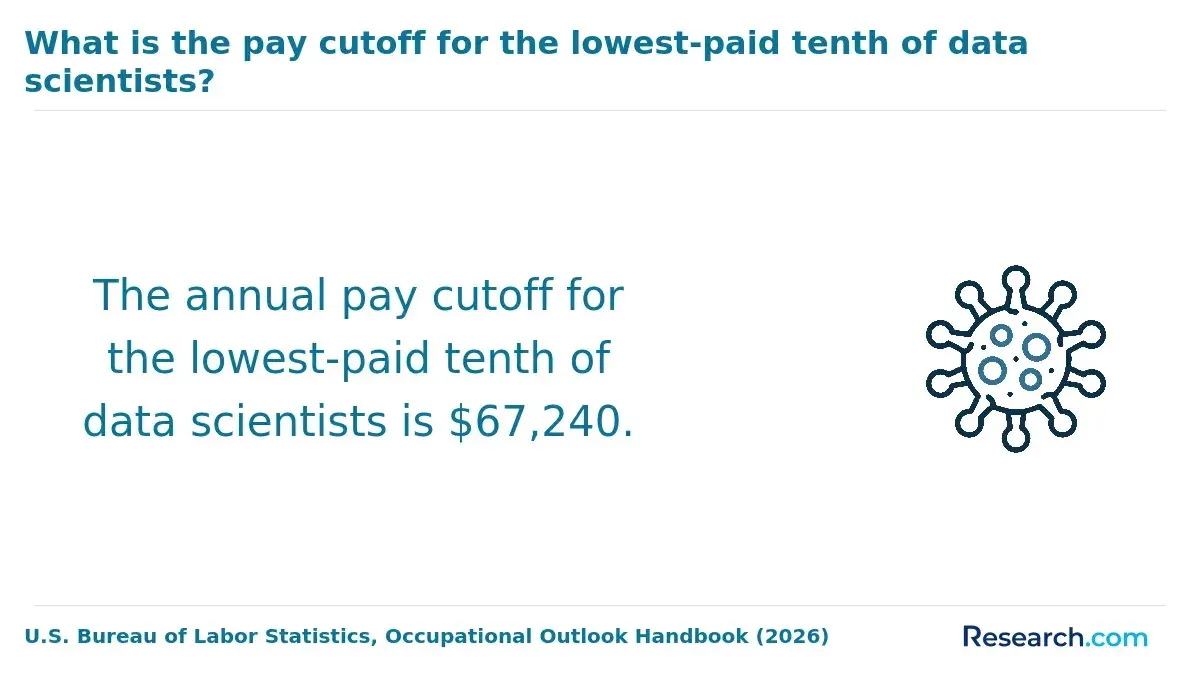
The U.S. Bureau of Labor Statistics reports a $120,230 median annual wage for data scientists in May 2025. That is an occupation-wide figure, not a starting salary or an estimate of what a master's graduate will earn.
Use career goals to judge how much Python matters. An R-centered research or statistical analysis goal may favor programs that support R work; a goal involving Python-based model development calls for more Python practice and evidence of completed projects. Employers' tools vary, and neither the degree nor a language choice guarantees a particular role.
Is Certification Required for Data Science Careers in the United States?
There is no general U.S. occupational license required simply to work as a data scientist. Employers may value particular certifications, and specialized work can carry additional employer or regulatory requirements. Check the roles you want rather than treating a certificate as a universal entry requirement.
For an R user considering a master's, a Python certificate is most useful if it helps you build verifiable skills or meets a target program's stated policy. A certificate alone does not prove you can complete graduate assignments; a substantial, reproducible project gives you a more direct way to assess your readiness.
Other Things You Should Know About Data Science
Often, technically yes, but course and capstone rules control what you may submit. Ask whether the project must use a specified language and make sure the full workflow is reproducible.
No. Python itself is free to use. A course may require particular tools or computing services, so check its materials list before buying anything.
Follow each course's academic integrity and disclosure rules. Even when permitted, generated code is a poor substitute for being able to explain, test, and debug your own work.
Not necessarily. Ask the program about hardware requirements and whether it provides remote computing resources before purchasing a new machine.
References
- Master's in Computer Science vs Master's in Data Science | jhu.edu https://ep.jhu.edu/news/masters-computer-science-vs-data-science/
- Master of Science (M.S.) in Applied Data Science - UGA Online https://online.uga.edu/degrees-certificates/master-of-science-in-applied-data-science/
- Master of Science in Data Science | CUNY SPS https://sps.cuny.edu/academics/graduate/master-science-data-science-ms
- Online Master's in Data Science (MSDS) | Northwestern University https://sps.northwestern.edu/masters/data-science/
- Choosing a master's degree: data science or artificial intelligence | edX https://www.edx.org/resources/choosing-a-masters-degree-data-science-or-artificial-intelligence
- Python vs. R: What's the Difference? | IBM https://www.ibm.com/think/topics/python-vs-r
- Python or R for Data Analysis: Which Should You Learn? | Coursera https://www.coursera.org/articles/python-or-r-for-data-analysis


