2027 BS in Business Administration Transfer Planning: Quarter-System Credits Versus Semester Credits
Audited and Verified:
Our Editorial and Data Verification Process
Research.com uses government datasets, official education statistics and primary institutional information to support its career and degree guides. Our review process checks factual accuracy, occupational definitions, source dates and the requirements associated with the credentials discussed.
How This Article Was Fact-Checked
Our editorial team verifies salary estimates, employment projections, education requirements and program information against original data providers and official organizations. Salary figures are checked against the relevant occupational definitions and reporting periods. Information about licensure, accreditation and required in-person training is reviewed separately.
Fact-checked and verified on:

Co-Founder and Chief Data Scientist
A quarter-system transcript can make a BS in Business Administration transfer look simpler - or more complicated - than it is. Converting credits is only the first step: the receiving university must also decide whether each course satisfies general education, business-core, concentration, or elective requirements.
For students transferring or returning to college, those decisions affect which classes to take next, how long completion may take, and what it may cost. This guide explains the conversion, the policies that can change its practical value, and the records to request before committing to a program.
Key Things You Should Know
- For an initial estimate, multiply quarter credits by 2/3: 45 quarter credits equal 30 semester credits. The receiving school controls its official conversion and rounding.
- Credits accepted by a university do not necessarily satisfy its business core, concentration, prerequisites, or minimum credits earned there; request a program-specific degree audit.
- Compare programs by required courses remaining, their availability, and total completion cost - not by the largest advertised transfer-credit allowance.
What Is the Difference Between Quarter and Semester Credits?
Quarter and semester credits measure academic work under different calendars. A quarter-system school typically divides its academic year into three main terms; a semester-system school typically uses two. A quarter credit therefore represents a smaller share of an academic year than a semester credit. A common comparison is 3 quarter credits to 2 semester credits.
The calendar affects scheduling, but it does not establish whether two business courses teach the same material. A quarter-length accounting course may cover only part of a semester-long accounting requirement - or may align with it when paired with another course. Likewise, transferring credits is different from enrolling in shorter or more intensive classes. If speed is a priority, a guide to accelerated bachelor's study can help you assess scheduling separately from transfer equivalency.
How Do You Convert Quarter Credits to Semester Credits for Transfer?
For a planning estimate, multiply the quarter-credit total by 2/3. For example, a completed 5-quarter-credit course converts to approximately 3.33 semester credits. This is arithmetic, not an assurance that the course will fulfill a 3-semester-credit requirement. The receiving institution determines how it records fractional credits, evaluates content, and applies its minimum-credit rules.
Use a course-by-course calculation rather than converting only your transcript total. It reveals whether a particular accounting, statistics, or economics course needs a companion course to meet a requirement. Before paying a deposit or registering, use this sequence to test the estimate:
- Collect official transcripts, course descriptions or syllabi, and any approved transfer agreement.
- Mark the quarter credits for each completed course and calculate its approximate semester-credit equivalent.
- Ask the transfer office how it records fractions and whether related quarter courses are evaluated together.
- Ask the business adviser to place each accepted course in the degree audit as general education, prerequisite, business core, concentration, or elective credit.
If several schools accept the same credits but apply them differently, price the remaining degree rather than the credits already earned. Try to find inexpensive online business administration colleges as a starting point for identifying schools to ask for individual evaluations, not a substitute for those evaluations.
How Do Quarter-System Credits Transfer Into a BS in Business Administration?
Transfer has two decisions: whether the university accepts a course for credit and whether its business program applies that credit to a specific requirement. A transcript might yield substantial elective credit while leaving financial accounting or a required quantitative course unfinished. Admission to the university and admission to a selective business major may also be separate decisions.
For illustration, suppose a student has 90 quarter credits. The standard calculation gives a preliminary estimate of 60 semester credits. If the receiving school accepts all 60 but assigns several business courses only as electives, the student may still need lower-division prerequisites before entering upper-division business courses. That sequence - not the converted total alone - determines the likely graduation date.
Ask for an official, program-specific audit under the catalog that will govern your enrollment. It should show accepted credits, where they apply, unmet requirements, and credits that must be earned at the receiving school.
If a different degree better matches a large block of prior coursework, compare its requirements rather than assuming every business-related degree uses credits identically. An accelerated business college program guide may help identify alternatives to investigate, but the school must confirm both credit application and pace.
Courses with clear counterparts in the receiving curriculum are generally easier to evaluate than narrowly titled electives. Written communication, economics, introductory accounting, mathematics, and statistics may have identifiable equivalents. Exact applicability still depends on content, credit value, grade, course level, and program policy.
Business courses need especially close review. "Business statistics" may not satisfy a program's statistics prerequisite if required topics differ; an introductory management course may transfer as an elective rather than replace an upper-division course. A sequence of quarter courses may collectively cover a semester requirement even when neither course does alone. Supply the syllabus and ask for a written equivalency or substitution decision before repeating a course.
If your prior coursework is concentrated in one function, compare whether a specialized degree uses more of it. For example, online project management bachelor's programs accepting transfer credits may be worth investigating if your goal and completed courses align with project work. A related course is not automatically an approved major requirement in either program.
Check that the receiving institution holds recognized institutional accreditation and ask whether its transfer policy accepts credit from your prior institution. Recognition matters, but accreditation alone does not compel a university to accept a course or assign a particular equivalency. The receiving institution has final authority under its policies.
Business-school or programmatic accreditation - such as AACSB, ACBSP, or IACBE - is separate from institutional accreditation. Confirm the accreditor's actual scope if that distinction matters to you; do not assume that a business accreditation label determines transferability. When you compare leading American online business degree schools, review each school's transfer and degree requirements alongside its accreditation information.
Policies worth checking include maximum transfer credits, minimum grades, limits on older coursework, treatment of pass/fail or experiential credit, upper-division requirements, and residency - the credits you must complete at the degree-granting institution. Request the policy for your intended enrollment term and ask who can approve an exception or appeal. Save written decisions and updated audits; an informal estimate is not a graduation clearance.
A BS in Business Administration usually combines general education with foundational and advanced business study. Common subjects include accounting, economics, statistics or another quantitative course, finance, marketing, management, operations, and business law or ethics. Programs differ in their required math level, course order, electives, concentration rules, and capstone requirements. A BS and a BBA can also have different curricula even when their names sound similar.
Read the receiving school's curriculum as a prerequisite chain, not just a list. For example, an accepted introductory accounting course may unlock a later finance course, while an unevaluated statistics course may delay it. Confirm whether transferred quarter courses fulfill prerequisites as well as degree credits. If you plan a specialization, check whether it is an officially designated concentration and whether required courses are offered during your remaining terms.
Students with extensive operations coursework might compare the BS curriculum with supply chain program tuition, time, and earnings context. The useful question is not which title sounds broader: it is which verified audit preserves more applicable credit while teaching the skills needed for your goal.
Transfer admission may depend on prior college coursework, academic standing, a minimum GPA, and required application records. A business major can impose additional admission or prerequisite conditions after university admission. Requirements vary, so check both sets before assuming that enough converted credits make you eligible for upper-division business courses.
Submit transcripts from every college attended and ask whether the school needs syllabi for quarter-system courses. If you earned an AA, AS, or AAS, ask how that specific credential affects general education and major requirements; an applied degree does not necessarily satisfy the same requirements as a transfer-oriented associate degree. Applicants with military, competency-based, or international coursework should ask which documentation and separate evaluation rules apply.
Application fees are a smaller consideration than credit applicability, but they can add up when requesting several evaluations. Colleges with no upfront application payment may broaden your comparison set; verify each school's current fee policy and whether it provides a detailed transfer assessment before enrollment.
There is no reliable completion estimate from converted credits alone. The practical estimate starts with the official degree audit, then accounts for prerequisites, required course availability, enrollment load, and residency. A student with more accepted credits can take longer than one with fewer if a missing prerequisite blocks an annually offered course.
To compare offers, ask each school for a term-by-term path under your realistic work and family schedule. Price the courses on that path, including mandatory fees, books or software, travel or proctoring if applicable, and the cost of any required repeated or additional course. Ask the financial-aid office how your enrollment level and remaining requirements affect aid eligibility; do not assume accepted electives reduce the courses you must pay to take.
A shorter advertised program is not necessarily a shorter path for your transcript. If you are considering a related degree because it appears to fit your credits better, compare completion times for organizational leadership degrees only after obtaining equivalent audits and course schedules. Compare the degree content as well as the estimated finish date.
Choose the format that lets you complete the remaining required courses, not merely the one that accepts the most credits. An online program may reduce travel but still require scheduled meetings, group work, proctored assessments, or an internship. A campus program may offer more predictable access to particular courses or local employers, but commuting and fixed meeting times can constrain a working student.
Request a schedule of the business courses your audit says you still need. Check how often they run, whether they are online or on campus, and whether required activities fit your weekly availability. Then compare total cost under the same enrollment pace. Online business administration program cost-and-time comparisons can help narrow your options, but advertised timelines cannot account for your individual transfer evaluation.
What Careers, Salaries, and Certifications Follow a Business Administration Degree?
A BS in Business Administration can support applications for roles in operations, marketing, human resources, purchasing, and other business functions. Entry requirements differ by job: relevant employment, internships, spreadsheets, communication, and evidence of function-specific skills can matter alongside the degree. Completing a business degree does not itself confer a management position or a professional certification.
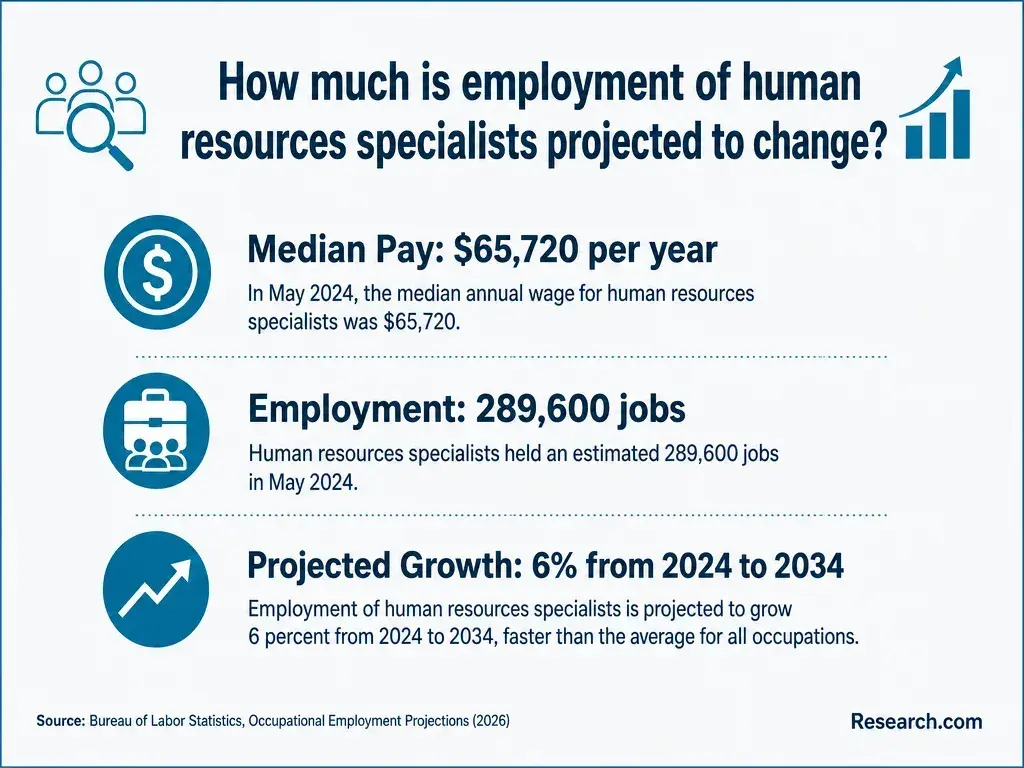
For salary context, the U.S. Bureau of Labor Statistics reports a May 2025 median annual wage of $75,940 for human resources specialists, with employment projected to grow 6% from 2025 to 2035. That occupation-wide median includes workers at different career stages; it is not a starting salary for business administration graduates. If HR is your target, a human resources program selection guide can help you compare specialized study with a general business degree.
Before choosing a concentration or pursuing a separate credential, check the target occupation's actual requirements with employers and the relevant certifying or licensing body. Accounting licensure and other regulated work have requirements beyond a general business degree. For a transfer student, the immediate priority is still to confirm that the degree plan you can finish develops skills relevant to the role you want.
Other Things You Should Know About Business Administration
Yes. A syllabus can document topics, assignments, and course level when a title alone does not establish equivalency. Keep copies before your former school removes access to its course site.
Many institutions offer a review or appeal process. Ask the transfer office which department decides the equivalency, what evidence it accepts, and when the request must be filed.
No. Each receiving institution evaluates coursework under its own policies and degree requirements. Obtain a separate written evaluation from every school you are seriously considering.
Ask the receiving school for written preapproval first. It can confirm whether the proposed course will fulfill the requirement you intend, rather than merely add elective credit.
- Implementation of updated clock-to-credit conversion regulations (EA ID: GENERAL-21-34) | Knowledge Center https://fsapartners.ed.gov/knowledge-center/library/electronic-announcements/2021-05-25/implementation-updated-clock-credit-conversion-regulations-ea-id-general-21-34
- Transfer Dispute - Texas Higher Education Coordinating Board https://www.highered.texas.gov/transfer-dispute/
- Definitions | Transfer Credit Ohio https://transfercredit.ohio.gov/educational-partners/educational-partner-initiatives/articulation-transfer-policy-policy/articulation-transfer-policy-definitions
- College of Business Administration - Academic Catalog https://catalog.uic.edu/ucat/colleges-depts/business-administration/
- Upper Division Requirements - Purdue Business https://business.purdue.edu/undergraduate/current-students/upper-division.php
- Transfer Credit Guidelines | Undergraduate Admissions https://admissions.uconn.edu/apply/transfer/transfer-credit-guidelines/
- Converting Credits - Tusculum University https://catalog.tusculum.edu/content.php
- Transfer Guide - UNCP https://coursetransfer.northcarolina.edu/guide/2024-2025/101
- Transfer Plans | Admissions - The University of Iowa https://admissions.uiowa.edu/transfer-plans
- Minimum Transfer Standards - Academic Catalog - CU Denver https://catalog.ucdenver.edu/cu-denver/undergraduate/records-registration/transfer-credit/minimum-transfer-standards/