
2027 Best Two-Year Degrees With Job Placement Support

Co-Founder and Chief Data Scientist
A college may advertise job placement support, but that phrase can mean anything from access to a job board to help arranging clinical placements. If you want a two-year degree that leads toward work, the difference matters. The U.S. Bureau of Labor Statistics reports a 2024 median annual wage of $93,600 for registered nurses, an example of a career with strong pay potential, but one that also requires licensure. This guide compares degree fields, explains what career support can and cannot do, and shows you how to check outcomes before committing your time and money.
Key Things You Should Know
- Prioritize an accredited program that documents employer connections, work-based learning, and recent outcomes for your specific major; career services alone do not establish a placement rate.
- Career-focused healthcare and nursing programs can offer clearer routes to specific occupations, but clinical capacity, selective admission, exams, and state licensing affect access to those jobs.
- Compare total cost, not tuition alone. College Board reported average published in-district tuition and fees of $4,050 at public two-year colleges for 2024-25, before books, supplies, transportation, and living expenses.
Top 10 Best Two-Year Degrees With Job Placement Support
Business Programs
An Associate of Applied Science (AAS) in accounting, business administration, or supply chain operations may prepare students for bookkeeping, administrative, or logistics support roles. An Associate of Arts (AA) in business is often a better fit for students planning to transfer. For job support, look for employer projects, internships, recruiting events, and published outcomes for the business major. Ask whether placements are paid and whether the college helps students find them. A general business degree offers flexibility, but it may provide a less direct route to a particular job than a specialized program.
Healthcare Programs
Career-focused associate programs in dental hygiene, respiratory therapy, and diagnostic medical sonography can connect classroom learning with supervised clinical experience. That structure may create useful employer contacts, but a school-assigned clinical site is not a job offer. Check programmatic accreditation, clinical-site availability, graduate outcomes, and eligibility for any required exam or state license. Admission may require science prerequisites and a separate competitive application. If the schedule or physical demands of clinical work are a poor fit, compare less clinically intensive health information programs, while checking their distinct hiring requirements.
Information Technology Programs
An AAS in information technology, networking, or cybersecurity may support entry into help desk and junior technical roles through labs, employer projects, or internships. Ask which employers recruit associate-level candidates and whether the college helps students build a portfolio and practice interviews. Certifications may improve fit for particular openings but do not replace experience. Cybersecurity analyst jobs often require additional qualifications, so be wary of programs that present them as automatic first jobs. An Associate of Science (AS) with transferable computing courses may suit students aiming for a bachelor's degree.
Nursing / Pre-Nursing Programs
An Associate Degree in Nursing (ADN) combines coursework with supervised clinical training and can lead toward registered nurse (RN) licensure after graduates meet state requirements and pass the required licensing exam. Ask for nursing-specific completion, exam-pass, and employment outcomes - not college-wide figures. Pre-nursing is different: it typically covers prerequisites and does not guarantee admission to an ADN program or eligibility for RN licensure. Confirm which credential you would earn, how clinical placements are assigned, and whether the program meets requirements where you intend to practice.
Criminal Justice Programs
An AA or AAS in criminal justice can introduce legal systems, report writing, and public-safety practice. Career offices may connect students with internships or local agencies, but hiring for law enforcement and corrections also depends on agency screening, training, and other requirements. Ask which agencies recruit from the program and whether graduates enter paid roles related to their studies. Choose a transfer-oriented degree if your target occupation or advancement plans call for a bachelor's; an associate degree alone does not confer police authority or ensure academy admission.
Psychology / Counseling Programs
An AA or AS in psychology is usually a transfer pathway rather than a direct route to becoming a counselor or psychologist. Some graduates pursue entry-level behavioral-health support positions, but duties and employer requirements vary. Ask whether the college has supervised service-learning opportunities and an articulation agreement with your intended bachelor's program. Professional counseling and psychologist roles require substantially more education and, typically, licensure. If you need employment soon after graduation, compare the program's documented support-role outcomes with more occupation-specific associate degrees.
What Are the Best Two-Year Degrees With Job Placement Support?
The best two-year degree with job placement support is one that fits your target occupation and has verifiable, major-specific help getting there. No field guarantees employment. The comparison below identifies where structured employer contact may be valuable and what evidence to request before calling a program a strong choice.
| Degree field | Potential career-support advantage | Most important check |
| Nursing and allied health | Supervised clinical experience and contact with local employers | Clinical capacity, accreditation, licensing eligibility, and program-level outcomes |
| Information technology | Employer projects, portfolios, internships, and recruiting | Evidence of placements into realistic entry-level roles |
| Business | Broad local employer networks and internships | Whether support and outcomes apply to your specialization |
| Criminal justice or psychology | Agency connections or service-learning opportunities | Whether the intended job requires further training or a higher degree |
When a college publishes a placement rate, request its definition, reporting period, graduating cohort size, and response rate. Find out whether it counts any employment or only work related to the major. Treat internships and clinical placements as learning opportunities, not proof of postgraduation employment.
Which Two-Year Degrees Lead to the Highest-Paying Jobs?
Among occupations with common associate-degree pathways, dental hygienist and registered nurse roles have strong wage potential. The Bureau of Labor Statistics reports a 2024 median annual wage of $94,260 for dental hygienists. That is the median for workers in the occupation, not a predicted starting salary for graduates. Location, experience, hours, and employer all affect individual pay.
Higher occupational pay can also come with harder entry requirements. Dental hygiene and RN pathways involve clinical training and licensure; pre-nursing alone is not enough. Compare those demands with the income you need while studying, the availability of local training sites, and the program's completion and licensing-exam outcomes. A lower-paying entry role with an affordable transfer path may be the better choice if your long-term goal requires a bachelor's degree.
How Do You Choose an Accredited Two-Year Degree Program?
Start by confirming that the college has institutional accreditation recognized by the U.S. Department of Education. Then check whether your major needs separate programmatic accreditation for licensure, certification, or employer acceptance. Institutional accreditation by itself does not establish that a nursing or allied-health program meets every professional requirement.
Request the program's written curriculum, recent outcomes, and career-services details. Ask who arranges internships or clinical sites, whether assistance is available to online and part-time students, and what happens if a placement is delayed. For a transfer-oriented AA or AS, confirm in writing how courses apply to the intended bachelor's major, not merely whether another college accepts the credits. A warning sign is a school that advertises a placement percentage but will not explain how it was measured.
Which Two-Year Degree Programs Offer Online or Campus Options?
Business, psychology, criminal justice, and some IT associate programs may offer substantial online coursework. Nursing and clinical allied-health programs generally require in-person skills training or supervised practice, even when lectures are online. Check for scheduled live classes, proctored exams, campus labs, and who secures local placements before assuming an online option fits your location or work schedule.
Students who move frequently, including military families, should ask whether advising and career services continue across locations and whether a regulated program meets the requirements of the state where they expect to work. A guide to colleges for military spouses can help frame that broader school search; each specific major still needs its own delivery and licensing check.
What Do Two-Year Degree Programs Teach and Require for Admission?
Associate programs commonly combine general education with major courses. Career-focused AAS degrees may also require labs, internships, or clinical practice; transfer-oriented AA and AS degrees often emphasize courses intended to apply toward a bachelor's program. Admission to the college may require a high school diploma or equivalent, while nursing and allied-health majors may separately require prerequisites, background checks, or competitive selection.
Match the credential level to the job before applying. An associate degree can prepare someone for certain entry-level roles, but it is not a substitute for the graduate education required for professional counseling or psychology practice. Even searches for 1 year PhD programs online concern a different educational level, not a shortcut from an associate program into a licensed profession.
How Long Do Two-Year Degrees Take, and What Do They Cost?
Many associate degrees require about two years of full-time study, but prerequisites, course sequencing, clinical-site availability, part-time enrollment, and accepted transfer credits can change that timeline. An accelerated associate degree online may use short terms or substantial previously earned credit; a short course length alone does not mean a new student can complete an entire degree in that time.
For a cost baseline, College Board reported average published in-district tuition and fees of $4,050 at public two-year colleges for 2024-25. Your total may differ substantially: add required credits, residency-based tuition, program and laboratory fees, books, equipment, transportation, and unpaid clinical time. Compare financial-aid offers using the amount you would pay or borrow, and ask whether the program and your enrollment status qualify for federal aid. Low tuition is less useful if required courses are unavailable when you need them.
What Jobs and Salaries Can Two-Year Degree Graduates Expect?
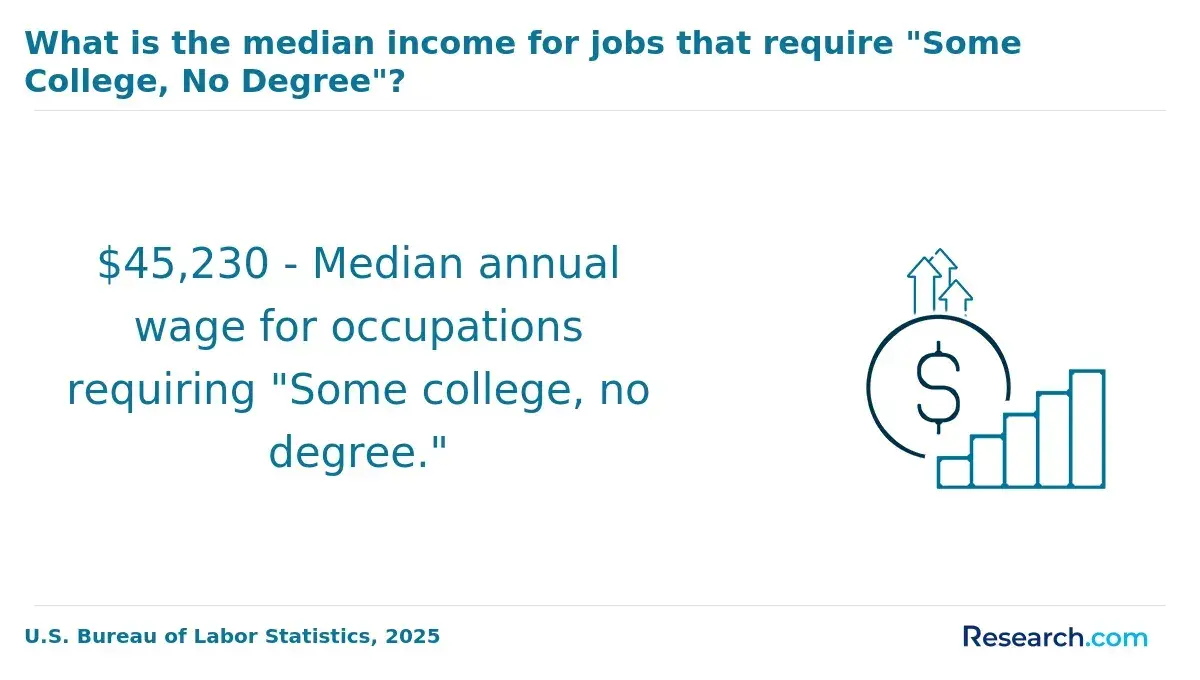
An associate degree is a pathway, not a job title. This comparison separates plausible starting points from occupations with additional entry requirements; occupational wages should never be read as guaranteed graduate earnings.
| Program area | Possible direction | Important qualification |
| Business | Administrative, bookkeeping, or logistics support | Employers may prioritize specific software skills and experience |
| Information technology | Help desk or junior technical support | Projects, experience, or certifications may strengthen applications |
| Nursing | Registered nursing | An eligible nursing program and state RN licensure are required |
| Dental hygiene | Dental hygienist | Accredited education and state licensure are generally required |
| Psychology | Behavioral-health support or transfer study | Professional counseling requires further education and licensure |
Use BLS occupational wages to compare careers, then ask individual colleges for major-specific graduate outcomes and local employers about entry requirements. This avoids mistaking a national, all-experience wage for a likely first-year offer.
Which Two-Year Careers Require Licensure or Professional Certification?
Registered nurses, dental hygienists, respiratory therapists, and other regulated healthcare workers generally must meet state licensing requirements beyond earning a degree. Those requirements may include an approved or accredited program, supervised training, an exam, and an application to the state board. Some IT and business credentials are voluntary professional certifications rather than state licenses; their value depends on the job posting and employer.
Before paying for any extra credential, confirm whether it is required for your target role, whether your associate program establishes eligibility, and what exam and renewal costs apply. Resources on easy licenses and certifications to get online can introduce alternatives, but an online certificate cannot replace a state-required clinical program or professional license.
How Strong Is Job Demand for Graduates With Two-Year Degrees?
Demand differs more by occupation and location than by degree label. The Bureau of Labor Statistics projects registered nurse employment to grow 5% from 2024 to 2034. That national projection suggests continuing opportunities, but it does not predict hiring by a particular hospital or guarantee a new graduate a position. IT hiring likewise depends on the skills employers need, while public-safety openings depend partly on local agency budgets and hiring standards.
For a useful local test, compare recent job postings with the program's taught skills, ask employers which credentials they accept, and request the college's recent major-specific outcomes. If a school cannot identify relevant employers, explain how it supports applications, or provide a clear outcome definition, keep comparing programs - even if its career-services page sounds impressive.
Other Things You Should Know About
No. It may include coaching, job listings, employer introductions, or help finding experiential placements. Ask what services are provided and whether the college publishes verifiable employment outcomes.
An occupation-specific program with strong local employer connections may offer a clearer route, provided you can meet its admission, training, and licensing requirements. Compare actual program outcomes rather than relying on the degree name.
Some academic courses may be online, but programs leading to clinical roles generally include in-person labs or supervised practice. Confirm every attendance and placement requirement with the school.
Choose based on the curriculum and your goal. AA and AS programs are often transfer-oriented; AAS programs often emphasize workforce preparation. Verify both job requirements and how credits would apply to any future bachelor's degree.
References
- Educational Attainment and Nonwage Labor Market Returns in the United States - PMC https://pmc.ncbi.nlm.nih.gov/articles/PMC10923559/
- Will I need a license or certification for my job?: Career Outlook | bls.gov https://www.bls.gov/careeroutlook/2016/article/will-i-need-a-license-or-certification.htm
- Research Summary: Education and Lifetime Earnings | ssa.gov https://www.ssa.gov/policy/docs/research-summaries/education-earnings.html
- Career-Connected Learning (Career Exploration & Work-Based Learning) | Department of Education https://educate.iowa.gov/higher-ed/cte/iowa-quality/career-connected-learning
- Understanding College Costs | studentaid.gov https://studentaid.gov/resources/prepare-for-college/students/choosing-schools/consider-costs
- Cost of Attendance (Budget) | 2025-2026 Federal Student Aid Handbook https://fsapartners.ed.gov/knowledge-center/fsa-handbook/2025-2026/vol3/ch2-cost-attendance-budget
- Annual Earnings by Educational Attainment - COE https://nces.ed.gov/programs/coe/indicator/cba/annual-earnings
- Cost of Attendance - Financial Aid and Scholarships | The University of Utah https://financialaid.utah.edu/tuition-and-fees/cost-of-attendance.php
- [PDF] Career Guide - NCSU go links https://go.ncsu.edu/careerguide
- Choosing Schools: Where Should You Apply? | umn.edu https://healthcareers.umn.edu/choosingschools


