2027 Best Online Two-Year Degrees With Academic Advising

Co-Founder and Chief Data Scientist
Choosing an online associate degree is only half the decision: you also need a workable plan for finishing it. Academic advising can help you sequence courses, avoid credits that do not advance your goal, and plan around work or family obligations. The College Board reported average published tuition and fees of $4,050 for in-district students at public two-year colleges in 2024-25, before books and other expenses.
That makes an associate degree a potentially accessible option, but the best fit depends on its total cost, delivery requirements, transfer value, career relevance, and the advising you can actually use.
Key Things You Should Know
- Choose by goal: an AA or AS may suit a bachelor's transfer plan, while an AAS often emphasizes workforce skills; confirm how required courses apply before enrolling.
- Use $4,050 - the 2024-25 average published in-district tuition and fees at public two-year colleges - as a benchmark, not a quote; residency, fees, books, and program requirements change the total.
- Ask whether an advisor will build and update your degree plan, evaluate transfer credits, and help schedule required courses; access to an advising office alone does not establish that level of support.
Top 10 Best Online Two-Year Degrees With Academic Advising
Business Programs
Business administration AA or AS programs often make sense for students planning a bachelor's degree in business, accounting, or management. An AAS in accounting or office administration may put more emphasis on job-ready software and operations skills. Advising matters because a transfer destination may require specific math, economics, or accounting courses. Ask an advisor to compare a term-by-term transfer plan with an employment-focused plan before choosing electives. An associate degree can support entry-level roles, but management jobs commonly require experience.
Healthcare Programs
Health information technology and medical coding are possibilities for students seeking computer-based healthcare coursework, though employers may prefer or require a separate credential. Diagnostic imaging and other patient-facing allied-health programs can require competitive admission, supervised clinical placements, and in-person labs despite online lectures. Advising should cover prerequisites, placement availability, certification eligibility, and the exact semester in which students can enter the major. Do not assume an online course schedule means the entire degree can be completed from home.
Information Technology Programs
IT support, networking, and cybersecurity associate programs can combine online coursework with virtual labs and hands-on projects. A career-focused AAS may suit someone seeking technical support work; an AS with transferable mathematics and programming courses may better serve a future bachelor's student. Ask an advisor whether required classes run every term and whether the curriculum prepares students for relevant industry certification exams. Cybersecurity titles alone do not establish readiness for analyst positions, which may require further education or experience.
Nursing / Pre-Nursing Programs
An associate degree in nursing may include online theory, but required skills labs and supervised clinical work generally take place in person. Nursing-major admission may be selective even at a college with broadly accessible admission. Pre-nursing AA or AS coursework, by contrast, usually prepares students to apply to a nursing program; it does not itself qualify them for registered nurse licensure. An advisor should map science prerequisites, application deadlines, clinical-site obligations, state board requirements, and eligibility for the NCLEX-RN examination.
Criminal Justice Programs
A criminal justice AA or AS can provide a transfer foundation in law, government, and social science; an AAS may emphasize applied public-safety coursework. Neither degree automatically meets police, corrections, or federal hiring standards, which differ by employer and jurisdiction and may include academy training or background checks. Advising is especially useful when choosing between a transfer pathway and occupation-specific electives. Confirm whether internships or field experiences require local attendance before treating a program as fully online.
Psychology / Counseling Programs
A psychology AA or AS is generally a starting point for bachelor's study, not a qualification to practice as a licensed counselor or psychologist. Students interested in human services may also find applied associate programs with supervised fieldwork. An advisor should help select courses accepted by the intended bachelor's program and explain the additional graduate education and licensure typically required for counseling roles. Choose this route for a longer education plan, rather than expecting an associate degree alone to open clinical practice.
What Are Online Two-Year Degrees With Academic Advising?
Online two-year degrees with academic advising are associate programs that deliver some or all academic coursework online and provide access to staff who help students plan courses and make academic decisions. "Two-year" describes a common full-time pathway, not a guaranteed finish date. Many programs require roughly 60 semester credits; part-time enrollment, prerequisites, course availability, and accepted transfer credits change the timeline.
Advising also varies. One college may offer appointment-based help when requested, while another assigns an advisor who reviews a degree plan each term. A useful comparison asks not merely whether advising exists, but whether it covers the decisions your field requires: transfer, clinical placement, course sequencing, or career preparation.
Which Online Two-Year Degrees Offer the Best Career Opportunities?
No single field offers the best opportunity for everyone. The stronger choice connects an attainable entry point with your preferred work and a clear plan for any required next credential. This comparison summarizes the principal trade-offs across the six fields above.
| Field | Potential starting point | Key advising decision |
| Business | Administrative or accounting-support work | Transfer courses versus applied electives |
| Healthcare | Health information or an eligible allied-health pathway | Certification and in-person requirements |
| Information technology | Technical support or junior IT work | Projects, certifications, and course availability |
| Nursing | Registered nursing after an eligible nursing degree and licensure | Selective admission and clinical scheduling |
| Criminal justice | Public-safety or administrative pathways | Employer requirements and transfer plans |
| Psychology | Transfer or entry-level human-services pathways | Further education needed for clinical roles |
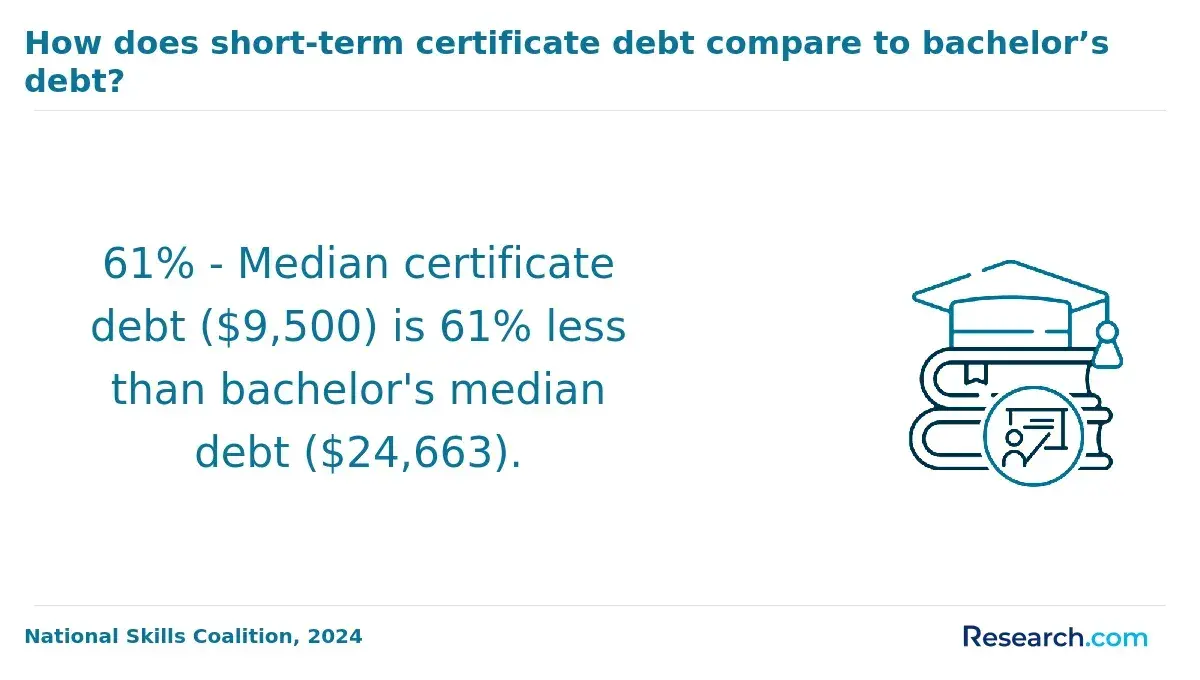
If a specific entry-level job is the goal, compare the associate curriculum with shorter certifications that pay well. A certificate may be more direct for a narrow skill; an associate degree can offer broader education and, when planned carefully, a route to further study.
How Much Do Online Two-Year Degrees Cost and How Long Do They Take?
Many associate programs require about 60 credits and can take roughly two years at a full-time pace. Taking fewer courses, waiting for a prerequisite, or completing a clinical sequence may extend that schedule. Eight-week classes can change when courses begin without reducing the total work required. If speed is your priority, a discussion of what degree can I get online in 6 months is most useful when you check how much prior credit the advertised timeline assumes.
For cost, compare a written estimate through graduation, not just a per-credit rate. Include mandatory online and program fees, books, technology, travel to labs or clinical sites, and any difference between in-district and out-of-district tuition. Then ask the financial aid office about eligibility for grants, scholarships, employer assistance, and federal aid. A lower tuition rate may not produce a lower total bill if it comes with extra credits or fees.
How Does Academic Advising Support Online Two-Year Degree Students?
Good advising turns a catalog into a usable plan. An advisor can identify prerequisites, flag classes offered only in certain terms, explain withdrawal consequences, and coordinate referrals to tutoring or financial aid staff. For an online student, appointment hours, response times, and access by video or phone matter as much as the existence of an advising webpage.
Before enrolling, ask who will advise you, when you first receive a degree plan, and how often it is reviewed. Students returning to school may also want to ask how the college evaluates older credits and accommodates part-time study; resources on the best degrees for older adults can offer another perspective on those priorities. Academic advising helps students navigate choices, but it does not guarantee graduation or a job.
What Accreditation Should Online Two-Year Degree Programs Have?
Start with institutional accreditation by an accreditor recognized by the U.S. Department of Education. It matters for federal student aid and is a basic check on the college, though it does not guarantee that another school will accept a particular credit. Ask the intended transfer institution to confirm how courses will apply to your major.
Some career paths require an additional program-level check. For nursing or an allied-health occupation, confirm that the specific program meets applicable state approval, accreditation, examination, and clinical requirements. Ask for the exact program name and approval status, especially if you will live or seek licensure in a different state. A claim that a college is accredited is not, by itself, proof that a regulated program qualifies you for licensure.
What Are the Admission Requirements for Online Two-Year Degrees?
Associate degree applicants commonly submit an application and evidence of high school completion or an equivalent credential. Colleges may also request previous college transcripts and use placement measures to determine starting courses. Requirements vary, so check the actual program rather than assuming every online major follows the college's general admissions policy.
Nursing and some allied-health majors may have separate applications, prerequisite science courses, grade thresholds, background checks, or limited seats. An advisor can clarify the distinction between being admitted to the college and being accepted into the major. If you have prior credits, request an evaluation showing both which credits transfer and which fulfill degree requirements; those are not always the same thing.
What Coursework Do Students Complete in Online Two-Year Degree Programs?
Most associate programs combine general education - such as writing, mathematics, and social science - with major courses. An AA or AS may reserve more room for courses intended to transfer, while an AAS may devote more credits to occupational study. These tendencies are not universal: review the required course list and any articulation agreement rather than judging by initials alone.
Online IT students may complete virtual labs and projects; healthcare and nursing students may also need campus labs or local clinical placements. Internships and practicums can likewise affect criminal justice or human-services programs. If your ultimate profession requires graduate training, plan backward from bachelor's transfer requirements before exploring a one year masters degree; an associate degree is not a substitute for the intervening qualifications.
What Salaries and Job Outlook Can Graduates Expect?
Occupational pay is useful for comparing destinations, but it is not a forecast of what an associate graduate will earn. The U.S. Bureau of Labor Statistics reported a May 2024 median annual wage of $93,600 for registered nurses. That figure describes workers in the occupation, not new associate degree graduates; becoming an RN also requires completion of an eligible nursing program and state licensure. Local openings, shift patterns, experience, and employer requirements can change a job seeker's prospects.
For other fields, compare the exact job title you would pursue rather than attaching an advanced occupation's salary to an entry-level degree. An IT support role and a cybersecurity analyst role, for example, have different expectations. Ask programs for clearly defined completion, licensure-exam, transfer, and employment outcomes where applicable - and how recently those outcomes were measured.
How Can Students Choose a Reputable Online Two-Year Degree Program?
Build a shortlist around your goal, then verify each college's institutional accreditation and the specific program's format. Request a degree map and total-cost estimate for your residency and enrollment pace. If you plan to transfer, get the destination school's guidance on which courses satisfy the intended bachelor's major; if you need a license, check the relevant state board's requirements before committing.
Finally, test the advising service. Ask for a sample first-term plan, how appointments work for online students, and who helps if a required course is full or a clinical placement falls through. Be wary of programs that advertise "fully online" without explaining in-person requirements, promise a fixed completion date regardless of prior credits, or substitute career-services access for evidence of employment outcomes. The best program is the one whose requirements, support, and next step you can verify - not simply the one with the lowest advertised price.
Other Things You Should Know About
Sometimes. Check for scheduled live classes, proctored activities, campus labs, internships, and local clinical placements before enrolling.
An advisor can recommend a sequence and explain requirements, but you should confirm that the plan matches your transfer destination, career goal, and available time.
Choose based on the specific curriculum. AA and AS pathways often emphasize transfer, while AAS pathways often emphasize employment; individual programs and transfer agreements vary.
No. Employers may require experience or certification, and regulated occupations can require exams, supervised training, or state licensure beyond the degree.
References
- Estimate your college cost | USAGov https://www.usa.gov/estimate-college-cost
- Student support in higher education: campus service... - PMC https://pmc.ncbi.nlm.nih.gov/articles/PMC9834745/
- Community College Student Advising | Blue Ridge Community College https://www.blueridge.edu/services-support/academic-advising-registration/
- How Many Credits Do You Need to Graduate College? | SNHU https://www.snhu.edu/about-us/newsroom/education/how-many-credits-to-graduate-college
- Undergraduate Policies and Procedures - UT Dallas Course Catalogs https://catalog.utdallas.edu/2025/undergraduate/policies/academic
- Prior Learning and Transfer Credit - New College LifeTrack https://nclt.ua.edu/future-students/prior-learning/
- Advising - Baton Rouge Community College https://mybrcc.edu/advising/
- Academic Advising - Concordia University Irvine https://www.cui.edu/about/offices/academic-advising/
- Academic Advising and Registration - Academic Catalog 2025 - 2026 | Forsyth Tech Community College https://catalog.forsythtech.edu/2526/page/academic-advising-and-registration