2027 Best Majors With No SAT or ACT Requirement

Co-Founder and Chief Data Scientist
Choosing a major is hard enough without ruling out a field because you lack SAT or ACT scores. In most cases, the college's admissions policy - not the major's name - determines whether you must submit them. That distinction matters when comparing career paths: the U.S. Bureau of Labor Statistics reports a $133,080 median annual wage for software developers in 2024, but a computer science degree alone does not secure that job or wage.
This guide compares ten fields, explains where separate program admission applies, and shows how to check costs, credentials, and outcomes before you apply.
Key Things You Should Know
- Business, healthcare, technology, education, and other majors may be available without SAT or ACT scores when the applicable undergraduate admissions policy is test-optional or test-free; selective programs can still have separate requirements.
- No-test admission does not remove costs: the College Board reports $11,610 in average published tuition and fees for in-state students at public four-year colleges in 2024-25, before aid and living expenses.
- Match the credential to the occupation: registered nurses had a $93,600 median annual wage in 2024, according to the U.S. Bureau of Labor Statistics, but becoming an RN also requires an approved nursing pathway and licensure.
Top 10 Best Majors With No SAT or ACT Requirement
Business Programs
Undergraduate business majors can lead toward accounting, finance, marketing, or operations. Look for a test-optional or test-free undergraduate admissions policy, then check whether the business school has separate entry standards or prerequisite courses. Accounting is a stronger fit for students pursuing CPA eligibility than a broad management major, but state CPA education and examination rules extend beyond admission. An MBA is a later option, not a substitute for an undergraduate major; its admissions process may consider professional experience or GMAT/GRE scores rather than SAT or ACT scores.
Healthcare Programs
Healthcare administration, public health, and health sciences can suit students interested in healthcare without necessarily seeking a clinical license. A college may waive SAT/ACT submission for undergraduate admission while a clinical track still requires prerequisites, background checks, or separate selection. Compare curricula: administration emphasizes operations, while health sciences may prepare students for further professional study. A master's in public health or healthcare administration is generally a later credential with its own admissions rules. Neither a general healthcare major nor a master's automatically qualifies someone to practice a licensed profession.
Information Technology Programs
Information technology majors typically emphasize networks, systems, cybersecurity, databases, and user support. They may appeal to students who prefer deploying and maintaining technology over designing software. Check the college's undergraduate test policy and whether the IT program requires math placement or preparatory courses. Labs, projects, internships, and relevant certifications may strengthen job preparation, though certifications do not automatically replace a degree. A later master's in IT or cybersecurity has separate graduate admissions criteria; the absence of an SAT/ACT requirement at the undergraduate level says nothing about those criteria.
Computer Science Programs
Computer science is a good fit for students interested in programming, algorithms, software, and mathematical problem-solving. A test-optional college may admit applicants without SAT/ACT scores yet use coursework or placement assessments to determine their starting math class. Compare required calculus, programming sequences, projects, and internship access - not just the admissions policy. Some colleges admit students to the university before separately admitting them to the major. A computer science master's is a distinct graduate path and may require prior computing coursework or other preparation, even when SAT/ACT scores are irrelevant.
Nursing Programs
Nursing requires the closest admissions check on this list. An undergraduate college may be test-optional while its nursing program separately screens applicants using prerequisites, grades, entrance assessments, or clinical eligibility requirements. Compare an associate degree in nursing with a bachelor of science in nursing according to cost, clinical placement, and your intended career path. Graduates of an approved pathway must also meet state requirements and pass the NCLEX-RN to become registered nurses. A nursing master's generally serves applicants with prior nursing preparation and does not use SAT/ACT scores as its standard admissions measure.
Psychology Programs
A psychology major develops research, statistics, and human-behavior knowledge that can support varied entry-level work or graduate study. Check the undergraduate test policy and the program's research and internship opportunities. Do not confuse admission without SAT/ACT scores with a direct path to psychologist licensure: independent practice typically requires a doctoral degree, supervised experience, and state licensure. A psychology master's may prepare students for particular research or applied roles, but licensing eligibility depends on the degree, specialization, and state. Students seeking counseling should compare counseling-specific pathways.
Education Programs
Education majors can prepare students for classroom teaching, but admission to a test-optional university may not mean immediate entry to its teacher-preparation program. Check required coursework, minimum grades, background screening, student teaching, and state-approved licensure pathways. An education studies major without teacher preparation may suit students interested in training or education policy but may not qualify them for a teaching license. A master's in education may support specialization or advancement; its admission and licensure implications must be checked separately from the undergraduate SAT/ACT policy.
Criminal Justice Programs
Criminal justice majors study law, policing, corrections, and the justice system. A test-optional undergraduate policy may make applying simpler, but it does not waive agency hiring standards, background reviews, academy training, or other job-specific requirements. Compare internships and research methods with the roles you actually want; some positions accept multiple majors, making work experience important. A criminal justice master's is generally aimed at specialization or advancement and follows graduate admissions rules. Applicants concerned about background eligibility should check requirements for the specific occupation before committing to a program.
Engineering Programs
Engineering majors combine mathematics, science, design, and laboratory work. Before applying without SAT/ACT scores, verify whether test-optional admission extends to the engineering school and whether calculus readiness, prerequisites, or capacity limits affect entry. Compare disciplines by the problems you want to solve and look for appropriate ABET program accreditation when professional engineering practice is a goal. Licensure generally requires additional steps beyond graduation. Engineering master's programs have separate graduate prerequisites; a college's undergraduate test policy does not establish eligibility for them.
Social Work Programs
A bachelor of social work can provide practice-oriented preparation, often including supervised field education. Confirm both the college's SAT/ACT policy and whether the social work program has a separate application or field-placement requirements. For students aiming at clinical social work, a bachelor's alone is generally insufficient: a master of social work, supervised experience, and state licensure are commonly required. An accredited BSW may qualify some applicants for advanced-standing MSW options, but eligibility and remaining coursework vary by program. Compare those rules before assuming an accelerated route.
What majors can you study without submitting SAT or ACT scores?
You can potentially study any of the ten fields above without submitting SAT or ACT scores, provided the admissions policy that applies to you and your intended program permits it. "No-test major" describes an admissions route, not a different academic credential or an easier version of the major. Policies can differ for first-year and transfer applicants, and a college-wide policy may not cover a selective school or direct-entry program.
Start with the occupation or subject that interests you, then narrow the list to colleges whose current policy covers that major. If you are still comparing fields, use best college degrees for the future as a starting point for questions about demand and fit - not as evidence that a particular college waives test scores.
Are test-optional and test-free colleges the same?
No. At a test-optional college, eligible applicants may generally choose whether to submit SAT or ACT scores. At a test-free or test-blind college, those scores are not used for the applicable admissions decision. Neither label, by itself, tells you whether scores might matter for scholarships, placement, honors programs, or a selective major.
Read the policy for your entry term and applicant category. A temporary policy may change, and wording such as "optional for admission" may have a narrower scope than you expect. If you have scores, ask how submitting them could affect your application; if you do not, confirm that every route you intend to use - including direct entry to a program - accepts an application without them.
What admission requirements replace SAT or ACT scores?
Colleges commonly review high school coursework and grades in place of, or alongside, standardized scores. Depending on the institution and major, they may also consider an essay, activities, recommendations, an interview, or a portfolio. Selective programs may require prerequisite classes or a second application. These factors are not interchangeable: strong grades do not necessarily waive a nursing prerequisite or demonstrate readiness for calculus.
For each college, compare its published first-year or transfer admissions requirements with the intended major's requirements. Ask whether admission is directly to the major, whether placement testing is separate from admission, and what happens if a required prerequisite is unfinished. Request clarification in writing when the general admissions page and program page appear to conflict.
Which no-test majors offer the strongest career opportunities?
The strongest choice depends on the job you want and the credentials it requires. Computer science and IT can lead toward technology roles; nursing has a defined licensure route; business offers several specializations. Education and social work are better evaluated against state approval and field-placement requirements than against a broad salary ranking. A psychology major may be valuable preparation, but students aiming to practice as psychologists face substantially more education and licensing.
Compare degrees that pay well with occupation entry requirements and your likely total cost. A high occupational median is not a graduate earnings forecast. Before selecting a major, identify a few realistic target jobs, check whether employers require that major, and account for any additional education, exams, or supervised practice.
Can you earn a no-test degree online or on campus?
Yes. Test-optional and test-free admissions can apply to online, hybrid, and campus programs, but delivery format and admissions policy are separate facts to verify. An online program may still have live meetings or fixed deadlines. Nursing, education, social work, and some healthcare programs commonly involve clinical, student-teaching, or field placements that must be completed in person.
Compare the format against your schedule and location before applying: confirm any required campus visits, local placement support, lab attendance, and access to courses needed to finish the major. Military-connected students comparing online options may also find best online college for military useful, but should verify the intended major's current test policy and delivery requirements directly.
How long do degree and certificate programs without test scores take?
Skipping SAT or ACT scores generally does not shorten the curriculum. A full-time bachelor's path is commonly planned around four academic years, while associate degrees and certificates are usually shorter; actual timelines depend on credits required, course availability, enrollment intensity, prerequisites, and experiential work. Graduate degrees have their own timelines and admissions requirements.
Transfer credit may reduce remaining coursework, but accepted credits must apply to the degree - not merely appear on a transcript as electives. Ask for a program-specific degree audit showing remaining general education, major, lab, clinical, and residency-credit requirements. A short-term class schedule is not proof of a short time to graduation, particularly in majors with sequenced courses or placements.
What do no-test college programs cost, including online options?
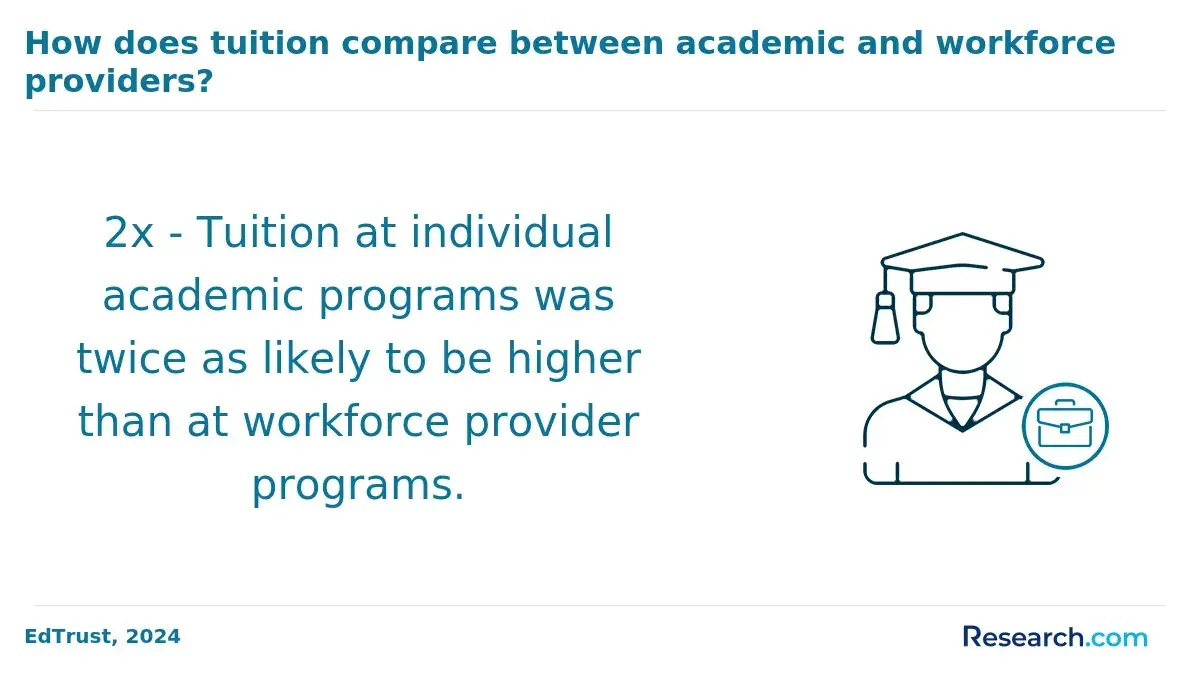
No-test admission is not a tuition discount. Published tuition is only one part of the amount you may pay, and online study can add technology fees while reducing some travel or housing expenses. The College Board's public four-year in-state average cited above is a sector-wide benchmark, not the price of a particular major or the amount students pay after aid.
Build an estimate for each actual program before deciding. These costs can change which option is least expensive overall:
- Tuition and mandatory fees for the credits you still need, including any major-specific charges.
- Books, equipment, software, transportation, and costs tied to labs or placements.
- Housing and living expenses, plus any required campus visits for an online program.
- Grants, scholarships, employer assistance, and other aid for which you qualify.
Use each college's aid offer and program requirements to compare likely out-of-pocket cost, not sticker price alone. If borrowing, consider the total amount needed to complete the credential rather than just the first year.
What careers, salaries, and job outlooks follow these majors?
A major can prepare you for multiple jobs, while one job may accept multiple majors. The comparison below pairs fields with plausible directions and the qualification question most likely to affect your decision; it is not a placement or salary promise.
| Field | Possible direction | Qualification to check |
| Business | Accounting or operations | Whether the target role requires specialized coursework, certification, or experience |
| Computer science or IT | Software development or systems work | Technical skills, projects, and the employer's education requirements |
| Nursing | Registered nursing | Approved education, examination, and state licensure |
| Education | Classroom teaching | State-approved preparation and teacher licensure |
| Psychology or social work | Human services or further professional study | Whether the intended role requires a graduate degree and license |
The U.S. Bureau of Labor Statistics publishes occupation-specific wages and employment projections, which are more useful here than a claim that every graduate of a major earns the same amount. Use the occupation you actually want - not the highest-paying job loosely associated with a field - to assess prospects. For licensed roles, include the time and cost of qualifying after admission.
How can you verify accreditation, licensing, and program quality?
First, confirm that the institution holds accreditation recognized for federal student-aid purposes. Then check programmatic accreditation and state approval where they matter to your goal - particularly for nursing, social work, teacher preparation, and engineering. Institutional accreditation alone does not establish that a specific program meets a licensing board's requirements.
Common mistakes are assuming that a no-test policy covers every major, that online means no in-person work, or that a degree automatically qualifies you for a licensed job. The safest next step is to match the current admissions page to the program catalog and ask the program or relevant state board to clarify any discrepancy before paying an enrollment deposit. Applicants considering justice-system work should also check occupation-specific background standards; the discussion of what can a felon go to college for can help frame that research, but admissions eligibility and employment eligibility remain different questions.
Other Things You Should Know About
Yes, if the policy covering your applicant category and intended program allows an application without scores. Check scholarship and placement rules separately.
No. Colleges still evaluate other qualifications, and selective majors may have additional requirements.
Requirements vary. Some colleges evaluate transfer applicants primarily through prior college work, but you should check the published policy for your completed credits and target program.
The admissions route generally does not change the credential. Focus on whether the program provides the coursework, experience, accreditation, and licensing preparation your target role requires.
References
- Fast Facts: Tuition costs of colleges and universities (76) | ed.gov https://nces.ed.gov/fastfacts/display.asp
- Admissions Eligibility | Colorado Department of Higher Education Home https://cdhe.colorado.gov/admissions-eligibility
- Field of degree: Occupational Outlook Handbook | bls.gov https://www.bls.gov/ooh/field-of-degree/
- Cost of Attendance - Financial Aid and Scholarships | The University of Utah https://financialaid.utah.edu/tuition-and-fees/cost-of-attendance.php
- Cost of Attendance | Student Finances at CU Denver https://www.cudenver.edu/student-finances/cost-of-attendance
- Test-Optional FAQs | University of South Carolina https://sc.edu/about/offices_and_divisions/undergraduate_admissions/apply/for_freshmen/test_optional/
- Application Requirements & Deadlines | Undergraduate Admissions https://admissions.charlotte.edu/apply/first-year-students/application-requirements/
- ACT/SAT Optional List for Fall 2025 - Fairtest https://fairtest.org/test-optional-list/
- What Colleges Require the SAT - BigFuture | College Board https://bigfuture.collegeboard.org/plan-for-college/find-your-fit/what-colleges-require-SAT