2027 Applying to a Data Science Master's After a Long Academic Gap

Co-Founder and Chief Data Scientist
A long academic gap does not, by itself, rule out a data science master's. The harder question is whether your earlier coursework, recent experience, and current technical skills meet a particular program's expectations.
If you have been working, caregiving, or pursuing another path since college, this guide will help you identify what to refresh, what evidence to submit, and when a preparatory course may be more useful than applying immediately.
Key Things You Should Know
- There is no universal maximum time since graduation; eligibility depends on each program's published requirements, particularly its math and programming prerequisites.
- Recent, assessable work - such as a graded course or a reproducible project - can show readiness more clearly than an old transcript or an unsupported claim that your skills are current.
- Compare the cost and time needed to close prerequisite gaps before choosing a degree; the data scientist occupation's projected 35% employment growth from 2025 to 2035 does not guarantee an individual job outcome.
Can you apply to a data science master's after a long academic gap?
Yes, if you meet the program's eligibility rules. An applicant who finished college years ago should not assume the gap is disqualifying - or that professional experience automatically substitutes for required coursework. Admissions committees need enough evidence to judge whether you can handle graduate-level quantitative and computing work now.
Start by separating time away from school from time away from relevant skills. Someone who uses SQL and statistical analysis at work may need a different preparation plan from someone returning to both subjects after years away. If a requirement is unclear, ask admissions whether your specific course or experience satisfies it before paying an application fee.
What are the admission requirements for a data science master's program?
Requirements vary by institution. Programs generally ask applicants to document an undergraduate degree and submit academic records; they may also request a statement of purpose, recommendations, a résumé, test scores, or evidence of particular coursework. Check the current admissions page for each program rather than relying on a general description of what data science schools accept.
For an older transcript, look closely at how the program evaluates prerequisite courses. An admissions office may distinguish between having taken a course and having knowledge that is sufficiently current for its curriculum. Ask whether it accepts coursework from a community college or nondegree program, whether courses must carry academic credit, and whether professional experience can satisfy any stated requirement. Get the answer for your circumstances in writing when possible.
How can you prove your readiness for graduate-level data science?
Use evidence that lets a reviewer see both your current ability and how you reached a result. A recent graded course can document formal preparation; a work or independent project can demonstrate application. Neither should be presented as a substitute for a formal prerequisite unless the program confirms that it is.
A focused application can connect several kinds of evidence without turning your statement into an apology for the gap:
- Academic evidence: Identify recent, relevant coursework and explain what earlier transcript entries do - and do not - show about your preparation.
- Technical evidence: Present a project with a clear question, data source, method, evaluation, and reproducible code or documented workflow; remove confidential employer data.
- Professional evidence: Explain analytical decisions you made at work, the tools you used, and the limits of your role rather than relying on a job title alone.
- A credible study plan: Name the skills you still need to strengthen and show how you will address them before or during the degree, subject to program policy.
A common mistake is submitting a collection of certificates without showing what you can independently do. Another is overstating a project's sophistication: a well-explained analysis with sensible validation is stronger evidence than an ambitious model whose results you cannot defend.
Which prerequisites do data science master's programs require?
Published prerequisites differ, but mathematics, statistics, and programming are the areas to check first. This table explains why commonly listed subjects matter; it is not a universal admissions checklist.
| Subject | Relevance to graduate study |
| Calculus and linear algebra | Support the mathematical reasoning behind optimization and many machine-learning methods. |
| Probability and statistics | Support inference, uncertainty assessment, and evaluation of analytical results. |
| Programming and data handling | Support reproducible analysis, data preparation, and implementation of models. |
Compare your transcript with each school's exact course descriptions, not just course titles. If you lack a required class, ask whether you must complete it before applying, before enrolling, or through an approved foundation pathway. A self-paced course may help you learn the material without fulfilling a credit-bearing requirement. If your interests are shifting toward artificial intelligence, bridge pathways into an AI master's offer another model to investigate - but confirm their eligibility rules separately.
Should you choose an online or campus-based data science master's?
Choose based on the support and schedule you need while rebuilding academic momentum, not on an assumption that one format is inherently easier. An online program may fit continuing employment or caregiving, but scheduled classes, group projects, exams, and access to instructors can vary. A campus program may make in-person collaboration easier while adding commuting or relocation demands.
Ask for a sample course schedule and find out whether classes are live or self-paced, how students get help with difficult prerequisite material, and whether a part-time student can follow the required course sequence. If speed is your priority, compare shorter-duration master's degrees in data science against your actual preparation: a compressed schedule is a poor bargain if it leaves too little time to refresh foundational skills.
What do you study in a data science master's program?
Curricula vary, but data science graduate study commonly brings statistical reasoning, programming, data management, and modeling together in applied work. For a returning student, the important distinction is between a program that teaches material you need and one that expects you to know it on the first day. Read required-course descriptions and sample sequences, paying particular attention to where foundational work ends and advanced work begins.
Evaluate electives and projects against your intended field rather than choosing by degree title alone. If you want to apply analytics in clinical or health settings, for example, examine the program's treatment of sensitive data and domain-specific projects. Master's pathways connecting AI and healthcare may be relevant, but the fit depends on their actual curriculum and your career goal.
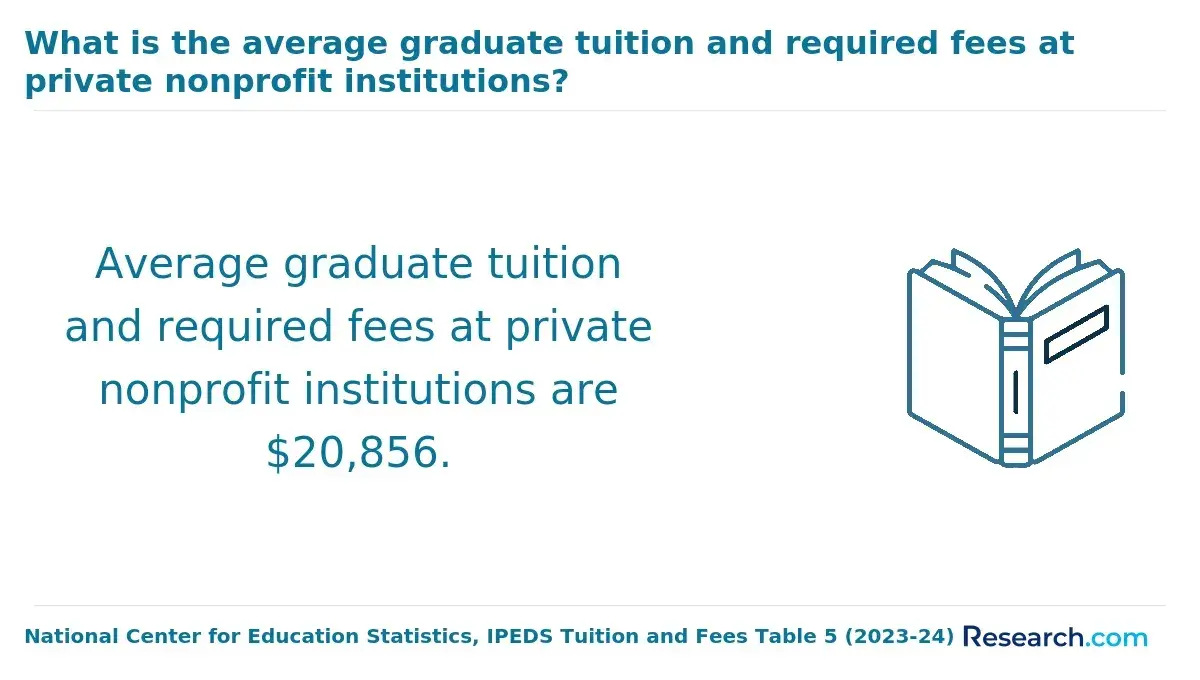
How long does a data science master's take and cost?
There is no reliable single duration or price for this decision. Required credits, enrollment pace, foundation courses, and tuition policies all vary. A returning applicant should calculate the time and expense of any preparation before the degree as well as the published cost of completing it.
Request a program-specific estimate covering tuition, mandatory fees, required materials or technology, and any campus visits. Then ask whether prerequisite courses are billed separately and whether taking fewer courses at a time changes fees or aid eligibility. Employer assistance or financial aid may reduce what you pay, but eligibility and award amounts must be verified. For a closer look at funding options, see covering the cost of a data science master's. Avoid comparing one school's tuition-only figure with another school's total estimated cost.
How do you choose an accredited data science master's program?
Verify that the institution holds recognized U.S. institutional accreditation, then evaluate the specific degree on its own merits. Accreditation does not establish that its data science curriculum, prerequisite support, or schedule suits you. If you plan to study online from another state, also confirm that the institution can enroll students where you live.
For applicants with an academic gap, a useful shortlist contains programs with clear prerequisite policies, courses sequenced at a manageable pace, accessible academic support, and projects relevant to a target role. Compare published completion requirements and obtain a full cost estimate. Lower-tuition online data science master's programs can broaden the shortlist, but a lower tuition figure alone does not resolve foundation-course costs or program fit. Rankings are not a substitute for checking those details.
What careers and salaries can a data science master's lead to?
A degree may support applications for data scientist and related analytical roles, but the appropriate target depends on your previous work, technical depth, and portfolio. An experienced professional may be able to combine new methods with existing industry knowledge; a career changer with limited applied experience may first need to demonstrate narrower analytical skills. A master's is not automatically required for every such role.
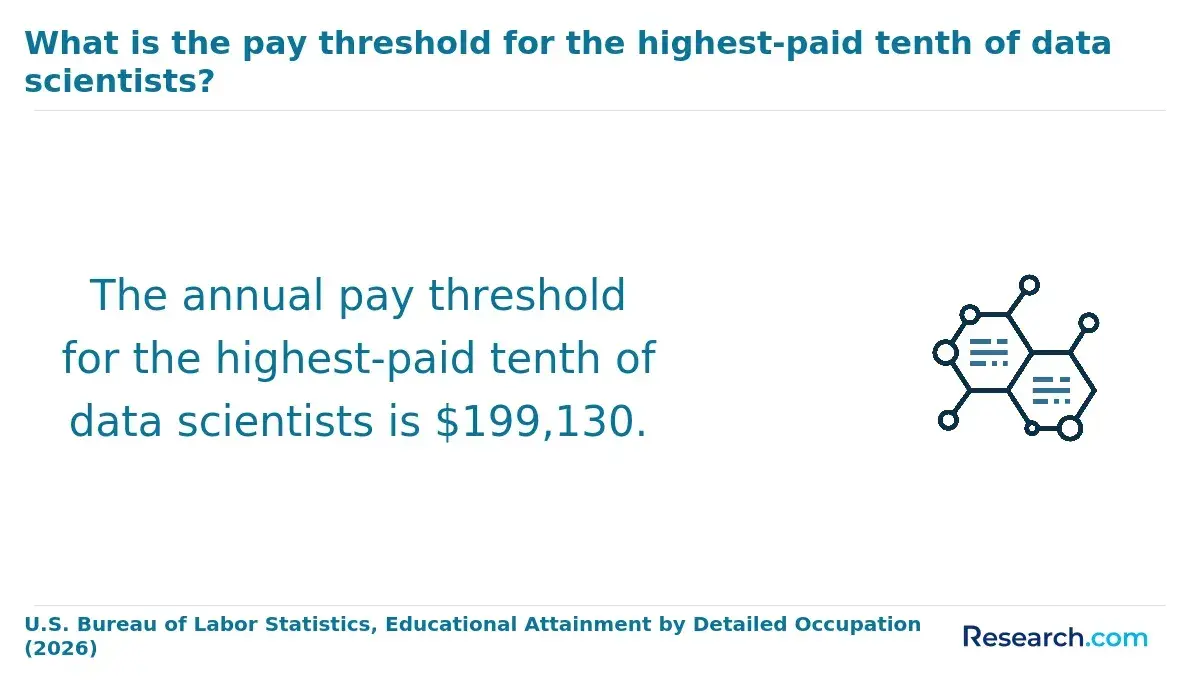
The U.S. Bureau of Labor Statistics reports a $120,230 median annual wage for data scientists in May 2025. That is an occupation-wide figure, not an expected starting salary or a measure of what this degree adds to an individual's pay.
BLS projects 35% employment growth from 2025 to 2035. The outlook supports investigating the field, but it does not indicate how many openings will fit a new graduate in a particular location or specialty. Before enrolling, compare job descriptions for roles you would actually pursue with the program's courses and the skills you can already demonstrate.
What certifications or licenses do data scientists need?
Data scientist is not generally a licensed occupation in the U.S. Employers may value particular software or cloud credentials, but those credentials do not replace the analytical preparation needed to do the work. Requirements can differ when a role sits within a regulated field or includes duties belonging to another licensed profession.
If you are returning to school after a gap, prioritize the skills and admissions prerequisites your target programs actually assess before purchasing a certification. For career planning, check current postings from employers you would consider; treat a frequently named tool as a skill to investigate, not proof that a particular certificate is mandatory.
Other Things You Should Know About Data Science
Often, programs accept professional recommendations, but their rules vary. Choose someone who can describe your analytical work and readiness for advanced study, and check whether the program specifically requires an academic reference.
There is no universal expiration rule. Ask each program whether it imposes a recency requirement and whether a recent graded course can update evidence of your knowledge.
Some programs may permit it; others require the course to be complete before an application is reviewed. Confirm the deadline, acceptable course provider, and minimum grade before enrolling.
You can explain it briefly if it makes your timeline clearer. You do not need to disclose unnecessary personal details; use the available space to show your current preparation and purpose for pursuing the degree.
References
- 4 Flexible Ways to Earn a College Degree on Your Schedule | St. John's University https://www.stjohns.edu/news-media/johnnies-blog/4-flexible-ways-earn-college-degree-your-schedule-0
- M.S. admissions | Data Science https://cse.umn.edu/datascience/graduate-admission-requirements
- Asking for Letters of Recommendation | Academic Advising https://advising.stanford.edu/current-students/advising-student-handbook/letters-recommendation
- Prerequisite Key Topics - UVA School of Data Science https://datascience.virginia.edu/pages/prerequisite-key-topics
- Personal Statements & Statements of Purpose | Career Services https://careerservices.cns.utexas.edu/resources/graduate-school-preparation/personal-statements-statements-purpose
- MS in Data Science | columbia.edu https://datascience.columbia.edu/education/ms-data-science
- Writing Your Academic Statement of Purpose - Graduate School https://gradschool.cornell.edu/inclusion/recruitment/prospective-students/writing-your-statement-of-purpose/
- Prerequisites and prework | Machine Learning | Google for Developers https://developers.google.com/machine-learning/crash-course/prereqs-and-prework
- Do Students Really Need Four or Five Math Prerequisites Before They Can Begin Learning AI? - CRA https://cra.org/do-students-really-need-four-or-five-math-prerequisites-before-they-can-begin-learning-ai/