
2027 Distributed Computing in an Online Data Science Master's: Courses, Projects, and Program Selection

Co-Founder and Chief Data Scientist
Choosing an online data science master's for distributed computing takes more than finding "big data" in a course title. If you want to build data pipelines or train models across multiple machines, you need to know how much of the curriculum goes beyond basic tool use - and whether you can practice those skills remotely. This guide shows you what to look for in courses and projects, then how to weigh format, cost, and career fit before applying.
Key Things You Should Know
- Look for assessed work in distributed data processing, data engineering, or scalable machine learning; a course title or brief Spark demonstration does not establish depth.
- Strong projects document why distributed processing was needed, how the system handled failures or data movement, and whether its results were reproducible.
- Compare current course availability, remote computing access, total cost, and scheduling before enrolling. The U.S. Bureau of Labor Statistics projects 35% growth in data scientist employment from 2025 to 2035, but that projection does not predict an individual graduate's outcome.
What is distributed computing in an online data science master's program?
Distributed computing means coordinating work across multiple computing processes or machines rather than relying on one computer. In data science, that may involve processing a large dataset in parallel, maintaining a pipeline that spans several services, or training and serving models using shared computing resources.
At graduate level, the goal should extend beyond running a notebook on a cluster. Students should be able to explain partitioning, data movement, fault tolerance, performance bottlenecks, and the trade-off between system complexity and the size of the problem. A useful starting point is SQL and Python or another programming language, plus basic probability, data structures, and comfort with a command line. Those are preparation needs, not universal admissions requirements.
Not every data scientist needs to administer a cluster. Choose substantial distributed-systems study if your target work involves production-scale pipelines, large datasets, or scalable model training. If your interests center on statistical inference or smaller research datasets, a lighter introduction may be sufficient.
Which courses teach distributed computing in data science master's programs?
Relevant material may sit in courses titled data engineering, big data analytics, cloud computing, database systems, distributed systems, or scalable machine learning. Compare descriptions and assessments, not titles alone: a course that mentions Apache Spark is different from one requiring students to design, benchmark, and explain a distributed workflow.
The table distinguishes levels of exposure that can look similar in a short program description.
| Curriculum evidence | Likely depth | What to confirm |
| Distributed computing named in a program overview | Unclear; it may be a passing mention | Which required or elective course teaches it? |
| A unit on parallel tools within a broader course | Introductory exposure | Is there assessed work beyond a guided exercise? |
| Dedicated data engineering or distributed-systems course | Potentially substantive | Do students address partitioning, failures, and performance? |
| Advanced elective plus an independent project | Potentially deeper application | Is the elective offered often enough, with remote access to computing resources? |
Ask for a recent syllabus or assignment description. An advertised elective has limited value if it is rarely offered or cannot fit your course sequence. If scalable model training is your main goal, compare the required work with that in specialized ML master's degrees with tuition and fees below $20,000; the degree label alone does not establish which curriculum is stronger in distributed computing.
What projects build practical distributed data science skills?
A strong project begins with a question that genuinely benefits from distributed processing. Moving a small dataset to a cluster without measuring any benefit demonstrates tool familiarity, but little understanding of when the added complexity is worthwhile.
These project formats let you test different parts of the skill set. In each case, the submission should include code, setup instructions, evaluation results, and an explanation of technical choices.
- Batch analytics pipeline: Ingest and transform a large or deliberately partitioned dataset, then compare runtime and data movement under different partitioning choices.
- Streaming workflow: Process arriving records and document how the pipeline handles late data, duplicate events, and interruptions.
- Scalable model training: Compare a single-machine baseline with distributed training or feature processing, reporting model quality alongside computing cost and runtime.
For portfolio value, explain what failed as well as what worked: a skewed partition, an expensive shuffle, or a result that did not improve with more workers can show sound judgment. Confirm that the program provides suitable remote computing access and permits you to share a sanitized version of the work. Do not publish restricted datasets, credentials, or employer data.
How do online and campus-based data science master's programs compare?
For distributed computing, the important difference is not the physical location of a lecture. It is whether students can access computing infrastructure, get help debugging systems, and collaborate effectively. Either format can teach the subject well; neither guarantees hands-on access.
Online study may better suit someone keeping a full-time job, particularly if labs are remotely accessible and most work is asynchronous. Campus study may be preferable if a program's research computing, in-person lab support, or employer connections are central to your goals. Check for scheduled live sessions, group-project time zones, exams, and any campus visits before assuming an online degree is entirely self-paced or remote.
If speed matters more than a broad data science curriculum, shorter online AI master's pathways offer another format comparison. Verify that any shorter option still includes the distributed-computing coursework and project access you need.
What are the admission requirements for an online data science master's?
Requirements vary by institution. Programs may ask for a bachelor's degree, transcripts, recommendations, a statement of purpose, and evidence of quantitative or programming preparation; some specify prerequisite courses while others evaluate relevant work. Only the program's current admissions policy can tell you what formally satisfies a requirement.
If you have not studied programming, statistics, or linear algebra recently, ask admissions staff which gaps would affect eligibility and which would mainly make the coursework harder. An independent course or workplace project can demonstrate preparation, but it does not automatically fulfill a formal prerequisite. For a distributed-computing goal, experience with SQL, Python, and debugging data workflows is especially useful to document.
How long does an online data science master's take, and what does it cost?
Completion time and price depend on credit requirements, enrollment pace, tuition policy, and fees. Do not infer a timeline from the word "online," or treat a tuition figure as the full cost of a degree. A course may also require cloud computing resources or software access; ask whether those costs are covered and whether usage limits apply.
Before comparing offers, build the same cost estimate for each program using its current published rates and your intended pace. Include required fees, materials, possible travel, and any extra terms needed because a key elective is unavailable. Employer assistance or financial aid may change your out-of-pocket cost; data science master's education financing options can help you identify questions to ask, but confirm eligibility and award terms with each school.
How can you verify an online data science master's program's accreditation?
Check the institution's current accreditation status through its stated institutional accreditor and the U.S. Department of Education's accreditation database. Then confirm that the degree is awarded by that institution, rather than assuming a third-party course provider confers it. Institutional accreditation does not, by itself, certify that a particular data science curriculum has strong distributed-computing content.
If you will study from another state, ask the school whether it can enroll students where you live and whether any in-person activity has location restrictions. Verify these details directly before paying a deposit; accreditation, authorization to enroll, and technical curriculum quality answer different questions.
What careers can distributed computing graduates pursue?
Distributed-computing skills can support work in data engineering, machine learning engineering, analytics infrastructure, and data science roles involving large-scale data. Job titles are not interchangeable: a data engineer may focus on reliable pipelines, while a data scientist may use those pipelines to test models and answer analytical questions. Some roles place greater weight on software engineering or production operations than a data science degree alone may provide.
Match the projects you can complete to the roles you want. A candidate targeting pipelines needs evidence of ingestion, testing, and reliability; one targeting scalable machine learning needs evidence of model evaluation as well as computing decisions. When comparing career-oriented online data science degree options, check whether their required work produces that evidence, rather than relying on a list of possible job titles.
What salary and job outlook can data science graduates expect?
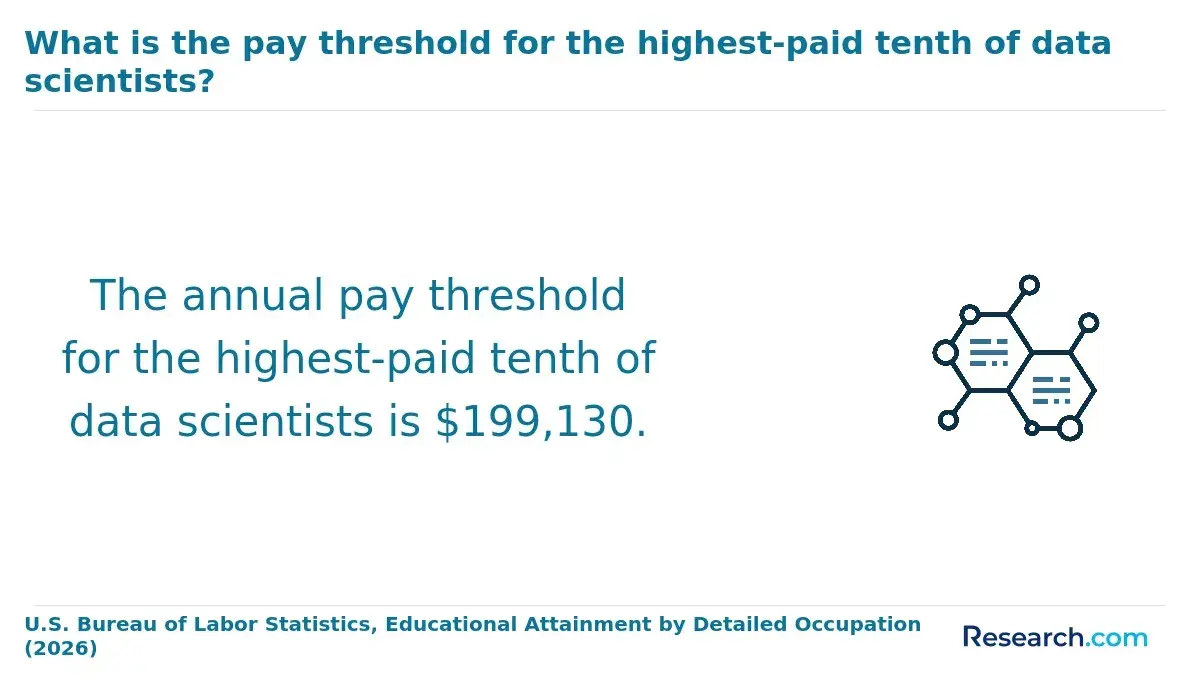
The U.S. Bureau of Labor Statistics reports a $120,230 median annual wage for data scientists in May 2025. That is an occupation-wide figure, not a starting salary or a measured outcome for graduates of online master's programs. Experience, role, employer, and location can all affect an individual offer.
BLS projects 35% employment growth for data scientists from 2025 to 2035. The projection signals demand across the occupation, but it does not show how many openings require a master's degree or distributed-computing expertise. Use it as labor-market context, then examine postings for your target roles to see which skills employers actually request.
How should you choose a reputable online data science master's program?
Shortlist programs by the work you want to do after graduation, then test whether each program can deliver the necessary instruction and practice. A lower price or a prominent tool name is not enough if the relevant elective is inaccessible or the project never requires independent system design.
Use the following questions when reviewing current catalogs and speaking with program staff. Request examples or written policies where possible.
- Which required courses assess distributed processing, and what do students build without following a supplied tutorial?
- When were the relevant electives last offered, and can students taking your intended course load complete them before graduation?
- What remote computing resources, technical support, and cloud-usage allowances are included?
- Can the capstone address a distributed-data problem, and what restrictions apply to publishing the result?
- What is your estimated total cost and feasible completion schedule, including fees and any live or in-person obligations?
Choose a program with dedicated technical depth and an independently assessed project if distributed systems are central to your career goal. If you primarily want AI or machine learning skills and need to control costs, compare online AI degrees with lower tuition as alternatives - but check their course-level systems content before treating them as substitutes.
Other Things You Should Know About Data Science
Not necessarily. Many assignments can use remote computing resources, but access and local setup requirements vary. Ask for the program's hardware specifications and whether cloud resources are included before buying a new computer.
No. Spark can be useful, but the transferable skills include partitioning data, managing failures, measuring performance, and choosing when distributed processing is justified. Tools change faster than those principles.
Yes. A small, partitioned workload can reveal coordination and correctness issues. Be clear about its limits, though: it cannot prove that a design performs well at production scale.
No. Remove secrets and sensitive information, follow data-use agreements, and check course or employer policies. You can still describe the architecture, evaluation method, and lessons learned without releasing restricted material.
References
- RDHPCS Cloud Computing | NOAA RDHPCS https://docs.rdhpcs.noaa.gov/systems/cloud_user_guide.html
- Curriculum | Online Data Science Masters Degree | MDS@Rice https://csweb.rice.edu/academics/graduate-programs/online-mds/curriculum
- Cloud Computing - UWIT https://uwconnect.uw.edu/it
- Online Program - UChicago Data Science Institute https://datascience.uchicago.edu/education/masters-programs/online-program/
- Cloud Computing at U-M - Information and Technology Services https://its.umich.edu/computing/virtualization-cloud/cloud-computing
- Master's in Data Science | utexas.edu https://cdso.utexas.edu/msds
- What's the Difference Between Asynchronous and Synchronous Learning? | Ohio State Online https://online.osu.edu/content-hub/blogs/whats-the-difference-between-asynchronous-and-synchronous-learning/
- What Is Distributed Computing? | Microsoft Azure https://azure.microsoft.com/en-us/resources/cloud-computing-dictionary/what-is-distributed-computing
- What is Distributed Computing? | Amazon Web Services, Inc. https://aws.amazon.com/what-is/distributed-computing/


