Is Gisma a Good University? What Its Rankings, Accreditations, & Reputations Tell You

Co-Founder and Chief Data Scientist
Over the past 5 years, Gisma University of Applied Sciences has built a broad external validation portfolio covering academic quality, professional standards, institutional performance, program recognition, and regional impact. These include highly sought recognitions from the Association of MBAs (AMBA), Chartered Institute of Marketing (CIM), Foundation for International Business Administration Accreditation (FIBAA), QS 4 Stars, and Eduniversal Top 10.
The article examines these recognitions, how their different scopes contribute to Gisma's validated business education model. Most importantly, what do they mean to you as an aspiring business professional or someone moving up the corporate ladder.
Key Findings
- Gisma’s recognition includes AMBA, BGA, CIM, FIBAA, the German Accreditation Council, QS Stars, CHE, Eduniversal, and EFMD's BSIS framework.
- AMBA focuses on the Global MBA; BGA evaluates the business school as a whole; CIM addresses professional marketing education; while FIBAA and German accreditation address program quality and quality assurance.
- QS Stars, CHE, Eduniversal, and BSIS provide additional perspectives on institutional performance, program positioning, and impact.
- Gisma's 5-Year Institutional Foundation Institutional History
- AMBA and BGA Provide Business-School-Level Validation Business Accreditation
- CIM Connects Gisma's Marketing Degrees With Professional Standards CIM Recognition
- FIBAA and the German Accreditation Council Support Formal Quality Assurance Quality Assurance
- QS Stars Evaluates Gisma Across Multiple Performance Areas QS Stars
- CHE Adds a German Student and Program Perspective CHE Rankings
- Eduniversal Provides Program-Level Recognition Program Recognition
- BSIS Measures Gisma's Regional Impact Regional Impact
- Industry and International Partnerships Support Gisma's Applied Model Global Partnerships
- Gisma's Reported Graduate Outcomes Add an Employment Perspective Graduate Outcomes
Gisma's 5-Year Institutional Foundation
Gisma University of Applied Sciences was established in 2021 to provide business and management education. The state-recognized private university operates campuses in Potsdam and Berlin and now offers programs in business, management, data science, artificial intelligence, engineering, and technology, with English as the language of instruction. Prior to 2021, Gisma was known as Gisma Business School, and had been offering degrees through academic partnerships since 1999.
Gisma reports that its students come from 95+ nations, reflecting the international environment across its programs. It lists 20+ study programs as of 2025, spanning management, leadership, data science, artificial intelligence, and software engineering, with English as the language of instruction.
Institutional Scale
Gisma reported 2,000+ students in September 2025, providing a clear measure of its own institutional scale. This figure is distinct from the more than 15,000 students across the wider GUS Germany network.
Gisma's business education portfolio is validated across a range of accreditations, rankings, and quality assessments, factors that anyone exploring a business degree may find helpful when determining the type of program to focus on.

AMBA and BGA Provide Business-School-Level Validation
Gisma's AMBA and BGA accreditations provide complementary forms of business-education validation. AMBA accredits Gisma's Global MBA, while BGA's accreditation covers the wider business school. Gisma received the joint accreditation in 2025 following an assessment by a panel of senior business-school leaders from around the world.
AMBA: Global MBA Accreditation
AMBA accredits MBA, DBA, and master's degree programs from the top 2% of business schools globally. Its accreditation is awarded at the program level, with accredited programs assessed against rigorous standards and reviewed every five years. Gisma's Global MBA holds AMBA accreditation, making it one of six AMBA-accredited business schools in Germany.
BGA: Whole-School Accreditation
BGA adds a school-wide dimension to Gisma's external validation. Its accreditation examines the business school's overall impact and value creation, with a focus on positive impact, responsible management, lifelong learning, and continuous improvement. Gisma is currently listed in AMBA & BGA's joint-accredited school directory.
Together, they give Gisma's business portfolio both a specialized postgraduate accreditation and a broader institutional quality-assurance perspective.
CIM Connects Gisma's Marketing Degrees With Professional Standards
Gisma's CIM accreditation covers two marketing-focused business degrees and provides a pathway to professional CIM qualifications. Announced in January 2025, it covers the BSc Business Management (Marketing) and the MSc Business Management (Marketing). Gisma states that it is the only university in Germany with CIM-accredited marketing degrees.
A Professional Qualification Pathway
CIM-accredited degrees are mapped against CIM qualification learning outcomes, allowing eligible graduates to receive exemptions from some CIM assessments. CIM states that, for relevant accredited degrees and qualifications, exemptions can reduce the number of assessments required from three to one, subject to eligibility requirements and the specific exemptions available for the degree.
For Gisma, the accreditation creates a direct link between its two marketing degrees and a separate professional marketing qualification framework. This gives the CIM credential a distinct role within Gisma's wider portfolio of institutional and program-level validations.
FIBAA and the German Accreditation Council Support Formal Quality Assurance
Gisma's degree programs also fall within Germany's formal higher education accreditation framework, with FIBAA serving as the accreditation agency and the German Accreditation Council providing the national accreditation seal.
FIBAA and the German Accreditation Council contribute to Gisma's formal quality-assurance framework in three key ways:
- FIBAA: FIBAA conducts program-level accreditation assessments covering program objectives, admission requirements, curriculum and teaching concepts, academic environment, and quality assurance and development.
- Independent expert panels: FIBAA accreditation reviews use independent panels comprising academics, professional practice representatives, and students, bringing different perspectives to the accreditation process.
- German Accreditation Council: The Council provides the national accreditation framework and makes the accreditation decision for programs assessed under Germany's accreditation system. These procedures operate under the Interstate Study Accreditation Treaty and applicable state regulations.
Together, these mechanisms place Gisma's degree programs within a formal, externally reviewed German accreditation system, giving this layer of quality assurance a different role from the international business-school and professional credentials.
QS Stars Evaluates Gisma Across Multiple Performance Areas
QS Stars is an opt-in rating system that evaluates universities across multiple performance areas. Unlike conventional rankings, it provides an overall star rating alongside category-level ratings. Gisma received four QS Stars overall in February 2026, with the following category ratings:
- 5 Stars: Online Learning
- 4 Stars: Teaching
- 4 Stars: Employability
- 4 Stars: Global Engagement
- 4 Stars: Global MBA Programme Strength
QS Stars evaluates institutions through several key components:
- It assesses multiple performance areas: QS Stars evaluates institutions across five broad categories, such as Learning Experience, Employability & Outcomes, Sustainability, Research & Innovation, and Global Engagement.
- It uses ratings rather than conventional rankings: Institutions receive category ratings from 0 to 5 stars, while the overall QS Stars rating ranges from 0 to 5+ stars. QS says the system provides an in-depth picture of an institution's strengths and weaknesses rather than directly comparing institutions through a conventional ranking.
Gisma's four-star overall rating, together with its category results, provides a broader performance profile alongside its formal accreditations.
CHE Adds a German Student and Program Perspective
The CHE University Ranking uses multiple indicators to provide subject-specific information on study conditions and academic environments in Germany, rather than assigning institutions a single overall score. Depending on the subject, indicators can cover teaching and study conditions, equipment, international orientation, career and practical orientation, research, study results, and student and location information. CHE combines institutional data with assessments from groups such as students and professors.
For Gisma, the 2026 results placed its Department of Business and Department of Computer and Data Science in the Top Tier of the CHE University Ranking 2026 across a range of indicators, highlighting international learning, industry-connected education, academic quality, and student experience.
Eduniversal Provides Program-Level Recognition
Gisma's 2025 Eduniversal results placed three graduate programs among the highest-ranked programs in Germany within their respective fields:
| Gisma Program | 2025 Eduniversal Position in Germany |
| MSc Data Science | 4th |
| MSc International Business Management | 6th |
| Global MBA | 10th |
Here’s how Eduniversal provides program-level recognition:
- It ranks graduate programs by field. Eduniversal's Best Master's & MBA Ranking covers programs across 56 fields of study, allowing individual master's and MBA programs to be ranked within their respective categories.
- It compares individual programs within each field. The ranking lists specific master's and MBA programs and assigns them positions within their respective fields and countries, providing a program-level comparison rather than only a business-school-level assessment.
BSIS Measures Gisma's Regional Impact
Gisma received the EFMD Business School Impact System (BSIS) Impact Label in 2025, recognizing its measurable impact beyond the institution's boundaries.
| Gisma BSIS Impact Measure | Reported Result |
| Economic activity in Berlin-Brandenburg | €126.5 million annually |
| Start-ups created by students and alumni | 15+ |
| Jobs generated by those start-ups | 120+ |
How BSIS Measures Gisma's Regional Impact
BSIS measures Gisma's regional impact through a comprehensive assessment framework:
- It examines seven dimensions of impact: Financial, educational, business development, intellectual, regional ecosystem, societal, and image impact.
- It uses more than 130 indicators: EFMD uses more than 130 indicators to assess the impact of business schools across these seven dimensions.
- It looks beyond institutional activity: The framework considers how a business school affects its surrounding environment, including its economic, entrepreneurial, ecosystem, societal, and broader regional impact.
For Gisma, BSIS provides an impact-focused perspective, assessing its regional impact across seven dimensions and supporting its 2025 BSIS Impact Label.
Industry and International Partnerships Support Gisma's Applied Model
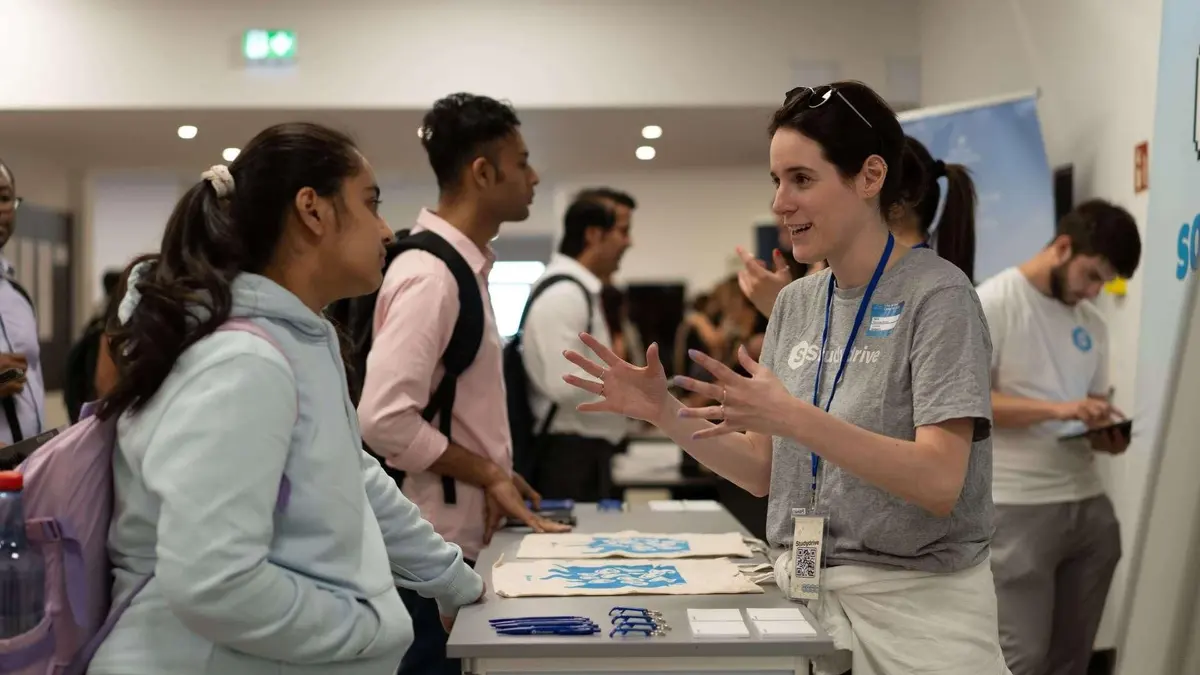
Gisma supports its applied education model through industry partnerships, professionally experienced faculty, and international degree pathways.
- SAP partnership: Gisma joined SAP University Alliances in 2023, giving students access to academic resources, internships, graduate programmes, training, certifications, and workshops.
- Industry-experienced faculty: Gisma highlights faculty experience with organizations including Amazon, the United Nations, Harvard, KPMG, Boston Consulting Group, IBM, Allianz, and the 2020 Tokyo Olympic Games, bringing professional perspectives into its academic environment.
- International double degrees: Gisma offers double-degree programmes with Kingston University London, allowing eligible students to earn degrees from both institutions. The partnership includes International Business Management programmes at undergraduate and postgraduate levels.
- UC Berkeley partnership: In 2025, Gisma entered into a global partnership with the Sutardja Center for Entrepreneurship & Technology (SCET) at the University of California, Berkeley, providing students access to entrepreneurship education opportunities, including the Startup Semester and the Berkeley Method of Entrepreneurship Bootcamp.
Together, these initiatives show how Gisma connects academic study with industry resources, professional experience, and international degree opportunities.
Gisma's Reported Graduate Outcomes Add an Employment Perspective
Gisma's 2023 Alumni Survey reported that 77% of graduates across all programmes earned annual salaries ranging from €55,000 to €60,000. On the other hand, the 2022 Alumni Survey reported that 88% of respondents secured a job before graduation, while 93% found employment within six months of graduation.
These figures provide an institution-reported view of graduate employment and salary outcomes and should be interpreted separately from independently collected national employment data because they come from Gisma's alumni surveys.
What Makes Gisma's Validation Portfolio Distinctive?
Gisma's validation portfolio is distinctive in that it brings together diverse forms of external evaluation spanning institutional quality, professional standards, program performance, and regional impact. Each framework examines a different aspect of the university, giving prospective students several types of evidence to consider.
The value of this structure lies in the breadth of perspectives, rather than in any single accreditation, ranking, or rating. Students can consider these external results alongside factors such as curriculum, program structure, learning format, costs, and career goals. A broader comparison of business administration programs can also help students assess how these factors align with their individual priorities and intended career paths.
References:
- AMBA & BGA. (2025). Gisma University of Applied Sciences receives AMBA & BGA joint accreditation. Retrieved September 8, 2026, from https://www.amba-bga.com/insights/gisma-university-of-applied-sciences-receives-amba-bga-joint-accreditation
- AMBA & BGA. (n.d.). Accreditation framework. Retrieved September 8, 2026, from https://www.amba-bga.com/insights/gisma-university-of-applied-sciences-receives-amba-bga-joint-accreditation
- Chartered Institute of Marketing. (n.d.). Accredited and recognised degrees. Retrieved September 8, 2026, from https://www.cim.co.uk/qualifications/cim-accredited-and-recognised-degrees/
- CHE. (n.d.). CHE University Ranking. Retrieved September 8, 2026, from https://www.che.de/en/ranking-germany/
- Eduniversal. (n.d.). Ranking methodology. Retrieved September 8, 2026, from https://www.eduniversal.com/rankings/methodology
- EFMD Global. (n.d.). BSIS benefits. Retrieved September 8, 2026, from https://www.efmdglobal.org/accreditations-assessments/business-schools/bsis/bsis-benefits/
- EFMD Global. (2025). Gisma University receives BSIS Impact Label. Retrieved September 8, 2026, from https://blog.efmdglobal.org/2025/10/10/gisma-university-bsis-label/
- FIBAA. (n.d.). Programme accreditation according to the international quality standards of FIBAA. Retrieved September 8, 2026, from https://www.fibaa.org/en/accreditation-certification/procedures-at-programme-level/programme-accreditation-according-to-the-international-quality-standards-of-fibaa/
- FIBAA. (n.d.). Criteria for appointing FIBAA experts. Retrieved September 8, 2026, from https://www.fibaa.org/en/expert-management/criteria-for-appointing-fibaa-experts/
- Gisma University of Applied Sciences. (n.d.). Accreditations & recognition. Retrieved September 8, 2026, from https://www.gisma.com/accreditations-and-recognition
- Gisma University of Applied Sciences. (n.d.). Alumni survey and graduate outcomes. Retrieved September 8, 2026, from https://www.gisma.com/programmes/undergraduate/foundation-programme
- Gisma University of Applied Sciences. (2025). Gisma University of Applied Sciences: Factsheet. Retrieved September 8, 2026, from Gisma Factsheet
- Gisma University of Applied Sciences. (n.d.). International Business Management Double Degree. Retrieved September 8, 2026, from https://www.gisma.com/programmes/postgraduate/msc-international-business-management-double-degree
- Gisma University of Applied Sciences. (n.d.). Gisma University of Applied Sciences joins SAP University Alliances program. Retrieved September 8, 2026, from https://www.gisma.com/blog/gisma-university-of-applied-sciences-joins-sap-university-alliances-program
- German Accreditation Council. (n.d.). Quality assurance framework. Retrieved September 8, 2026, from https://akkreditierungsrat.de/en/
- QS. (n.d.). QS Stars University Rating System. Retrieved September 8, 2026, from https://www.qs.com/en-us/solutions/university-ratings
- QS. (n.d.). Reflecting students' needs: Revising the QS Stars methodology. Retrieved September 8, 2026, from https://www.qs.com/insights/reflecting-students-needs-revising-the-qs-stars-methodology
- UC Berkeley Sutardja Center for Entrepreneurship & Technology. (2025, December 16). Gisma University of Applied Sciences and UC Berkeley’s Sutardja Center for Entrepreneurship & Technology announce new global partnership. Retrieved September 8, 2026, from https://scet.berkeley.edu/gisma-university-of-applied-sciences-and-uc-berkeleys-sutardja-center-for-entrepreneurship-technology-announce-new-global-partnership/
Frequently Asked Questions (FAQs)
They can be useful when comparing programs across countries because they provide additional information from organizations outside the institution itself. Their practical value, however, depends on the student's target country, profession, employer, and any local requirements that may apply.
Start by checking what the credential actually evaluates and whether it applies to your intended program. Students should then consider whether employers, professional bodies, or further-study providers in their target field recognize or value that type of external validation.
Check the specific program's admission requirements, curriculum, tuition and other costs, study format, duration, location, and available student services. It is also useful to confirm which external credentials apply to that particular program and review the latest information directly from Gisma before making a decision.
Recognition depends on the regulations of the country where the degree will be used. Students planning to work or continue their education abroad should check the requirements of the relevant government authority, professional body, employer, or university.