2027 Major vs Minor: What's the Difference?

Co-Founder and Chief Data Scientist
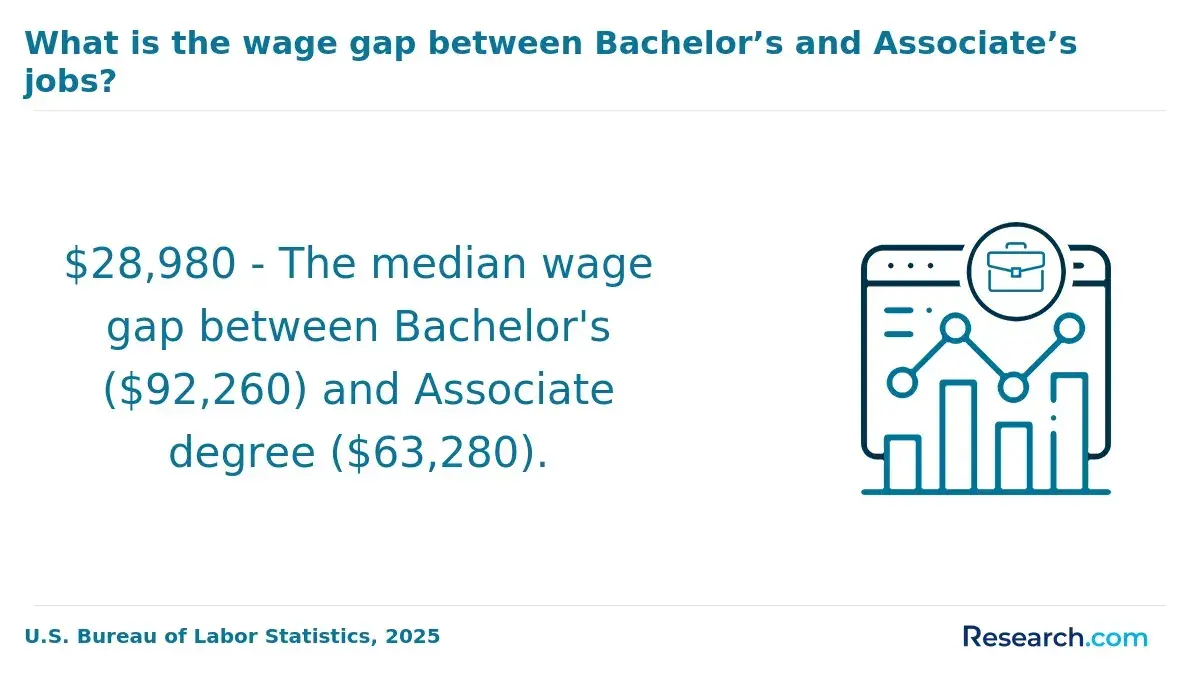
Choosing a major and minor can shape your classes, costs, graduation timeline, and early career options. The decision matters because education still carries strong labor-market value: BLS 2024 data show bachelor's degree holders had median weekly earnings of $1,543, compared with $1,099 for associate degree holders.
This guide is for students, parents, transfers, and online learners who want a practical way to compare majors, minors, double majors, and alternatives so they can build a degree plan that fits their goals without adding unnecessary time or debt.
Key Things You Should Know
- A major is the primary academic field that appears most prominently on your degree record; a minor is a smaller secondary field that usually adds breadth, specialization, or career context.
- Majors commonly require about 30 to 60 credits, while minors often require about 15 to 24 credits, but the exact number depends on the college, department, accreditation rules, and transfer-credit policies.
- A minor can help when it adds a practical skill set, such as data analytics, writing, language, business, or cybersecurity, but it may not be worth delaying graduation when the added tuition and opportunity cost outweigh the benefit.
What is the difference between a college major and minor in the U.S.?
A college major is your main area of study. It determines the core courses, upper-division requirements, labs, studios, clinical hours, capstones, internships, or exams that define your bachelor's degree. A minor is a secondary concentration that is smaller than a major and usually does not carry the same depth, sequencing, or professional preparation.
The simplest way to compare them is to ask what each one does on your transcript and in your career story. A major signals your primary academic preparation; a minor signals a complementary interest or skill set.
| Feature | Major | Minor |
| Primary purpose | Builds deep preparation in one field and usually determines your degree pathway | Adds a focused secondary area that supports or broadens your main field |
| Transcript role | Usually listed as the main program of study | Often listed separately as an additional credential within the degree |
| Typical depth | Introductory through advanced coursework, often with a capstone or practicum | Introductory to intermediate coursework, sometimes with limited upper-level classes |
| Career impact | Often matters most for entry into field-specific jobs, graduate programs, and licensure pathways | Can strengthen a resume when it adds marketable skills or supports a clear career goal |
| Flexibility | Harder to change late because it affects many requirements | Easier to add or drop, depending on remaining electives and course availability |
For example, a computer science major with a statistics minor may be preparing for software, data, or AI-related roles. A psychology major with a business minor may be building a path toward human resources, marketing research, or organizational development. The minor does not replace the major, but it can make the student's academic profile easier to explain.
How do majors and minors affect your degree requirements and time to graduate?
Majors and minors affect graduation time differently because they compete for space in your degree plan. Most bachelor's degrees require around 120 total credits, but those credits are divided among general education, major requirements, electives, and sometimes college-wide requirements. A major usually occupies a large required block; a minor often fits only if it uses elective space efficiently.
Cost matters because extra semesters can be expensive. The College Board's 2024-25 pricing data reported average published tuition and fees of $11,610 for in-state students at public four-year colleges, before housing, books, transportation, and lost work time. That means even a small scheduling mistake can become a real financial decision if it pushes required courses into another term.
Before adding a minor, students should check whether it fits into unused electives or creates a longer path. Use this sequence with an academic advisor so the decision is based on degree requirements rather than guesswork:
- Map all remaining major, general education, and residency requirements by semester.
- Identify whether minor courses double-count toward electives or general education rules.
- Check prerequisites and course rotations, especially for classes offered only once per year.
- Ask whether the minor changes financial aid eligibility, full-time status, or satisfactory academic progress.
- Compare the career value of the minor with the cost of any added credits or delayed graduation.
If your long-term plan includes graduate study, think about sequencing early. For example, students comparing accelerated graduate options such as a 6-month master's degree should be especially careful not to add undergraduate requirements that delay the transition unless those requirements clearly strengthen admissions or prerequisite readiness.
How many credits and courses are typically required for majors versus minors?
Credit requirements vary widely by institution and field, but the major is almost always larger than the minor. The difference is not just the number of credits; it is also the structure. Majors usually have prerequisites, required sequences, minimum grades, upper-division courses, and completion milestones. Minors are often more flexible, though some still require a specific sequence.
The table below summarizes common U.S. undergraduate patterns. It should be used as a planning guide, not as a substitute for your school's catalog, because departments can set stricter rules.
| Requirement area | Typical major pattern | Typical minor pattern | What to check |
| Total credits | About 30 to 60 credits | About 15 to 24 credits | Whether credits include prerequisites outside the department |
| Course levels | Lower-division foundation plus upper-division specialization | Often a smaller mix of lower- and upper-division courses | Minimum upper-level credit rules |
| Sequencing | Frequently sequential, especially in STEM, business, education, nursing, and engineering | May be flexible, but some courses still require prerequisites | Whether required courses are offered every term |
| Minimum grade | Commonly requires a minimum grade in major courses | May require a minimum grade or GPA within the minor | Whether pass/fail courses count |
| Completion requirement | May include capstone, portfolio, practicum, lab, studio, clinical, or internship | Usually fewer culminating requirements | Whether experiential courses are required |
A useful rule of thumb is this: a major should prepare you to enter or continue in a field, while a minor should help you tell a stronger story about your skills. If a minor requires so many prerequisites that it behaves like a second major, compare it against a formal double major before committing.
How should you choose a major and minor based on your career goals?
The best major is the one that connects your interests, abilities, academic performance, financial situation, and target career. The best minor is the one that fills a gap the major does not cover. Career planning should come before course picking, because a minor that sounds interesting may not matter much if employers or graduate schools in your target field care more about licensure, internships, portfolios, or technical skills.
Start by connecting each academic choice to a specific outcome. Students comparing return on investment can review fields often associated with stronger earnings through resources on the highest-paid degrees, but salary should be weighed alongside fit, completion likelihood, required credentials, and local job markets.
Use these questions to narrow your options before declaring or changing a major or minor:
- What job titles, graduate programs, or professional licenses am I trying to qualify for?
- Does the major provide the required prerequisites, accreditation, clinical hours, portfolio work, or technical training?
- Will the minor add a skill employers can recognize, such as coding, accounting, statistics, communication, a language, or public policy?
- Can I complete the minor using open electives without delaying graduation?
- Have I tested the field through an introductory course, internship, student organization, job shadow, or informational interview?
Common strong pairings include biology with data science, marketing with analytics, criminal justice with psychology, education with special education, English with technical writing, and finance with information systems. Weak pairings are not necessarily "bad," but they should have a clear purpose. If you cannot explain how the minor supports your goals in one or two sentences, it may be a personal interest rather than a career investment.
Do employers and graduate schools care more about your major or your minor?
Employers and graduate schools usually care more about your major than your minor when the field has specific preparation requirements. Engineering, nursing, accounting, teacher education, computer science, architecture, and pre-professional pathways often depend on major coursework, accreditation, licensure alignment, or prerequisite completion. In those cases, a minor can help, but it rarely substitutes for the required major or credential.
Minors matter most when they make your profile more credible for a specific role. A business minor can help an arts or humanities major speak the language of organizations. A statistics minor can make a social science major more competitive for research assistant or analyst roles. A writing minor can strengthen a technical major if the student wants roles involving documentation, policy, product communication, or grant writing.
Graduate schools evaluate minors differently. Research-oriented programs may care more about methodology, lab experience, faculty recommendations, GPA in prerequisite courses, and a writing sample than the minor label itself. Professional programs may use the minor as supporting evidence, but they still focus on required coursework, test scores when applicable, experience, and fit.
The practical takeaway is to treat your minor as supporting evidence, not the centerpiece. On a resume, it should reinforce the story already created by your major, internships, projects, certifications, and measurable skills.
Can your major and minor be in different fields, and when is that beneficial?
Yes, your major and minor can be in different fields, and that is often where a minor creates the most value. Cross-field combinations can help students prepare for hybrid roles that require both subject knowledge and applied skills. This is especially relevant as employers increasingly look for workers who can communicate across technical, business, and human-centered contexts.
Different-field pairings are beneficial when the minor fills a real competency gap. For example, a public health major may add data analytics to work with health outcomes data. A computer science major may add ethics or philosophy to prepare for AI governance, responsible technology, or policy work. A journalism major may add Spanish to improve reporting access in bilingual communities.
These combinations tend to work best when the fields interact in the labor market:
- STEM major plus communication, business, public policy, or ethics minor for roles that require explaining technical work to nontechnical audiences.
- Humanities or social science major plus data, statistics, GIS, accounting, or digital media minor for roles that require applied analysis or technical tools.
- Business major plus psychology, sustainability, computer information systems, or international studies minor for roles involving people, systems, markets, or global operations.
- Health-related major plus language, sociology, informatics, or public administration minor for patient-facing, community, or health-systems roles.
The risk is fragmentation. A student with too many unrelated academic interests may look unfocused unless they can explain the connection. If the pairing does not produce a coherent career story, consider using electives, certificates, internships, or student projects instead of a formal minor.
How do online degree programs handle majors and minors compared with campus programs?
Online degree programs handle majors much like campus programs: students still complete general education, major requirements, electives, and institutional rules. The biggest differences are course delivery, advising, scheduling flexibility, proctoring, lab access, internship coordination, and how often required classes are offered. Minors may be available online, but not every online program offers the same minor options as the campus version.
Online learners should be especially careful about sequencing because flexibility does not always mean unlimited course availability. Some programs are asynchronous and allow students to complete weekly work on their own schedule; others require live sessions, set cohort pacing, or supervised field experiences. Students who want faster progress may also compare competency-based online colleges, where progress may depend on demonstrated mastery rather than a traditional semester calendar.
Before choosing an online major or minor, ask the school direct questions that affect completion and cost:
- Can the entire major be completed online, including labs, practicums, internships, or capstones?
- Are the minor courses guaranteed online, or are some offered only on campus?
- How often are required upper-division courses offered?
- Will transfer credits apply to the major, the minor, general education, or only free electives?
- Does the program meet licensure or certification requirements in my state, if my career path requires them?
Online programs can be a strong fit for working adults, transfer students, military learners, caregivers, and students who need location flexibility. They may be a poor fit when the student needs extensive in-person labs, studio access, campus recruiting, clinical placements, or hands-on mentoring that the online program does not provide.
What role do accreditation and program quality play in selecting a major and minor?
Accreditation and program quality matter more than the major-versus-minor label because they affect credit transfer, financial aid eligibility, licensure alignment, employer trust, and graduate-school recognition. At minimum, students should look for institutional accreditation recognized by the U.S. Department of Education or the Council for Higher Education Accreditation. Some fields also require or strongly prefer specialized accreditation.
Specialized accreditation is especially important in programs tied to professional practice. Nursing, teacher education, engineering, business, social work, public health, counseling, architecture, and dietetics may have field-specific standards or licensure implications. A minor usually does not need specialized accreditation on its own, but the major may need it if the student's career goal requires a recognized pathway.
Watch for red flags before enrolling or changing programs. These issues can cost time, money, or eligibility later:
- The school cannot clearly state its accreditor, or the accreditor is not recognized by a reliable U.S. authority.
- The program claims broad career or salary outcomes without explaining the occupations, locations, sample sizes, or limitations.
- Admissions staff cannot explain whether credits apply to the major, minor, or only electives.
- The program is marketed as licensure-ready but does not confirm state-specific requirements.
- Required courses are rarely offered, making a minor or concentration difficult to finish on time.
Quality is also visible in advising, faculty credentials, internship support, student outcomes, employer relationships, learning technology, and transparency about total cost. A highly ranked program is not automatically the best choice if it does not fit your goals, schedule, transfer situation, or budget.
How do majors and minors influence salary potential and long-term job outlook?
Majors often influence salary potential more directly than minors because they connect more strongly to occupational pathways. A finance, nursing, engineering, computer science, or accounting major may align with roles that have defined hiring pipelines. A minor can still influence earnings indirectly when it adds technical, quantitative, communication, or industry-specific skills that improve job fit.
BLS May 2024 wage data show why the occupation matters more than the academic label alone. For example, the median annual pay was $133,080 for software developers, $93,600 for registered nurses, and $81,680 for accountants and auditors. These figures do not mean every graduate in a related major earns those amounts; they reflect workers in those occupations across experience levels, industries, and regions.
The table below shows how a major and minor can influence career positioning. Use it to compare the role of each credential, not to assume a fixed salary outcome.
| Academic choice | Typical career signal | Salary and outlook implication | Limitation |
| Career-aligned major | Shows preparation for a defined field or occupation | Often carries the strongest link to entry-level eligibility and occupational wage data | Outcomes still depend on experience, location, internships, skills, and hiring demand |
| Skill-building minor | Adds a marketable secondary competency | May improve fit for hybrid roles or specialized responsibilities | Usually weaker than a major, portfolio, certification, or work experience by itself |
| Unrelated interest minor | Shows curiosity and breadth | Can support personal development and interview storytelling | May have little direct labor-market value if it does not connect to a role |
| No minor | Keeps degree plan focused and efficient | Can reduce cost and speed completion if electives are used strategically | May miss a chance to document a useful secondary skill |
Job outlook also varies by occupation, not by degree title alone. BLS 2024-2034 projections generally show stronger growth in some technology and health-related roles than in slower-growing fields, but students should compare specific job titles in their target region. If you are prioritizing flexibility and earnings while studying remotely, reviewing the best degrees to get online can help you compare fields before choosing a major-minor combination.
When is it better to add a minor, double major, or skip a minor entirely?
Adding a minor, choosing a double major, or skipping a minor are all reasonable choices in the right situation. The best option depends on your goal, remaining credits, academic workload, cost, and how clearly the extra credential improves your next step.
A minor is usually better when you want a focused secondary skill and can complete it without delaying graduation. A double major is better when two fields are central to your career or graduate-school plan and you are willing to handle a heavier requirement load. Skipping a minor is better when your time is better spent on internships, certifications, research, a portfolio, exam preparation, or graduating sooner.
Use this decision framework before making the commitment:
- Add a minor if it fits into electives, strengthens a clear career story, and gives you recognizable skills.
- Choose a double major if both fields are essential and you can complete all requirements without excessive debt or burnout.
- Skip the minor if it delays graduation, duplicates your major, lacks career relevance, or prevents you from gaining experience.
- Consider a certificate if you need a targeted skill in less time than a minor requires.
- Consider a lower-cost pathway first if you are still exploring fields; an online associate degree can sometimes help students test interests, earn transfer credits, and reduce upfront cost before committing to a bachelor's plan.
The most common mistake is treating a minor as a shortcut into a career that actually requires a major, license, portfolio, certification, or graduate degree. Another mistake is adding credentials to look impressive without considering course availability or cost. A focused degree plan with strong experience usually beats a crowded transcript with no coherent direction.
Other Things You Should Know About
Usually no. Most U.S. bachelor's programs require a major, but minors are commonly optional. Some colleges or specialized programs may require a concentration or supporting area, so always check the catalog.
It depends on the school. A minor commonly appears on the official transcript, but some institutions do not print minors on diplomas. Ask the registrar how your school records minors.
Yes, but changing a major late can delay graduation because major courses are more extensive and sequenced. Changing or dropping a minor is usually easier, especially if the courses also count as electives.
It can be worth it for personal growth, graduate-school interests, or intellectual exploration, but it is less likely to improve job prospects unless it adds relevant skills or supports a clear professional story.
References
- How many credits for a bachelor's degree? | edX https://www.edx.org/resources/how-many-credits-do-you-need-for-a-bachelors-degree
- Online Degree vs. Traditional: Choosing the Right Path https://beal.edu/online-degree-vs-traditional/
- Understanding Majors and Minors: The Key to Navigating Your College Education https://www.providenceready.org/resources/blog/2025/may/understanding-majors-and-minors-the-key-to-navig/
- The Role of Rankings and Accreditation in Choosing a University - Zylentrix https://zylentrix.net/rankings-and-accreditation-choosing-a-university/
- What is a college minor? https://www.citizensbank.com/student/articles/what-is-a-college-minor.aspx
- Benefits of a College Degree on Salary & Earning Potential | UMass Global https://www.umassglobal.edu/blog-news/how-college-impacts-salary-and-future-earning-potential
- Is Adding a Minor to Your Degree Worth It? https://www.pointloma.edu/resources/undergraduate-studies/adding-minor-your-degree-worth-it
- The benefits of picking the right major and minor for your career goals - Take Stock in Children https://www.takestockinchildren.org/the-benefits-of-picking-the-right-major-and-minor-for-your-career-goals/
- The Problem With Exclusively Online Degree Programs https://tcf.org/content/commentary/the-problem-with-exclusively-online-degree-programs/
- Do employers and grad schools care about minors? https://talk.collegeconfidential.com/t/do-employers-and-grad-schools-care-about-minors/889045