
2027 Tribal Social Work vs County Social Services: Questions About Context and Preparation
Audited and Verified:
Our Editorial and Data Verification Process
Research.com uses government datasets, official education statistics and primary institutional information to support its career and degree guides. Our review process checks factual accuracy, occupational definitions, source dates and the requirements associated with the credentials discussed.
How This Article Was Fact-Checked
Our editorial team verifies salary estimates, employment projections, education requirements and program information against original data providers and official organizations. Salary figures are checked against the relevant occupational definitions and reporting periods. Information about licensure, accreditation and required in-person training is reviewed separately.
Fact-checked and verified on:

Co-Founder and Chief Data Scientist
A tribal social work position and a county social services position may serve the same family, but they do not necessarily answer to the same government, follow the same procedures, or define a good outcome in the same way. That distinction matters when choosing a degree, field placement, or first job. This guide is for students, career changers, and early-career practitioners comparing the settings. It explains the qualifications each role may require, the importance of tribal sovereignty and the Indian Child Welfare Act (ICWA), and the questions to ask before committing to a program or employer.
Key Things You Should Know
- Tribal social work operates within a sovereign tribal government's authority and community priorities; county social services operate under state and local government authority.
- A child welfare case may involve both. A CSWE-accredited BSW or MSW can prepare you for either setting, but the job - not the setting's name - determines whether you also need a state license, clinical supervision, or specialized training.
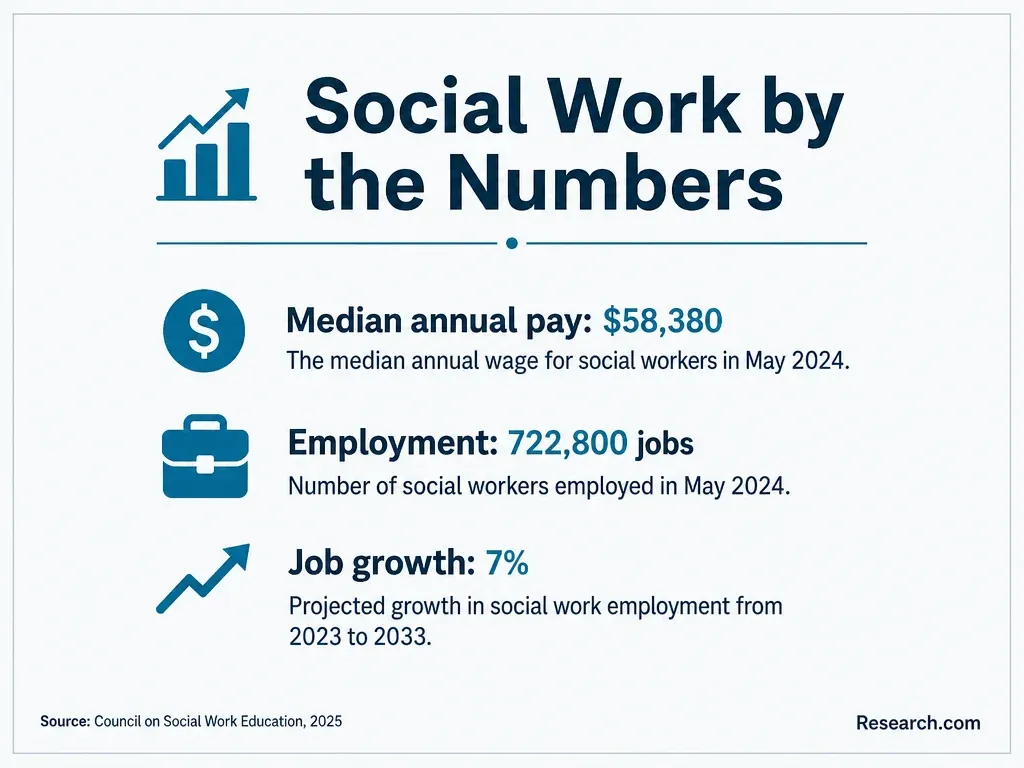
- Pay data do not separate tribal from county employers. For context, the U.S. Bureau of Labor Statistics reports a May 2025 median annual wage of $59,550 for child, family, and school social workers, not a salary for either agency type.
How does tribal social work differ from county social services?
Tribal social work can mean service through a tribal government, tribally operated program, or organization accountable to a tribal community. County social services are typically administered through local government under state law and funding rules.
Neither label describes every job: a practitioner in either setting might coordinate benefits, support elders, respond to child welfare concerns, or manage a program. The comparison below identifies questions that matter more than an agency label when evaluating a placement or job.
| Decision factor | Tribal setting | County setting |
| Accountability | Tribal law, leadership, program rules, and community priorities may shape the work, alongside applicable federal or state requirements. | State statutes, county procedures, civil-service rules, and public funding requirements commonly shape the work. |
| Relationships | Work may require sustained relationships with tribal departments, families, cultural resources, and other governments. | Work often involves referrals across county departments, courts, schools, and contracted providers. |
| Practical constraint | Service area, travel, staffing, and access to culturally appropriate resources vary considerably by tribe and program. | Eligibility rules, standardized workflows, caseloads, and documentation systems vary by county and role. |
Tribal practice is not simply county practice with different terminology. Ask who has decision-making authority, how community members participate in program design, and which relationships must be maintained across jurisdictions. If your goal is advanced direct practice rather than government services broadly, comparing jobs that use a social work master's degree can help narrow the role before you choose a setting.
What degrees prepare you for tribal or county social work?
A BSW provides generalist social work preparation and may fit entry-level casework or community services positions. A traditional MSW offers a route for graduates of other majors as well as BSW graduates; an advanced-standing MSW is a shorter, program-specific route for applicants with a qualifying social work bachelor's degree.
An MSW may be required for clinical-track roles or preferred for specialized and supervisory positions. Read the actual job classification: some benefits, outreach, and service-coordination jobs accept other degrees or relevant experience.
For someone changing careers, transferable experience in education, healthcare, advocacy, or public administration can strengthen an application, but it does not replace required social work coursework, approved field education, or a license. Choose courses and placements that address your gap: tribal governance and community engagement for tribal practice, or public benefits administration and statutory workflows for a county role.
A DSW or PhD is generally unnecessary for entry into either setting; consider one only for a defined leadership, practice-scholarship, or research objective. If that objective is established, compare actual funding and total cost before considering lower-cost doctoral pathways for social workers.
What licensing requirements apply to tribal and county social workers?
There is no single "tribal social worker" or "county social worker" license. State social work boards set license categories and requirements, while employers set qualifications for particular jobs. A position may require a BSW or MSW, an active state license, another professional qualification, or no social work license at all. Clinical assessment or psychotherapy roles require particular care: an MSW alone does not authorize independent clinical practice.
Check the job posting's exact duties and required license title against the applicable state board's current rules, then confirm the employer's requirements. For tribal employment, also ask how the position's location, governing authority, and activities affect credential requirements; do not assume that working for a tribal government automatically removes state licensing obligations.
A social work master's licensure requirement guide can help you frame questions, but the board - not a program advertisement - determines license eligibility and permitted practice.
Both settings may hire child and family services workers, case managers, benefits specialists, elder services staff, behavioral health team members, program coordinators, and supervisors.
Tribal programs may also emphasize culturally grounded prevention, family preservation, community partnerships, and coordination among tribal, federal, state, and county systems. County roles may involve larger eligibility systems, statutory investigations, or civil-service classifications. Duties depend on the agency, not just the job title.
Compare two offers by looking beyond the credential line: ask about caseload and travel, safety procedures, documentation time, training in applicable law, access to consultation, and who provides day-to-day supervision. A county worker moving to a tribal position may bring strong case-management skills yet need substantial learning about tribal authority and local relationships.
A tribal worker moving to a county may need training in the county's eligibility systems and procedures. For roles that do require a degree, exploring academic pathways in online social work is most useful after you have identified the employer's specific qualification requirements.
What are social work program admission requirements, costs, and completion times?
BSW admission may involve entry to the university followed by separate admission to the social work major. Traditional MSW programs commonly consider applicants from other undergraduate disciplines; advanced-standing MSW programs generally require a qualifying BSW and may impose additional recency or grade rules.
Review each school's transcripts, prerequisites, experience expectations, references, and deadlines rather than assuming relevant employment qualifies you for advanced standing. MSW programs with accessible admissions still require scrutiny of accreditation, field support, and fit with your target job.
Completion time depends on the approved course sequence, enrollment pace, and placement availability. For a realistic cost comparison, add tuition and fees to books, screening, travel, unpaid or reduced paid hours during field, and any required campus visits.
Ask for a term-by-term degree plan and total estimated charges, then check whether employer education assistance or an approved employment-based placement changes your costs. A less expensive or shorter program is not a bargain if it cannot support the field learning or qualifications your intended role requires.
Other Things You Should Know About Social Work
Possibly. Eligibility and any hiring preferences depend on the tribal employer and position. Read the posting closely, respect the tribe's hiring authority, and be prepared to explain how you would learn from community guidance rather than claim expertise you do not have.
Not necessarily. Office locations, service areas, remote-work policies, and travel requirements vary. Ask where services are delivered and how often staff must be present in the community.
No blanket permission should be assumed. Applicable law, consent, court orders, agreements, and agency policy govern particular disclosures. Obtain guidance through the agencies' authorized privacy and legal procedures.
Ask how the agency's priorities are set and how new staff learn its laws, community protocols, and working relationships. The answer can reveal whether the role includes the preparation and support needed to serve well.
- Tribal and Native American Issues | gao.gov https://www.gao.gov/tribal-and-native-american-issues
- Indian Child Welfare Act (ICWA) and Tribal Collaboration | Virginia Department of Social Services https://dss.virginia.gov/supporting-families/icwa/ICWA
- Apply today to join our amazing team of Social Workers! | santaclaracounty.gov https://ssa.santaclaracounty.gov/about-us/join-our-team/apply-today-join-our-amazing-team-social-workers
- Tribal Court Systems | Indian Affairs https://www.bia.gov/CFRCourts/tribal-justice-support-directorate
- Social Workers, All Other | in.gov https://topjobs.dwd.in.gov/Occupation/Soc/21-1029.00/
- Center for Tribal Social Work | ou.edu http://www.ou.edu/cas/socialwork/centers-and-programs/center-for-tribal-social-work.html
- Indian Child Welfare Act (ICWA) | MSU Denver https://www.msudenver.edu/ccwsc/national-resources/indian-child-welfare-act-icwa/
- What can you do as a licensed clinical social worker in California? | University of the Pacific https://socialwork.pacific.edu/blog/what-can-you-do-licensed-clinical-social-worker-california
- About Tribal Nations, Tribal Citizens, and the United States | Native American Rights Fund https://narf.org/about-tribal-nations-united-states-treaties/
- Indian Child Welfare Act | ntcwcia.org https://www.ntcwcia.org/indian-child-welfare-act/


