2027 Text Messaging in Social Work Services: Boundaries, Consent, and Documentation Policies
Audited and Verified:
Our Editorial and Data Verification Process
Research.com uses government datasets, official education statistics and primary institutional information to support its career and degree guides. Our review process checks factual accuracy, occupational definitions, source dates and the requirements associated with the credentials discussed.
How This Article Was Fact-Checked
Our editorial team verifies salary estimates, employment projections, education requirements and program information against original data providers and official organizations. Salary figures are checked against the relevant occupational definitions and reporting periods. Information about licensure, accreditation and required in-person training is reviewed separately.
Fact-checked and verified on:

Co-Founder and Chief Data Scientist
A client's text can make coordination easier or create an unanswered crisis message, a privacy breach, or a gap in the record. For social workers, field students, supervisors, and agency leaders, the decision is not simply whether texting is convenient. It is whether a particular service can use it safely, with clear consent, response limits, security, and documentation.
This guide explains how to make that decision, what to put in an agency policy, and when a phone call, secure portal, or other channel is the better choice.
Key Things You Should Know
- Text clients only through an agency-approved channel, for agreed purposes, with stated response hours and a separate crisis plan. Ordinary SMS is not automatically appropriate for confidential exchanges.
- Consent should explain privacy risks and alternatives; a reply to a text is not, by itself, a substitute for the agency's informed-consent process.
- Preserve clinically or operationally significant messages in the authorized record under the applicable retention policy. Do not rely on a worker's phone or delete a thread merely because a case note summarizes it.
Can social workers text clients, and what boundaries should they set?
Often, social workers can contact their clients, but permission depends on the setting, applicable law, the employer's policy, the worker's role, and the client's preferences. Texting may work well for appointment logistics, transportation updates, and brief service-coordination questions. It is usually a poor default for psychotherapy, detailed assessments, sensitive disclosures, or urgent safety concerns.
Set boundaries before the first exchange: identify the approved number or app, permitted topics, hours monitored, expected response time, and how to reach help when texting is unavailable.
Avoid personal numbers, disappearing-message features, social-media direct messages, and informal promises to "text anytime." A client may choose a different channel without losing access to services where a reasonable alternative is available.
Role matters. A housing case manager's scheduling texts and a clinician's treatment-related messages create different documentation and risk decisions. Workers comparing clinical and nonclinical MSW career directions should ask how each setting limits digital contact rather than assuming every social work job uses texting the same way.
How should social workers obtain informed consent for texting?
Discuss texting in a private conversation or approved intake process before using it for ongoing contact. Explain what the channel is for, who on the team may see messages, when staff respond, what enters the record, and whether the client can withdraw permission. Check that the number is current and whether another person shares the device, account, notifications, or phone bill.
Consent should address the actual risk: an unencrypted SMS may appear on a locked-screen preview, be forwarded, reach a reassigned number, or be visible to someone with access to the device. Offer the agency's available alternatives, such as calls, mail, or a secure portal.
Record the client's choice and any restrictions—for example, "appointment reminders only, with no service details"—and revisit it if the number, living situation, or safety concerns change. Follow any additional authorization rules that apply to the information or population served.
Field students should practice this conversation under agency supervision, not obtain consent through a personal account or assume a classroom exercise authorizes client contact. When evaluating MSW programs with organized practicum resources, students can ask how placements teach and supervise digital consent in real agency workflows.
How should social workers document and retain client text messages?
Use the agency's approved record system. A useful note identifies the date, participants, relevant message content, action taken, referrals or escalation, and any follow-up owed. Preserve the original exchange or an authorized export when policy, clinical relevance, an investigation, or a records request requires it; a summary alone may not capture timing or exact wording. Avoid copying an entire thread into a widely accessible note when only part is relevant.
Agencies should specify whether their messaging platform archives messages automatically, how staff reconcile those messages with the case record, who reviews unassigned or missed messages, and how corrections are made. Retention periods depend on applicable law, contracts, and agency schedules; a legal hold or pending request can override routine deletion. A worker should never independently erase messages from a device or platform to "clean up" the record.
Students in traditional and advanced-standing MSW placements may encounter different onboarding schedules, but neither route removes the need to learn the site's record rules before client contact. MSW pathway differences by prior degree can affect when that supervised practice begins, not which agency documentation standard applies.
Choose the channel through a documented risk assessment, not an app's "secure" label. An agency-managed messaging product may offer access controls and archiving that consumer SMS cannot, but its protections must be verified against the agency's workflow and legal obligations.
Security review should cover the following controls and failure points:
- Agency-owned accounts, role-based access, multifactor authentication, device locks, and prompt removal of departing staff.
- Encryption where available, vendor security review, required agreements, and controls on message previews, backups, exports, and notifications.
- Number verification before sensitive contact, minimal identifying detail in reminders, and a process for wrong-number messages and lost devices.
- Approved archiving, audit access, incident reporting, and a backup workflow when the platform is unavailable.
Do not assume end-to-end encryption solves shared-device access, screenshots, misdirected messages, or record retention. Students comparing the total cost of an affordable online MSW should also ask what secure devices and software a field placement supplies; personal technology should not quietly become the agency's client-record system.
A workable policy assigns responsibility, not just rules for individual workers. It should identify who approves a channel, who trains staff, who monitors queues, and who audits compliance. Before rollout, test the policy against a shared phone, a wrong number, staff absence, a crisis message, and a request for copies of records.
The policy should specify these operational decisions:
- Eligible services and clients, approved platforms and devices, permitted content, and prohibited uses.
- Consent language, identity and number checks, accessibility alternatives, and how preferences are changed or withdrawn.
- Coverage hours, response expectations, handoffs, crisis escalation, and what happens during outages or staff leave.
- Record capture, retention, access, vendor oversight, incident response, and periodic review by privacy, legal, and practice leaders.
Apply the same rules to employees, interns, and graduate assistants who have authorized client contact. Where an agency hosts students supported through online MSW funding through university assistantships, the agency still must define their access, supervision, and messaging duties; funding or student status is not authorization to use client data.
Which social work careers use texting, and what do they pay?
Texting can support appointment reminders, outreach, and service coordination in child and family services, healthcare, and behavioral health. How much a worker texts depends on the employer's platform, client needs, caseload, and role, not the job title alone. The U.S. Bureau of Labor Statistics reports occupation-wide medians, not pay for texting duties or guaranteed wages for BSW or MSW graduates.
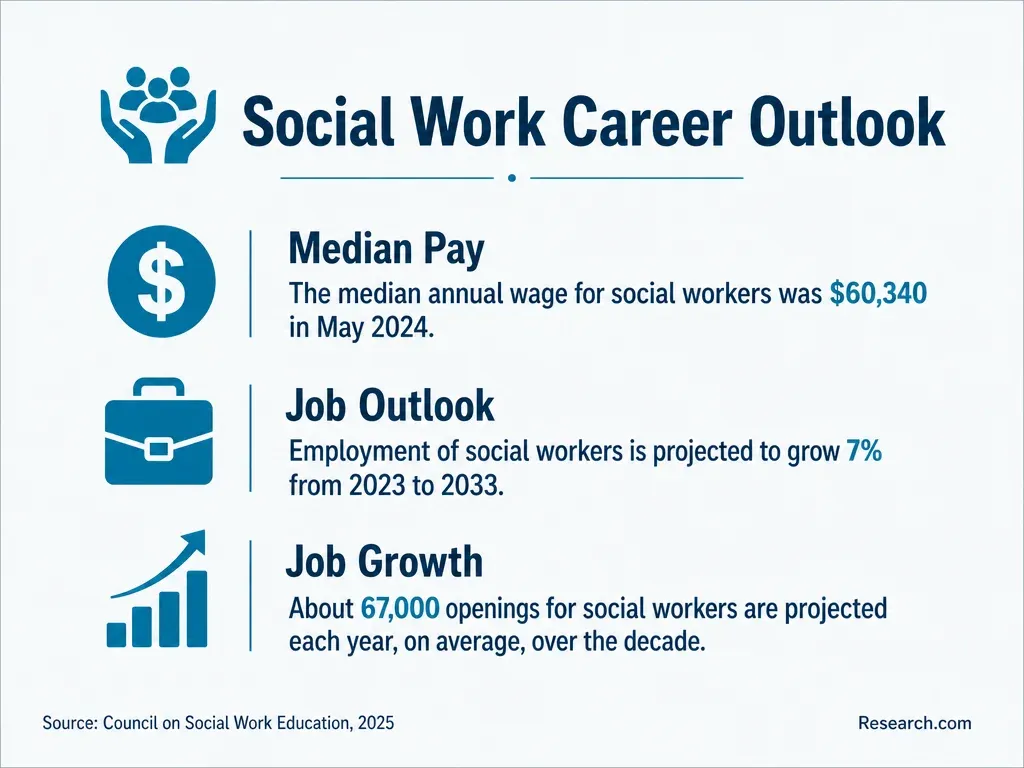
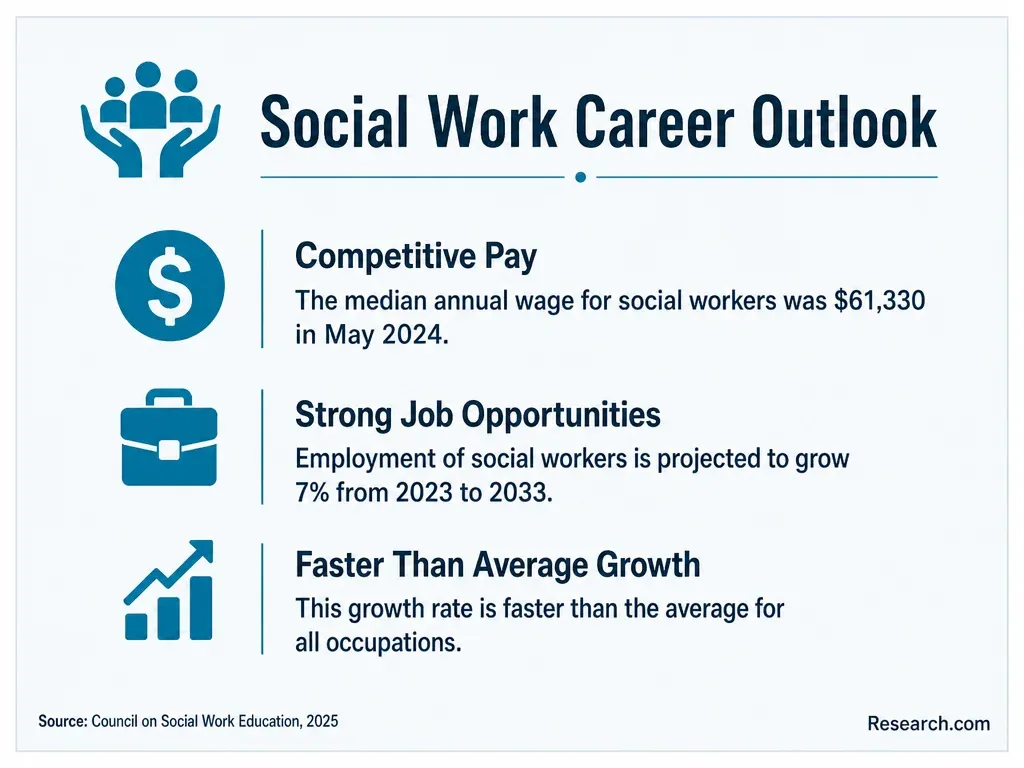
The table shows relevant U.S. occupational categories and their May 2025 median annual pay, alongside projected employment growth for 2025-2035. Use the figures to compare broad fields, then check local openings for actual credential, license, schedule, and messaging expectations.
| Occupation | May 2025 median annual pay | Projected growth, 2025-2035 |
| Child, family, and school social workers | $59,550 | 4% |
| Healthcare social workers | $67,880 | 8% |
| Mental health and substance abuse social workers | $60,280 | 10% |
For job fit, ask whether messaging is limited to logistics or includes clinical contact, who covers after-hours messages, and how much time documentation adds to the caseload. Pay also varies by location and employer.
MSW compensation and relocation considerations should be assessed alongside a state's licensing rules and the workplace's support for safe communication.
Other Things You Should Know About Social Work Programs
Yes. Record the changed preference, stop routine texts through that channel, and agree on another workable way to communicate. Check whether any required service notices need a separate delivery method.
It may confirm receipt in a low-risk scheduling workflow, but it can be ambiguous. Follow the agency's confirmation rules, especially when attendance affects transportation, benefits, or safety planning.
Not without an approved contingency procedure. Use the agency's designated alternative and report the outage; a personal phone can create access, privacy, and record-retention problems.
Do not circulate the message informally. Follow the agency's misdirected-message procedure, route any urgent concern to the appropriate team, and document the handoff as required.
- Protecting Personal Information: A Guide for Business | Federal Trade Commission https://www.ftc.gov/business-guidance/resources/protecting-personal-information-guide-business
- Informed Consent - StatPearls - NCBI Bookshelf - NIH https://www.ncbi.nlm.nih.gov/books/NBK430827/
- Informed Consent FAQs | hhs.gov https://www.hhs.gov/ohrp/regulations-and-policy/guidance/faq/informed-consent/index.html
- How to keep good clinical records - PMC https://pmc.ncbi.nlm.nih.gov/articles/PMC5297955/
- Cybersecurity Best Practices | fbi.gov https://www.fbi.gov/investigate/cyber/cybersecurity-best-practices
- How to Protect the Data that is Stored on Your Devices | cisa.gov https://www.cisa.gov/resources-tools/training/how-protect-data-stored-your-devices
- The Complexities of Informed Consent | Social Work Today Magazine https://www.socialworktoday.com/news/eoe_0803.shtml
- Informed Consent, Privacy, and Confidentiality | Preparing for the Masters ASWB Exam https://umsystem.pressbooks.pub/aswbprep/chapter/consent-confidentiality-privacy/
- Practice Notes | ocswssw.org https://www.ocswssw.org/ocswssw-resources/practice-notes-communication-technology-and-ethical-practice-evolving-issues-in-a-changing-landscape/
- Social Workers' Ethical Responsibilities to Clients https://www.socialworkers.org/About/Ethics/Code-of-Ethics/Code-of-Ethics-English/Social-Workers-Ethical-Responsibilities-to-Clients