2027 Stress and Coping Theory in Social Work: Appraisal, Resources, and Context
Audited and Verified:
Our Editorial and Data Verification Process
Research.com uses government datasets, official education statistics and primary institutional information to support its career and degree guides. Our review process checks factual accuracy, occupational definitions, source dates and the requirements associated with the credentials discussed.
How This Article Was Fact-Checked
Our editorial team verifies salary estimates, employment projections, education requirements and program information against original data providers and official organizations. Salary figures are checked against the relevant occupational definitions and reporting periods. Information about licensure, accreditation and required in-person training is reviewed separately.
Fact-checked and verified on:

Co-Founder and Chief Data Scientist
When two people face the same setback, they may experience it differently, and neither response can be understood without considering the resources available to them. Stress and coping theory gives social work students and practitioners a way to examine that interaction without blaming clients for circumstances beyond their control.
This guide explains appraisal, coping strategies, and social context; shows how to use the framework in supervised practice; and helps readers decide what training is useful for the work they want to do.
Key Things You Should Know
- Appraisal has two central parts: Primary appraisal concerns what an event means to a person; secondary appraisal concerns what they believe they can do about it.
- Coping has two broad functions: Problem-focused strategies address a stressor or its practical effects, while emotion-focused strategies address the emotional response. People often need both.
- Context changes what is possible: Income, housing, discrimination, relationships, and service access can constrain coping. Effective social work assesses those conditions alongside individual responses.
What is stress and coping theory in social work?
Stress and coping theory, associated especially with Richard Lazarus and Susan Folkman, describes stress as a relationship between a person and an environment they appraise as taxing or exceeding their resources.
]It is not simply a list of stressful events or a claim that stress exists only in someone's thoughts. A housing notice, for example, has material consequences even though its meaning and the available responses differ from person to person.
For social workers, the theory is a framework for asking better assessment questions: What does the situation mean to the client? What options do they perceive? What support and constraints exist? How is their response working over time? It complements person-in-environment assessment, but it is not a diagnosis, a standardized treatment, or evidence that one coping technique will work for every client.
Students comparing exploring academic pathways in online social work should look for coursework and field learning that connect human behavior theory to assessment and supervised practice, rather than assuming that a course title alone establishes practical competence.
How do primary and secondary appraisal shape responses to stress?
Primary appraisal concerns whether a situation seems irrelevant, beneficial, or stressful; a stressful situation may be experienced as harm or loss, a threat, or a challenge.
Secondary appraisal concerns perceived options and resources, such as time, support, money, information, and the ability to influence what happens. These are related processes, not a rigid checklist completed in sequence.
Consider a hypothetical worker whose hours are cut. They may appraise the change as a threat to rent payments. If they know they can obtain replacement shifts and have temporary support, they may see workable options; if neither is available, the same event may feel far less manageable.
A social worker should not infer either appraisal from the event alone. Asking what feels most urgent and what options the person sees can reveal where practical assistance or emotional support may help.
Appraisals can change as circumstances change. If a student wants to learn this framework before entering practice, guide to no-prerequisite BSW entry pathways may help them investigate entry options; they should still check each program's actual admission, general education, and field requirements.
How do social workers apply stress and coping theory with clients?
In assessment, a social worker can explore the stressor, the client's interpretation, prior responses, available support, and barriers to action. The next step is collaborative: identify a goal the client values and consider whether practical assistance, emotional support, advocacy, referral, or a combination fits the situation. The worker then checks whether the plan remains useful as conditions change.
For example, a client facing a benefits interruption might want help understanding a notice, contacting the responsible office, and managing anxiety while awaiting a decision.
The theory helps organize these conversations; it does not determine eligibility, replace agency procedures, or authorize a worker to provide services outside their role. Safety concerns, confidentiality, consent, and reporting obligations require the applicable agency and jurisdictional rules.
Students can practice these distinctions through case discussion and approved field tasks. When comparing programs, graduate social work placement coordination options are relevant because field instruction and agency capacity affect whether students can receive feedback on actual assessment and engagement, not just describe a theory in class.
Problem-focused coping aims to change a stressor or its practical consequences. Examples include gathering information, arranging transportation, requesting an accommodation, or organizing with others for a policy change.
Emotion-focused coping aims to manage feelings associated with the situation, such as seeking comfort, using a grounding technique, or making space to grieve. Neither category is inherently better: the useful choice depends partly on what can be changed now.
The distinction is about a strategy's function, not a fixed label attached to an activity. Calling a friend might provide emotional support, help solve a childcare problem, or do both. A worker should ask whether a strategy is safe, accessible, consistent with the client's goals, and helpful over time rather than judging it by category alone.
Learning to select and evaluate responses takes more than a compressed theory lesson. Students considering accelerated Master of Social Work admission options should compare the pace of skills training and field education with their capacity to practice, reflect, and receive supervision.
A suggestion is not a usable coping option unless the person can realistically act on it. Paid leave, accessible transportation, language access, trusted relationships, and responsive public services can expand choices.
Poverty, discrimination, unsafe housing, disability-related barriers, or restrictive agency rules can narrow them. Social workers should examine these conditions before interpreting an apparent lack of action as low motivation.
Culture can shape how people describe distress, whom they trust, and which forms of help feel appropriate. It does not predict an individual's preferences.
Ask about the client's own meanings and support networks, including whether a proposed referral is affordable, accessible, and acceptable to them. Where barriers are shared across a community, advocacy or service redesign may be more appropriate than repeating individual coping advice.
Financial resources also shape the student's choices. Someone seeking more training in this framework can compare comparing lower-cost MSW pathways, but an additional degree is not necessary solely to learn the theory. Targeted coursework, supervised practice, or professional development may better fit an existing role.
What are social workers' salary expectations and job outlook?
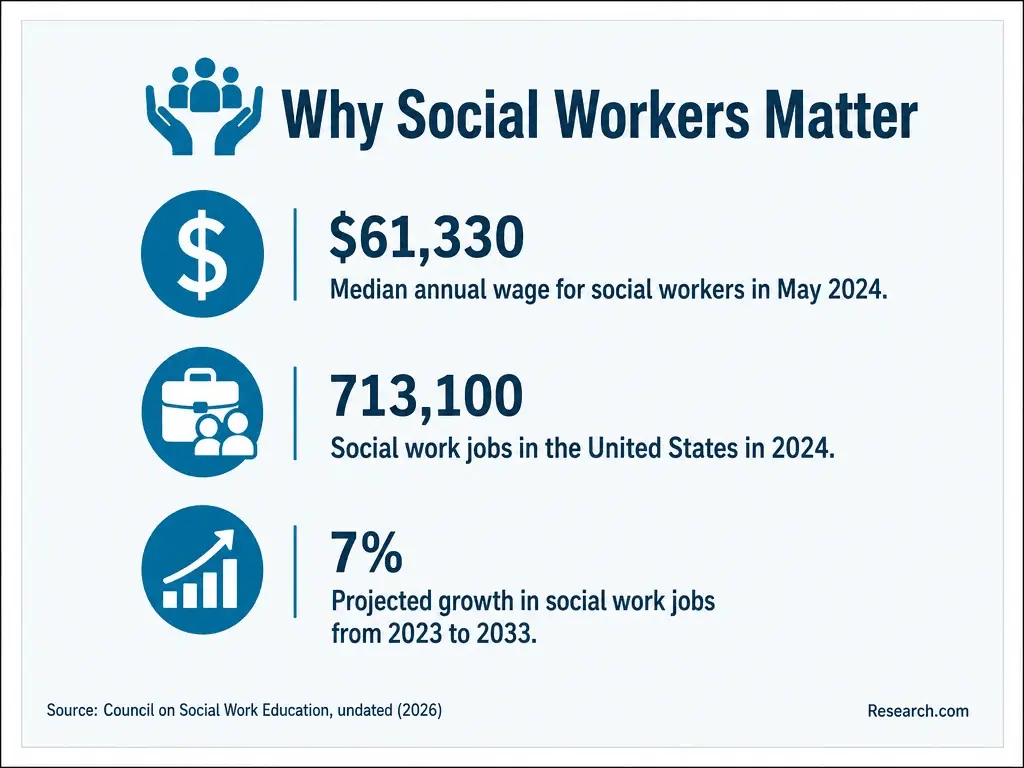
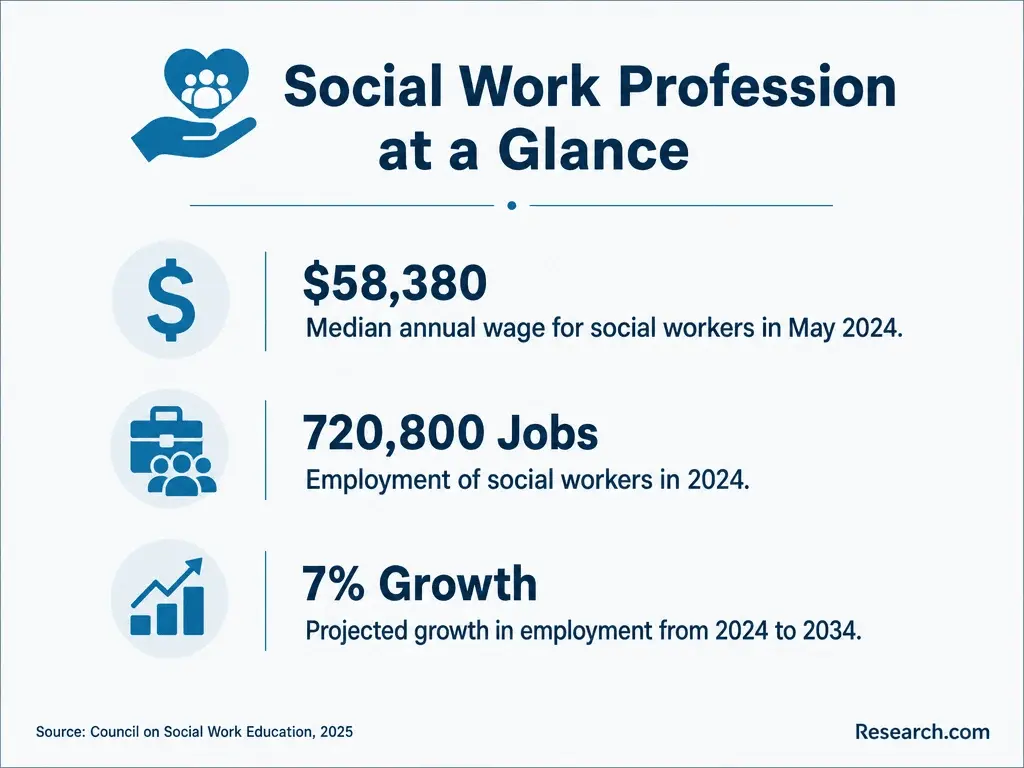
U.S. Bureau of Labor Statistics figures put the May 2025 median annual wage for social workers across specialties at $61,780, with employment projected to grow 6% from 2025 to 2035.
The categories most relevant to stress and coping work vary: healthcare social workers had a $67,880 median and projected growth of 8%; mental health and substance abuse social workers had a $60,280 median and projected growth of 10%; child, family, and school social workers had a $59,550 median and projected growth of 4%.
These are occupation-wide U.S. figures, not starting salaries, wages for a particular license, or returns promised by an MSW. Setting, location, experience, and job duties matter.
Use them to compare broad career directions, then examine local openings and compensation; MSW earnings and geographic career planning can provide another starting point for that comparison.
Other Things You Should Know About Social Work
No. Coping refers to responses to a particular demand; resilience concerns adaptation in the face of adversity over time. Neither term should be used to imply that someone must manage structural hardship alone.
No. A questionnaire may support a conversation or an approved evaluation, but its purpose, validity, interpretation, and privacy implications must be considered. It does not substitute for assessment within a professional's authorized scope.
Yes. It can help workers notice demands and available support, but reflection is not a substitute for manageable caseloads, supervision, workplace safety measures, or organizational changes.
Lazarus and Folkman's Stress, Appraisal, and Coping is a foundational text. Students should read it alongside social work material on person-in-environment practice and structural inequality so that appraisal does not become the whole explanation for a client's situation.
- Problem-focused and emotion-focused coping options... - PMC https://pmc.ncbi.nlm.nih.gov/articles/PMC5549139/
- Culture as a Protective Factor | Child Welfare Information Gateway https://www.childwelfare.gov/topics/prevention/culture-protective-factor
- Mental health | who.int https://www.who.int/news-room/fact-sheets/detail/mental-health-strengthening-our-response
- Stress: Appraisal and Coping | Springer Nature Link https://link.springer.com/rwe/10.1007/978-1-4419-1005-9_215
- Part Three, Chapter Ten: Key Constructs | upenn.edu https://www.med.upenn.edu/hbhe4/part3-ch10-key-constructs.shtml