2027 Solution-Focused Theory in Social Work: Goals, Exceptions, and Professional Learning
Audited and Verified:
Our Editorial and Data Verification Process
Research.com uses government datasets, official education statistics and primary institutional information to support its career and degree guides. Our review process checks factual accuracy, occupational definitions, source dates and the requirements associated with the credentials discussed.
How This Article Was Fact-Checked
Our editorial team verifies salary estimates, employment projections, education requirements and program information against original data providers and official organizations. Salary figures are checked against the relevant occupational definitions and reporting periods. Information about licensure, accreditation and required in-person training is reviewed separately.
Fact-checked and verified on:

Co-Founder and Chief Data Scientist
Solution-focused questions can help clients describe what they want to change and identify steps that are already within reach. For social work students and early-career practitioners, the challenge is using those questions without overlooking safety, structural barriers, or the client's own priorities.
This guide explains how solution-focused practice works, where its limits lie, and how to develop the skill through coursework, field education, supervision, or targeted training. It also helps you decide whether further formal education is necessary for the work you want to do.
Key Things You Should Know
- Solution-focused practice builds on client-defined goals, exceptions to a problem, and observable signs of progress; it does not replace assessment or safeguarding.
- A useful exception question asks about a time the difficulty was less severe, not a time the client was entirely free of it.
- Learning the approach does not expand a social worker's legal scope: independent therapy depends on the applicable state license, while many nonclinical uses can be developed through supervision and continuing education.
What is solution-focused theory in social work?
Solution-focused practice is an approach to conversation and change that emphasizes a person's preferred future, existing resources, and small, workable next steps. Its best-known clinical form is solution-focused brief therapy (SFBT).
Rather than assuming that a detailed explanation of a problem must come before change, practitioners ask what improvement would look like and what, if anything, is already helping.
It fits social work's attention to strengths and self-determination, but it is not the same as the broader strengths perspective or person-in-environment framework.
Those frameworks also direct attention to relationships, institutions, and unequal access to resources. A solution-focused conversation should therefore not recast a lack of housing, benefits, or safety as merely a failure to think positively.
The approach can inform engagement in case management, schools, healthcare, and other settings, but a brief goal-setting conversation is not necessarily psychotherapy. When comparing jobs that use a social work master's degree, look at the actual duties and required license before deciding how extensively you need to learn the clinical model.
How do social workers set solution-focused goals with clients?
A solution-focused goal describes a change the client wants and could recognize in everyday life. It is more useful than a practitioner-imposed label such as "be more motivated."
For example, a person seeking steadier access to food might identify "knowing where next week's meals are coming from" as a priority; the social worker would also address eligibility, transportation, and available services rather than relying on conversation alone.
In a hypothetical learning exercise, a student might move from "things will be better" to "I'll have called the benefits office and know which documents it needs."
The student can then ask who could help, what might obstruct the call, and how the client would know the step was worthwhile. The point is to make progress observable and client-defined, not to turn every concern into a numerical target.
Practice these conversations with feedback: a field instructor can observe whether a student follows the client's priorities, checks access barriers, and documents agreed steps accurately.
If you are evaluating an online MSW, investigate field placement assistance in online MSW education; coursework alone cannot show how someone responds when a real conversation changes direction.
What are exception questions in solution-focused social work?
Exceptions are occasions when an expected problem occurred less intensely, lasted less time, or was handled differently. An exception question might be, "Was there a recent day when getting to the appointment was a little easier? What was different?" Follow-up questions explore whether the difference is repeatable and whether the client wants to build on it.
An exception is not proof that the underlying problem has disappeared. If someone reached one appointment because a neighbor offered a ride, the useful finding may be both a supportive relationship and an unstable transportation plan. Asking only what the client "did right" would miss the practical constraint.
Students can rehearse exception questions in recorded simulations and review whether their wording sounded curious rather than leading. When considering flexible-paced online Master of Social Work pathways, check whether self-paced coursework still includes live interviewing practice and timely feedback. Flexibility in lectures is not the same as flexibility in skills labs or field placements.
A miracle question invites a client to imagine that a difficulty has improved and describe the first signs they would notice. The value lies in making the desired change concrete, not in suggesting that circumstances can change by wish alone.
If the wording feels unrealistic or culturally uncomfortable, a practitioner can ask instead, "Suppose things became a little more manageable next week, what would you notice first?"
A scaling question uses a client-defined scale, often 0 to 10, to explore present circumstances and possible next steps. "What makes it a 4 rather than a 2?" can uncover resources; "What would a 5 look like?" can clarify a modest change.
The number is a conversation aid, not a diagnostic score or a validated outcome measure. Ask what each endpoint means to this client rather than assuming that everyone interprets the scale alike.
These questions take practice to use naturally and to set aside when a different response is needed. Applicants comparing online social work master's programs by duration should look beyond the advertised completion time to the opportunities for observed interviews, feedback, and reflection.
The approach can make meetings purposeful, surface client expertise, and help workers and clients recognize incremental progress. Its collaborative language may be especially useful when a client has repeatedly been told what to do.
Research on SFBT reports promising results in some populations and settings, but findings vary by study and outcome; they do not establish that the approach is superior for every client or service.
Its main limitation is not brevity itself but using brevity as a reason to skip necessary work. Risk assessment, mandated procedures, diagnostic assessment when within role, and action on housing, discrimination, or service gaps may all require attention.
A client who cannot identify an exception should not be pressed to produce one. Practitioners can change the question, provide practical assistance, consult a supervisor, or use another appropriate approach.
For someone already qualified for their role, a supervised workshop or continuing education may be a better investment than another degree. If a new degree is needed for the intended position, compare its full cost and field demands, not just tuition, when reviewing online MSW costs and career outcomes. A degree is not a prerequisite for learning a conversational technique, though regulated clinical work has separate requirements.
What careers, salaries, and job prospects are available to social workers?
Solution-focused skills may be useful in school and family services, healthcare discharge planning, behavioral health, and community agencies. The required qualification follows the job duties: some service-coordination roles accept varied backgrounds, while clinical therapy positions generally require an appropriate social work license and, for independent practice, the state's clinical requirements.
Review job postings for caseload, supervision, documentation, and safety expectations as well as the preferred intervention style.
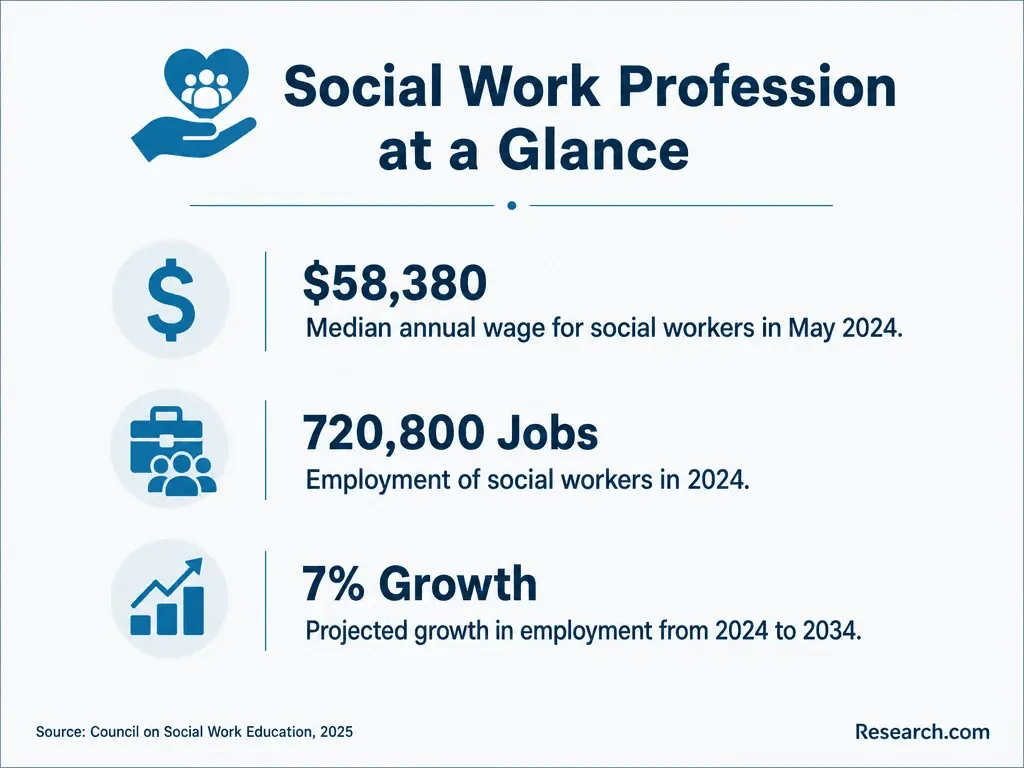
U.S. Bureau of Labor Statistics figures give occupation-wide context, not a salary attributable to SFBT training or an MSW. The listed May 2025 median annual pay was $59,550 for child, family, and school social workers, $67,880 for healthcare social workers, and $60,280 for mental health and substance abuse social workers.
Projected employment growth for 2025-2035 was 4%, 8%, and 10%, respectively. Actual pay varies with location, setting, experience, and role; social work master's pay and geographic differences can help frame a local comparison without treating an occupational median as a graduate's starting offer.
For an early-career worker, the strongest next step may be a position with dependable supervision and manageable opportunities to practice, not an additional credential advertised as a route to higher pay.
Other Things You Should Know About Social Work
No. It asks about desired change and useful resources while still taking distress, material needs, and structural barriers seriously.
Respect that preference. Ask in more concrete terms what would make the next day or meeting more useful, or shift to the practical concern the client raises.
Yes, if they fit the purpose of the meeting and the client's priorities. First-meeting duties such as explaining confidentiality, assessing immediate needs, and clarifying available services still matter.
Seek feedback on an observed or simulated conversation. Look for evidence that the questions were understandable, followed the client's lead, and produced a useful next step without minimizing constraints.
- NASW Standards for Social Work Case Management | nycourts.gov https://www.nycourts.gov/reporter/webdocs/nasw_standards_socialwork_casemgt.htm
- Solution-focused approaches in adult mental health research | nih.gov https://pmc.ncbi.nlm.nih.gov/articles/PMC10098109/
- What should you do if a case is outside your skill set? | apa.org https://www.apa.org/monitor/2018/05/ce-corner
- NASW Standards for Social Work Case Management | socialworkers.org https://www.socialworkers.org/Practice/NASW-Practice-Standards-Guidelines/NASW-Standards-for-Social-Work-Case-Management
- B3. Exception seeking | YouthAOD Toolbox https://www.youthaodtoolbox.org.au/b3-exception-seeking