2027 Social Workers and Teachers: Collaboration Around Student Needs and Family Context
Audited and Verified:
Our Editorial and Data Verification Process
Research.com uses government datasets, official education statistics and primary institutional information to support its career and degree guides. Our review process checks factual accuracy, occupational definitions, source dates and the requirements associated with the credentials discussed.
How This Article Was Fact-Checked
Our editorial team verifies salary estimates, employment projections, education requirements and program information against original data providers and official organizations. Salary figures are checked against the relevant occupational definitions and reporting periods. Information about licensure, accreditation and required in-person training is reviewed separately.
Fact-checked and verified on:

Co-Founder and Chief Data Scientist
A student's attendance, behavior, or coursework may change for reasons a teacher cannot see from the classroom. School social workers and teachers can respond more effectively when they combine classroom observations with a careful understanding of student and family needs - without making assumptions or sharing more information than necessary.
This guide explains how that collaboration works, where each role begins and ends, and how privacy shapes their decisions. It also helps educators, social work students, and career changers evaluate the education and qualifications needed for school social work.
Key Things You Should Know
- Effective collaboration starts with a specific classroom concern, a shared support goal, and a plan to review whether the student benefits - not a broad request for family details.
- School-held student records are generally governed by FERPA; access depends on authorized roles and legitimate educational interest, while outside providers may operate under different privacy rules.
- The closest BLS occupation, child, family, and school social workers, had a May 2025 median annual wage of $59,550 and projected employment growth of 4% from 2025 to 2035; neither figure describes every school social work position.
How do social workers and teachers collaborate to support students?
Teachers identify patterns in learning, attendance, peer relationships, and classroom participation. School social workers help assess barriers across school, home, and community settings, engage students and caregivers, and coordinate appropriate services. Their collaboration works best when it addresses an observable need rather than treating a student's family circumstances as an explanation by default.
A practical sequence is to describe the concern, check what supports are already in place, agree on a limited action, and review the result. For example, after repeated late arrivals, a teacher might document missed instruction while a social worker explores - with the family's involvement - whether transportation, caregiving responsibilities, or another issue is relevant. The team might then arrange a permitted support and monitor attendance. This is an illustrative process, not a determination about any particular student.
Collaboration can also occur through schoolwide prevention, attendance teams, and, when appropriate, individualized education program (IEP) or Section 504 processes. Those formal processes have their own eligibility and procedural rules. A concern involving immediate safety follows the school's crisis and reporting procedures rather than waiting for a routine team meeting. For readers comparing school practice with other settings, the guide to professional pathways after an MSW provides broader career context.
How do school social workers' and teachers' roles differ?
Teachers lead instruction and classroom assessment. School social workers bring social work assessment, family engagement, service coordination, and systems-level problem-solving to the educational setting. Both may build supportive relationships with students, but neither should assume the other has addressed a concern without an agreed handoff.
The comparison below clarifies who usually takes the lead. Actual assignments depend on district staffing, qualifications, and the student's plan.
| Need | Teacher's typical contribution | School social worker's typical contribution |
| Attendance concern | Documents patterns and missed learning | Explores barriers, engages caregivers, and coordinates available supports |
| Classroom difficulty | Adjusts instruction and classroom supports | Assesses related social or emotional needs within the role's scope |
| Family connection | Communicates about learning and school routines | Helps connect family priorities, school resources, and community services |
A school social worker is not automatically an independently licensed therapist, and a teacher should not be expected to investigate family circumstances. If the work that appeals to you is primarily instruction, a teaching qualification may be more direct than another social work degree. If you want to coordinate support across students, families, and systems, compare the relevant roles through a social work degree pathway overview.

How does family context shape student support at school?
Family context includes caregiving arrangements, work schedules, language access, housing stability, transportation, health needs, and a family's experience with schools. These factors may affect access to learning, but none should be inferred from a student's identity, address, or a single interaction. Ask what the student and caregivers consider important before selecting a response.
A support that looks simple at school may be impractical at home. A proposed morning meeting, for instance, may conflict with a caregiver's work hours; a referral may be unusable without transportation or interpretation. Teachers can explain the educational goal, while social workers can help identify feasible options and community connections. Families should have a meaningful voice in the plan, subject to applicable student rights and safety obligations.
This work calls for cultural humility rather than a checklist of presumed family problems. Students preparing for sustained assessment or intervention with families can examine choosing a clinically focused social work master's program, while checking separately whether its school-related learning and field opportunities match the intended job. A clinical emphasis alone does not confer school qualifications.
An accredited bachelor of social work (BSW) provides generalist preparation and may qualify graduates for some school-related jobs, depending on state and district rules. Many positions designated school social worker require an MSW and a state-issued school qualification or social work license. The job posting and state education agency - not the degree title alone - determine the relevant route.
A graduate with a qualifying BSW may be eligible for an advanced-standing MSW, subject to the program's criteria. Applicants with other bachelor's degrees typically seek a traditional or foundation MSW; relevant work experience does not, by itself, establish advanced-standing eligibility. Career changers should compare these routes against the duties they want: family liaison and other school support positions may accept different qualifications, while a regulated school social work role may not.
Admissions accessibility and professional eligibility are separate questions. Exploring less competitive MSW admission pathways may help applicants identify options, but they should still verify accreditation, field opportunities, and eligibility for the school role in their state.
What are school social workers' salary expectations and job outlook?
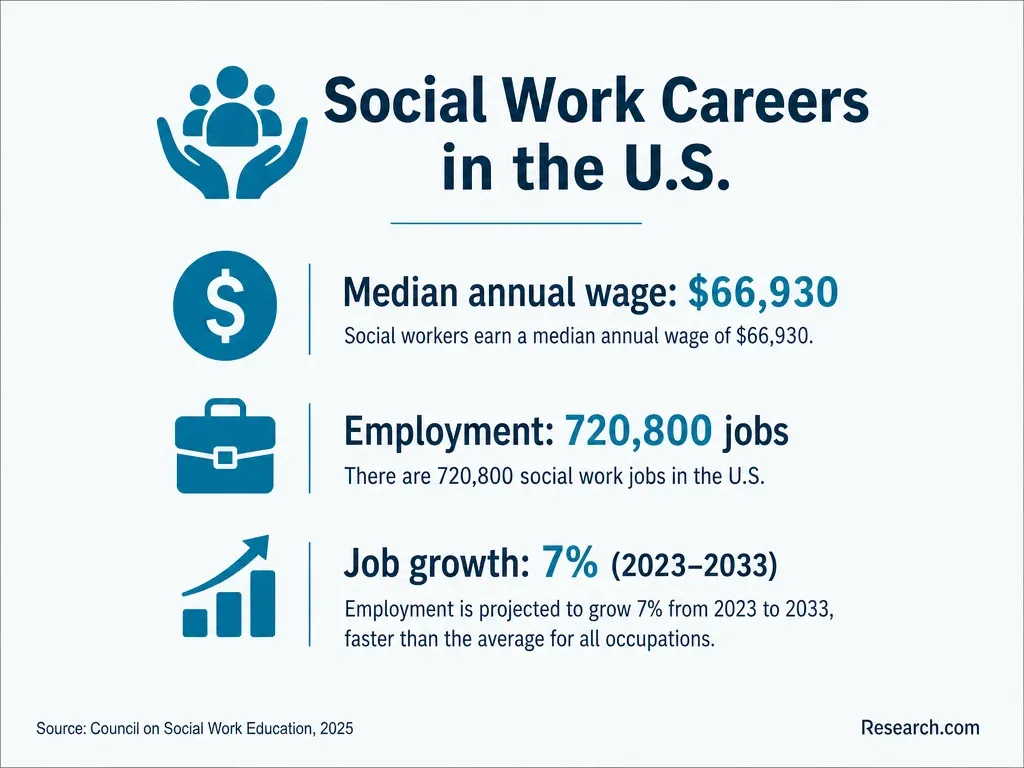
The U.S. Bureau of Labor Statistics groups school social workers with child and family social workers. For that combined occupation, the May 2025 median annual wage was $59,550, and employment was projected to grow 4% from 2025 to 2035. These are national occupation-level figures, not a school-only wage, a starting salary, or a forecast for one district.
District pay schedules, contract length, experience, location, and required credentials can change the offer substantially. Compare actual postings using annual pay alongside scheduled days, benefits, caseload, travel between schools, supervision, and available community partnerships. Planning an MSW career with regional salary context can inform that comparison, but local district terms should control a job decision.
Other Things You Should Know About Social Work
Some positions include home visits, but staff must follow district policy, role expectations, safety procedures, and applicable consent rules. A visit should have a clear purpose rather than serve as an informal investigation.
It depends on the contract. Some follow the school calendar; others have extended-year duties or summer assignments. Check paid workdays and compensation in the specific offer.
Possibly, if their role, qualifications, district policies, privacy safeguards, and applicable state rules permit it. Remote service does not remove jurisdiction-specific practice restrictions.
No. Duties can overlap, but school counselors and school social workers generally follow different preparation and credentialing pathways. Compare the state's role descriptions and actual job duties before choosing either route.
- Characteristics and Outcomes of School Social Work Services | nih.gov https://pmc.ncbi.nlm.nih.gov/articles/PMC10187493/
- Privacy and Information Sharing | education.vic.gov.au https://www2.education.vic.gov.au/pal/privacy-information-sharing/guidance/sharing-information
- Scope of Practice Addressing Barriers to Learning | CT.gov https://portal.ct.gov/sde/publications/delivery-of-school-social-work-services/scope-of-practice-addressing-barriers-to-learning
- Effects of poverty, hunger and homelessness on children and youth | apa.org https://www.apa.org/topics/socioeconomic-status/poverty-hunger-homelessness-children
- The Meaning and Value of Supervision in Social Work Field Education: Applied Learning in Social Work Education https://alswe.simmons.edu/article/the-meaning-and-value-of-supervision-in-social-work-field-education/
- The Community Collaboration Model for School Improvement | Scholar Commons https://scholarcommons.sc.edu/cgi/viewcontent.cgi
- Chapter 78 Individuals with Disabilities Education Act | oup.com https://global.oup.com/us/companion.websites/9780199861750/chapter78
- School social workers as partners in the school mission | Kappan Online https://kappanonline.org/finigan-carr-shaia-school-social-workers-partners-school-mission/
- Chapter 4: Privacy and confidentiality https://www.privacy.org.nz/resources-and-learning/a-z-topics/protecting-children-and-young-peoples-privacy/childrens-privacy-guidance-for-the-education-sector/chapter-4-privacy-and-confidentiality/
- The Role of the School Social Worker | NJCommonGround.org https://njcommonground.org/the-role-of-the-school-social-worker/