2027 Social Skills Groups in Social Work: Facilitator Preparation and Population Fit
Audited and Verified:
Our Editorial and Data Verification Process
Research.com uses government datasets, official education statistics and primary institutional information to support its career and degree guides. Our review process checks factual accuracy, occupational definitions, source dates and the requirements associated with the credentials discussed.
How This Article Was Fact-Checked
Our editorial team verifies salary estimates, employment projections, education requirements and program information against original data providers and official organizations. Salary figures are checked against the relevant occupational definitions and reporting periods. Information about licensure, accreditation and required in-person training is reviewed separately.
Fact-checked and verified on:

Co-Founder and Chief Data Scientist
A social skills group can help participants practice communication, cooperation, and relationships - but only when its goals and format fit the people attending. For social work students, new practitioners, and agency staff, the decision is both practical and professional: which groups can you competently facilitate, and what preparation would you need?
This guide explains population fit, supervision, credentials, degree pathways, and ethical methods. It also shows when targeted training may be more useful than another degree, so you can choose a realistic next step for your setting and role.
Key Things You Should Know
- Match the group to a defined skill goal, participants' preferences, and the setting; a shared diagnosis or age alone does not establish fit.
- Facilitating a nonclinical skills group may not require independent clinical licensure, but psychotherapy, protected titles, school roles, and reimbursement can trigger different state or employer requirements.
- Observed group practice and supervision matter more than a degree label alone. For salary context, the U.S. Bureau of Labor Statistics reports a $60,280 May 2025 median for mental health and substance abuse social workers - not a salary specific to group facilitators.
What are social skills groups in social work?
Social skills groups are structured opportunities to learn and practice interactions such as starting conversations, recognizing social cues, handling disagreement, or asking for help. A facilitator may demonstrate a skill, invite practice, help participants reflect on what happened, and support its use outside the group. Social workers also consider barriers around the person - such as inaccessible environments, discrimination, or limited opportunities to participate - rather than treating every interaction difficulty as an individual deficit.
A school-based practice group, a community peer-connection program, and a clinical group addressing anxiety may all involve conversation skills, but they are not interchangeable. Their screening, consent, supervision, documentation, and facilitator qualifications can differ. A social work degree is one route into this work, not the definition of the intervention; readers exploring that route can compare social work degree options and program formats against the duties of the role they want.
Which populations are social skills groups best suited for?
Fit depends on a participant's own goals, communication preferences, readiness for a group, and access needs - not simply a referral label. These examples show why facilitators should define the purpose before selecting a curriculum.
| Potential participants | Possible group goal | Fit question |
| Children or adolescents in schools | Practice joining activities or resolving peer conflict | Are skills relevant to students' goals, and are school permissions and supports in place? |
| Autistic people or people with other disabilities | Build chosen communication or self-advocacy skills | Does the group respect neurodivergent communication and offer needed accommodations? |
| Adults experiencing isolation or a life transition | Practice connection and mutual support | Would a peer or community group serve the goal better than a clinical group? |
| People receiving behavioral health services | Practice interactions related to an agreed treatment goal | Does the group require clinical assessment, treatment oversight, or a licensed facilitator? |
Group participation should be voluntary where possible and should not be used to pressure someone to mask a disability or conform to one cultural style of interaction. If participants need individual treatment, a different level of support, or a safer format, referral or adaptation may be preferable. For a BSW graduate considering clinical group work with a particular population, shorter graduate pathways in social work may be worth examining - but a faster MSW does not replace population-specific training or supervision.
What licenses or credentials are needed to facilitate social skills groups?
There is no single U.S. "social skills group facilitator" license. Requirements follow the activities performed, professional title used, service setting, state law, employer policy, and any payer rules. An agency may allow a trained, supervised staff member to lead a nonclinical practice group, while a psychotherapy group may require a clinician with an appropriate license or supervision arrangement. Schools can impose separate qualifications and procedures.
Before accepting a role, ask whether it includes diagnosis, psychotherapy, clinical records, school social work duties, or billing under a licensed provider. Check the applicable state board and agency requirements rather than assuming an MSW, a training certificate, or a license from another state authorizes the work. Prospective online students should also check online MSW program eligibility by intended state; enrollment eligibility and eventual license eligibility are separate decisions.
Look for preparation that connects group theory to observed performance: planning goals, facilitating practice without shaming participants, managing participation and conflict, adapting activities, and evaluating whether skills transfer beyond sessions. Population-specific training may address disability access, child development, trauma-informed engagement, or clinical methods appropriate to the role.
In a BSW or MSW placement, the strongest opportunity is not merely watching a group. It is an approved learning assignment with orientation, observation, co-facilitation, feedback, and a gradual increase in responsibility. Ask the field office and site who supervises group work, whether you can practice the relevant tasks, and how your performance will be assessed. Guidance on online MSW placement responsibilities before enrollment can help frame those questions. Curricular field education is not automatically post-degree clinical supervision, even when both involve group sessions.
What careers, salaries, and job outlooks are associated with social skills group facilitation?
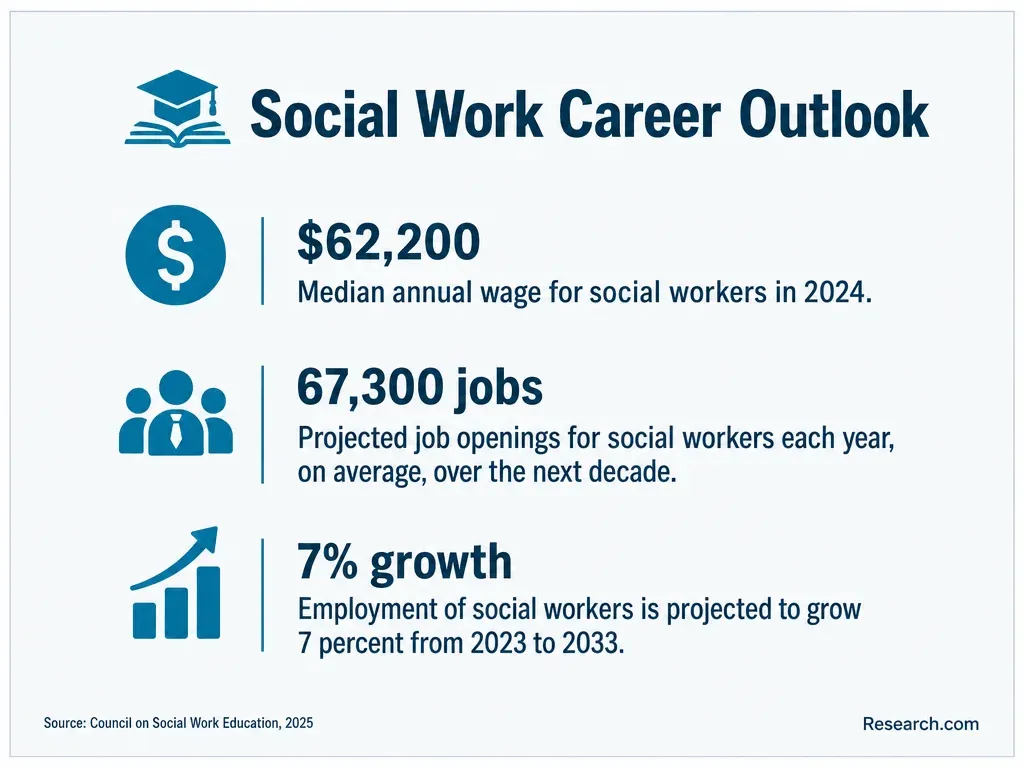
Group facilitation is usually a duty within a broader job, not a distinct occupation tracked by the U.S. Bureau of Labor Statistics (BLS). Depending on the setting, relevant roles may include school social worker, community-program staff member, behavioral health social worker, or clinician. Compare postings by population, actual group duties, required degree and license, supervision, caseload, documentation, and whether group time is protected in the schedule.
BLS reports May 2025 median annual pay of $59,550 for child, family, and school social workers, with 4% projected employment growth from 2025 to 2035. For mental health and substance abuse social workers, the figures are $60,280 and 10%, respectively. These are occupation-wide U.S. measures - not starting pay, pay for group facilitation, or predicted demand for a particular agency program. Location and role can change the comparison; MSW career compensation by state offers additional geographic context.
If your goal is to lead a nonclinical community group, first investigate supervised experience and targeted training available through an employer. If your goal is clinical treatment, start with the job's degree and state-license requirements, then choose education and supervision that support that specific pathway.
Other Things You Should Know About Social Work
No. A shared, meaningful goal and a workable group format matter more than identical diagnoses. Screening should consider participants' preferences, support needs, and whether the planned activities are appropriate for them.
There is no universal ideal size. Choose a size that lets participants practice and receive feedback while allowing facilitators to support access and safety; staffing, setting, and participant needs should guide the decision.
Sometimes. Their involvement may help participants practice outside sessions, but it should fit the group's purpose and participants' wishes. Clarify consent, privacy, and roles before inviting anyone.
Agree on modest, participant-centered goals at the start. Review feedback and relevant observations over time, while protecting records and avoiding claims that attendance alone proves improved social functioning.
- Group interventions - PMC - NIH https://pmc.ncbi.nlm.nih.gov/articles/PMC5844165/
- Assess Training Needs: Conducting Needs Analysis | cdc.gov https://www.cdc.gov/training-development/php/about/assess-training-needs-conducting-needs-analysis.html
- Section 7. - Building Culturally Competent Organizations https://ctb.ku.edu/en/table-of-contents/culture/cultural-competence/culturally-competent-organizations/main
- The Nine CSWE Social Work Competencies | texascollege.edu https://www.texascollege.edu/the-nine-cswe-social-work-competencies
- Group Facilitation Skills (4 videos) | The Office of Academic Success https://sites.rutgers.edu/shp-shpri/group-facilitation-skills-4-videos/
- Understanding Evidence-Based Social Work | Virginia Commonwealth University https://onlinesocialwork.vcu.edu/blog/evidence-based-social-work/
- Standards and Indicators for Cultural Competence in Social Work Practice | socialworkers.org https://www.socialworkers.org/Practice/NASW-Practice-Standards-Guidelines/Standards-and-Indicators-for-Cultural-Competence-in-Social-Work-Practice