2027 Social Workers and Child Life Specialists: Supporting Children and Families in Healthcare
Audited and Verified:
Our Editorial and Data Verification Process
Research.com uses government datasets, official education statistics and primary institutional information to support its career and degree guides. Our review process checks factual accuracy, occupational definitions, source dates and the requirements associated with the credentials discussed.
How This Article Was Fact-Checked
Our editorial team verifies salary estimates, employment projections, education requirements and program information against original data providers and official organizations. Salary figures are checked against the relevant occupational definitions and reporting periods. Information about licensure, accreditation and required in-person training is reviewed separately.
Fact-checked and verified on:

Co-Founder and Chief Data Scientist
A child's hospital stay can leave a family managing medical decisions, missed work, and an unfamiliar environment at once. Pediatric social workers and child life specialists help with different parts of that experience, so choosing between the careers requires more than a shared interest in helping children.
This guide is for students and career changers comparing the roles. It explains what each professional does, how to qualify, what training may cost, and which questions to ask before committing to a program.
Key Things You Should Know
- Choose by the work: Pediatric social workers address family and social needs, resource access, and care coordination; child life specialists use developmentally appropriate education, play, and coping support to help children navigate healthcare.
- Credentials are separate: Social work licensure depends on state rules; the Certified Child Life Specialist credential has its own education, internship, and examination requirements. Neither degree alone grants either credential.
- Compare wages carefully: The U.S. Bureau of Labor Statistics reports a May 2025 median of $67,880 for healthcare social workers and projects 8% employment growth from 2025 to 2035; it does not publish an equivalent child-life-specific wage series.
How do pediatric social workers and child life specialists differ?
Pediatric social workers assess how illness affects a child's family and access to care. Depending on the position, they may help with discharge planning, transportation or insurance barriers, family meetings, referrals, safeguarding concerns, and grief support. Clinical assessment or psychotherapy requires the appropriate license, supervision, and employer authorization; it is not part of every pediatric social work job.
Child life specialists focus on children's developmental and emotional experience of healthcare. They may explain procedures in age-appropriate language, use therapeutic play to prepare a child for an unfamiliar experience, support coping during procedures, and help siblings and caregivers understand what to expect. Their role is not to provide licensed psychotherapy or determine a family's benefits eligibility.
The distinction is the problem each professional is primarily hired to solve. If you want to address family systems, service access, and care transitions, explore the social work degree pathway overview. If you want daily, hands-on work helping children understand and cope with medical experiences, investigate child life first. Hospital job descriptions matter: duties and team structures vary by employer.
What degrees do social workers and child life specialists need?
A CSWE-accredited bachelor of social work (BSW) prepares graduates for generalist social work roles. Many hospital social worker positions prefer or require a master of social work (MSW), particularly when duties involve complex assessments or clinical services.
A traditional MSW can admit applicants with bachelor's degrees in other fields; advanced-standing MSW tracks are generally for applicants with a qualifying BSW who meet the program's additional criteria. A psychology or human services bachelor's degree does not automatically qualify for advanced standing.
Child life applicants generally need a bachelor's degree, though the major need not always be called child life. What matters for certification is whether their education meets the Association of Child Life Professionals' (ACLP) current coursework requirements, alongside its other eligibility rules. Degrees in child life, child development, psychology, and related fields can be starting points, but applicants should check their individual courses rather than rely on the degree title.
Neither a DSW nor a PhD is a standard entry requirement for either hospital role. An MSW makes sense for someone seeking social work practice options; an additional social work degree is usually a less direct choice for someone set on child life. If you already hold an MSW and are considering leadership or research later, fast-track social work master's study options are relevant only to an earlier educational decision - not a substitute for child life preparation.
What licenses or certifications do these careers require?
Social work licenses are issued by states, not by universities or professional associations. License categories, protected titles, examinations, and supervised-experience requirements vary. An MSW graduate may be eligible to apply for a particular license but cannot assume that graduation - or passing an exam - authorizes independent clinical practice. Before choosing a program, compare its educational route with the licensing board rules in the state where you intend to work.
Post-degree clinical supervision is distinct from MSW field education; planning supervised experience in a social work career requires checking which work, supervisors, and records the board accepts.
The Certified Child Life Specialist (CCLS) credential is administered by ACLP, not by a state social work board. Candidates must meet ACLP's current academic and clinical-experience eligibility requirements and pass its certification examination. Employers may specify CCLS certification or eligibility in job postings. A child life degree alone does not confer certification, and CCLS certification does not grant a social work license.
BSW and MSW field education places students in approved practice settings with defined learning objectives, instruction, and school evaluation. A pediatric hospital placement can be valuable, but it is not guaranteed and is not the only way to develop relevant skills.
Ask whether the school has pediatric partners, who secures placements, what supervision is available, and whether an employment-based placement can be approved. A paid hospital job or volunteer shift does not automatically count toward a social work degree.
Child life preparation has a different clinical-training pathway. ACLP requires a supervised child life internship for certification eligibility; its published internship standard is 600 hours. Students should confirm the current requirement, internship eligibility, and application procedures directly with ACLP and prospective sites.
Competition for placements may affect when a graduate can become certification-eligible. Experience with children is useful preparation but does not replace an approved internship.
For either path, compare the placement schedule with paid work, transportation, and caregiving before enrolling. Students considering an online MSW can use a guide to school-supported MSW placements to frame questions, then obtain the school's actual placement policies in writing.
For a BSW or MSW, verify the exact program and its status in the Council on Social Work Education (CSWE) directory, including whether that status applies to your expected graduating cohort.
Also confirm the institution's accreditation and ask the intended state licensing board whether the education meets its requirements. These are different checks: institutional accreditation alone does not establish CSWE program accreditation or license eligibility. This distinction is especially important when reviewing online social work master's programs and state board requirements.
For child life, check whether a program is endorsed by ACLP and what that endorsement covers. Endorsement can help identify coursework aligned with ACLP expectations, but it is not the same as CCLS certification, an internship offer, or a guarantee of examination eligibility. A nonendorsed program may still be usable if an applicant's coursework meets current ACLP rules. Request a course-by-course eligibility review and ask how the program supports internship applications.
Yes, some academic coursework for either pathway is available online. Online delivery does not eliminate in-person field education, a child life internship, required skills activities, or site onboarding. An online MSW may also have live classes or scheduled practice sessions. Compare those commitments before choosing a format; an accelerated schedule can reduce calendar time while increasing weekly demands.
Review budget-conscious doctoral social work study only if doctoral study serves a separate, later career goal - it is not preparation required for these entry roles.
Ask each school whether it can approve a placement near you, who is responsible for finding a site, and whether it can support students in your state. Child life students should additionally ask how online courses satisfy ACLP coursework criteria and how they will obtain the required supervised internship. If you work or care for family members, request an actual sample weekly schedule rather than assuming "online" means asynchronous.
BSW admission may involve entry to the university followed by a separate application to the social work major. MSW programs typically review a prior bachelor's degree, academic record, statement, and other program-specific materials; a traditional MSW can be a route for career changers without a BSW. Child life programs set their own admission rules, while ACLP separately evaluates whether coursework satisfies certification eligibility.
The most useful course comparison is whether each curriculum develops the skills used in the target job. Social work study commonly covers human behavior, social policy, research, ethics, assessment, and practice with people and systems.
Child life preparation emphasizes child development, family systems, play, healthcare experiences, and developmentally appropriate support. A former teacher may bring strong child-development skills; a community case manager may bring referral and advocacy experience. Neither background, by itself, replaces required coursework or supervised training.
Ask admissions staff to identify missing prerequisites and the point at which placement or internship applications begin. If an MSW application requires references, compare the school's stated policy rather than assuming every program uses the same standard; social work master's reference requirements compared can help narrow that question.
A bachelor's degree commonly takes about four years of full-time study from entry, although transfer credit and course sequencing change individual timelines.
Traditional MSW study often takes about two years full time; qualifying advanced-standing routes are shorter. For child life, completing a bachelor's degree is not necessarily the end of the timeline: required coursework and obtaining an internship can extend the path to certification eligibility. Schools and internship sites, rather than a general estimate, can give you a realistic schedule.
There is no single reliable price for either career path. Published tuition alone can obscure the cost of completing supervised training. Compare the following expenses against your own circumstances:
- School charges: Total credits, per-credit tuition, mandatory fees, and any additional coursework needed for credential eligibility.
- Training expenses: Placement or internship travel, parking, screening, and required equipment or campus visits.
- Opportunity costs: Paid hours reduced to accommodate daytime placements, plus caregiving or relocation costs.
- After graduation: Applicable examination, certification, licensure, and renewal fees.
Request a written total-credit estimate and a typical field or internship schedule from each program. Affordable online Master of Social Work options may lower tuition, but a lower advertised rate is not the lower-cost choice if placement logistics substantially reduce your earnings or add travel expenses.
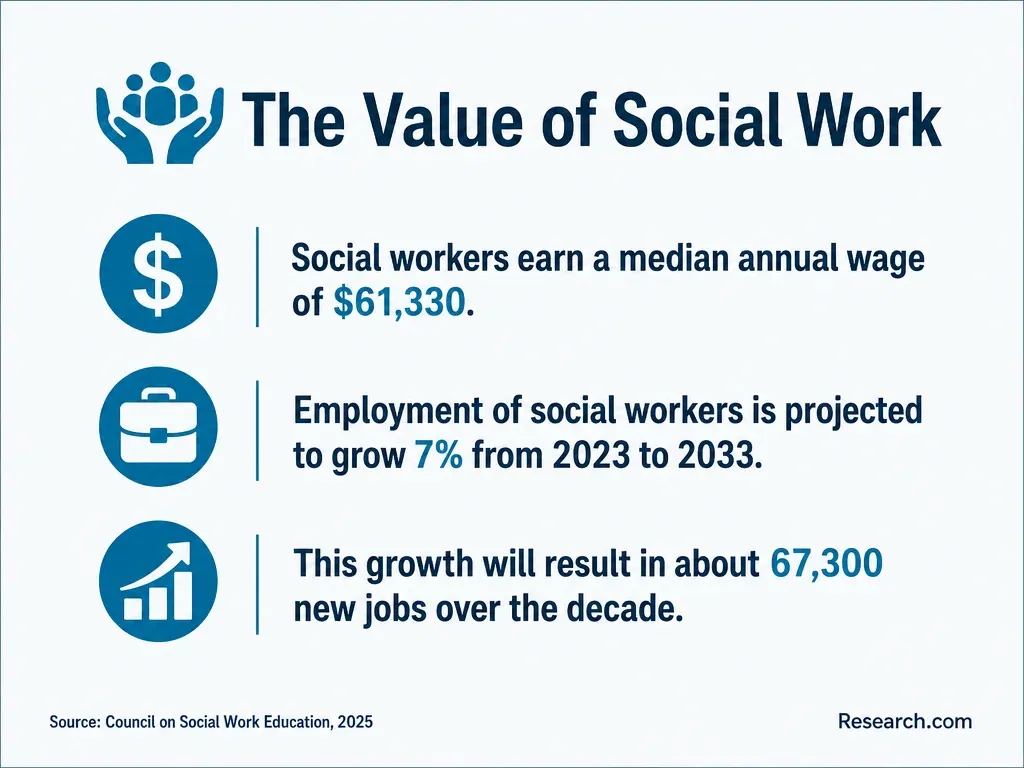
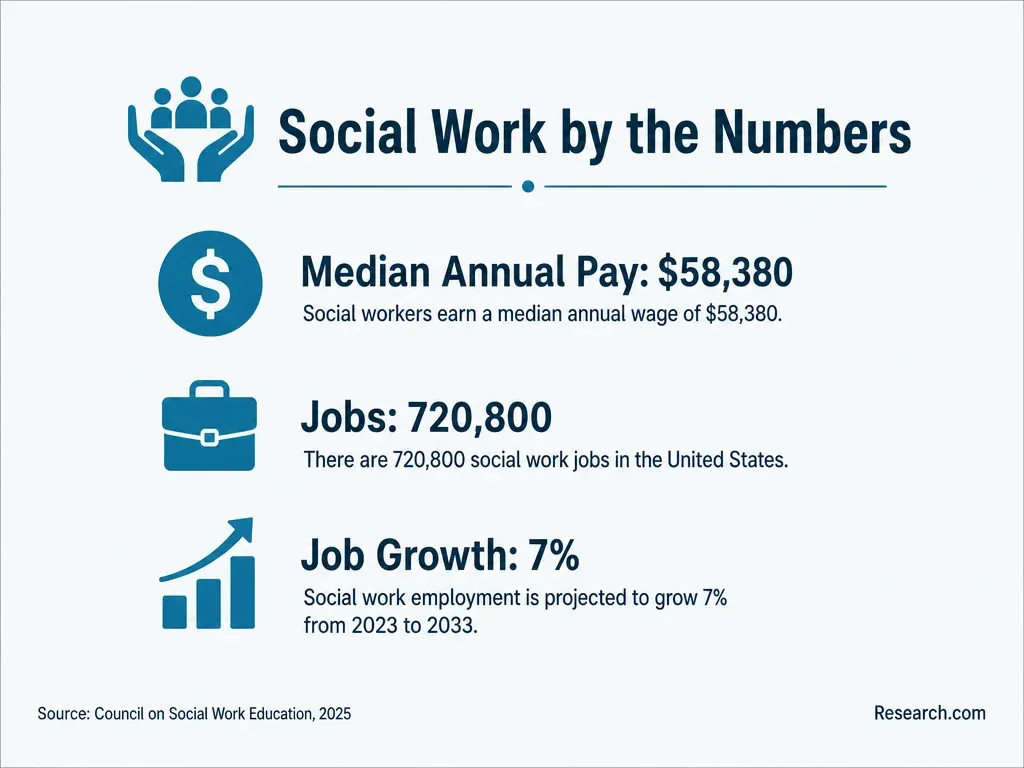
Federal wage data offers a useful benchmark for social work, but not a direct salary comparison between these two job titles. The U.S. Bureau of Labor Statistics (BLS) reports a May 2025 median annual wage of $67,880 for healthcare social workers and projects 8% employment growth from 2025 to 2035. Some pediatric social worker jobs fit that occupation; an individual offer will also reflect location, employer, duties, experience, and license requirements.
For geographic context, see social work master's salary geography without treating state averages as hospital offers.
BLS does not publish a child-life-specific occupational wage and growth series. Substituting healthcare social worker pay - or an unrelated broad occupation - would create a misleading comparison. For child life, request salary ranges from hospitals hiring in your target area and compare postings that specify the same certification status, schedule, and experience level. Do the same for pediatric social work positions before calculating whether additional education is financially workable.
How do social workers and child life specialists collaborate in pediatric healthcare?
Both professionals support a child and family, but they contribute different information to a coordinated plan. Before a procedure, a child life specialist might assess what the child understands and identify a developmentally appropriate coping approach.
A social worker might address transportation, caregiver work constraints, or referrals that could affect access to treatment. Each shares information with the care team under applicable consent, privacy, and hospital policies rather than assuming all family details should circulate freely.
Collaboration also helps prevent gaps and duplication. Child life can flag a family concern that needs social work follow-up; social work can request child life support when a child needs preparation for an unfamiliar hospital experience. Neither professional should promise a resource, provide services outside their role, or substitute for the other's specialized judgment.
When comparing jobs, ask how referrals work between the two teams, who participates in care meetings, what supervision is available, and how the hospital handles difficult cases. Those answers reveal more about daily practice than a job title alone. Social workers exploring where pediatric experience can lead can compare broader MSW education and career pathway connections; someone committed to therapeutic play and procedural preparation should prioritize child life qualifications instead.
Other Things You Should Know About Social Work
Yes, but a social work degree or license does not automatically meet CCLS requirements. Have ACLP review your coursework and confirm what internship and examination steps remain.
Yes, through qualifying social work education and any license required for the intended position and state. Child life experience may strengthen an application, but it does not replace a BSW or MSW when one is required.
No. Pediatric social workers can work across healthcare and community services, while child life specialists may work in hospitals and other settings serving children with healthcare-related needs. Available roles depend on local employers.
Clinical social work is the more relevant of these two routes. It requires meeting state-specific education, licensing, and supervised-practice rules; neither an MSW alone nor CCLS certification authorizes independent psychotherapy.
- Minimizing pediatric healthcare-induced anxiety and trauma | nih.gov https://pmc.ncbi.nlm.nih.gov/articles/PMC4857227/
- 19.29 Coordination of Care with Hospitals | ga.gov https://pamms.dhs.ga.gov/dfcs/cws/19-29/
- Summary of the HIPAA Privacy Rule | hhs.gov https://www.hhs.gov/hipaa/for-professionals/privacy/laws-regulations/index.html
- Social Determinants of Health (SDOH) | cdc.gov https://www.cdc.gov/about/priorities/why-is-addressing-sdoh-important.html
- Child Health and Health Care: Uniqueness, Societal... - NCBI https://www.ncbi.nlm.nih.gov/books/NBK610738/
- Social Drivers of Health and Health-Related Social Needs | cms.gov https://www.cms.gov/priorities-innovation-key-concepts-social-drivers-health-health-related-social-needs
- Child Life Specialist - Explore Healthcare Careers | Mayo Clinic College of Medicine and Science https://college.mayo.edu/academics/explore-health-care-careers/careers-a-z/child-life-specialist/
- Parents and caregivers are essential to children's healthy development | apa.org https://www.apa.org/topics/families/parents-caregivers-kids-healthy-development
- Integrating Social Needs Into Health Care Practice - Penn LDI https://ldi.upenn.edu/our-work/research-updates/integrating-social-needs-into-health-care-practice-evidence-and-barriers/
- How Child Life Specialists Support Children and Families in Healthcare Settings | Vanderbilt University https://blog.peabody.vanderbilt.edu/the-peabody-blog/how-child-life-specialists-support-children-and-families-in-healthcare-settings