2027 Social Work with Young Carers: Schools, Families, and Community Services
Audited and Verified:
Our Editorial and Data Verification Process
Research.com uses government datasets, official education statistics and primary institutional information to support its career and degree guides. Our review process checks factual accuracy, occupational definitions, source dates and the requirements associated with the credentials discussed.
How This Article Was Fact-Checked
Our editorial team verifies salary estimates, employment projections, education requirements and program information against original data providers and official organizations. Salary figures are checked against the relevant occupational definitions and reporting periods. Information about licensure, accreditation and required in-person training is reviewed separately.
Fact-checked and verified on:

Co-Founder and Chief Data Scientist
A student who regularly manages a parent's medication, supervises a sibling, or translates at medical appointments may be providing care that adults around them have not recognized. For social workers and people considering this work, the challenge is to support the young person without treating family caregiving itself as a problem.
This guide explains how schools, families, and community services can respond together, and how to assess the degrees, credentials, placements, costs, and jobs that lead to this work.
Key Things You Should Know
- Young carers are children or young adults who provide substantial help to someone with an illness, disability, mental health condition, or substance-use concern; support should reduce harmful demands while respecting the family's strengths and choices.
- School-based, family, and community roles overlap, but their qualifications differ: some support jobs accept a BSW or related degree, while school social work and independent clinical practice may require additional state-specific credentials.
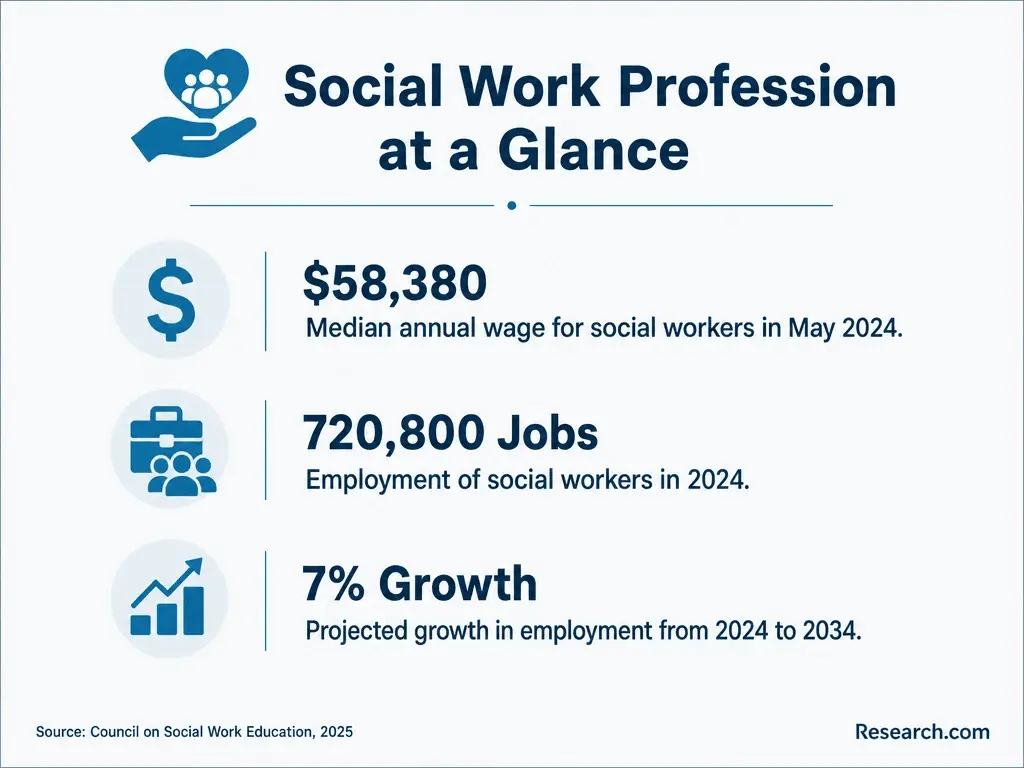
- For the closest BLS occupation, child, family, and school social workers, the May 2025 median annual wage was $59,550, with employment projected to grow 4% from 2025 to 2035; neither figure predicts a particular young-carer role's pay or openings.
Who are young carers, and what challenges do they face?
Young carers are minors, and, in some programs, young adults, who regularly help a family member or other close person manage a health condition, disability, mental health concern, or substance-use concern.
Their responsibilities can include household tasks, personal care, emotional support, interpreting, or looking after siblings. The term describes a caregiving role, not a diagnosis or a finding that the family has done something wrong.
Some young people value helping and develop useful skills. Problems arise when responsibilities become unsafe, developmentally inappropriate, or difficult to combine with sleep, school, friendships, and their own health. A student may miss class because transportation or another caregiver is unavailable, for example.
A useful assessment asks what the young person actually does, how often, what support they want, and which adult services could take on the burden. It does not presume that every absence or tired student is a young carer.
Caregiving can also shape a young person's plans after high school. A former young carer interested in helping families professionally can investigate starting a social work bachelor's degree without an associate degree; prior caregiving may inform their perspective, but it does not replace professional education or field learning.
How do social workers support young carers in schools, families, and communities?
Effective support starts with the young person's account of their responsibilities and goals, then addresses the conditions placing so much care on them.
With appropriate consent and information-sharing, a social worker can coordinate among a school, the person receiving care, other family members, healthcare providers, and community agencies. The aim is not simply to teach the child to cope better with an excessive workload.
The setting changes what a social worker can do directly and what requires a partner:
| Setting | Useful response | Important boundary |
| School | Notice attendance or concentration changes; arrange a private conversation and coordinate appropriate school supports. | Do not disclose family health information broadly or assume an academic problem proves neglect. |
| Family | Assess caregiving tasks and safety; help adults plan respite, transportation, benefits, or home-based assistance. | Include the young person's wishes without making them responsible for fixing adult service gaps. |
| Community | Connect the family with disability, aging, behavioral health, food, or peer-support services and follow up on access barriers. | Check eligibility and availability; a referral alone does not establish that help was received. |
For someone choosing a career, this distinction matters: school support, family case management, and service coordination offer different ways to help the same young person. Comparing MSW education and career pathway connections can help identify whether the desired work is direct service, clinical care, or program leadership.
What degree do you need to work with young carers?
There is no single "young carer social worker" degree. Start with the duties in the job posting. A BSW can prepare graduates for generalist social work and some family-support or case-management positions. Some outreach and service-navigation jobs also accept human services or related degrees.
An MSW is more relevant when an employer requires graduate-level social work, the role involves specialized school or clinical practice, or the applicant seeks a license category for which an MSW is required.
A traditional or foundation MSW can admit applicants with bachelor's degrees outside social work, subject to program requirements.
Advanced-standing MSW entry generally depends on a qualifying BSW and the program's additional criteria; caregiving, volunteering, or a psychology degree does not by itself confer eligibility. Use a comparison of BSW-to-MSW progression and traditional entry routes to avoid choosing a track you cannot enter.
A DSW or PhD is not necessary for ordinary young-carer support roles. A doctorate may serve a later leadership or research goal, but targeted child-and-family experience, supervision, and training may be a more direct next step.
Compare programs against the role you want, not the delivery label. Verify the institution's accreditation, the exact BSW or MSW program's Council on Social Work Education (CSWE) accreditation status for your entry cohort, and any state requirements tied to the intended credential. Then ask where students can complete approved field placements involving children and families.
Online coursework does not make field education remote or automatically flexible. Compare required live classes, skills sessions, campus visits, placement hours and schedules, travel, and who is responsible for finding a site and qualified field instructor.
A guide to choosing an online social work degree can help frame the search, but the program and relevant state authorities must confirm details for your location and entry term.
BSW applicants may first enter a university and then apply to its social work major; requirements and timing vary. Traditional MSW programs commonly review a bachelor's transcript, writing, references, and relevant experience, but specific prerequisites and minimum grades are program-dependent. Advanced-standing applicants face additional review of their qualifying social work degree and, where required, its recency.
Ask admissions staff to confirm the entry track, any missing prerequisites, and when field-placement screening begins. An accelerated schedule is a separate consideration from eligibility: accelerated online MSW programs may compress the same major commitments into a shorter calendar, making placement scheduling especially important for applicants balancing work or family care.
What are the salary and job outlook for child, family, and school social workers?
The U.S. Bureau of Labor Statistics reports a May 2025 median annual wage of $59,550 for child, family, and school social workers and projects 4% employment growth from 2025 to 2035.
This is the closest broad occupational category for many of the roles discussed here, not a wage survey of specialists serving young carers. Community navigation roles classified in other occupations may have different pay and entry requirements.
Use those figures as context, then compare actual local postings by setting, required credential, schedule, and benefits. State-level salary context for MSW careers can help with geographic comparisons, but an occupational median does not establish what an MSW graduate, or a particular school or nonprofit, will earn.
Other Things You Should Know About Social Work
They can tell a trusted school staff member what tasks they handle and how those tasks affect school or rest. The conversation can begin with their needs; staff should explain confidentiality and its limits before seeking sensitive details.
No. Some want to keep helping in ways that feel manageable. Support should ask what they value and reduce unsafe or excessive demands, rather than impose a single view of family caregiving.
No. Eligibility, capacity, cost, and waiting lists vary. A useful follow-up checks whether the family connected with the service and whether the young person's responsibilities actually changed.
Only within the school's and placement agency's rules for consent, privacy, and educational work. Students should not assume that changing a name sufficiently protects an identifiable family.
- Young carers' experiences of services and support - PMC - NIH https://pmc.ncbi.nlm.nih.gov/articles/PMC10980198/
- Family-Centered Practice in Social Work | VCU MSW https://onlinesocialwork.vcu.edu/blog/family-centered-practice-in-social-work/
- Youth caregivers of adults in the United States | The PAIR Center https://pair.upenn.edu/publication/youth-caregivers-of-adults-in-the-united-states-prevalence-and-the-association-between-caregiving-and-education/
- The health, well-being and future opportunities of young carers: a population approach - ScienceDirect https://www.sciencedirect.com/science/article/pii/S0033350620301554
- Health outcomes and psychosocial determinants in young carers: a systematic review - The Lancet Public Health https://www.thelancet.com/journals/lanpub/article/PIIS2468-2667(25)00099-4/fulltext
- Children and adolescents as informal caregivers. | sozialministerium.gv.at https://broschuerenservice.sozialministerium.gv.at/Home/Download
- Young Carers of Patients with Serious Illness | Palliative Care Network of Wisconsin https://www.mypcnow.org/fast-fact/young-carers-of-patients-with-serious-illness/