2027 Social Work with People on Probation: Team Roles and Professional Boundaries
Audited and Verified:
Our Editorial and Data Verification Process
Research.com uses government datasets, official education statistics and primary institutional information to support its career and degree guides. Our review process checks factual accuracy, occupational definitions, source dates and the requirements associated with the credentials discussed.
How This Article Was Fact-Checked
Our editorial team verifies salary estimates, employment projections, education requirements and program information against original data providers and official organizations. Salary figures are checked against the relevant occupational definitions and reporting periods. Information about licensure, accreditation and required in-person training is reviewed separately.
Fact-checked and verified on:

Co-Founder and Chief Data Scientist
Working with someone on probation means helping them access support while a court-supervised process tracks compliance. That creates a practical challenge for social workers: collaborate with probation officers without becoming an extension of enforcement or promising confidentiality they cannot provide. This guide is for students, early-career social workers, and human services professionals considering community corrections work. It explains team responsibilities, information-sharing boundaries, relevant degrees and licenses, and how to judge whether a probation-related role fits your skills and goals.
Key Things You Should Know
- Social workers generally address treatment, housing, benefits, family needs, and other barriers; probation officers generally monitor court-ordered conditions and respond to alleged noncompliance.
- Before services begin, clarify who receives information, what must be reported, and whether the social worker is a treatment provider, a probation employee, or both.
- A BSW or MSW can prepare you for different roles, but job duties, state law, employer rules, and clinical licensing requirements - not the degree alone - determine what you may do.
What do social workers do for people on probation?
Probation is community supervision under conditions set by a court or other authorized body. Social workers may help a person meet immediate needs and build stability during that period. Depending on the employer and their qualifications, their work can include assessing housing and income needs, coordinating behavioral health referrals, helping with benefits applications, supporting family relationships, and planning transitions from treatment or incarceration.
The social worker's contribution is a person-in-environment assessment: a missed appointment, for example, may warrant attention to transportation, work hours, disability access, or caregiving - not an assumption about motivation. The worker still documents accurately and does not promise that addressing a barrier will excuse a probation violation.
Some positions are social work jobs; others are case management or reentry jobs open to graduates of several disciplines. For a broader view of where an MSW may lead, see exploring roles for master's-prepared social workers. Compare the actual duties and required credentials rather than relying on a job title.
How do social workers and probation officers work together?
Effective collaboration starts with a shared service goal and distinct authority. A probation officer typically explains supervision conditions, monitors compliance, and follows agency procedures when concerns arise. A social worker may assess service needs, coordinate referrals, provide permitted interventions, and report information within the agreed legal and professional boundaries. Neither should assume the other has approved a change to a court condition or treatment plan.
The distinction matters most when a service problem might also become a compliance problem. For example, the team can coordinate an accessible referral and clarify attendance-reporting expectations without routinely circulating psychotherapy notes or treating every treatment setback as a violation. Before a case conference, staff should identify its purpose, who will attend, and what information each person is authorized to share.
For students, a placement should offer supervised opportunities to observe both service coordination and these role limits. Ask who provides field instruction, who supervises daily tasks, and whether students attend case conferences. MSW field placement support and student responsibilities are especially worth checking if a school proposes a justice-system placement outside its usual agency network.
What professional boundaries and confidentiality rules apply in probation settings?
Explain the information-sharing arrangement before asking for sensitive disclosures. A person on probation needs to know the social worker's employer, role, recordkeeping practices, who may receive updates, and the limits of confidentiality. Treatment, court, probation, and agency records may be governed by different rules. HIPAA may apply to a covered healthcare provider; federal substance use disorder confidentiality rules, including 42 CFR Part 2, may apply to certain records. Neither rule should be assumed to cover every probation-office record.
Consent, a court order, reporting law, or another legal basis can affect what may be disclosed. Workers should use the applicable authorization and agency process, share only what is permitted and necessary, and seek supervision or legal guidance when authority is unclear. Ethical guidance, including the NASW Code of Ethics where applicable, informs professional judgment but does not replace law or employer policy.
Boundaries also include avoiding promises about court outcomes, not acting as a person's legal adviser, and keeping help with services separate from decisions only probation or the court can make. If you are entering a role that requires a social work license, a guide to MSW education and state licensing expectations can help frame questions for the state board; licensing and confidentiality obligations still need separate, setting-specific checks.
There is no single degree required for every probation-related job. A BSW can prepare graduates for generalist social work and some case management positions. An MSW may be required or preferred for advanced assessment, clinical-track positions, supervision, or specialized services. Some reentry, peer support, and probation officer positions accept other qualifications; check the posting and civil-service classification.
If you already have a bachelor's degree in another subject, a traditional or foundation MSW may be an option. Advanced-standing MSW admission generally depends on a qualifying prior social work degree and the program's rules - not simply related work experience or a psychology or human services degree. Understanding advanced standing versus standard admission can help you avoid planning around a shortened route you may not qualify for.
Choose additional education for the function you want to perform. If the goal is reentry coordination and local employers accept your current degree, targeted experience and training may be more direct than another degree. If the goal is independently providing psychotherapy, plan for an appropriate MSW, state-specific licensure, and any required post-degree supervised practice.
Requirements follow the position, activities, and state, not the fact that clients are on probation. A social work title or clinical service may require a state license, while some case management and probation officer jobs do not require social work licensure. States use different license names and rules; an MSW does not itself authorize independent clinical practice.
Read a prospective job posting alongside the state social work board's current requirements. Check the qualifying degree, any examination and application steps, permitted scope, and whether post-degree supervised experience is required. Academic field hours are not automatically post-degree clinical supervision hours. Likewise, online MSW timelines for working students describe possible degree pacing, not a shortened state licensing process.
What are the salary and job outlook for probation-related social work careers?
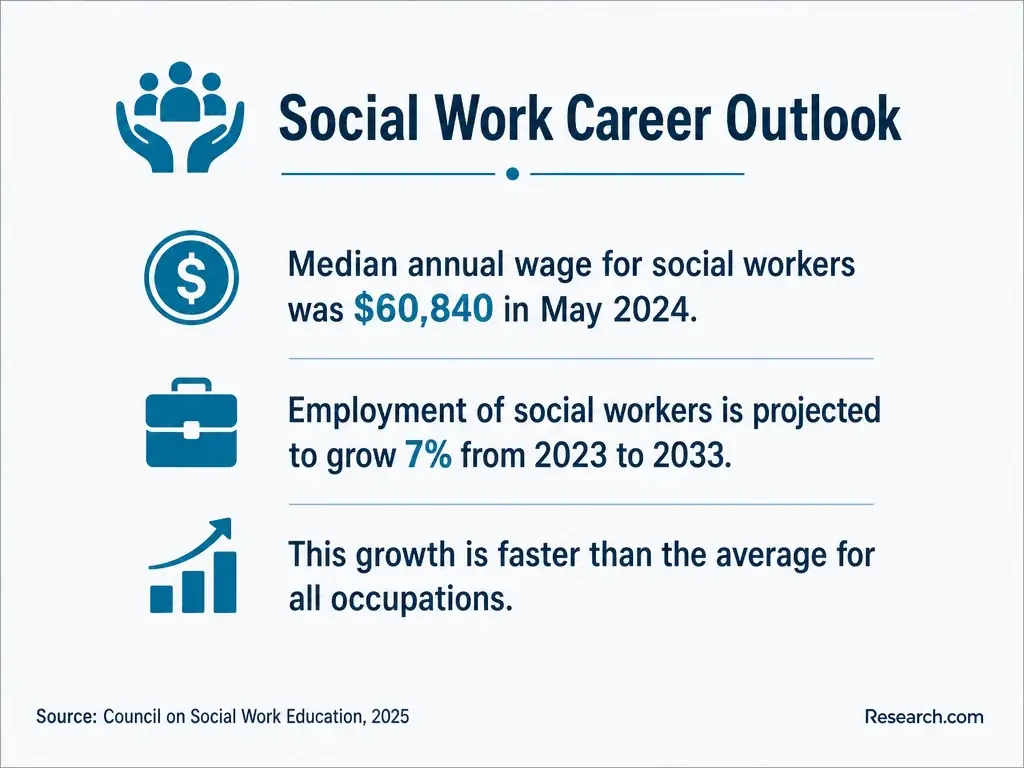
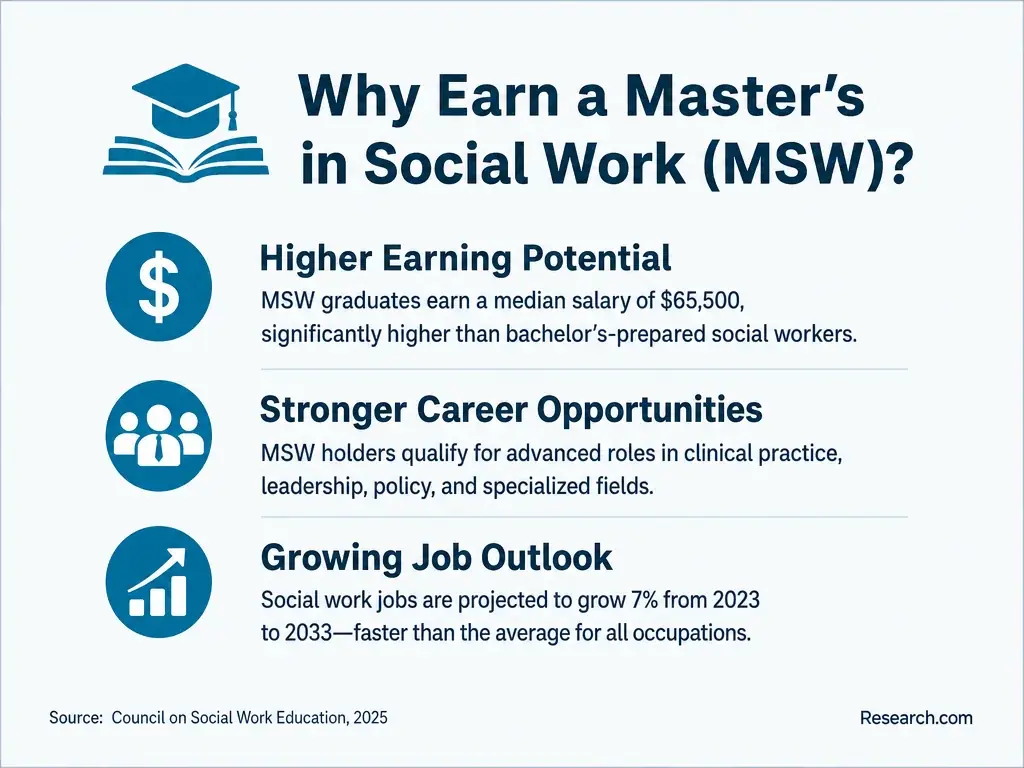
There is no single national wage for "probation social worker." The closest Bureau of Labor Statistics category depends on the work performed, not just the employer's name. The following U.S. BLS medians are for May 2025; projections cover 2025-2035.
| Occupation | Median annual pay | Projected employment growth |
| Social workers, all specialties | $61,780 | 6% |
| Mental health and substance abuse social workers | $60,280 | 10% |
| Child, family, and school social workers | $59,550 | 4% |
The mental health and substance abuse category may be informative for a treatment-focused role; the child and family category may be more relevant to some family-service jobs. Neither median is a promised starting salary, and neither projection measures demand specifically inside probation agencies. Compare actual local postings, civil-service pay scales, and exploring regional pay patterns for MSW careers before estimating the financial value of another degree.
Other Things You Should Know About Social Work
That depends on whether the service is optional or a condition of supervision. The social worker should explain the choice and its known limits without claiming authority to change a court order.
Often, if the client wants that involvement and agency rules allow it. Establish consent, the family member's role, and what information can be discussed first.
Possibly, within their role and agency policy. A letter should be accurate, appropriately authorized, and limited to information the worker can substantiate; it should not promise an outcome.
Follow the agreed attendance and reporting procedure, document what is known, and check for practical barriers. Do not label the absence a probation violation unless that determination belongs to your role.
- Relational practice | justiceinspectorates.gov.uk https://hmiprobation.justiceinspectorates.gov.uk/our-research/evidence-base-relationship-centred-services/relational-practice/
- The Effect of Individual Characteristics and Supervision... - PMC https://pmc.ncbi.nlm.nih.gov/articles/PMC8277149/
- 1: Introduction to Multidisciplinary Teams | United States Department of Justice https://www.justice.gov/elderjustice/mdt-guide-toolkit/1-introduction-multidisciplinary-teams
- Probation FAQ | Colorado Judicial Branch https://www.coloradojudicial.gov/probation/probation-faq
- Role of Human Services During Community Supervision | National Institute of Justice https://nij.ojp.gov/topics/articles/role-human-services-during-community-supervision
- Social work with adults experiencing complex needs - NCBI https://www.ncbi.nlm.nih.gov/books/NBK588598/
- INFORMATION SHARING GUIDE | az.gov https://goyff.az.gov/file/101/download
- Probation and Pretrial Services - Mission | United States Courts https://www.uscourts.gov/about-federal-courts/probation-and-pretrial-services/history/probation-and-pretrial-services-mission
- Frequently Asked Ethics Questions - Ohio CSWMFT Board https://cswmft.ohio.gov/for-professionals/resources-for-professionals/ethics-faq
- Full article: The conflict between maintaining confidentiality in social work and protecting a minor from harm https://www.tandfonline.com/doi/full/10.1080/10522158.2023.2194346