2027 Social Work with Parents of Medically Complex Children: Systems and Coordination Roles
Audited and Verified:
Our Editorial and Data Verification Process
Research.com uses government datasets, official education statistics and primary institutional information to support its career and degree guides. Our review process checks factual accuracy, occupational definitions, source dates and the requirements associated with the credentials discussed.
How This Article Was Fact-Checked
Our editorial team verifies salary estimates, employment projections, education requirements and program information against original data providers and official organizations. Salary figures are checked against the relevant occupational definitions and reporting periods. Information about licensure, accreditation and required in-person training is reviewed separately.
Fact-checked and verified on:

Co-Founder and Chief Data Scientist
A parent may leave a pediatric appointment with a new treatment plan, only to find that home nursing, school supports, transportation, and insurance approval each require a separate conversation.
Social workers help families navigate those disconnected systems without taking decisions away from parents. This guide is for students, career changers, and early-career professionals considering that work. It explains the coordination role, the preparation employers may expect, and the questions to ask before choosing a degree program or job.
Key Things You Should Know
- The central task is family-led coordination: identify gaps between medical care, school supports, benefits, and daily caregiving, then help the right people act on an agreed plan.
- A BSW may qualify someone for generalist support roles; many hospital social work positions prefer or require an MSW. Clinical treatment requires separate, state-specific authorization.
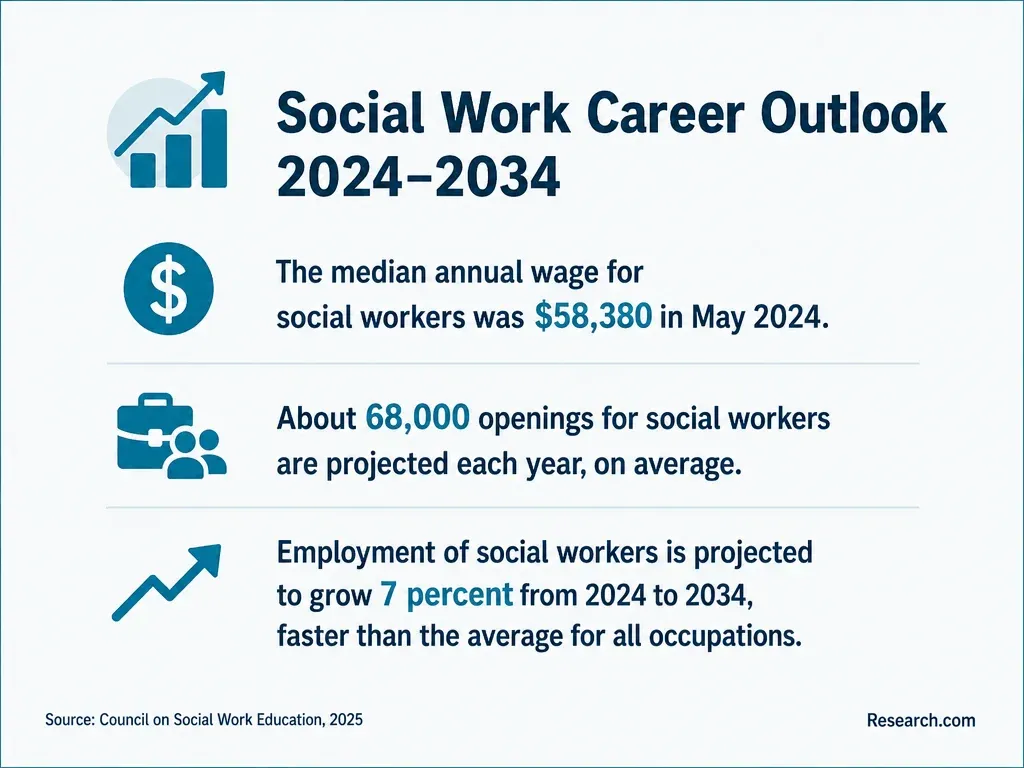
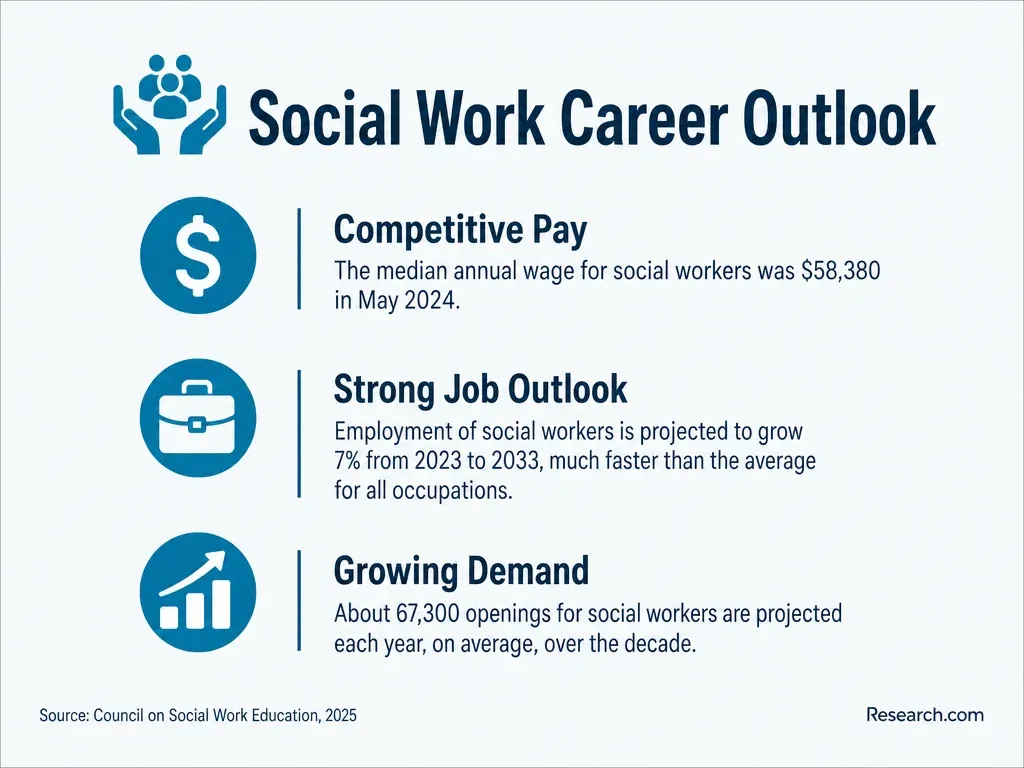
- The U.S. Bureau of Labor Statistics reports a $67,880 median annual wage for healthcare social workers in May 2025 and projects 8% employment growth from 2025 to 2035; neither figure predicts a pediatric hire's pay.
What is social work with parents of medically complex children?
Children described as medically complex often have substantial ongoing health needs involving multiple clinicians, equipment, therapies, or care settings. The term describes a pattern of needs, not one uniform diagnosis or an automatic entitlement to services. Parents may be coordinating care while also managing employment, other children, costs, and uncertainty.
A social worker assesses those pressures in the context of the family's strengths, goals, and available resources. The role may involve discharge planning, emotional support, benefits navigation, referrals, advocacy, and follow-up when a service falls through. A useful measure of coordination is not how many referrals were sent, but whether the family knows who is responsible for each next step and whether a workable connection was made.
This is distinct from prescribing medical care, deciding school eligibility, or promising insurance coverage. If you are comparing educational routes into this work, exploring academic pathways in online social work can be a starting point; evaluate each route against the duties of the jobs you actually want.
How do social workers coordinate healthcare, school, and community services for families?
Coordination starts with the parent's priorities, not an agency's list of available referrals. A family preparing for discharge might prioritize safe care at home, a reliable way to reach appointments, and a school plan that accounts for the child's needs. The social worker then helps clarify which organization can address each issue and where a handoff could fail.
A practical coordination sequence makes responsibilities visible:
- Ask the parent what is working, what is urgent, who already helps, and how the family prefers to communicate; include the child's perspective when appropriate.
- With appropriate permission, identify the healthcare, school, insurer, public-benefit, and community contacts needed for the family's goals.
- Clarify the requested action, responsible contact, deadline, and backup plan - for example, who will confirm whether a home service can start after discharge.
- Document referrals and follow up on access barriers, rather than recording a referral as though the service has begun.
School coordination may include helping a parent prepare for a discussion about an individualized education program (IEP), a Section 504 plan, or school health supports. The school determines eligibility and services through its own processes; a hospital recommendation does not automatically become a school service. Similarly, a social worker can help a family understand an insurer's or Medicaid program's application and appeal process but cannot approve a benefit.
Sharing information across systems requires attention to consent, applicable privacy rules, and agency policy. Healthcare and school records can be governed by different rules; having a shared goal does not create blanket permission to exchange records. Students seeking this kind of work should examine comparing MSW practicum placement assistance alongside the actual pediatric and family-service placements a program can help them pursue.
What degree do you need for pediatric medical social work?
There is no single degree requirement for every family-coordination job. A CSWE-accredited BSW prepares students for generalist social work and may fit some community-based family support or case-management positions.
Hospital-based pediatric social worker positions commonly seek an MSW, particularly when the work includes complex psychosocial assessment or specialized intervention. Read the employer's stated degree, license, and experience requirements rather than relying on the job title alone.
A traditional or foundation MSW can admit qualified applicants whose bachelor's degree is in another field. Advanced-standing MSW admission generally requires a qualifying BSW and satisfaction of the program's additional criteria; healthcare experience alone does not substitute for that educational requirement.
For a career changer, experience in education, healthcare, disability services, or benefits navigation is valuable, but field education and supervised practice help translate it into a social work role.
If application logistics are limiting your options, exploring MSW programs without letters from referees may widen a shortlist. Do not let an easier application outweigh program accreditation, relevant placements, or the qualifications required by target employers. A doctorate is generally unnecessary for frontline pediatric family coordination; targeted training or experience may be more useful than another degree.
Check both the institution and the specific social work program. Institutional accreditation concerns the college or university; Council on Social Work Education (CSWE) accreditation concerns BSW and MSW programs. Do not infer the social work program's status from the university's accreditation or from a general claim that graduates can pursue licensure.
Search CSWE's program directory for the exact BSW or MSW program and its status, then confirm the campus or online option, entry term, and any status questions with the program. Check the institution through its recognized institutional accreditor.
Finally, ask the licensing board in the state where you expect to work whether the proposed education meets its current requirements. Undergraduate social work program quality comparisons can help form a shortlist, but the official program listing and written answers about your intended route should settle accreditation questions.
Look for coursework that connects person-in-environment assessment with healthcare systems, child and family development, disability, social policy, ethics, and interdisciplinary practice. Practice in interviewing, documentation, and evaluating whether a referral actually reached a family matters as much as knowing program names.
A pediatric hospital placement can offer direct exposure to care teams and discharge planning. Children's rehabilitation, community disability, home-based service, and family-support placements can build related coordination skills, sometimes with more sustained attention to life outside the hospital. Ask what tasks students may observe and perform, who provides qualified field instruction, and how the learning agreement addresses family engagement, privacy, and follow-up.
Placement availability is not guaranteed.
For students with a BSW, understanding advanced standing versus standard admission is useful when comparing MSW field sequences. A shorter sequence may avoid repeated foundation study, but it does not guarantee a pediatric placement or replace employer onboarding. Academic field instruction also differs from post-degree clinical-license supervision.
The strongest match depends on whether you want to work mainly at a medical transition, alongside a family over time, or within a community access system. Job titles are inconsistent, so compare duties and qualifications rather than assuming every "care coordinator" is a licensed social worker.
These settings illustrate the differences worth investigating when reading job postings:
| Setting or role | Typical coordination focus | Qualification to check |
| Pediatric hospital social worker | Psychosocial assessment, discharge planning, family support, and care-team communication | MSW, state license, and pediatric experience required or preferred by the employer |
| Community family support or case manager | Benefits, referrals, access barriers, and ongoing family contact | Whether a BSW, another human services degree, or a license is required |
| Health-plan or community-based care coordinator | Service navigation and follow-up across providers | Employer-specific degree, clinical, and caseload requirements |
In interviews, ask about caseload size, after-hours expectations, interpreter access, supervision, authority to resolve failed handoffs, and how the team tracks whether families received services. These conditions affect both family support and workplace sustainability. Understanding work opportunities associated with an MSW can provide broader context, but a nonclinical coordination job may not require that degree if the employer accepts another qualification.
What are the salary and job outlook for healthcare social workers?
The U.S. Bureau of Labor Statistics reports a $67,880 median annual wage for healthcare social workers in May 2025 and projects 8% employment growth from 2025 to 2035. That occupational category is the closest broad benchmark for many hospital-based pediatric social workers. It also includes work with other patient populations, so it is not a pediatric-specific salary or a promised starting wage.
A community family-support position may instead align with a different occupation or employer pay structure. Compare actual local postings by required degree, license, setting, schedule, and experience; MSW salary comparisons by state can add geographic context but cannot substitute for a specific offer. Weigh compensation against supervision quality, field-to-job fit, and the resources available to help families.
Other Things You Should Know About Social Work
For substantive care-planning conversations, ask the agency for a qualified interpreter and follow its language-access policy. A family's preference matters, but relying on a child to interpret sensitive or technical information can compromise accuracy and privacy.
Explore the reason without assuming the parent is uncooperative. Explain the option and its limits, document the discussion under agency policy, and consult a supervisor when safety or reporting duties may apply. A referral is not a substitute for family consent.
They can help families identify the decision maker, understand the stated reason and applicable appeal process, assemble permitted documentation, and connect with advocacy resources. They cannot guarantee that an insurer or public program will reverse its decision.
Ask parents whether sibling routines, transportation, or emotional support should be part of the family's goals. Offer age-appropriate resources when available, while respecting the family's preferences and avoiding assumptions about what siblings need.
- Children With Medical Complexity: An Emerging Population for Clinical and Research Initiatives - PMC https://pmc.ncbi.nlm.nih.gov/articles/PMC3387912/
- Transitions of Care - IRIS - World Health Organization (WHO) https://iris.who.int/server/api/core/bitstreams/0b80b1aa-50ed-4f6b-8d98-87c5d055534e/content
- Engaging Families as Partners in Decision-Making | Youth.gov https://youth.gov/youth-topics/family-engagement/service-level
- Care Coordination | Agency for Healthcare Research and Quality https://www.ahrq.gov/ncepcr/care/coordination.html
- NASW Standards for Social Work Case Management | nycourts.gov https://www.nycourts.gov/reporter/webdocs/nasw_standards_socialwork_casemgt.htm
- Family-Centered Practice in Social Work | VCU MSW https://onlinesocialwork.vcu.edu/blog/family-centered-practice-in-social-work/
- Social Work Student and Practitioner Roles in Integrated Care Settings - ScienceDirect https://www.sciencedirect.com/science/article/pii/S0749379718316040
- Medical Social Worker - Explore Healthcare Careers | Mayo Clinic College of Medicine and Science https://college.mayo.edu/academics/explore-health-care-careers/careers-a-z/medical-social-worker/
- Medically Complex Children | Casey Family Programs https://www.casey.org/medically-complex-children/
- Children with Medical Complexity | aap.org https://www.aap.org/en/patient-care/children-with-medical-complexity/