2027 Social Work with Families Facing Child Removal: Roles, Teamwork, and Preparation
Audited and Verified:
Our Editorial and Data Verification Process
Research.com uses government datasets, official education statistics and primary institutional information to support its career and degree guides. Our review process checks factual accuracy, occupational definitions, source dates and the requirements associated with the credentials discussed.
How This Article Was Fact-Checked
Our editorial team verifies salary estimates, employment projections, education requirements and program information against original data providers and official organizations. Salary figures are checked against the relevant occupational definitions and reporting periods. Information about licensure, accreditation and required in-person training is reviewed separately.
Fact-checked and verified on:

Co-Founder and Chief Data Scientist
When a family faces possible child removal, social workers must address immediate safety while working with parents, children, relatives, courts, and service providers. The decisions are consequential, but the social worker's authority depends on the job, agency, and state.
This guide is for students, career changers, and early-career practitioners considering child welfare work. It explains the role, the teamwork and rights involved, and how to evaluate education, field placements, licensure, and workplace support before pursuing a position.
Key Things You Should Know
- Child welfare workers assess and document safety concerns, help develop plans, and coordinate services; courts generally make judicial removal and permanency decisions under applicable law.
- A BSW or MSW can prepare graduates for different child welfare roles, but agency hiring rules and state license requirements vary; neither degree alone authorizes independent clinical practice.
- The closest BLS occupation, child, family, and school social workers, had a May 2025 median annual wage of $59,550 and projected employment growth of 4% from 2025 to 2035 - not a guaranteed child welfare salary.
What do child welfare social workers do when families face child removal?
Child removal means a child is separated from a parent or caregiver because of a safety concern under an applicable legal process. A child welfare worker may respond to a report, assess immediate and ongoing safety, speak with family members, consult a supervisor, and document what is observed, reported, and still unknown.
Depending on the position, the worker may also coordinate an in-home safety plan, identify relatives, arrange services, or manage a case after placement.
Assessment is not the same as a removal decision. Agency procedures and state law govern emergency actions; courts generally determine whether continued separation is legally justified and review plans for the child.
Workers must distinguish an imminent safety concern from a family's need for housing, childcare, or other resources. They also need to record the basis for their recommendations rather than presenting allegations as established facts.
Positions differ: an investigator's urgent fact-finding and safety work is not identical to a permanency worker's ongoing family contact and court reporting. Before applying, compare the duties, on-call schedule, travel, caseload, safety procedures, and supervision described in each posting. Graduate social work career planning can help place those jobs alongside other MSW-level roles.
What degree do you need to work with families facing child removal?
There is no single degree requirement for every child welfare job. Some public agencies hire bachelor's graduates from social work or specified related fields for investigation or case management; others prefer or require a BSW, MSW, or particular experience.
A BSW provides generalist social work preparation. An MSW may be useful for specialized practice, supervision, or positions whose employer specifically requires it, but it does not replace agency training.
Career changers should start with actual job classifications. Experience in education, healthcare, advocacy, or human services can strengthen an application, but it does not automatically satisfy a social work degree or license requirement.
If a target job accepts a related bachelor's degree, entering the agency and obtaining its training may be more direct than earning an MSW first.
If an MSW is necessary, applicants without a qualifying BSW generally seek a traditional or foundation track; comparing MSW credits across entry tracks helps clarify why advanced standing is a separate eligibility decision.
A DSW or PhD is not a standard prerequisite for family-facing child welfare work. Consider doctoral study for a specific leadership, teaching, or research objective, not as a substitute for supervised practice or agency experience.
What licenses are required for child welfare social work?
Licensure depends on the state, position, and duties. Some agency caseworker jobs do not require a social work license; positions with a protected social worker title or specified professional functions may require one.
Independent psychotherapy is a different scope of practice from child protection investigation or reunification case management and generally requires a qualifying clinical license.
Check the job posting and state licensing board separately. The employer determines its hiring qualifications, while the board determines eligibility and lawful licensed practice. Degree completion, an examination result where an exam is required, license issuance, and any post-degree supervised clinical experience are distinct steps.
For an online program, MSW professional licensure disclosure comparisons can flag questions to ask, but confirm eligibility directly with the relevant board before enrolling.
Reunification work seeks a safe return home when that is possible under the child's case plan and governing law. Workers can help parents understand documented safety concerns, arrange accessible services, coordinate visits, identify practical barriers, and report both progress and unmet needs.
A plan should connect requested actions to the safety issue; simply listing services does not show whether they are available, appropriate, or helping.
Parents' procedural rights, including notice, representation, participation, and opportunities to respond, depend on jurisdiction and case stage. Social workers should explain their role and the process accurately, provide information in an accessible language or format, and refer legal questions to counsel rather than giving legal advice.
They should consult supervisors and legal staff about applicable requirements, including the Indian Child Welfare Act when relevant. Respect for family connections does not override an immediate safety obligation, and a missed appointment alone should not be described as proof of a particular cause without further assessment.
An additional MSW is not automatically necessary to do this work well. Before borrowing for one, compare the target job's qualifications and advancement rules with exploring the career value of affordable MSW study; targeted agency training and strong supervision may better address an immediate practice gap.
What are child welfare social workers' salaries and job outlook?
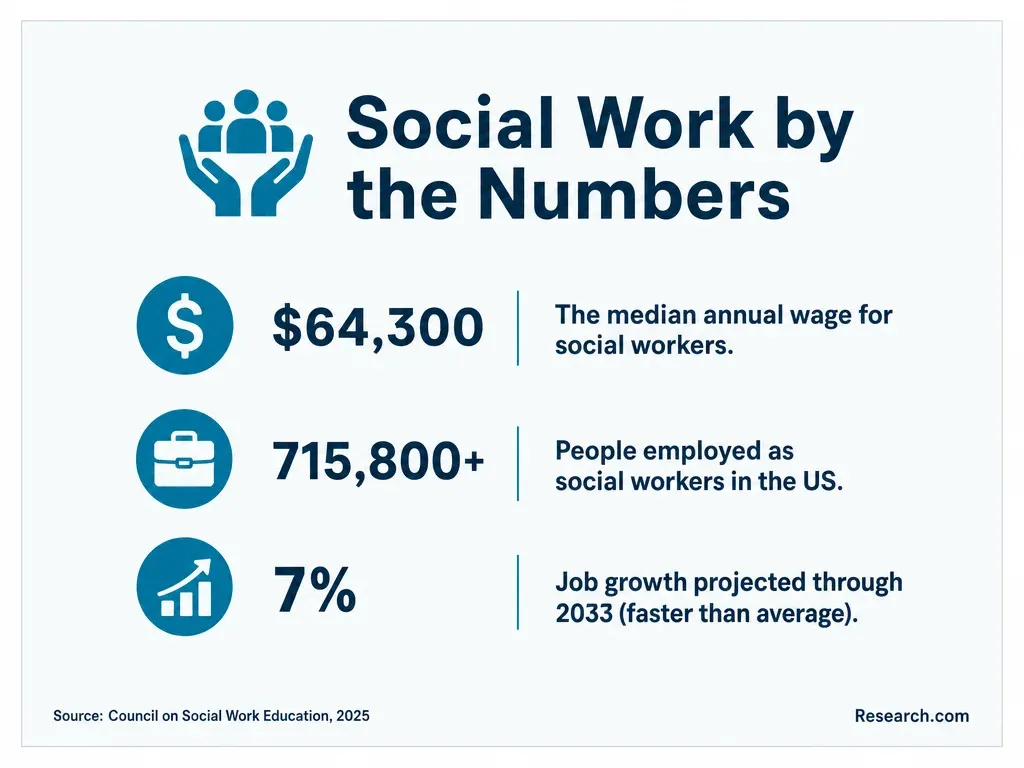
The U.S. Bureau of Labor Statistics reports a May 2025 median annual wage of $59,550 for child, family, and school social workers and projects 4% employment growth from 2025 to 2035.
This is the closest listed occupation, but it combines several settings; it is not a child protection agency pay scale or a predicted starting salary for a BSW or MSW graduate.
For a realistic offer comparison, check the agency's published pay grade, step placement, overtime or on-call rules, benefits, travel reimbursement, and promotion requirements. Geography and employer type matter, so comparing pay locations for master's-prepared social workers may provide context without replacing the actual posting.
Weigh compensation alongside caseload, supervision, worker safety, and the resources available to families: those conditions strongly affect whether the job is sustainable and whether you can practice responsibly.
Other Things You Should Know About Social Work
A child's views may be considered, but how they are gathered and weighed depends on age, circumstances, and state law. Workers should follow the case's procedures rather than promise that a preference will decide placement.
Follow agency rules for obtaining a qualified interpreter and accessible written information. Do not assume a child or relative can appropriately interpret sensitive case discussions.
It calls for careful, individualized safety planning and coordination with appropriately trained professionals. Workers should avoid treating a survivor's circumstances as evidence of unwillingness to protect a child without a sound assessment.
Ask how onboarding, case consultation, after-hours coverage, field safety, and reflective supervision work in practice. Request specifics about caseload expectations and who assists when a decision is urgent.
- Family Assessment and Action Planning Policy | mass.gov https://www.mass.gov/doc/family-assessment-action-planning-policy-2/download
- Concurrent Investigations with Law Enforcement | lacounty.gov https://policy.dcfs.lacounty.gov/Policy
- 10.1 Placement of a Child | ga.gov https://pamms.dhs.ga.gov/dfcs/cws/10-01/
- 5400 From Removal to the Adversary Hearing | texas.gov https://www.dfps.texas.gov/handbooks/cps/files/CPS_pg_5400.asp
- Reunifying Families | Child Welfare Information Gateway https://www.childwelfare.gov/topics/permanency/reunifying-families
- Evaluation of Family Preservation and Reunification Programs | ASPE https://aspe.hhs.gov/evaluation-family-preservation-reunification-programs-overview
- Family Reunification and Pathways to Permanency | ca.gov https://cdss.ca.gov/inforesources/cdss-programs/foster-care/family-reunification-and-pathways-to-permanency
- Reunification - child welfare manual - DSS Manuals - MO.gov https://dssmanuals.mo.gov/child-welfare-manual/section-4-chapter-8-permanent-outcomes-subsection-1-reunification/
- Pursue the Significant Role of a Child Welfare Social Worker | UMass Global https://www.umassglobal.edu/blog-news/child-welfare-social-worker