2027 Social Work with Blind and Low-Vision Clients: Accessibility and Service Coordination
Audited and Verified:
Our Editorial and Data Verification Process
Research.com uses government datasets, official education statistics and primary institutional information to support its career and degree guides. Our review process checks factual accuracy, occupational definitions, source dates and the requirements associated with the credentials discussed.
How This Article Was Fact-Checked
Our editorial team verifies salary estimates, employment projections, education requirements and program information against original data providers and official organizations. Salary figures are checked against the relevant occupational definitions and reporting periods. Information about licensure, accreditation and required in-person training is reviewed separately.
Fact-checked and verified on:

Co-Founder and Chief Data Scientist
A benefits notice a client cannot read or a referral they cannot reach can interrupt otherwise sound social work practice. For blind and low-vision clients, effective support depends on accessible communication, client-directed planning, and coordination across health, rehabilitation, and community systems.
This guide is for students, new social workers, and human services professionals deciding how to serve this population. It explains the work, the qualifications different roles require, and the practical questions to ask of a program, placement, or employer.
Key Things You Should Know
- Ask each client which formats and communication methods work for them; blindness or low vision alone does not establish what assistance they need.
- Social workers coordinate benefits, counseling, housing, and referrals, while vision rehabilitation specialists provide discipline-specific services such as orientation and mobility training.
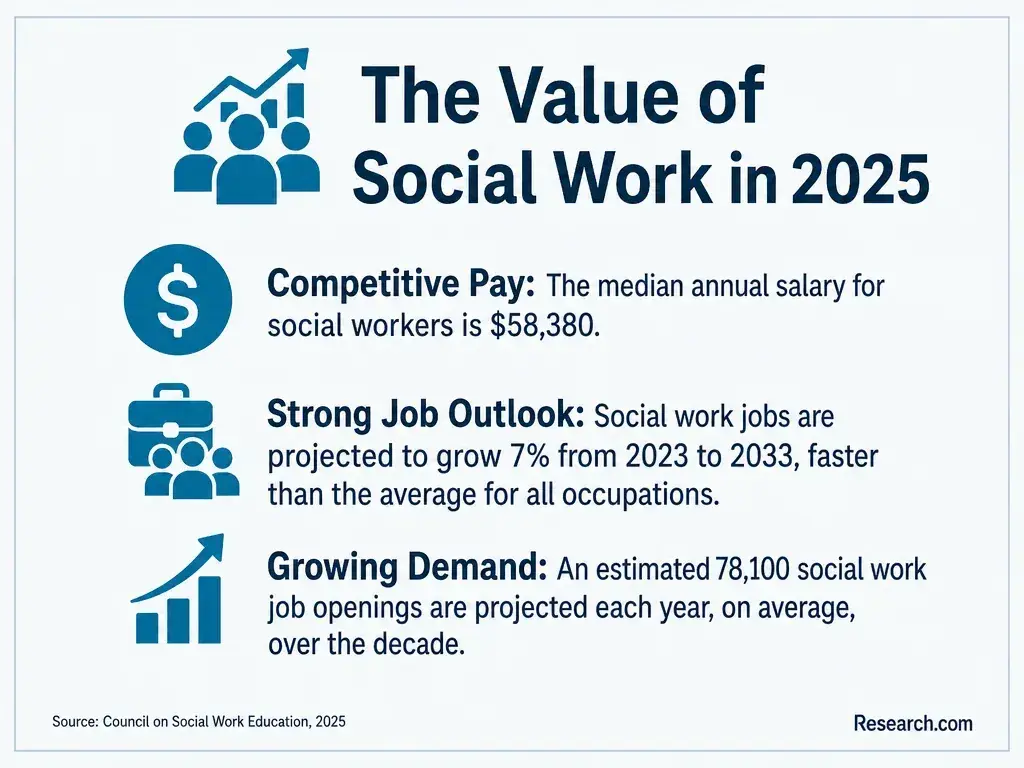
- Education should match the job: a BSW may prepare someone for generalist service, while independent clinical practice generally requires an MSW, a state license, and qualifying post-degree supervision. The BLS reports a $67,880 median annual wage for healthcare social workers in May 2025, not a starting salary for vision-related roles.
What do social workers do for clients who are blind or have low vision?
Social workers address the circumstances surrounding vision loss, not the eye condition itself. They assess how a client's goals intersect with transportation, income, employment, housing, healthcare, family support, and access to information. Work may include helping someone understand benefit options, arranging an accessible appointment, supporting adjustment to vision loss within the worker's scope, or advocating for a service that the client cannot readily use.
The client directs the plan. Some people have lived with blindness for decades; others are adjusting to recent vision changes. Neither group should be presumed unable to manage finances, travel, work, or make decisions. Social workers also need to distinguish their role from that of an ophthalmologist, occupational therapist, orientation and mobility specialist, or vision rehabilitation therapist. A worker considering broader roles can compare social work master's skills across career settings, then check which duties a particular employer assigns to its social workers.
What degrees prepare social workers to work with blind and low-vision clients?
No separate social work degree is required solely because clients are blind or have low vision. Choose education according to the work you intend to do. A BSW provides generalist preparation for roles such as case management or community service coordination, subject to employer and state requirements. An MSW adds specialized study and field learning and is the usual educational route toward clinical social work licensure; the degree alone does not authorize independent psychotherapy.
Applicants with a qualifying social work bachelor's degree may be considered for an advanced-standing MSW. Applicants from other disciplines can seek a traditional or foundation MSW; relevant work does not automatically qualify them for advanced standing. Compare social work master's entry routes explained against each program's actual eligibility rules. A DSW or PhD is generally unnecessary for frontline vision-related service coordination: consider doctoral study only if a defined leadership, teaching, or research goal warrants it.
For some agency navigator or disability-services positions, a social work degree may not be required at all. Read local job postings before committing to another degree, particularly if targeted accessibility training and relevant service experience would meet the employer's requirements.
What accreditation and state licensing requirements apply to social workers?
For BSW and MSW study, check the program's Council on Social Work Education accreditation status for the relevant degree and cohort, as well as the institution's accreditation. Then ask the licensing board in the state where you intend to practice whether your education meets its rules. Program accreditation, graduation, eligibility to apply for a license, and issuance of that license are separate matters. The steps in verifying social work degree recognition with a state board are especially useful when studying online or planning to move.
License titles, examinations where required, supervised experience, and permitted activities vary by state. A case-management job may have different credential requirements from a clinical counseling job, even within the same agency. Before accepting clinical duties, confirm both the board's current scope rules and the employer's supervision arrangements; academic field hours are not automatically post-degree clinical supervision hours.
Coordination begins with the client's priorities, not a standard bundle of referrals. Depending on those priorities, partners may include a state vocational rehabilitation agency, a vision rehabilitation provider, healthcare clinicians, an independent living center, a benefits office, an employer, or a local transportation service. Programs differ in eligibility, cost, coverage, and availability; a referral is not the same as access to a completed service.
A useful coordination sequence keeps responsibility clear:
- Agree on a specific goal, such as reaching medical appointments or returning to work, and ask which supports the client already uses.
- With appropriate consent, identify the provider responsible for each specialized service and confirm eligibility, accessible intake, and practical barriers.
- Document the referral and follow-up plan, including who will contact whom and how the client will receive updates.
- Check whether the connection worked, address gaps with the client, and revise the plan without taking over decisions they can make.
Coordination is a strong placement objective for prospective students. When reviewing online social work education options for career planning, ask whether the field office can support placements with disability-service partners in your area; an online classroom does not create a local referral network by itself.
What are social worker salaries and job prospects?
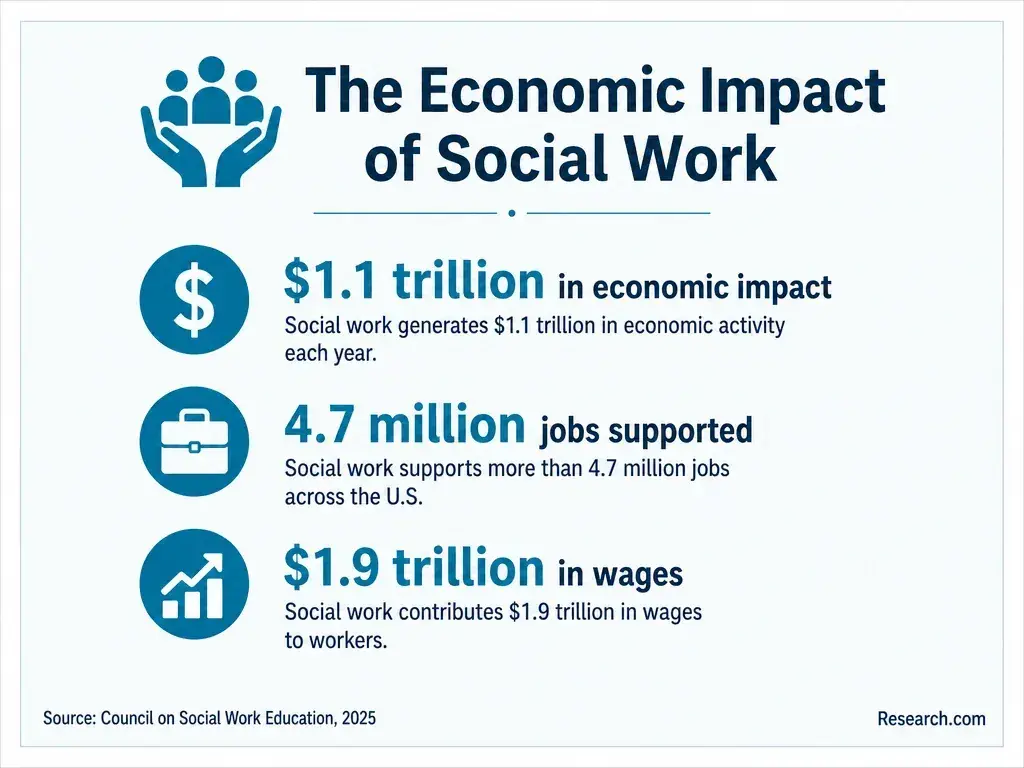
U.S. Bureau of Labor Statistics figures provide occupational context, not a wage forecast for a particular vision-services job. Its May 2025 median annual wages and 2025-2035 employment projections differ across social work specialties:
| BLS occupation | May 2025 median annual wage | Projected employment growth, 2025-2035 |
| Social workers, all specialties | $61,780 | 6% |
| Healthcare social workers | $67,880 | 8% |
| Child, family, and school social workers | $59,550 | 4% |
| Mental health and substance abuse social workers | $60,280 | 10% |
A vision rehabilitation coordinator may fall under a different occupation, and pay varies with location, employer, experience, and duties. Use the category closest to the work you want, then compare local postings and public-sector pay schedules. These figures do not establish a return on an additional degree: someone considering doctoral study should compare the intended role and funding with social work doctoral tuition comparisons, rather than assume a doctorate raises frontline service wages.
Other Things You Should Know About Social Work
No. Address the client directly and ask whether they want a companion involved. Do not infer decision-making ability from vision status.
Not automatically. Confirm the client's wishes and follow applicable consent, confidentiality, and agency rules before sharing information.
No. Ask the handler before approaching or distracting a working dog, and speak to the person rather than the animal.
Check that they received understandable information, discuss alternatives, and document the decision within agency policy. A referral remains the client's choice unless a specific legal or safety obligation applies.
- NASW Standards for Social Work Case Management | nycourts.gov https://www.nycourts.gov/reporter/webdocs/nasw_standards_socialwork_casemgt.htm
- Addressing Social Determinants of Vision Health - PMC - NIH https://pmc.ncbi.nlm.nih.gov/articles/PMC9174922/
- Advancing Health Equity: Social Determinants and Vision Loss | Vision and Eye Health | CDC https://www.cdc.gov/vision-health/health-equity/index.html
- Chapter 6 | usccr.gov https://www.usccr.gov/files/pubs/visual/chap6.htm
- Alternative Formats - DHCS - CA.gov https://www.dhcs.ca.gov/alternative-formats/
- Accessible Meetings | Section508.gov https://www.section508.gov/create/accessible-meetings/
- Request Help from the Bureau of Blindness and Visual Services | Commonwealth of Pennsylvania https://www.pa.gov/services/dli/request-help-from-the-bureau-of-blindness-and-visual-services
- Visual Disabilities in the Workplace and the Americans with Disabilities Act https://www.eeoc.gov/laws/guidance/visual-disabilities-workplace-and-americans-disabilities-act
- Americans with Disabilities Act Title II Regulations | ADA.gov https://www.ada.gov/law-and-regs/regulations/title-ii-2010-regulations/
- Meeting the Challenge of Vision Loss in the United States | nih.gov https://www.ncbi.nlm.nih.gov/books/NBK402380/