2027 Social Work Vacancy Planning: Service Continuity and Temporary Coverage
Audited and Verified:
Our Editorial and Data Verification Process
Research.com uses government datasets, official education statistics and primary institutional information to support its career and degree guides. Our review process checks factual accuracy, occupational definitions, source dates and the requirements associated with the credentials discussed.
How This Article Was Fact-Checked
Our editorial team verifies salary estimates, employment projections, education requirements and program information against original data providers and official organizations. Salary figures are checked against the relevant occupational definitions and reporting periods. Information about licensure, accreditation and required in-person training is reviewed separately.
Fact-checked and verified on:

Co-Founder and Chief Data Scientist
A social worker's departure can interrupt safety follow-ups, benefits applications, treatment coordination, and relationships clients rely on. Agency leaders need a coverage plan before a vacancy becomes a missed service - not simply a replacement job posting.
This guide is for supervisors and managers in US social service, healthcare, school, and public agencies. It explains how to prioritize work, compare temporary staffing options, verify practice authority, and transfer cases securely, so you can protect clients while hiring a permanent worker.
Key Things You Should Know
- Assign a named owner to every active case, with separate escalation coverage for urgent needs; a shared inbox is not a coverage plan.
- Choose temporary staff by duties and jurisdiction: a qualified case manager may coordinate services, but clinical or protected-title work requires the applicable license and supervision.
- Use a dated handoff, a risk-based caseload review, and weekly capacity checks; occupation-wide BLS wages do not establish the cost of temporary coverage.
What is social work vacancy planning, and why does service continuity matter?
Social work vacancy planning is the advance assignment of client responsibilities, decision authority, staffing resources, and escalation routes when a position is unfilled. Service continuity means clients can still reach an accountable professional, receive time-sensitive services, and understand who is handling their case, even if their usual worker has left.
The plan should cover expected absences and sudden departures. In child welfare, housing, healthcare, and behavioral health, the consequences differ, but the management question is the same: which obligations cannot wait, who is qualified to meet them, and how will the agency know they happened?
A long-term hiring pipeline may include people exploring BSW entry options without prior college coursework, but prospective students cannot solve an immediate coverage gap.
A useful plan names a coverage lead, a backup, and a review date. It also distinguishes a vacant position from lost capacity: an agency may have staff on its roster yet lack someone authorized, available, or trained to perform a particular service.
How can agencies maintain client services during a social worker vacancy?
Start by mapping what the departing worker actually does rather than dividing their client list evenly. The supervisor should identify scheduled contacts, open referrals, statutory or court-related deadlines, outstanding documentation, and services that depend on a specific credential. Then assign an individual, not just a team, to each responsibility.
A practical continuity sequence makes both the immediate response and its limits visible:
- Confirm the vacancy date, available staffing hours, supervisory capacity, and any services that must be suspended or referred elsewhere.
- Identify imminent deadlines and clients needing prompt contact under agency policy; document who will act and when.
- Tell affected clients how to reach their interim contact, using accessible communication and an interpreter where needed.
- Review completion, missed contacts, staff workload, and unresolved escalations at least weekly until stable coverage is in place.
Students can support approved tasks only within their placement agreements, supervision, and competence; they should not become unsupervised substitutes for employees. Agencies that also serve as placement sites can coordinate with programs on planning local placements through an online MSW program, but curricular field education remains distinct from vacancy staffing.
What temporary coverage options are available for social work vacancies?
The best option depends on the duties left uncovered, the expected vacancy length, available supervision, and the cost of onboarding. The comparison below separates staffing approaches by their main advantage and constraint:
| Coverage option | Best fit | Main limitation to check |
| Redistribute work internally | Short gaps with manageable caseloads | Overload and loss of other services |
| Hire a temporary employee | Predictable gaps requiring agency-specific work | Recruitment, orientation, and supervision time |
| Use a staffing-agency professional or contractor | Specialized or hard-to-fill coverage | Credentials, contracts, record access, and total cost |
| Arrange an interagency agreement or referral | Services another qualified provider can deliver | Client consent, capacity, and responsibility for follow-up |
| Reduce intake temporarily | Capacity is insufficient for safe new assignments | Access effects and applicable service obligations |
A contractor can bring experience without knowing local referral networks or the agency's records system. Internal reassignment avoids some onboarding but can quietly displace outreach, supervision, or documentation. Calculate the full cost of each option, including supervisory time and delayed work, and set a date to reassess it.
For workers considering short contracts alongside graduate study, advertised online MSW timelines for working students should be checked against actual class, skills-lab, and field-placement schedules. A temporary job does not automatically qualify as a placement.
Prioritize the next required action, not just a case label. Review immediate safety concerns, legally or contractually binding deadlines, interruptions to essential care or income, client ability to obtain help elsewhere, and the consequences of a delayed response.
Apply agency procedures and current jurisdiction-specific reporting requirements; a staffing rubric cannot replace professional judgment or a mandated response.
For each reassigned case, record its priority, next action and due date, assigned worker, backup, and supervisor for escalation. Balance assignments by expected work rather than case count: a case awaiting routine closure may require far less time than one with several pending referrals.
Check whether the receiving worker has the necessary language access, setting knowledge, credential, and capacity. Tell clients about the change and provide a way to raise concerns.
Vacancy coverage should not be based on an applicant's intended degree route or the perceived accessibility of MSW programs with flexible admission criteria.
Admission is not evidence of practice authority. If no qualified worker can take an assignment safely, leaders need to escalate the capacity problem, arrange an appropriate referral, or adjust intake under governing obligations.
Temporary employment does not create temporary practice authority. Before assigning work, verify the person's active license and permitted scope with the relevant state board where required, along with employer, payer, school, or contract qualifications.
License titles and rules differ by state. For remote work, verify authority in the jurisdiction where the client receives services as applicable; a license elsewhere is not automatic permission to practice across state lines.
Match the duties to the qualification. Service coordination may be open to appropriately trained nonlicensed staff in some settings, while psychotherapy, clinical diagnosis, protected social work titles, or school roles can carry distinct requirements.
An MSW alone does not authorize independent clinical practice. A clinician working toward a license may need an eligible supervisor and documented post-degree experience under that board's rules; ordinary agency oversight is not necessarily qualifying clinical supervision.
When evaluating a candidate's education, distinguish social work master's progression after different bachelor's degrees from licensure. Traditional and advanced-standing MSW routes differ in entry qualifications, but neither route bypasses license issuance or applicable supervised-practice requirements. Document credential checks before granting a temporary worker a caseload.
A good handoff contains enough information to continue service without becoming an unnecessary copy of the client's entire record. Use approved systems and role-based access.
Record the next action, deadline, relevant safety or accessibility needs, current contacts and referrals, and what the client has been told. Include the source and date of uncertain information so the new worker can verify it rather than treating an old note as a current fact.
Supervisors should confirm which records a temporary worker may access, how access will end, and whether a contractor or partner agency needs a specific agreement.
Apply relevant privacy law, consent rules, retention requirements, and agency policy; healthcare, school, and other records may be governed by different rules. Avoid personal email, unapproved messaging, and exporting case lists to private devices.
Introduce the interim worker to the client when feasible, explain the change and its privacy implications, and document any required consent or authorization before sharing with another organization.
For students preparing to do this work, a guide to choosing an online social work degree can help frame questions about supervised documentation practice; online delivery alone does not establish competence with an agency's record system.
What are the salary and job outlook for social workers in temporary roles?
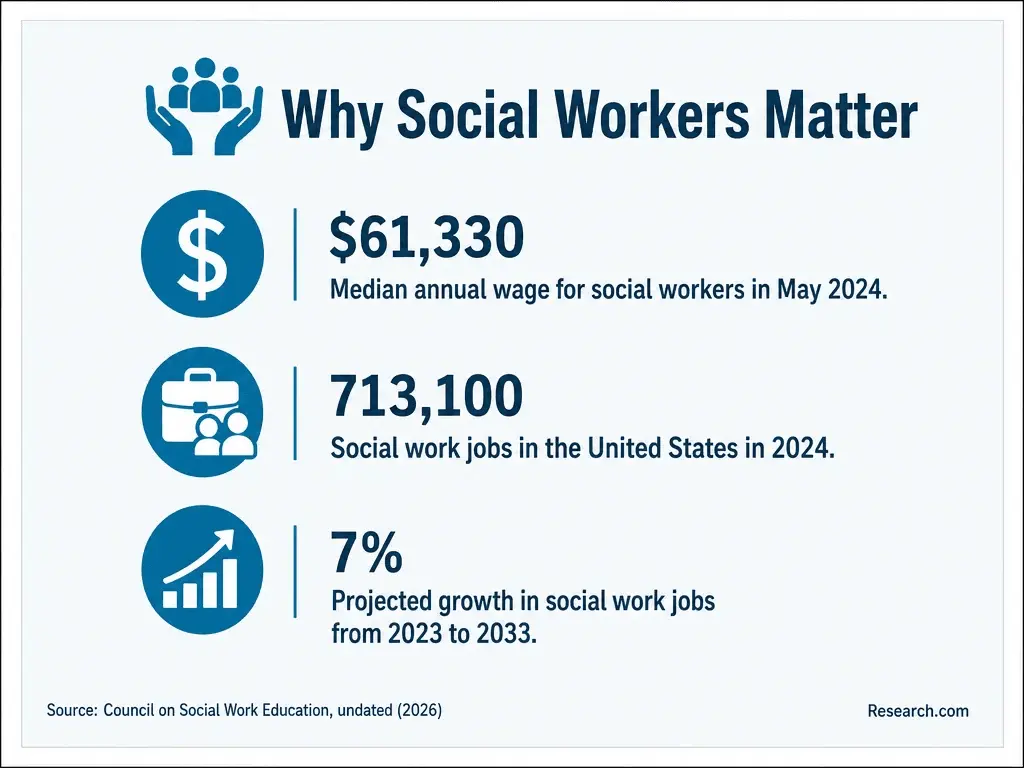
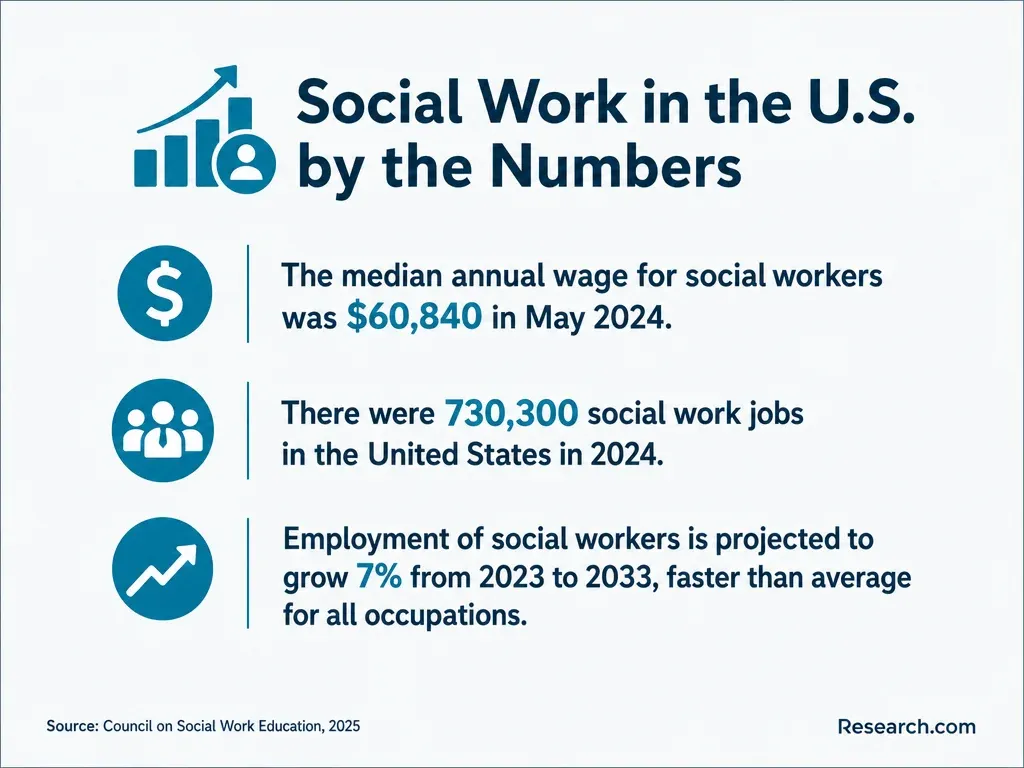
The US Bureau of Labor Statistics reports median annual pay for all social workers of $61,780 in May 2025, with employment projected to grow 6% from 2025 to 2035.
The more relevant occupational category depends on the assignment: child, family, and school social workers had a $59,550 median and 4% projected growth; healthcare social workers, $67,880 and 8%; and mental health and substance abuse social workers, $60,280 and 10%.
These are occupation-wide figures, not temporary-contract rates or promised earnings for a degree or license. They include workers with different experience, locations, employers, and schedules.
A higher contract rate may also need to cover benefits, time between assignments, and other costs. Agencies budgeting coverage should compare actual local quotes and total contract costs with the hours and qualifications the vacancy requires.
Workers can use the figures as broad context while reviewing connecting a social work master's degree to career goals. The better pay comparison is between offers for the same duties, location, credentials, and employment arrangement, not between a temporary offer and a national occupational median alone.
Other Things You Should Know About Social Work
Maintain a standing plan for unexpected departures, then update case ownership and deadlines as soon as a vacancy becomes known. Review it whenever staffing, services, or client needs change.
Give clients a clear way to express concerns or request a change. The agency should consider choice, continuity, accessibility, available staff, and any service obligations when responding.
Track overdue actions, missed contacts, unresolved referrals, client complaints, staff workload, and supervision needs. Review the findings regularly and change assignments when capacity is not matching demand.
The agency should explicitly assign ownership until the incoming worker has completed orientation and accepted a documented handoff. Filling the position alone does not transfer responsibility for pending actions.
- The Vermont Statutes Online https://legislature.vermont.gov/statutes/fullchapter/26/061
- A Study of the Roles and Use of Licensed Social Workers in the United States | ASPE https://aspe.hhs.gov/study-roles-use-licensed-social-workers-united-states
- Code of Virginia Code - Chapter 37. Social Work https://law.lis.virginia.gov/vacodefull/title54.1/chapter37/
- Virginia Board of Social Work - General FAQs https://www.dhp.virginia.gov/Boards/SocialWork/ApplicantResources/GeneralFAQs/
- NASW Standards for Social Work Case Management | nycourts.gov https://www.nycourts.gov/reporter/webdocs/nasw_standards_socialwork_casemgt.htm
- ORR Unaccompanied Alien Children Bureau Policy Guide | The Administration for Children and Families https://acf.gov/orr/policy-guidance/uac-program-policy-guide-section-5
- WISN - Workload indicators of staffing need - IRIS https://iris.who.int/server/api/core/bitstreams/8b880867-a0a8-43e4-83b7-cc35f36809a9/content
- BOD 26-04: Implementation Guidance for Prioritizing Security Updates Based on Risk | CISA https://www.cisa.gov/news-events/directives/bod-26-04-implementation-guidance-prioritizing-security-updates-based-risk
- Tool: Handoff | Agency for Healthcare Research and Quality https://www.ahrq.gov/teamstepps-program/curriculum/communication/tools/handoff.html
- Transitions of Care Handoffs Policy | University of Nevada, Reno https://med.unr.edu/about/policies/resident-handbook/supervision/transitions-of-care-handoffs-policy