2027 Social Work Team Meetings: Balancing Case Coordination and Operational Decisions
Audited and Verified:
Our Editorial and Data Verification Process
Research.com uses government datasets, official education statistics and primary institutional information to support its career and degree guides. Our review process checks factual accuracy, occupational definitions, source dates and the requirements associated with the credentials discussed.
How This Article Was Fact-Checked
Our editorial team verifies salary estimates, employment projections, education requirements and program information against original data providers and official organizations. Salary figures are checked against the relevant occupational definitions and reporting periods. Information about licensure, accreditation and required in-person training is reviewed separately.
Fact-checked and verified on:

Co-Founder and Chief Data Scientist
A social work team meeting can lose its purpose when an urgent case consumes the time reserved for staffing, or an operations update leaves no room to resolve a service gap. For social workers, supervisors, and students entering agency practice, the distinction matters: one kind of discussion coordinates support for a person or family; the other changes how the team works. This guide explains how to structure both, assign decisions to the right people, protect confidentiality, and assess whether education or training will help you participate effectively.
Key Things You Should Know
- Use a case-coordination discussion for a specific client's goals, risks, referrals, and next actions; use an operational discussion for staffing, workflows, capacity, and policy implementation.
- Give each discussion an owner, a time limit, and a decision record. A case consultation does not automatically count as clinical supervision or replace an urgent safety response.
- Share only information participants need for their roles. The correct consent, documentation, and disclosure rules depend on the setting, jurisdiction, and information involved.
What happens in a social work team meeting?
A social work team meeting brings relevant staff together to coordinate services, resolve barriers, or make decisions about the agency's work. Depending on the setting, participants may review pending referrals, identify who will contact a client or partner agency, discuss a recurring service bottleneck, or decide which issue needs a supervisor's approval.
A useful meeting ends with more than an exchange of updates. Participants should know what was decided, who is responsible, when the next action is due, and where the appropriate record belongs.
Client-specific decisions generally belong in an authorized case record; staffing or workflow decisions may belong in a separate operations log. Neither record should become a substitute for the other.
The mix of discussion varies by job. A hospital discharge team may coordinate referrals and follow-up, while a community program team may spend more time on eligibility backlogs and partner capacity. Readers comparing these responsibilities across roles can consult social work master's employment pathway comparisons.
How do case coordination meetings differ from operational meetings?
The distinction is the unit of decision: case coordination concerns an individual, family, or defined service situation; an operational meeting concerns the system that supports many cases. Both matter, but combining them without a boundary can expose unnecessary client details and leave agency-wide problems unresolved.
The comparison below helps a team decide where an agenda item belongs and what record its outcome requires.
| Meeting focus | Typical question | Appropriate outcome | Record |
| Case coordination | Who will follow up on a referral, and what does the client want? | Assigned, role-appropriate actions and a plan to revisit them | Authorized case documentation |
| Operational decisions | Why are referrals routinely delayed? | A workflow change, resource request, or escalation | Operations decision or policy record |
Some issues belong in both places, but not with the same detail. For example, a missed referral requires a case-specific response; repeated missed referrals may also justify an operations review using appropriately aggregated or de-identified information.
A case meeting is likewise not automatically qualifying post-degree clinical supervision. Anyone seeking licensure should check social work clinical hour requirements and obtain the applicable board's rules for supervision and documentation.
How can social work teams balance case discussions and operational decisions?
Start by separating the two purposes on the agenda, even when one meeting must cover both. Reserve protected time for cases needing multidisciplinary input and for decisions about capacity or workflow. Do not let a routine status report consume time needed for either.
A practical meeting sequence makes the boundary visible and gives participants a way to act on what they hear:
- Sort agenda requests into urgent case action, scheduled case consultation, operational decision, or an update that can be shared in writing.
- Address immediate safety concerns through the agency's response procedure rather than waiting for the meeting.
- For each discussion, state the decision needed, the people authorized to make it, and the time available.
- Close by naming an owner, deadline, documentation location, and follow-up point for every unresolved action.
If a case repeatedly reveals the same resource gap, carry the pattern - not unnecessary identifying details - into the operational discussion. Conversely, when a new workflow affects a client's plan, assign someone to review the case-specific implications.
Field students can practice this distinction through supervised participation; when evaluating a program, consider comparing faculty and agency support for MSW fieldwork, not just whether a placement offers meeting attendance.
Use the smallest appropriate audience and the least client information needed to make the decision. Before discussing an identifiable case, confirm the meeting's purpose, each participant's role, the applicable consent or disclosure authority, and whether an external partner should attend that portion. Use approved rooms, communication systems, and recordkeeping practices; a convenient video platform or shared document is not necessarily an authorized one.
Facilitators should interrupt unnecessary detail, prevent client information from appearing in general operations notes, and clarify who will enter the decision in the authorized case record. For remote meetings, check who can hear the conversation, how access is controlled, and whether recording is permitted. Students should receive agency orientation and supervision before accessing or presenting case information.
Confidentiality rules are not identical across schools, healthcare organizations, government agencies, and other settings. Federal and state law, professional duties, consent, and agency policy may all matter, including rules for specially protected records. If you are assessing online social work qualifications and career directions, ask how skills training and field supervision teach secure remote collaboration - not merely whether classes are online.
What social work careers involve team meetings, and what are their salary and job outlook?
Team meetings are common in child and family services, schools, hospitals, behavioral health, and community programs. The work differs: a healthcare social worker may coordinate discharge-related services with a care team, while a child and family social worker may collaborate with schools and service agencies.
Program managers also lead operational decisions, though their jobs do not map neatly to a single social-worker wage category.
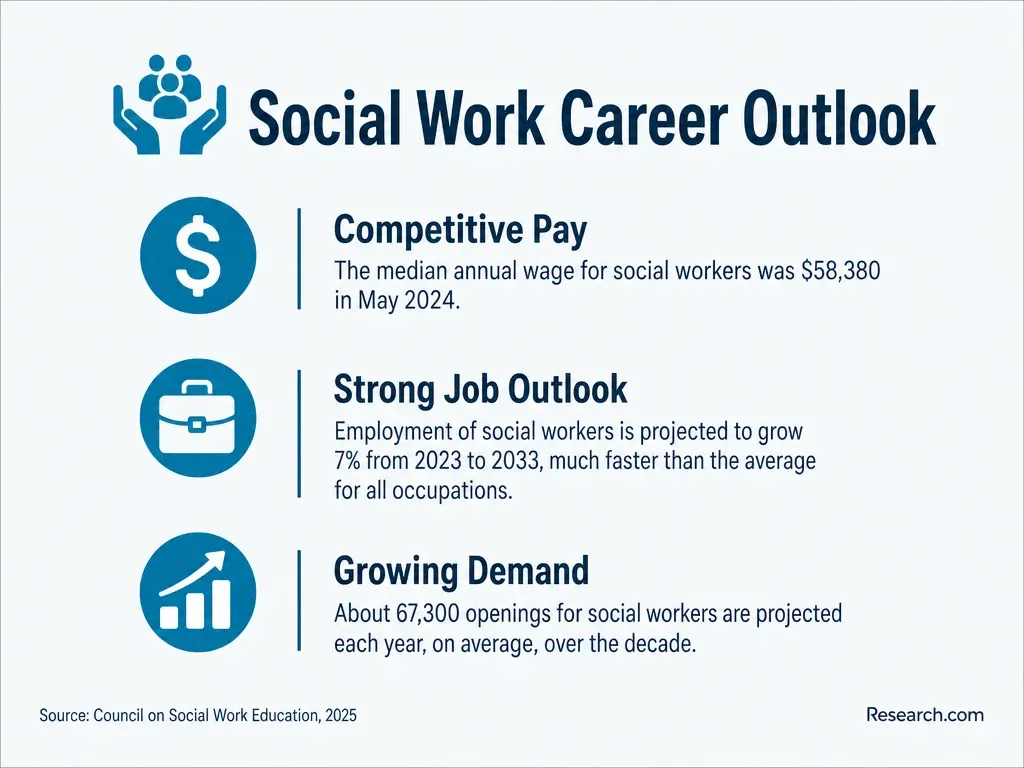
The U.S. Bureau of Labor Statistics figures below provide occupation-level context, using May 2025 median annual pay and projected employment growth from 2025 to 2035. They are not starting salaries, offers for a particular agency, or returns guaranteed by a BSW or MSW.
| BLS occupation | Median annual pay, May 2025 | Projected growth, 2025-2035 |
| Child, family, and school social workers | $59,550 | 4% |
| Healthcare social workers | $67,880 | 8% |
| Mental health and substance abuse social workers | $60,280 | 10% |
| Social workers, all specialties | $61,780 | 6% |
Use these categories to narrow a job search, then assess actual postings for degree and license requirements, caseload, supervision, meeting authority, and documentation time. Location and employer also affect pay; social work master's earnings across states can add geographic context, but an occupation-wide median remains a better benchmark than a salary promise.
Other Things You Should Know About Social Work
Set frequency around the decisions that cannot wait. A team with rapidly changing service needs may need brief, frequent coordination; a stable workflow may need less frequent operational review. Test whether the schedule produces timely actions rather than meeting for its own sake.
Client participation can support self-determination when the purpose and format make it appropriate. A separate collaborative planning conversation may be better than inviting a client to an internal staffing meeting. Follow the client's preferences and applicable agency procedures.
Decide whether the group has enough information and authority to proceed. If not, assign a time-sensitive follow-up or defer the decision. Do not treat an absent professional's assumed agreement as approval.
Review whether actions are completed on time, decisions are documented in the right place, and recurring barriers are resolved. Ask participants what information or authority was missing; meeting length alone does not show effectiveness.
- Minimum Necessary Requirement | hhs.gov https://www.hhs.gov/hipaa/for-professionals/privacy/guidance/minimum-necessary-requirement/index.html
- Defining Service Coordination: A Social Work Perspective - PMC https://pmc.ncbi.nlm.nih.gov/articles/PMC2992332/
- Case Coordination and Case Conferencing | ny.gov https://www.health.ny.gov/diseases/aids/providers/standards/casemanagement/case_coordination_conferencing.htm
- NASW Standards for Social Work Case Management | nycourts.gov https://www.nycourts.gov/reporter/webdocs/nasw_standards_socialwork_casemgt.htm
- Section 2. Developing Facilitation Skills - Community Tool Box https://ctb.ku.edu/en/table-of-contents/leadership/group-facilitation/facilitation-skills/main
- Leading Purposeful Team Gatherings | umn.edu https://hr.umn.edu/supervising/news/Leading-Purposeful-Team-Gatherings
- Tools for Effective Team Meetings | AAMC https://www.aamc.org/professional-development/affinity-groups/gfa/faculty-vitae/effective-team-meetings