2027 Social Work Stakeholder Interviews: Purpose, Preparation, and Analysis
Audited and Verified:
Our Editorial and Data Verification Process
Research.com uses government datasets, official education statistics and primary institutional information to support its career and degree guides. Our review process checks factual accuracy, occupational definitions, source dates and the requirements associated with the credentials discussed.
How This Article Was Fact-Checked
Our editorial team verifies salary estimates, employment projections, education requirements and program information against original data providers and official organizations. Salary figures are checked against the relevant occupational definitions and reporting periods. Information about licensure, accreditation and required in-person training is reviewed separately.
Fact-checked and verified on:

Co-Founder and Chief Data Scientist
A service can look effective in an agency report while remaining difficult for clients to access. Stakeholder interviews help social work students, practitioners, and program teams understand that gap by hearing from people who use, deliver, fund, or refer to a service.
This guide explains whom to interview, how to prepare and ask useful questions, how to analyze differing accounts, and how to act on findings without overstating them. It also helps you decide when interviews are appropriate - and when a survey, existing records, or targeted training would serve your project better.
Key Things You Should Know
- Stakeholder interviews are purposeful conversations about a defined service or decision, not a representative poll; include people affected by the service as well as those who operate it.
- Plan consent, accessibility, privacy, and oversight before recruitment. Analyze accounts systematically, including disagreements and perspectives you could not obtain.
- For educational projects, CSWE's 2022 accreditation standards identify engagement and evaluation as distinct social work competencies; interview practice can support both, but a degree or field placement does not itself authorize independent practice.
What are stakeholder interviews in social work, and why are they used?
A stakeholder interview is a structured or semi-structured conversation with someone who has experience of, influence over, or a stake in a social work-related program, policy, or service. The interviewer follows a common set of topics while leaving room for examples and unexpected concerns. Unlike a satisfaction score, the conversation can reveal why an appointment system, referral process, or policy works differently for different people.
Agencies use interviews to design services, examine access barriers, evaluate implementation, and decide what to change. A student might use them for an approved field or capstone project; an agency might interview referral partners before revising intake. Interviews can also help someone exploring graduate social work career planning understand how roles differ in practice. In every setting, firsthand accounts are evidence about experiences and perceptions - not, by themselves, proof that a service caused an outcome.
How do you prepare for a social work stakeholder interview?
Start with a decision the findings could inform: for example, whether to change referral hours or revise an outreach message. Then define the affected population, what existing records already show, whose perspectives are missing, and who has authority to approve recruitment and data use. A narrow question is more useful than asking participants to assess an entire agency.
Before inviting anyone, work through the practical and ethical arrangements:
- Write a short purpose statement and an interview guide with open-ended questions and neutral follow-up prompts.
- Agree with the agency or school on recruitment, consent, recording, note-taking, data access, retention, and who will see the results.
- Arrange an accessible location or approved remote option, language support where needed, and a way to participate without affecting services.
- Pilot the guide with an appropriate colleague or approved reviewer; remove confusing, leading, or unnecessarily sensitive questions.
Students should obtain field instructor and faculty approval before approaching agency clients or using agency information. If a field placement is needed to develop these skills, ask how the program arranges supervision and approved projects; field education support for distance MSW learners is especially relevant when a student cannot routinely visit campus. An available interview opportunity is not automatically an approved field task.
How do you analyze stakeholder interview data in social work?
Begin analysis soon after each interview. Store notes or recordings under the approved access rules, remove direct identifiers from working files where feasible, and document the interview context without attaching names to sensitive comments. Use a consistent approach so a vivid quotation does not outweigh quieter or conflicting accounts.
For a small practice-evaluation project, a manageable analysis sequence is:
- Read each account in full and note the stakeholder's relationship to the service.
- Label passages with short codes tied to the decision, such as "referral delay," while allowing new concerns to emerge.
- Group related codes into themes; compare clients', frontline staff's, and partners' accounts rather than merging them prematurely.
- Look deliberately for exceptions, disagreements, and gaps in who participated. Check relevant administrative measures when authorized.
- Write a brief evidence summary that separates what participants reported, what records show, and what the team infers.
A theme appearing in several interviews may warrant attention, but interview counts alone do not establish prevalence. Document how participants were recruited and acknowledge whose voices are absent. A dissertation or formal research project may require a more detailed analytic protocol, mentoring, and institutional review than an agency improvement exercise; budget-conscious doctoral social work study should therefore be evaluated alongside the time and support needed to conduct rigorous inquiry.
Ask about specific experiences before asking for recommendations. Questions should invite a description rather than imply that the agency already knows the cause of a problem. Adapt wording to each person's role and avoid requesting identifiable information about other clients.
The following prompts can be tailored to a service evaluation or approved student project:
- "Walk me through what happened when you tried to access or refer someone to this service."
- "Which step was most helpful, and which step was hardest to navigate?"
- "How did language, transportation, hours, technology, or eligibility rules affect the process?"
- "What do you think staff or decision-makers may not see from their position?"
- "If one change were possible, what would you prioritize, and what might that change make harder?"
For interviews about social work education, substitute questions about supervised practice, feedback, and field-site access. A prospective student considering BSW program selection for prospective students could ask program staff how students practice interviewing before and during field education. Treat a program's answer as a claim to verify through its curriculum and field policies, not as evidence that every student receives the same experience.
Open by confirming consent and explaining your role. Use the guide to cover comparable topics across interviews, but listen long enough for the participant to describe what matters to them. Neutral prompts such as "What happened next?" or "Can you give an example without naming anyone?" usually produce more useful detail than defending the current process.
Watch for power dynamics. A client may reasonably hesitate to criticize an agency that provides essential help; a staff member may fear that candid comments will reach a supervisor. Remind participants of the agreed confidentiality limits, avoid pressing for details they do not want to share, and do not turn the interview into an assessment, therapy session, or promise of service change. Close by summarizing your understanding and explaining what, if any, follow-up is planned.
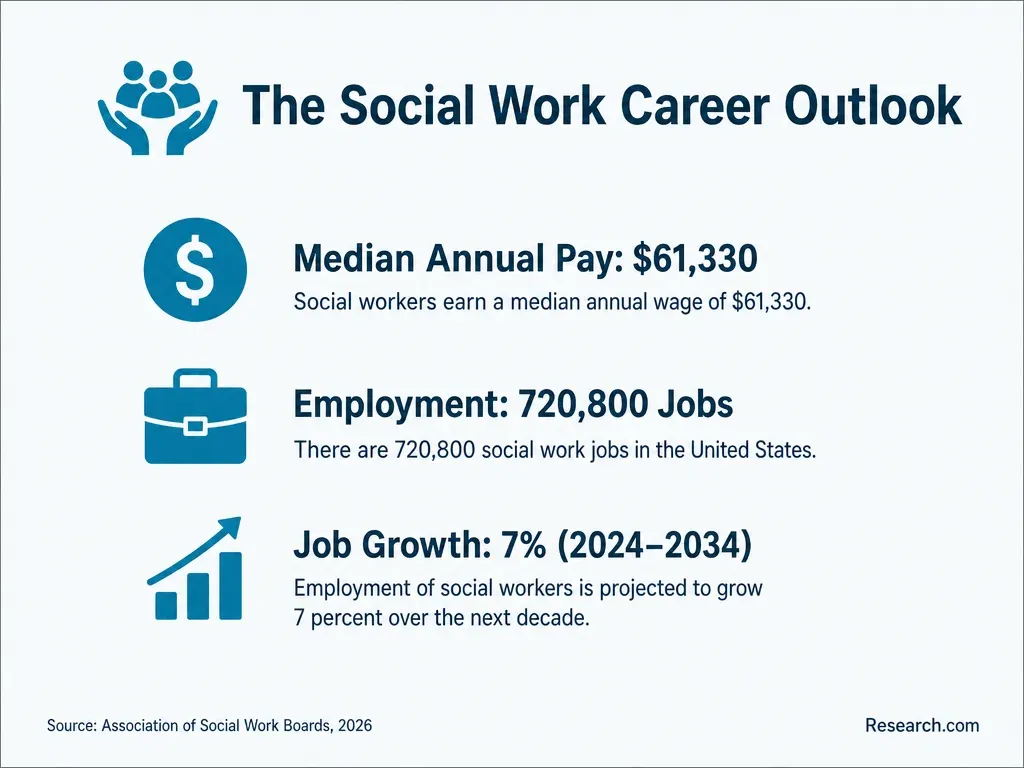
When interviewing agency leaders about recruitment or retention, distinguish their perceptions from verified labor-market evidence. Social work earnings across different state markets may provide context for a staffing discussion, but occupation-wide figures cannot establish what one agency pays or why an employee leaves. Check the agency's own authorized records before drawing that conclusion.
How can you compare accredited online and campus programs for stakeholder interview training?
Compare the actual learning opportunities, not the delivery label. Ask each program where students practice live interviewing, who observes and gives feedback, whether community-based evaluation projects are available, and how the field office approves client or stakeholder contact. Check the exact degree and entry track, the program's CSWE accreditation status for your cohort, institutional accreditation, and whether the school can enroll and place you in your intended jurisdiction.
Online courses may reduce travel to class but still require scheduled skills sessions, group work, and in-person field education. Campus access may offer local partnerships without guaranteeing a suitable project or placement. Request a sample course sequence and written field policies, then compare the time, travel, technology, and supervision each route requires. If future licensure matters, separately check online MSW program eligibility by intended state with the program and the relevant board; interview training, accreditation, graduation, and license issuance are different questions.
Other Things You Should Know About Social Work
There is no universal number. Choose a feasible range based on the decision, diversity of perspectives, project scope, and available oversight; explain any groups you could not reach.
Allow enough time for the agreed topics without placing an unnecessary burden on participants. Pilot the guide, tell invitees the expected duration, and let them stop or skip questions under the consent arrangement.
Use a survey when you need comparable responses from a broader group about clearly defined topics. Use interviews when you need to understand processes, meanings, or unanticipated barriers; a project may use both.
Only if the agency and school permit that use and the original consent, privacy rules, and any required oversight support it. Existing access to notes does not automatically authorize a new analysis or public portfolio use.
- Participant selection procedures in qualitative research - PMC https://pmc.ncbi.nlm.nih.gov/articles/PMC11697429/
- Structured Interviews | U.S. Office of Personnel Management https://www.opm.gov/policy-data-oversight/assessment-and-selection/structured-interviews/
- Public Participation Guide: Stakeholder Interviews | US EPA https://www.epa.gov/international-cooperation/public-participation-guide-stakeholder-interviews
- 6: Confidentiality | United States Department of Justice https://www.justice.gov/elderjustice/mdt-guide-toolkit/6-confidentiality
- Stakeholder Interview Guide - CFSR Information Portal https://www.cfsrportal.acf.hhs.gov/document/download/xEgkKW
- Conducting Research Interviews on Sensitive Topics | Illinois Criminal Justice Information Authority https://icjia.illinois.gov/researchhub/articles/conducting-research-interviews-on-sensitive-topics/
- Some Strategies for Developing Interview Guides | harvard.edu https://sociology.fas.harvard.edu/resource/interviewstrategiespdf
- 6. Conducting Focus Groups and Interviews | ufl.edu https://assessment.ufsa.ufl.edu/resource-guide/module-6/
- Thematic Analysis - Lorelli S. Nowell, Jill M. Norris, Deborah E. White, Nancy J. Moules, 2017 https://journals.sagepub.com/doi/10.1177/1609406917733847
- Identifying and Analyzing Stakeholders and Their Interests | ku.edu https://ctb.ku.edu/en/table-of-contents/participation/encouraging-involvement/identify-stakeholders/main