2027 Social Work Simulation Teaching: Learning Goals, Debriefing, and Evaluation
Audited and Verified:
Our Editorial and Data Verification Process
Research.com uses government datasets, official education statistics and primary institutional information to support its career and degree guides. Our review process checks factual accuracy, occupational definitions, source dates and the requirements associated with the credentials discussed.
How This Article Was Fact-Checked
Our editorial team verifies salary estimates, employment projections, education requirements and program information against original data providers and official organizations. Salary figures are checked against the relevant occupational definitions and reporting periods. Information about licensure, accreditation and required in-person training is reviewed separately.
Fact-checked and verified on:

Co-Founder and Chief Data Scientist
A simulated client interview can reveal a gap that a written exam misses: a student knows the ethical principle but struggles to apply it in conversation. For BSW and MSW students, instructors, and applicants comparing programs, simulation offers a way to practice difficult decisions before taking on field responsibilities. Its value depends on clear learning goals, constructive debriefing, and credible evaluation - not simply realistic acting or expensive technology. This guide explains how to judge those elements, what simulations can and cannot replace, and which questions to ask before choosing a program.
Key Things You Should Know
- Strong simulations pair an observable goal - such as explaining confidentiality or negotiating a referral - with structured feedback and a chance to try again.
- Instructors should assess what students actually say and do, using behavior-based criteria; a convincing performance is not proof of competence with real clients.
- Classroom simulation does not automatically count as accredited field education or post-degree supervised practice. The program and, where relevant, the licensing board determine what qualifies.
What is simulation-based teaching in social work education?
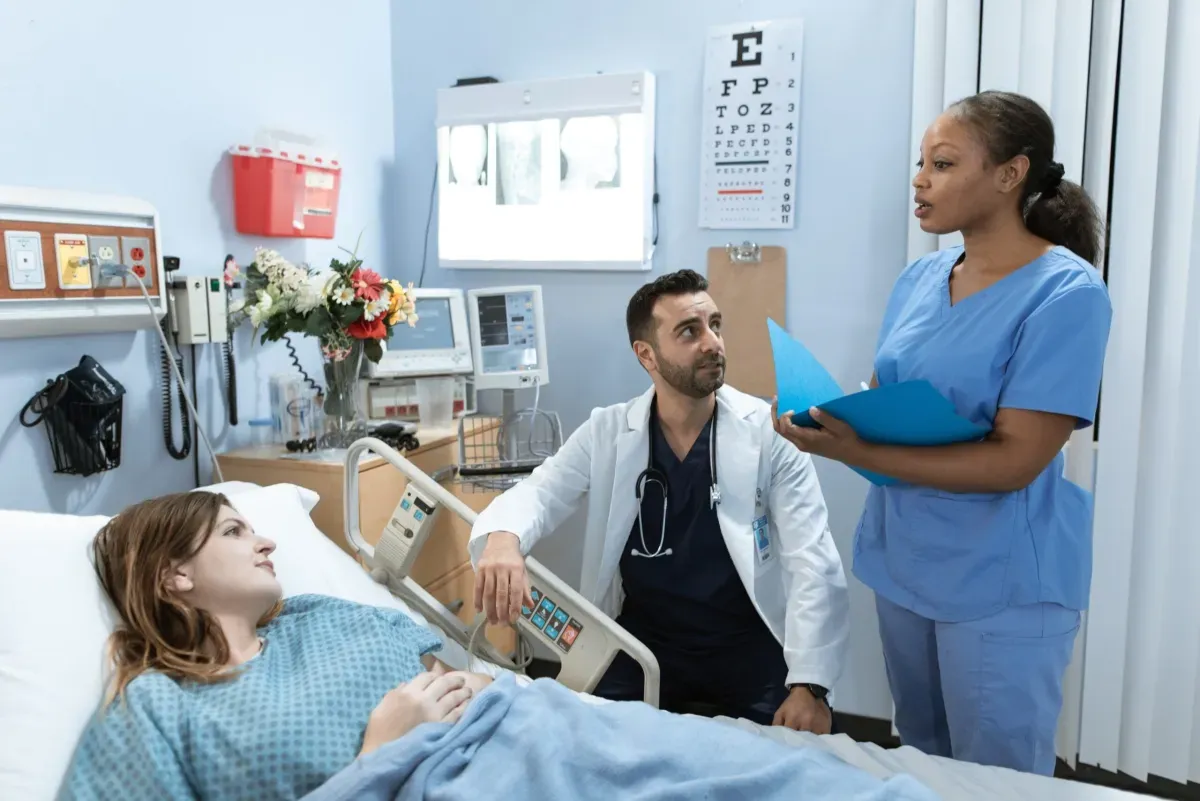
Simulation-based teaching is structured practice in a constructed social work situation. A student might interview a trained actor portraying a client, respond to a branching video, join a mock interprofessional meeting, or rehearse a community presentation. The instructor sets objectives, observes decisions, and provides feedback. The encounter is educational: the portrayed situation and any apparent outcome are not evidence of real client care.
Unlike a lecture or case discussion, simulation makes behavior visible. An instructor can observe whether a student asks permission before exploring sensitive information, notices a client's stated priorities, or recognizes when to consult a supervisor. It can prepare students for field learning, but it cannot reproduce an agency's caseload, accountability, relationships, or legal obligations. Applicants using a guide to choosing an online social work degree should therefore look beyond whether a school advertises "hands-on" activities and ask what students actually practice and receive feedback on.
What learning goals do social work simulations address?
The best goal is narrow enough to observe. "Demonstrate empathy" is less useful for assessment than "acknowledge the person's concern, ask how they understand the problem, and check whether the proposed next step fits their priorities." Programs may use simulations to develop engagement, person-in-environment assessment, collaborative planning, documentation, consultation, and ethical reasoning across individual, family, group, and community settings.
Goals should match the student's stage of training. A beginning BSW student might practice an opening conversation and the limits of confidentiality; an MSW student might explain an assessment to a supervisor or coordinate a referral within an assigned role. In neither case should a simulated safeguarding concern become a substitute for learning the agency's actual reporting procedures and jurisdictional law. Experienced practitioners interested in teaching or improving practice can also examine simulation design while exploring affordable online DSW education, but a doctorate is not necessary to run a well-designed skills exercise.
How does debriefing improve learning after a social work simulation?
Debriefing turns an encounter into an opportunity to examine judgment. A useful sequence starts with the student's account of what they noticed and intended, moves to specific moments in the interaction, and ends with one or two changes to test next time. The instructor can ask, "What did the client say immediately before you offered that referral?" rather than labeling the student "not client-centered." This connects feedback to observable behavior without assuming the actor's response proves a real-world outcome.
Debriefing should also make room for uncertainty: how power, culture, accessibility, structural barriers, and the student's role shaped the exchange. Peer observations can broaden the discussion, but instructors should prevent classmates from turning feedback into personal judgments. A second attempt or brief written reflection helps show whether the student can apply what they learned.
Live debriefing has scheduling implications even when other coursework is asynchronous. Working adults comparing online MSW scheduling for working adults should ask whether simulations and feedback meetings have required attendance times, evening options, and make-up procedures.
Scenarios can represent an intake conversation, a family meeting, a school consultation, a hospital discharge discussion, a housing-service referral, or a community meeting. The educational choice is not simply which setting feels most realistic. It is which decisions students need to practice and whether the scenario gives them a meaningful opportunity to make those decisions.
For example, a student may practice responding when a portrayed client disagrees with a proposed service plan. The learning goal is to explore the disagreement and respect self-determination within the student's role - not to "win" consent. A separate scenario might require the student to identify a concern, pause, and seek supervision rather than attempt an intervention beyond their preparation.
Applicants planning graduate study for clinical social work can ask whether scenarios include boundaries, assessment communication, and consultation, while recognizing that simulated clinical encounters do not authorize diagnosis, psychotherapy, or independent practice.
What careers, salaries, and job prospects are available to social work graduates?
Simulation skills can transfer to engagement, coordination, and consultation in schools, healthcare, behavioral health, and community agencies. Hiring requirements still depend on the role: some positions accept a BSW, others expect an MSW or a state license, and independent clinical work requires the applicable authorization. Employers also assess field experience, supervision needs, and setting-specific skills.
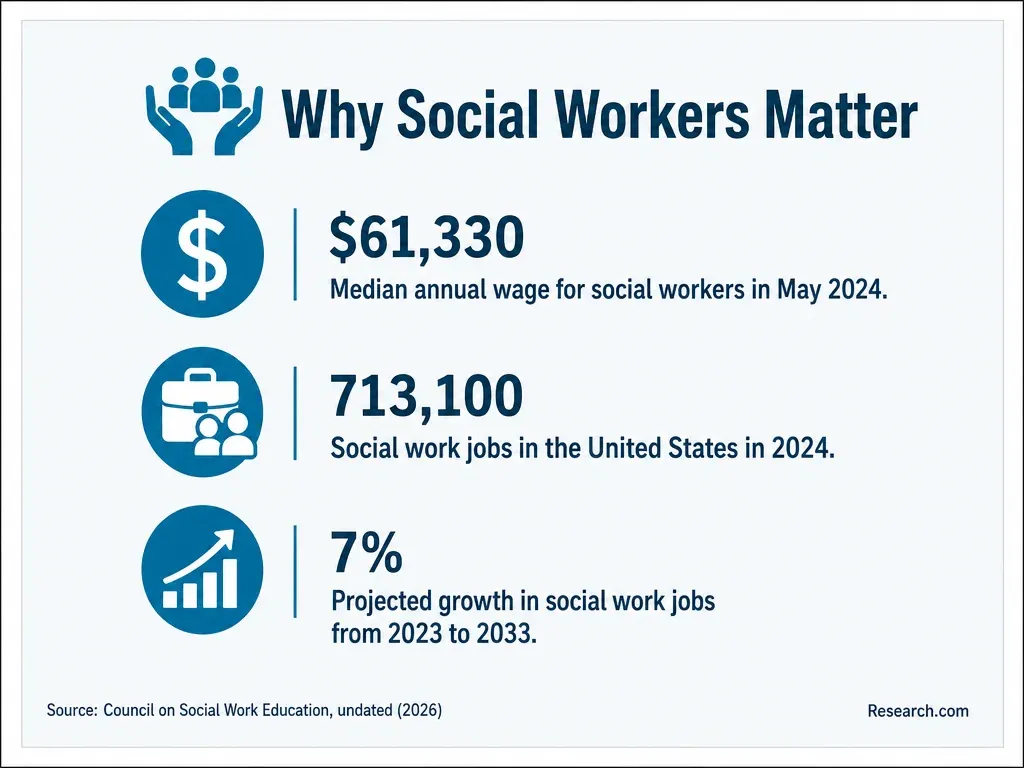
The U.S. Bureau of Labor Statistics figures below describe occupations, not salaries promised to graduates of a particular program. The May 2025 medians and 2025-2035 projections offer context for choosing settings, but local pay and eligibility can differ substantially.
| BLS occupation | Median annual pay, May 2025 | Projected employment growth, 2025-2035 |
| Child, family, and school social workers | $59,550 | 4% |
| Healthcare social workers | $67,880 | 8% |
| Mental health and substance abuse social workers | $60,280 | 10% |
Use the occupation that matches the work you want to do, then check actual job postings for degree, license, schedule, and supervision requirements. For location-specific pay context, see social work master's pay and geographic differences; neither national nor state-level averages guarantee an individual offer.
Other Things You Should Know About Social Work
Recording policies vary. Ask the instructor how recordings are used, who can access them, when they are deleted, and what options are available if you have a privacy concern. Do not record classmates or role players without authorization.
Tell the instructor what support or adjustment you need without feeling obliged to disclose private details to classmates. Programs should explain participation expectations, available support, and how a student can meet a learning goal through an appropriate alternative when needed.
Yes. Contact the school's disability services office early to discuss reasonable accommodations for the exercise and its assessment. An accommodation should provide access while preserving the essential learning goal.
No. Trained actors, instructors, peers, and digital tools can serve different purposes. What matters is whether the role player understands the scenario, responds consistently enough for the learning goal, and contributes to useful feedback without being treated as a real client.
- The impact of simulation-based training in medical education | nih.gov https://pmc.ncbi.nlm.nih.gov/articles/PMC11224887/
- CSSW Practicum Evaluation: Direct Practice | columbia.edu https://www1.columbia.edu/sec/cu/ssw/field/evaluation-forms/cssw-peval-direct-practice.html
- Full article: Simulation-based assessments in health professional education: a systematic review | tandfonline.com https://www.tandfonline.com/doi/full/10.2147/JMDH.S92695
- Understanding Simulation in Social Work Education | jstor.org https://www.jstor.org/stable/48585534
- Assessing Student Performance in Field Education | Applied Learning in Social Work Education Journal https://alswe.simmons.edu/article/assessing-student-performance-in-field-education/
- Using simulation to prepare social work students for field education - University of the Sunshine Coast, Queensland https://research.usc.edu.au/esploro/outputs/journalArticle/Using-simulation-to-prepare-social-work/99710584402621
- The Use of Simulation in Forensic Social Work Education | sagepub.com https://journals.sagepub.com/doi/10.1177/14999013241301097