
2027 Social Work Service Coordination for Clients Using Several Agencies
Audited and Verified:
Our Editorial and Data Verification Process
Research.com uses government datasets, official education statistics and primary institutional information to support its career and degree guides. Our review process checks factual accuracy, occupational definitions, source dates and the requirements associated with the credentials discussed.
How This Article Was Fact-Checked
Our editorial team verifies salary estimates, employment projections, education requirements and program information against original data providers and official organizations. Salary figures are checked against the relevant occupational definitions and reporting periods. Information about licensure, accreditation and required in-person training is reviewed separately.
Fact-checked and verified on:

Co-Founder and Chief Data Scientist
A client may be working with a housing program, a clinic, a benefits office, and a food pantry, each with different rules, records, and timelines. Effective service coordination helps those efforts work together without taking decisions away from the client or sharing information inappropriately.
This guide is for students, new social workers, and human services professionals who want to understand the work and decide whether additional education is necessary.
It explains a practical coordination process, the skills employers value, and how degrees, field placements, licensure, and job conditions affect your options.
Key Things You Should Know
- Coordinate around the client's priorities: agree on who handles each task, obtain appropriate permission before sharing information, and confirm whether referrals resulted in access - not just whether they were sent.
- A BSW can prepare graduates for many generalist coordination roles; some case manager and navigator jobs accept other degrees or relevant experience. Clinical duties may require an MSW and a state-specific license.
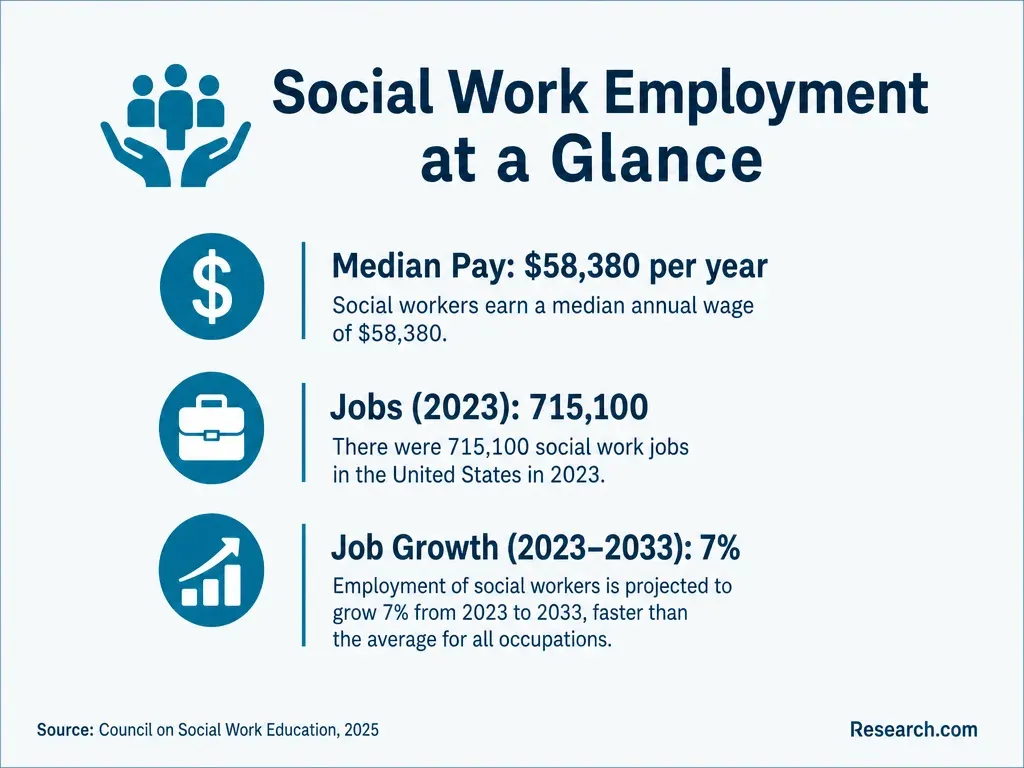
- Compare jobs by caseload, supervision, partner-agency access, and documentation demands. U.S. social workers' median annual pay was $61,780 in May 2025, but that figure does not predict pay for a particular coordinator job.
What is social work service coordination for clients using multiple agencies?
Service coordination is the ongoing work of helping a client identify priorities, connect with appropriate services, and navigate the gaps between organizations. It is more than making referrals: a coordinator checks eligibility and access barriers, clarifies responsibilities, follows up, and revises the plan with the client.
Depending on the setting, the work may be called case management, care coordination, navigation, or discharge planning; those titles do not establish a single credential or scope of practice.
For example, a client might want stable housing before scheduling additional appointments. A coordinator could help identify housing application requirements, ask the client which providers may communicate, and agree on who will follow up.
The clinic and housing program might each have useful information, but neither should assume it can access the other's records. The client's priorities, accessible communication methods, and ability to decline a service remain central.
A workable coordination process keeps responsibility visible without treating the client as a project to be handed between agencies:
- Ask what the client wants addressed first, what support they already have, and what barriers make services hard to use.
- Map agencies involved, eligibility requirements, deadlines, points of contact, and any conflicting plans.
- Explain proposed information sharing and obtain and document any consent or authorization required by law and agency policy.
- Agree on specific next steps, including what the client will do, what the coordinator will do, and who will check on each referral.
- Confirm access and reassess: an unanswered call, waitlist, or rejected application calls for a revised plan, not a closed referral marked "complete."
Coordination does not give one agency authority over another. When responsibilities overlap, a shared meeting or agreed lead contact may help, but participation and information sharing still depend on applicable rules and the client's preferences.
People considering formal preparation can use a social work degree pathway overview to compare educational routes after deciding which coordination duties they actually want to perform.
What degree do you need for social work service coordination?
There is no universal degree requirement for a job called service coordinator. A CSWE-accredited BSW provides generalist social work preparation that is relevant to assessment, advocacy, referral, and agency collaboration.
Employers may also hire graduates of human services, public health, psychology, or related programs for navigator or case management positions. The job description, state rules on protected titles, and the actual duties determine what qualifies - not the job title alone.
An MSW may be useful when a position calls for advanced social work assessment, specialized practice, supervision, or eligibility for a social work license.
Someone whose goal is coordinating benefits and community referrals should first compare local job postings with their existing qualifications; an additional graduate degree may not be the most direct route. Someone aiming for independently licensed clinical practice needs to examine an MSW-to-licensure pathway, not assume coordination experience substitutes for it.
Applicants with a qualifying BSW may be considered for an advanced-standing MSW under a program's rules. Applicants with other bachelor's degrees generally look at traditional or foundation MSW entry.
The planning the transition into an appropriate MSW track comparison can help identify which sequence to ask programs about; admission and advanced-standing decisions belong to the individual school.

Do service coordinators need a social work license or certification?
Many referral, navigation, and nonclinical case management jobs do not require a social work license. Others, particularly jobs using a protected social worker title or assigning clinical responsibilities, may require a particular state license.
A voluntary case management credential, employer training certificate, or university certificate is not a substitute for state authorization to perform licensed work.
Read the posting for both its required credential and its assigned activities. Ask whether the position involves clinical assessment, diagnosis, psychotherapy, or supervision, and check the applicable state licensing board's current rules before accepting those duties.
An MSW, field placement, or passed examination does not by itself confer independent clinical authority. For a broader comparison, see the guide to MSW education and state licensing expectations.
Both online and campus BSW/MSW students must complete their program's approved field education. Classes delivered online do not make placements virtual or eliminate agency hours.
Programs differ in who identifies sites, how placements are approved, whether students can use their workplace, and when supervision, seminars, skills sessions, or campus visits occur.
Before enrolling, ask the field office where past students in your area have been placed, who secures a qualified field instructor, what days and hours agencies typically require, and how the school handles a site that falls through.
If you hope to use your job as a placement, request the written policy: ordinary paid duties do not automatically count as approved learning. Compare those answers, not just course delivery labels, when choosing an MSW program with structured field support.
BSW applicants typically enter an institution first and may then apply to its social work major after completing specified undergraduate courses.
Traditional MSW programs consider applicants with bachelor's degrees in other fields, while advanced-standing tracks set separate criteria for applicants with qualifying prior social work education. Each school determines its GPA standards, prerequisites, references, essays, deadlines, and any experience expectations.
For a coordinator changing careers, relevant work can strengthen an application and clarify career goals, but it does not automatically waive foundation coursework or field education. Ask admissions staff to review your transcript for the specific track you want and to explain when field placement begins.
If timing is important, compare actual course and placement calendars rather than assuming an accelerated option offers flexible agency hours; guides to condensed social work master's program schedules can help frame those questions.
What are the salary expectations and job outlook for social workers?
The U.S. Bureau of Labor Statistics reports the following May 2025 median annual pay and projected 2025-2035 employment growth for social work occupations.
These categories provide labor-market context, but they are not pay scales for the job title "service coordinator."
| U.S. occupation | Median annual pay, May 2025 | Projected employment growth, 2025-2035 |
| Social workers, all specialties | $61,780 | 6% |
| Child, family, and school social workers | $59,550 | 4% |
| Healthcare social workers | $67,880 | 8% |
| Mental health and substance abuse social workers | $60,280 | 10% |
A coordination position may fall outside these occupational categories, and pay varies with setting, location, credentials, experience, and employer funding. Use local postings with comparable duties to judge an offer.
If considering an MSW primarily for earnings, compare the jobs it would make you eligible for against tuition, placement-related lost income, and your current options; online social work master's investment considerations offer a framework, not a guaranteed return.
Other Things You Should Know About Social Work
Record the contact attempts, check whether the client still wants that service, and look for another appropriate contact or option. Follow your agency's escalation and safety procedures when a delay creates a material concern.
Agree on an accessible contact plan with the client, such as scheduled check-ins or communication through an approved location or person. Do not assume a relative or another agency may receive private updates without appropriate permission.
Clarify each agency's requirements with an authorized contact, identify the conflict, and help the client understand available choices. Do not promise that one agency will accept another's interpretation of its rules.
Often, yes, but the effect depends on each program's rules and the client's circumstances. Explain any known consequences, respect the client's decision, and document the change according to agency policy.
- Service Coordination Partnerships Toolkit | acl.gov http://acl.gov/HousingAndServices/Service-Coordination
- Informed Consent FAQs | hhs.gov https://www.hhs.gov/ohrp/regulations-and-policy/guidance/faq/informed-consent/index.html
- Case Management - StatPearls - NCBI Bookshelf https://www.ncbi.nlm.nih.gov/books/NBK562214/
- Communication During Transitions of Care | PSNet https://psnet.ahrq.gov/perspective/communication-during-transitions-care
- NASW Standards for Social Work Case Management | nycourts.gov https://www.nycourts.gov/reporter/webdocs/nasw_standards_socialwork_casemgt.htm
- Transitions of Care - IRIS - World Health Organization (WHO) https://iris.who.int/server/api/core/bitstreams/0b80b1aa-50ed-4f6b-8d98-87c5d055534e/content
- Patient and Family Engagement | Agency for Healthcare Research and Quality https://www.ahrq.gov/hai/cusp/modules/patient-family-engagement/notes.html
- NYS Social Work: Practice Guidelines: Maintaining Confidentiality | nysed.gov https://www.op.nysed.gov/professions/social-work/maintaining-confidentiality
- NASW Standards for Social Work Case Management | socialworkers.org https://www.socialworkers.org/Practice/NASW-Practice-Standards-Guidelines/NASW-Standards-for-Social-Work-Case-Management


