
2027 Social Work Research Grant Careers: Proposal Writing, Partnerships, and Project Management
Audited and Verified:
Our Editorial and Data Verification Process
Research.com uses government datasets, official education statistics and primary institutional information to support its career and degree guides. Our review process checks factual accuracy, occupational definitions, source dates and the requirements associated with the credentials discussed.
How This Article Was Fact-Checked
Our editorial team verifies salary estimates, employment projections, education requirements and program information against original data providers and official organizations. Salary figures are checked against the relevant occupational definitions and reporting periods. Information about licensure, accreditation and required in-person training is reviewed separately.
Fact-checked and verified on:

Co-Founder and Chief Data Scientist
Social service agencies need funding to study needs, test programs, and report results—but winning a grant is only the beginning. Grant professionals turn community priorities into feasible proposals, coordinate partners, and keep funded projects accountable.
This guide is for social work students, practitioners, and career changers considering that work. It explains the jobs, qualifications, pay evidence, and skills that matter, so you can decide whether to pursue a social work degree, build targeted experience, or move directly into a grant-related role.
Key Things You Should Know
- Proposal writing, research coordination, and grant management are distinct jobs; many do not require a social work license or even a social work degree.
- The May 2025 median for all social workers was $61,780, but that figure is not a reliable salary estimate for a grant writer or research coordinator.
- Choose education by the job's actual duties: community-informed practice may favor an MSW, while grants administration or data coordination may favor targeted experience or another degree.
What are social work research grant careers?
These careers support funded research, program evaluation, and service projects in settings such as universities, nonprofits, hospitals, and public agencies. The work can begin before an application is submitted and continue through hiring, data collection, reporting, and closeout. A grant writer may develop proposals for a housing intervention; a research coordinator may organize approved study activities; a project manager may track the intervention's budget, partners, and deliverables.
The common thread is translating a social problem into a credible, manageable project. Success depends on understanding the population and service setting—not simply producing persuasive prose. Readers exploring related roles can compare MSW job families and professional development, while checking each posting's specific research, fundraising, or practice requirements.
What degrees prepare you for social work research grant careers?
There is no single required degree. Start with the position you want: developing funding proposals, managing sponsored awards, coordinating human-subjects research, or leading practice-informed inquiry. These routes develop different strengths and do not carry the same cost or time commitment.
The comparison below shows where each educational route is most useful; employer requirements and the work you can already document should determine whether another degree is worthwhile:
| Route | Best fit for grant-related work | Important limitation |
| BSW | Community-informed program support and generalist social work roles | Advanced research leadership may require additional methods experience |
| Traditional MSW | Advanced practice, program evaluation, and agency leadership for applicants from varied bachelor's disciplines | Includes foundation study and field education; it is not the shortest route to every grant job |
| Advanced-standing MSW | Specialized MSW study for applicants who meet a program's qualifying BSW criteria | A different bachelor's degree does not ordinarily establish eligibility |
| DSW or PhD | Practice-focused leadership and applied inquiry, or original research and academic research careers, respectively | Emphases and requirements vary; neither is routinely needed for proposal support |
| Public health, public administration, research, or related training | Evaluation methods, grants administration, budgets, and cross-sector projects | Does not substitute for a required social work qualification in a designated practice role |
For a career changer with strong writing, finance, community organizing, or data skills, a grants assistant or coordinator position may be a better first move than graduate school. If an MSW is necessary for the intended role, compare its full workload rather than assuming an accelerated option eliminates field requirements; see education portals for accelerated MSW coursework and field expectations.
How much do social work grant writers and research coordinators earn?
There is no dependable single national median for "social work grant writer" or "research coordinator." Those job titles span fundraising, university research administration, program operations, and social work practice, so assigning them one occupational wage would be misleading.
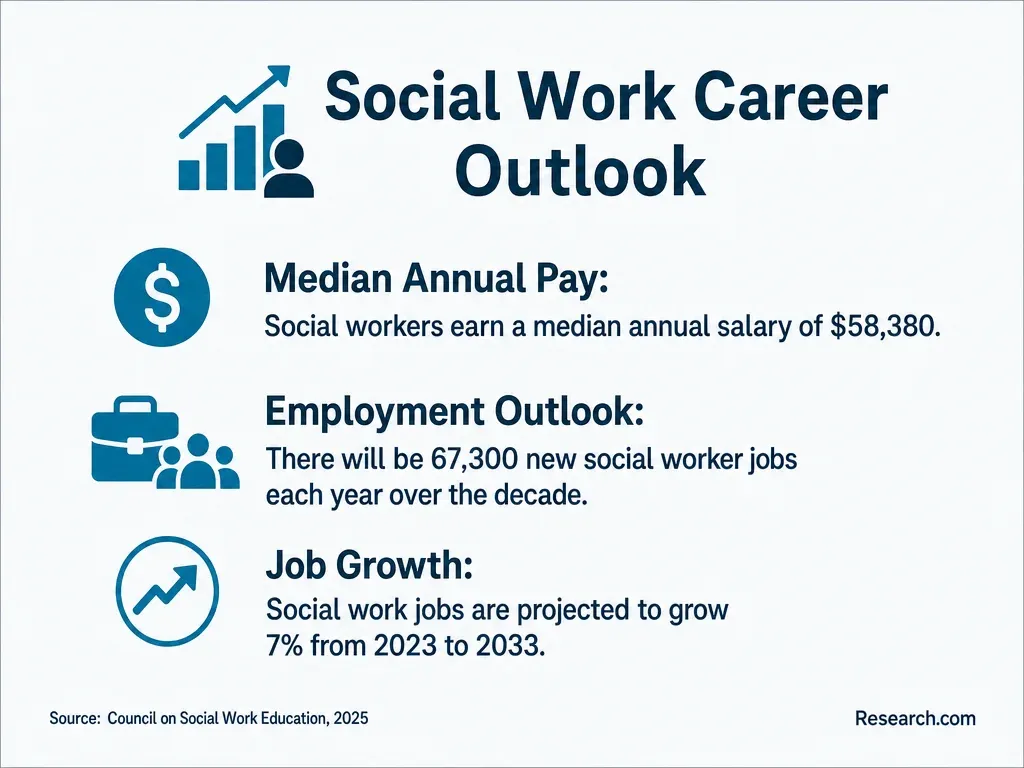
For context only, the U.S. Bureau of Labor Statistics reports a May 2025 median annual wage of $61,780 for social workers across specialties. That is an occupation-wide benchmark, not the expected pay for someone writing proposals. It may be more relevant to a position that actually combines grant responsibilities with social work duties. Geographic differences within social work are explored in social work master's pay and geographic differences.
For a realistic offer comparison, use posted salary ranges for the same function and seniority in your area. Check whether the position is grant-funded, whether employment continues after the award ends, and whether benefits, indirect-cost funding, supervisory duties, and required travel differ. A higher posted salary is less attractive if the role is short-term or requires substantially more unpaid overtime around deadlines.
The three functions overlap, but each produces different evidence of competence. A polished proposal cannot rescue an infeasible staffing plan, and an award does not excuse weak reporting or disregard for participant rights.
A useful way to understand the work is to follow a project from an identified community need to its final report:
- Define the project: Work with service users, practitioners, and community partners to identify the need, a feasible response, and measures that will answer the funder's questions.
- Build the application: Match the funder's eligibility and instructions, draft the narrative and evaluation plan, obtain authorized partner commitments, and reconcile the budget with the proposed activities.
- Launch and monitor: Assign responsibilities, track milestones and spending, document approved changes, and resolve recruitment or service-delivery problems with project leadership.
- Report responsibly: Check data quality, explain limitations, protect confidential information, and submit required financial and performance reports.
In research projects, a coordinator must follow the approved protocol and applicable institutional requirements; an agency evaluation may have different oversight. Neither a grant award nor access to agency systems automatically authorizes use of client records. If you are choosing coursework to build deadline-management skills, comparing self-paced and structured MSW coursework can help—but ask how the program teaches collaborative projects with fixed deadlines, not just how quickly you can complete individual assignments.
What are the admission requirements, costs, and timelines for social work degrees?
Requirements vary by school and route. BSW programs may require admission to the social work major after initial university admission. Traditional MSW programs can consider applicants with bachelor's degrees in other fields; advanced-standing tracks assess a qualifying social work degree and additional program-specific conditions. DSW and PhD admissions generally examine professional or research fit, but their prerequisites and funding arrangements differ.
Compare the total cost to reach the target job, not tuition alone: fees, books, technology, travel, placement-related expenses, and reduced paid hours can matter. A faster sequence may increase the weekly load without reducing field obligations. If an MSW is justified, affordable graduate social work education offers a starting point; request each school's current charges, aid conditions, field schedule, and expected completion plan before committing.
If postings accept strong writing and project experience without an MSW, first test a lower-cost route: relevant coursework, employer training, and an entry-level grants or research position. That choice preserves the option to pursue a degree later if the roles you want demonstrably require it.
Other Things You Should Know About Social Work
Yes, if you own or have permission to share it and remove confidential material. Label it accurately; do not imply that it was funded or that partner commitments remain valid.
No. A principal investigator is accountable for a project's scholarly or programmatic direction under an institution's rules. A grant writer may help prepare the application without holding that responsibility.
Some writing and administrative tasks can. Partner meetings, study procedures, agency access, and employer data-security rules may still require on-site work or approved systems.
Ask for the award end date, how the role is funded, what happens if funding changes, and whether the employer has a history of moving staff to other projects. No answer guarantees continued employment.
- How to Develop and Write a Grant Proposal | congress.gov https://www.congress.gov/crs-product/RL32159
- OJP Grant Application Resource Guide https://www.ojp.gov/funding/apply/ojp-grant-application-resource-guide
- Building Research for Academic and Community Equity (BRACE) - PMC https://pmc.ncbi.nlm.nih.gov/articles/PMC12557933/
- First Level: Peer Review | Grants & Funding https://grants.nih.gov/grants-process/review/first-level
- How to Write a Strong Research Proposal in Social Work | Tulane University https://online.tulane.edu/social-work/blog/research-proposal-social-work
- Budgeting, Cost Principles and Tools | Texas Research https://research.utexas.edu/resources/grant-management-services/budgeting
- 14. Applying for Grants | Community Tool Box https://ctb.ku.edu/en/applying-for-grants
- What Do Grant Writers Do? | News | USC Social Work https://dworakpeck.usc.edu/news/what-do-grant-writers-do
- How to build equitable partnerships between researchers and communities | UW School of Public Health https://sph.washington.edu/news-events/sph-blog/how-to-build-equitable-partnerships-between-researchers-and-communities
- Budget and Cost Resources - Research and Sponsored Projects https://orsp.umich.edu/project-lifecycle/develop-proposal/budget-and-cost-resources/


